Notes on:
Activating Parental Managerial Capital: How Role Clarity Improves Education Outcomes
Working paper
28 July 2026
development · education · management
Talk · Paper · Slides · PDF · Transcript
Written by Fable 5
Part of NBER Summer Institute 2026 — Development Economics
Mahounan Yedomiffi (Dartmouth), presented at nber Summer Institute Development Economics, July 28, 2026. Timestamps refer to the session video.
Yedomiffi opens with a memory from lower secondary school in Côte d’Ivoire. The neighborhood kids all went to the same school, had the same books, the same teachers. But a few friends — the ones whose parents had some education — would abruptly quit the evening football game at a fixed hour and go home to study, “ruining the whole fun.” Years later he noticed those were the kids who did well, and the question stuck: same school, same books — is the difference just that some households are better at converting educational inputs into learning? Not richer, not literate enough to tutor. Just better managed.
The framing move of the paper is to take the firm-management literature (Bloom et al. 2013) — the one where consultants raise Indian textile plants’ productivity by teaching standard practices — and point it at the oldest organization on earth. A household has resources and produces outputs, and the parent is the manager of the one input that matters most for an eighth-grader: the child’s time and effort. Parents in the study sample cannot help with homework in any direct sense. Mothers average two years of schooling, fathers five; half the surveyed parents are illiterate; the children are already the most educated people in the house. There is no parent-school communication whatsoever — a child can skip school for days, or collapse academically, and no one will ever inform the parents. The only margin these parents have is the one his friends’ parents used: structure. And the stakes are unusually visible, because in rural southern Benin about 30% of eighth-graders repeat the grade (up to 70% in some subgroups), in a system where two tests per subject per semester mechanically determine gpa and promotion.
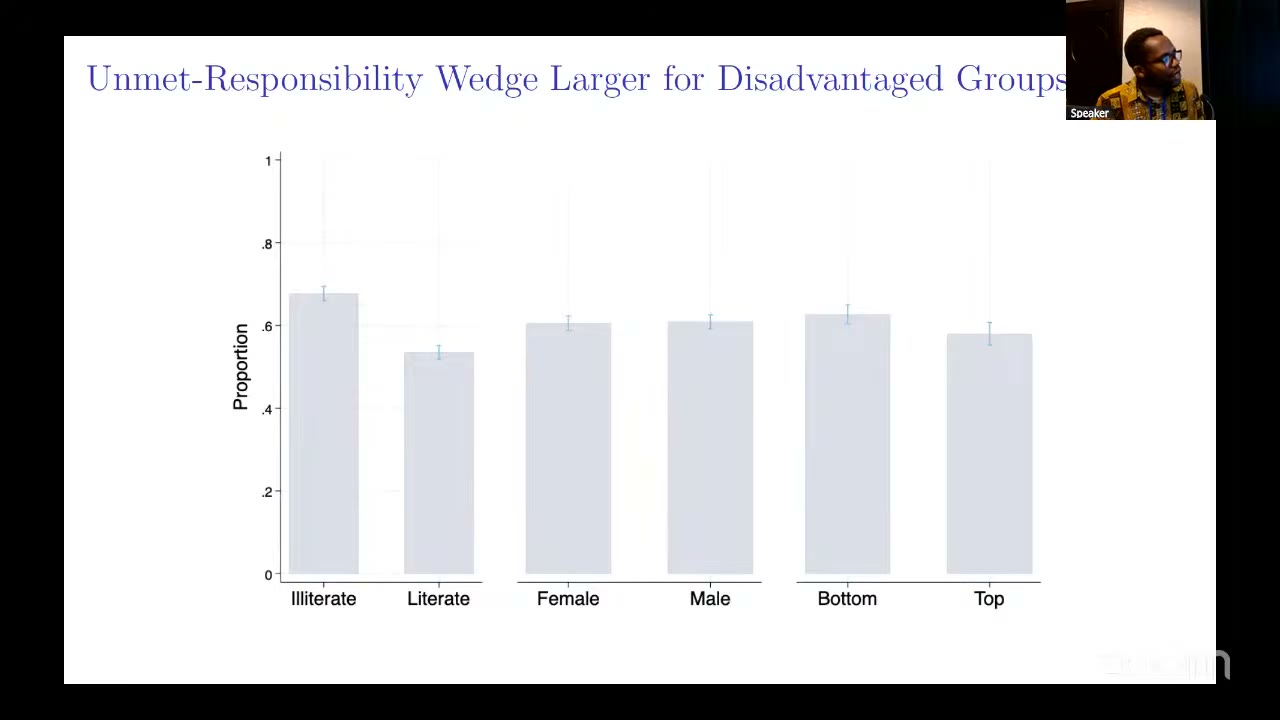
The diagnostic fact the paper is built on is what it calls the role–action wedge. Ask parents whose responsibility it is to make sure the child attends school, to check academic progress, to ensure evening study, to check that the notebook is filled in — and over 90% say: mine. Ask whether they’ve done anything about it, and mostly they haven’t. The wedge is not uniform: it barely varies by the child’s gender or baseline performance, but it yawns open for illiterate parents, and it grows with the “price” of the action. Merely talking to your child (how was school? when is the exam?) has a modest wedge; verification (check the homework happened, flip through the notebook for empty pages) a bigger one; and the high-friction actions — setting a study routine, rearranging chores, physically visiting the school — the biggest of all.
The intervention is engineered around those two frictions — parents don’t fully grasp why this matters, and they don’t know how to start — and it is aggressively cheap. No apps, no texts (half the parents can’t read them; 97% do own a basic phone): structured coaching calls over four months, about ten calls averaging five and a half minutes — less than one hour of total contact — following a script that clarifies why (no teacher will come home and make your child study; this one is on you), helps set achievable goals (you don’t personally have to stand guard at 6 p.m.; a cousin or a rule can do it — his favorite image is a slide of a mother cooking while her child studies within eyeshot), and troubleshoots (parents who did visit the school reported back: I got there and didn’t know whom to talk to). The recommended actions are calibrated to illiteracy: you cannot read your child’s homework, but you can demand it be shown to you; you cannot judge the notes, but you can spot empty pages in a notebook, which is what not-taking-notes looks like.
The design randomizes within classrooms (stratified by parental literacy) in 40 schools — treated and control kids share teachers and peers — with a set of pure-control schools held aside to check that gains aren’t coming out of untreated classmates’ hides. And the wedge moves: the role–action gap closes by about 8–9 percentage points overall, with the biggest gains exactly where the intervention aimed (conversation +11, verification +12, high-friction +6). Households reorganize — children get excused from chores around exam time, with siblings picking up the slack (the sibling-substitution worry was raised in Q&A; he lacked funding to collect sibling outcomes). Crucially, the self-reports are corroborated by administrative data: absenteeism falls, and parents become better informed about whether their child is passing — information the intervention never provided, which is the paper’s neatest point. The standard education-frictions literature treats parents’ ignorance of their child’s performance as the problem and mails them report cards. Yedomiffi’s reading is that the ignorance is a symptom: a parent who plays the managerial role acquires the information for free, by talking to their own child.
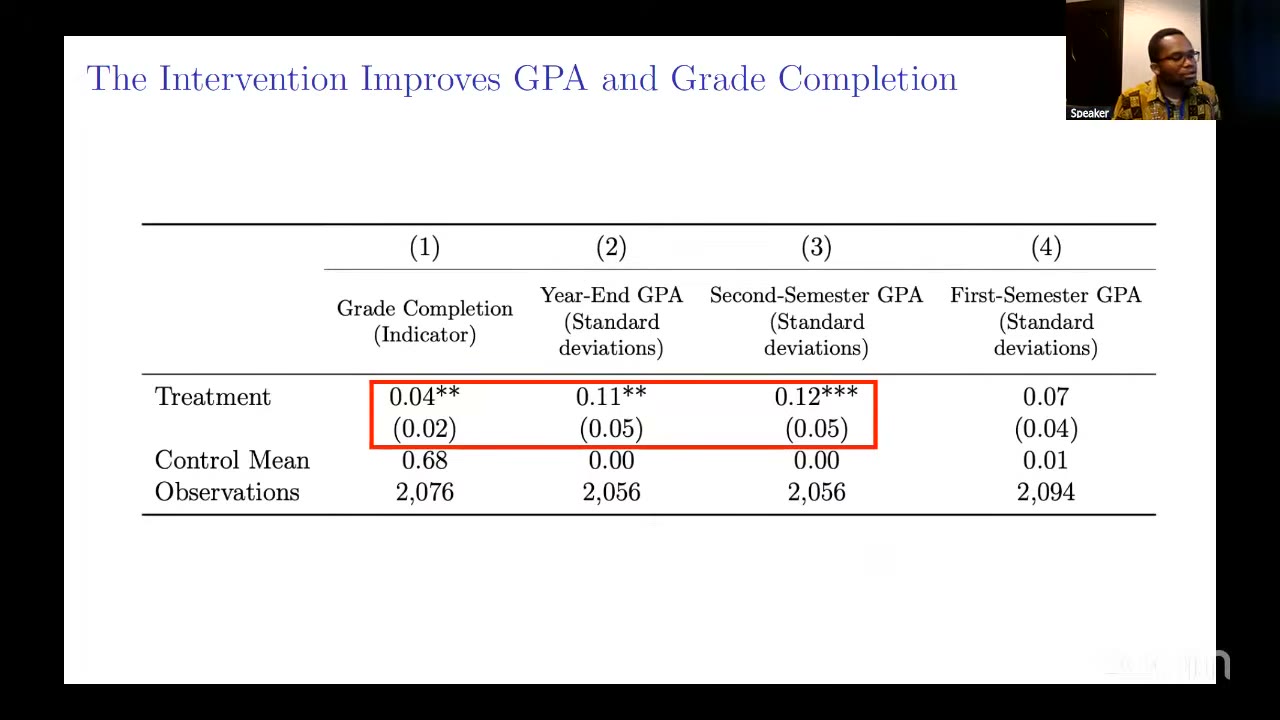
The outcomes: grade completion rises 4 percentage points against a baseline where 32% repeat; year-end gpa rises 0.11 standard deviations, concentrated (as timing predicts) in the second semester; subject-level gains show up in physics, biology, and marginally history and geography. The grade-completion effect is driven by the bottom quartile of baseline performers — the students for whom repetition was a 70% proposition. A year later, dropout falls for girls and for children of illiterate parents, and parents are still taking the actions — persistence worth underlining because the standard finding for pure information interventions runs the other way (tell parents their child is failing, and they cut their losses; he jokes he’s glad his own parents were never treated with one of those). In the talk he cited an effect-size benchmark — around the 75th percentile of evaluated learning programs — remarkable for under an hour of phone time per family.
The Q&A circled two interpretive worries worth keeping. One questioner proposed that the real mechanism is coordination: both parents think monitoring is “their” role, nobody does it, and calling one parent simply appoints an owner — less management training than a free-riding fix. (He conceded the data can’t separate this, since actions were measured at the household level.) Another pressed on whether parents learned management or simply updated their belief that a child’s study time is valuable — “that’s not management skills, that’s changing their beliefs.” His answer, drawing on his own illiterate parents, is that these families already invest heavily in fees and books and know education matters; what they lack, never having been through schooling themselves, is a model of what the process needs from them day to day. On that reading the paper’s title is precise: the capital was already there, latent in people who successfully run farms and market stalls. It just needed to be activated — pointed at the eighth-grader doing homework in the corner.