Notes on:
Relational Frictions Along the Supply Chain: Evidence from Senegalese Traders
Working paper
27 July 2026
development · trade · relational contracts
Talk · Paper · PDF · Transcript
Written by Fable 5
Part of NBER Summer Institute 2026 — Development Economics
Edward Wiles and Deivy Houeix (both Harvard), presented as the closing paper of Day 1, nber Summer Institute Development Economics, July 27, 2026. Paper: from the authors’ site. Timestamps refer to the session video.
If you run a garment shop in Dakar and want to import from Turkey — newer styles, better quality, lower prices than the local wholesale market — you face the two oldest problems in trade. You have to find a supplier (search), and you have to pay a stranger in Istanbul up front and hope the goods arrive (trust — which decomposes into adverse selection, some suppliers are just bad, and moral hazard, even good ones can pocket your money, since 99% of first-time orders are prepaid). Avner Greif (1993) wrote about medieval merchants solving this with coalitions; the modern Senegalese solution, it turns out, is WhatsApp — and this paper’s contribution is a field experiment with 1,862 garment wholesalers and retailers that takes the folk institution apart friction by friction, to see which piece actually does the work.
The market’s texture is half the fun. The “suppliers” are not Turkish manufacturers but Senegalese nationals living in Istanbul — hundreds of diaspora intermediaries whose profession is being the go-between (the paper’s photos show adjacent Istanbul storefronts specializing in exports to Senegal and to Mali). “Social commerce” is already ubiquitous: 86% of firms sit in at least one supplier WhatsApp group — not chat rooms but broadcast channels, 50–100 vetted regular customers, supplier-only posting, prices treated as “commercial secrets,” membership by referral and pruned quarterly for inactivity (the median firm is in four). A quarter of firms are also in buyer discussion groups for sharing information about suppliers. Asked why no “Turkish Alibaba” has taken this over: 80% of firms have never used a formal B2B platform — too complicated (bank accounts, formal addresses) and, more fundamentally, you’d have to trust the platform; on WhatsApp there’s no intermediary to trust, just the person on the other end.
The theory maps each friction to a lever. Search: a cost of finding a match. Moral hazard: a dynamic incentive constraint that caps order size — pay the supplier more than the relationship’s future value and he’ll take the money and run; social commerce converts private punishment into joint punishment (cheat me and I post your face with an X through it — the paper has real examples — and buyers stop buying, relaxing the cap -fold). Adverse selection: Bayesian learning about a supplier’s type, accelerated when socially-tied buyers pool their signals. A wedge equation prices both trust frictions between marginal revenue and marginal cost, and the model’s one non-obvious prediction is that fixing them is complementary: learn a supplier is good and you want to order big, which slams you into the moral-hazard ceiling — so information is worth most when incentives are also fixed.
The experiment rebuilds the folk institutions from scratch, at the buyer level, with 30 recruited Istanbul suppliers (in fixed buckets of three) kept blind to treatment. Search: get added to three study-specific supplier WhatsApp groups — the match cost paid on your behalf, with explicit we-match-don’t-endorse disclaimers (firms’ skepticism ran the other way: “are you going to insure my order?” No.). Adverse selection adds a fourth, buyers-only group of 20–30 firms matched to the same three suppliers, told to share notes — seeded with one genuine positive review sourced from pre-study mystery orders the team had placed with every supplier. Moral hazard: all suppliers were told bad feedback would get them ejected from their group (a real threat — the team are the admins, with a waitlist of replacement suppliers); the treatment is telling buyers those incentives exist. Plus both, plus pure control.
Short-run, everything works: mystery shoppers (deployed to all 2,000 firms, seeking specific foreign-made products defined by five quality-free criteria, purchases scored by tailors on a 50-point card — “we bought a lot of clothes for this study and still have quite a lot of them in a warehouse in Dakar”) find treated firms about a quarter more likely to stock the requested variety and a third more likely to have it in high quality, at unchanged prices. The question is what survives once the researchers leave.
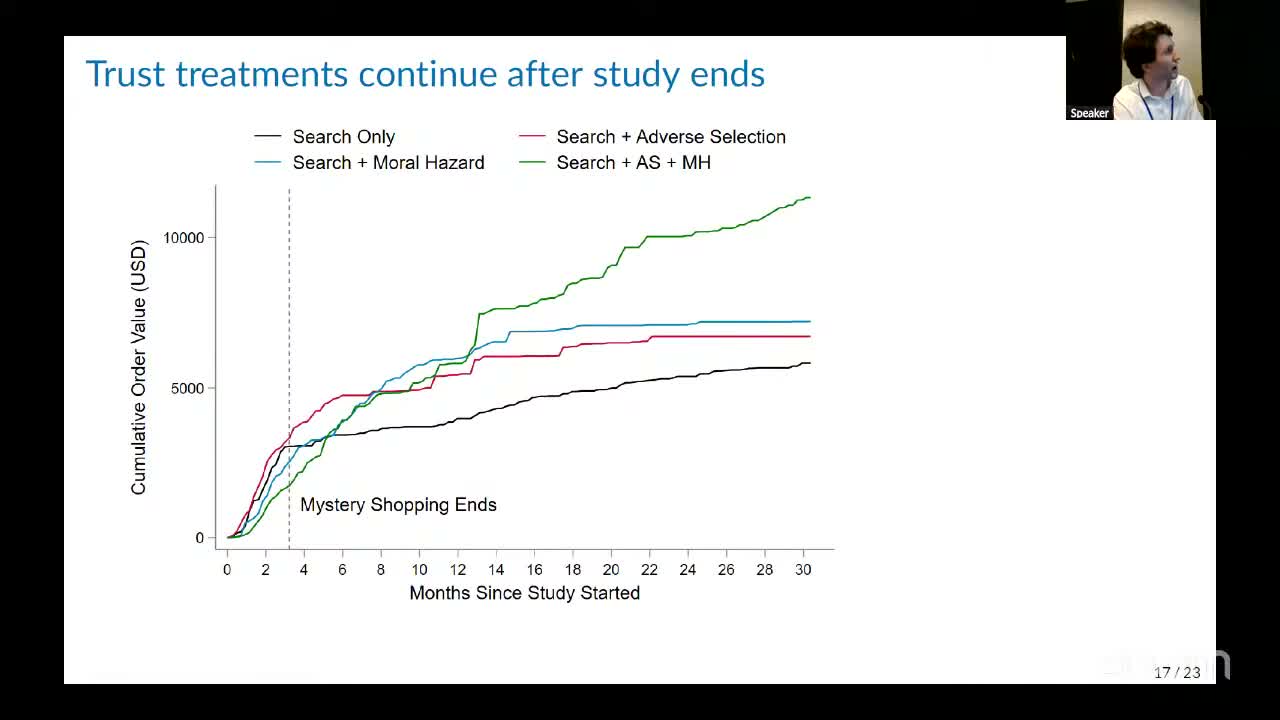
The long-run data are unusually good because the Istanbul suppliers, being Senegalese, accept payment through Senegal’s largest mobile-money provider — so actual transactions are observable for 30 months. Search alone dies: matched firms buy a little during the study and essentially stop after. The trust arms keep transacting, and the arm with both trust treatments compounds — exactly the complementarity the model predicted. An independent source, the three-month survey, shows the same pattern: “regular supplier in Turkey” (two orders plus intent to continue; control mean 17%) rises ~4 points pooled, concentrated in the both-treatments arm, surviving multiple-testing adjustment. Total supplier counts don’t rise — firms substitute away from Dakar wholesalers toward direct importing — and profits and sales rise sharply, again driven by the both-trusts arm. Mapping the treatment effects back through the model to a market-wide counterfactual, the gains from alleviating these frictions come out very large.
The one-line verdict — “we made matches, but they only developed into profitable relationships when we solved the trust frictions” — is a quiet indictment of a whole genre of matchmaking interventions, business-to-business matching programs included, that stop at introductions. Introductions are the cheap part. What the Senegalese garment trade had already figured out, and the experiment formalizes, is that a WhatsApp group is not a website: it’s a coalition with a membership roll, a reputation ledger, and an excommunication mechanism, run for free on borrowed infrastructure. Greif’s medieval merchants would have recognized it immediately — they’d just have been startled it fits in a pocket.