Notes on:
When Tariffs Disrupt Global Supply Chains
American Economic Review 114(4): 988--1029
2024
geoeconomics · tariffs · supply chains · trade war
Paper · doi · PDF
Made with AI: Opus 5 (reading and writing)
Gene Grossman (Princeton), Elhanan Helpman (Harvard), Stephen Redding (Princeton). American Economic Review 114(4), April 2024, pp. 988–1029, the published version of record and the text used throughout. It supersedes nber Working Paper 27722 of August 2020, “When Tariffs Disturb Global Supply Chains,” by Grossman and Helpman alone; the published version added Redding, changed the verb, and replaced the working paper’s illustrative arithmetic with a calibration. No talk recording could be found; pdf-only digest. All crops are from the published version.
A tariff on an input is not a tariff on a good
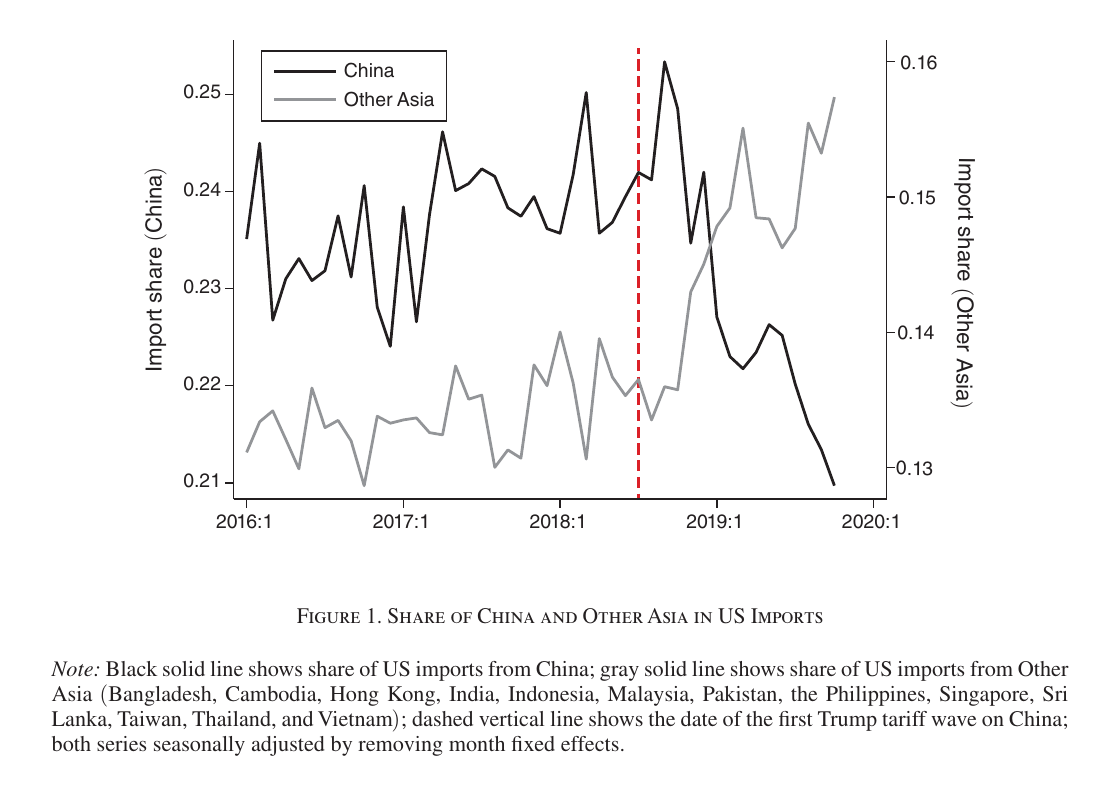
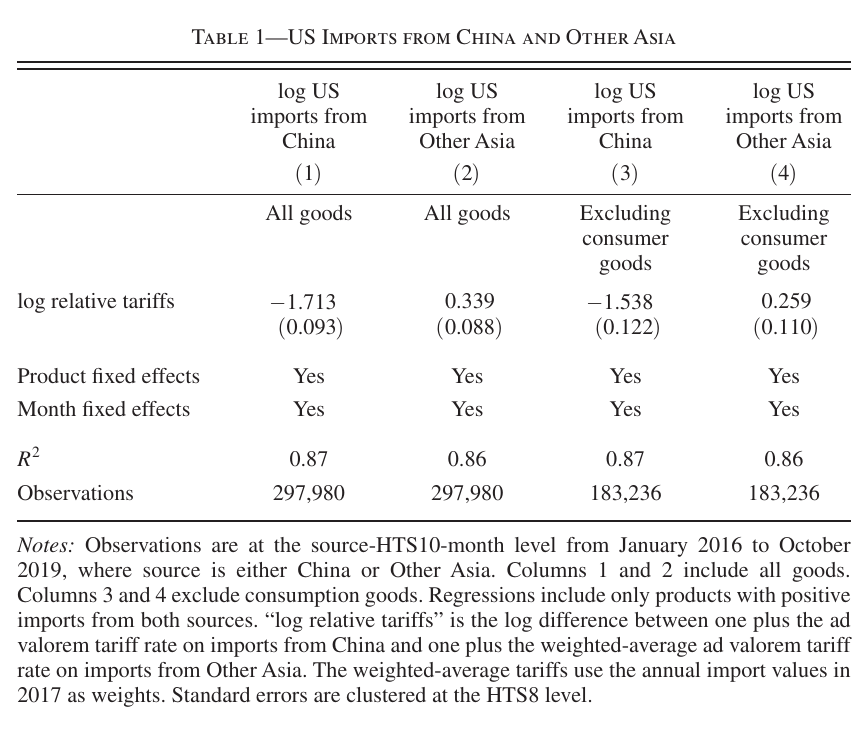
Before 2018 almost nobody had written down what an input tariff does to a supply chain, for the good reason that almost nobody levied one: the weighted average us tariff on imports from China stood at 2.7 percent at the end of 2017, and on the part of those imports that were not consumer goods it was a mere 1.0 percent. Then the Trump rounds arrived, and the weighted average on us imports from China — all of them, not the intermediates alone — reached 17.1 percent by the end of 2019. The early waves were concentrated on intermediate and capital goods, and only later expanded to consumer goods, as the administration began to run out of the former to target. The paper’s Figure 1 shows what happened next in the aggregate — China’s share of us imports fell about three percentage points after July 2018 and a group of thirteen low-cost Asian countries gained almost exactly that — and Table 1 shows it at the HTS10-month level: imports from China fell in the products where the relative tariff rose, imports from Other Asia rose in the same products, with or without consumer goods.
The question the paper asks is what that reallocation cost, given that the relationships being broken were not anonymous market purchases but matches that firms had paid to find and had been renegotiating under incomplete contracts. The answer involves two channels that a textbook tariff analysis does not have.
The model
Venables (1987) with supply chains in it. Two sectors: a homogeneous good made with labor, and differentiated varieties made from labor and a composite of a continuum of inputs in fixed proportions. A firm can make each input itself with a backstop technology, but prefers to search for a supplier in a low-wage country (A, read China). Search is costly and yields draws of match productivity; since a indexes inverse match productivity, the firm accepts a draw at or below a reservation level and then bargains Nash-in-Nash with each supplier over a renewable short-term contract, taking its other bargains as given. Entry and search happen under free trade. Then the home government imposes a permanent input tariff nobody expected. Firms can renegotiate with existing suppliers, or pay to search again — in A, in a second low-wage country B (Other Asia) with a somewhat higher wage, or at home.
Small tariffs, large tariffs
The paper’s Section II sorts tariffs into ranges. A small tariff, below the wage gap between A and B, changes no one’s sourcing location and triggers no new search. What it does is worsen the buyer’s outside option in every existing bargain, since a replacement match would now also carry the tariff, so renegotiation moves prices in the supplier’s favour: small input tariffs worsen the imposing country’s terms of trade, the opposite of the optimal-tariff logic. Above the wage gap, a firm’s best new search is in country B rather than A, which strengthens its hand against incumbent A suppliers and pushes renegotiated prices down — here the terms of trade improve with the tariff. Above a critical , firms actually sever their least productive A relationships and search anew in B; the newly sourced inputs cost more than the ones they replace, and average input prices can rise even as incumbents concede.
Welfare: four channels, two of them new
Section III identifies the welfare effects. Two are familiar — the differentiated sector contracts from a scale already too small under markup pricing, and firms substitute labor for inputs in a setting where the bargaining wedge already biased technique toward labor. Two are specific to supply chains: the terms-of-trade effect, which combines Vinerian diversion to a costlier source with the novel renegotiation effect, and the search costs that firms pay to replace suppliers and that would not have been paid under free trade. Proposition 3 gives the condition for welfare to fall at the first dollar of tariff, which the calibration satisfies.
The Trump tariffs, priced
Section IV calibrates to the initial share of Chinese imports in us manufacturing value added, manufacturing’s share of gdp, a 14 percent weighted tariff of the authors’ own import-weighted computation (p. 1017), and the event-study elasticities from Amiti, Redding and Weinstein (2020): a 34.23 percent fall in import values and a 2.14 percent fall in Chinese export prices — import and price elasticities of −2.15 and −0.04, close to Fajgelbaum et al. (2020). The model’s closed form (eq. 38) predicts that Other Asia’s gain in us import share relative to China’s loss should be −0.64; the data say −0.96, which the authors read as the tariff explaining most of the observed rerouting with other shocks making up the rest.
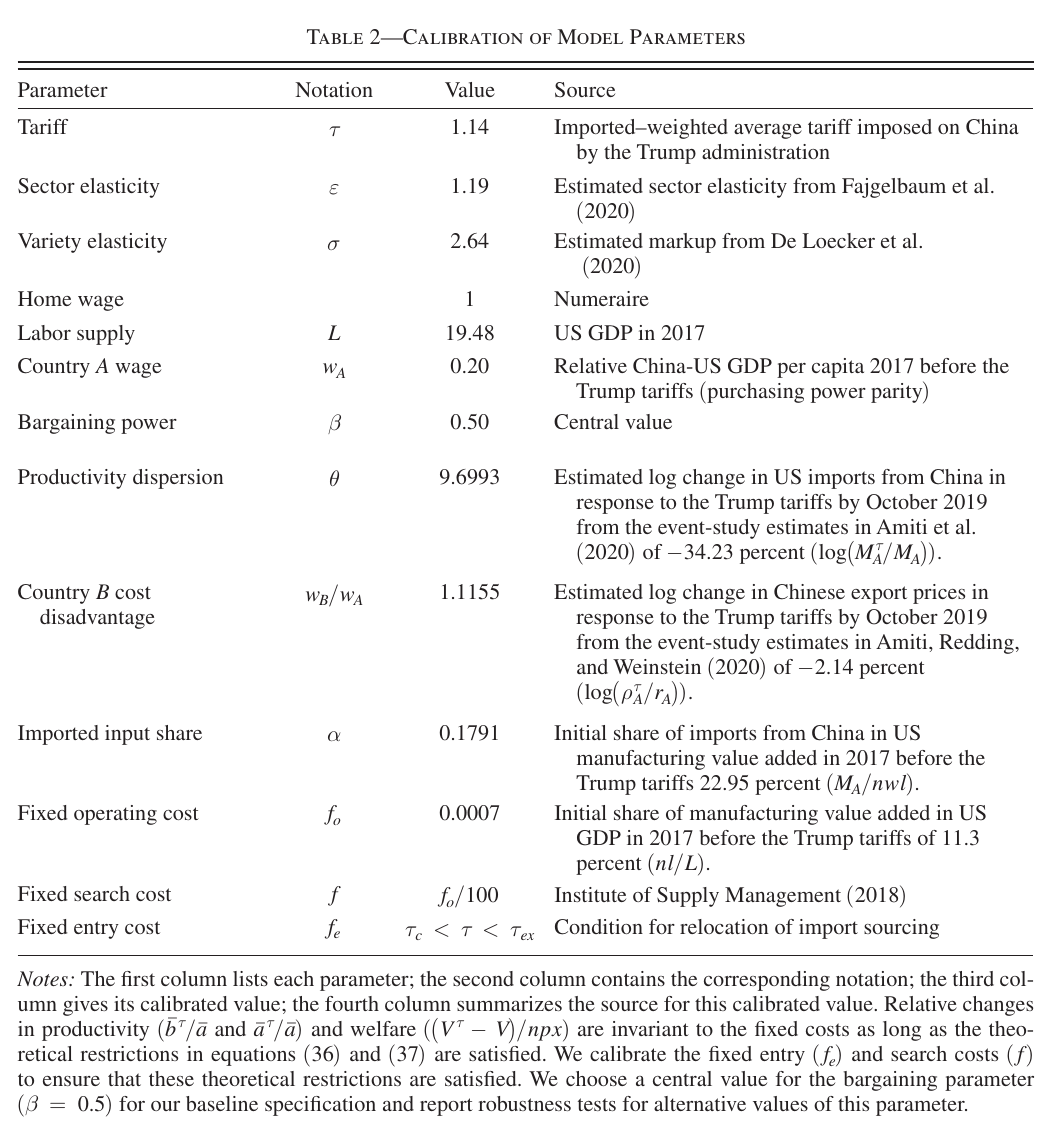
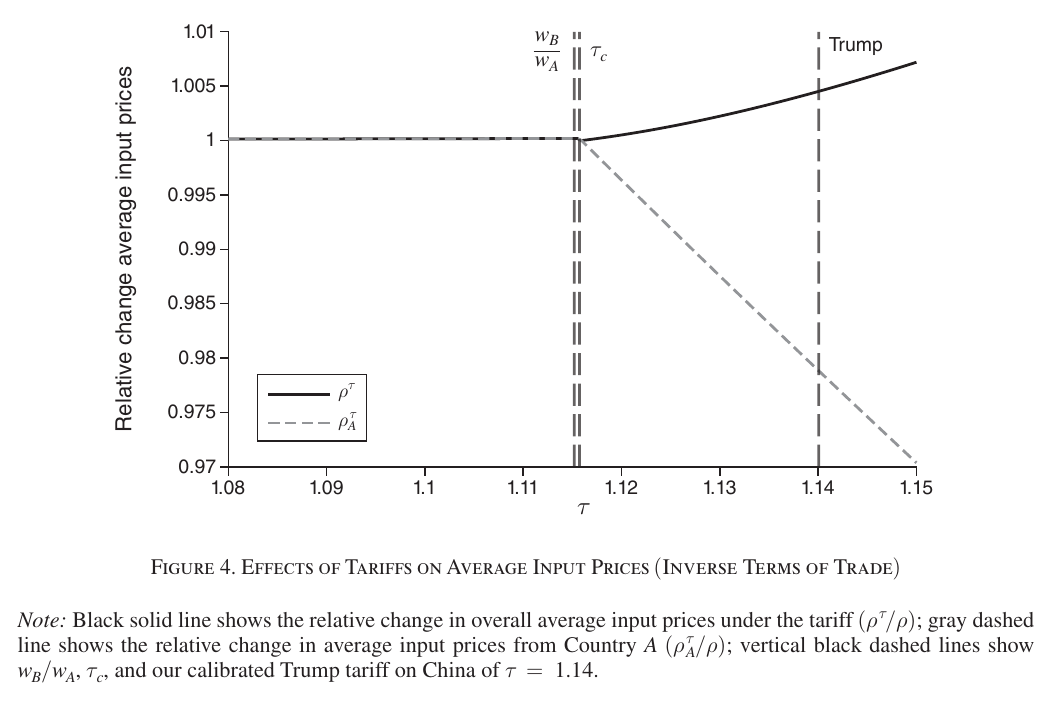
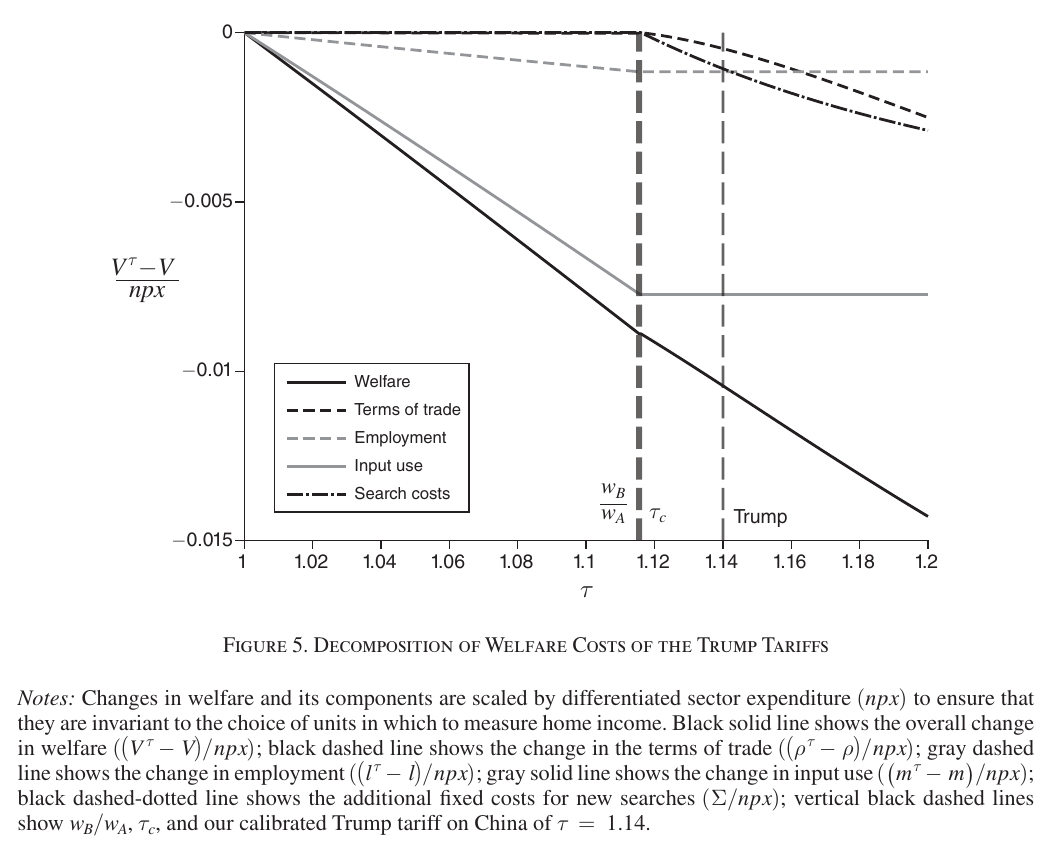
The calibrated tariff sits just past , in the range where relationships break. The terms of trade against China improve — Chinese export prices fall 2 percent — but the overall terms of trade deteriorate by 0.45 percent because newly sourced inputs from Other Asia cost more, and on top of that come the search costs. Welfare falls by 1.04 percent of differentiated-sector expenditure, 0.12 percent of gdp, with input sourcing and search costs the largest pieces. A counterfactual in which all relationships are reshored to the United States still shows a welfare loss. The results are robust to the productivity-dispersion parameter, B’s cost disadvantage, and the bargaining weight.
Three times the going rate
That 0.12 percent is the number to carry out of the paper, because it is roughly three times what the incidence literature had found. Amiti, Redding and Weinstein (2019) and Fajgelbaum et al. (2020) priced the Trump tariffs at 8.2 and 7.2 billion dollars respectively, which the authors note is around 0.04 percent of gdp. Grossman, Helpman and Redding are candid about why theirs is bigger and offer four reasons: a longer sample, taking in the two further waves of June and September 2019; no foreign retaliation in their model, which the incidence papers do include; relative wages held fixed by the outside sector rather than moving in general equilibrium; and the new bargaining channel itself. Three of those are differences in scope and closure. The fourth is the mechanism the paper exists to add, and it is the reason to read this alongside the incidence work rather than instead of it: the same tariffs, priced with relationships in the model, cost multiples of what they cost when inputs are bought at arm’s length.
What the published version threw away
The quantitative section is entirely new, and so, in a sense, is the paper’s answer. The 2020 working paper carried a second branch of the model, for the case where demand for differentiated products is inelastic, and closed with an illustrative numerical section on hand-picked parameters rather than a calibration to anything. In that branch protection could be good, and in one worked example it was emphatically good: with a wage gap of only ten percent between the cheapest and second-cheapest suppliers and most of the bargaining power sitting with the suppliers, a tariff of approximately 36.7 percent was optimal and raised welfare by more than 3.33 percent of initial spending, on the strength of profit shifted from foreign suppliers to domestic ones when supply relocated home. None of that is in the published version. The inelastic branch is gone, the worked example with it, and the illustrative arithmetic has been replaced by a calibration whose every case is a loss. It is worth knowing that the pro-tariff result existed, and worth knowing what disposed of it: not a refutation, but a decision to answer the question with data on the tariffs that actually happened instead of with parameters chosen to make a point.
Where it sits
Read it after The Return to Protectionism (whose incidence facts it takes as calibration targets) and beside Fajgelbaum et al. (2024) and Alfaro–Chor (2023), which document the rerouting to Other Asia that this model reproduces and prices. Its contribution to the block is the pair of supply-chain-specific channels — renegotiation under the shadow of a tariff, and the search cost of replacing a match — which are the reasons why a tariff on an input is costlier than its rate suggests, and why the reallocation that makes the trade war look painless in the aggregates (Goldberg–Reed 2023; Gopinath et al. 2025) was not free. For the geoeconomic reading, note what is exogenous: the tariff is a surprise from a home government, not a threat from a coercer, and firms’ search is about cost, not security; the de-risking papers (Lashkaripour–Simonovska 2026; ghl 2023) are where that is endogenized.