Notes on:
War Signals: A Theory of Trade, Trust, and Conflict
Review of Economic Studies
2013
geoeconomics · trade and conflict · trust · conflict traps
Made with AI: Fable 5.1 (reading and writing)
Dominic Rohner (Lausanne), Mathias Thoenig (Lausanne) and Fabrizio Zilibotti (Zurich). Review of Economic Studies 80(3), 2013, pp. 1114–1147; this digest works from the published version. No talk recording could be found, so it is pdf-only. Note at the outset: this is a theory of civil conflict between two ethnic groups, not of interstate geoeconomics; it is on the reading list because the presented papers borrow its mechanism.
Why wars repeat
Civil wars have a habit of coming back. The paper opens with the numbers everyone in the field carries around: 16 million deaths in the second half of the twentieth century, 68 per cent of outbreaks in countries where more than one conflict was recorded, more than three quarters of civil wars growing out of enduring rivalries between groups that have fought before (p. 1114). The standard answer is institutions, and the authors accept it as part of the story — weak institutions “likely are part of the explanation, but are not the sole cause” (p. 1114) — but they also point at the cases that make it awkward. Colombia, India, Turkey, Sri Lanka and the Philippines have decent institutions for their income level and recurrent conflict, and an average World Values Survey trust score of 0.16 against 0.22 for the typical non-oecd country. On the other side sit Bhutan, Cameroon, Gabon, Kazakhstan, Togo, China and Vietnam: low democracy scores, high ethnic fractionalisation, no recent civil war. Trust data exist for only two of the seven, China and Vietnam, and their average is 0.51, above the average oecd country (footnote 2, p. 1115). The persistent variable, on this reading, is not the constitution but the trust between groups, and the paper’s proposal is that trade is the channel through which trust matters, and that war destroys trust not just by burning the bridges but by telling the other side something about you.
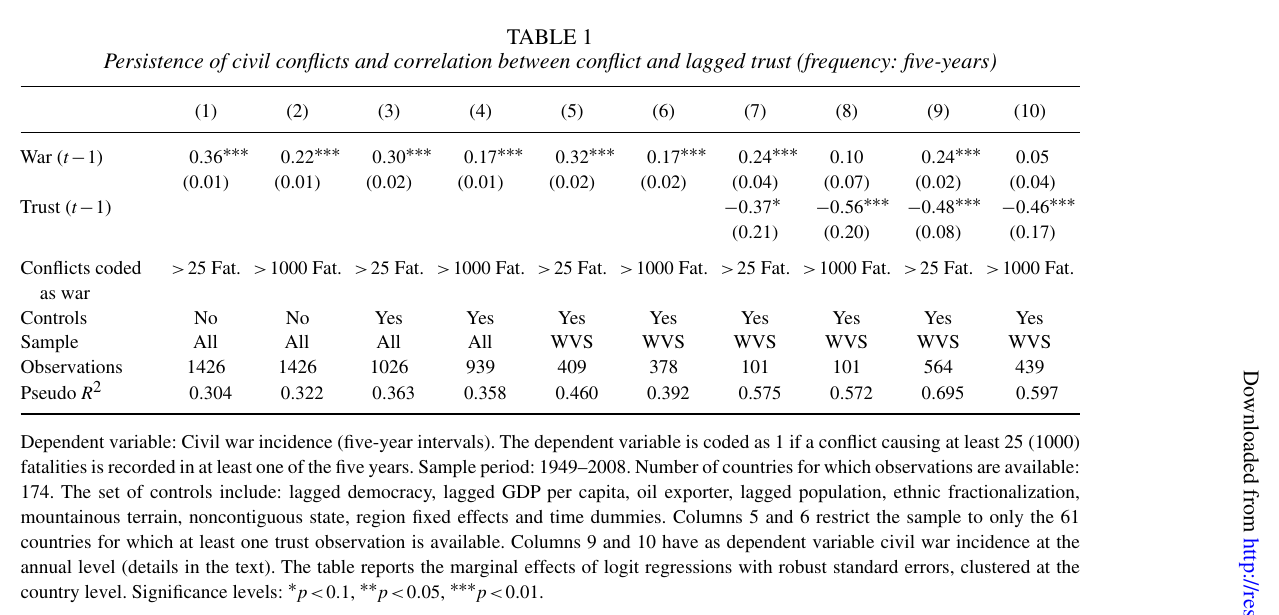
Before the theory there is a table, and it is worth reading carefully because it is easy to over-read. Table 1 (p. 1116) is a pooled logit on 174 countries over 1949–2008 in five-year windows, ucdp/prio conflicts at the 25- and 1000-fatality thresholds. A war in the previous window raises the probability of war now by 36 percentage points in the raw specification (column 1), and by 17 to 32 points once the controls go in — democracy, gdp per capita, oil, population, fractionalisation, mountains, non-contiguity, region and time dummies — and the effect survives country fixed effects in the supplementary appendix (p. 1117). Lagged trust, the share of respondents who say most people can be trusted, enters negatively and significantly wherever it appears, and the authors report that one standard deviation more of it is associated with 5.2 points less conflict for all wars and 7.9 points less for big wars (p. 1117). But note what adding trust does to the war coefficient: in the two big-war columns with trust, (8) and (10), lagged war drops to 0.10 and 0.05 and loses significance. The sample is the problem, not the theory — trust exists for 61 countries and only 101 observations in columns 7 and 8 — and the authors are careful about what the table is: they “do not claim to identify causal effects of trust on civil wars”, not least because their own theory says the causation runs both ways (p. 1118). The table is the two correlations the model has to generate, not a test of it.
Trade as a stag hunt with a temperament
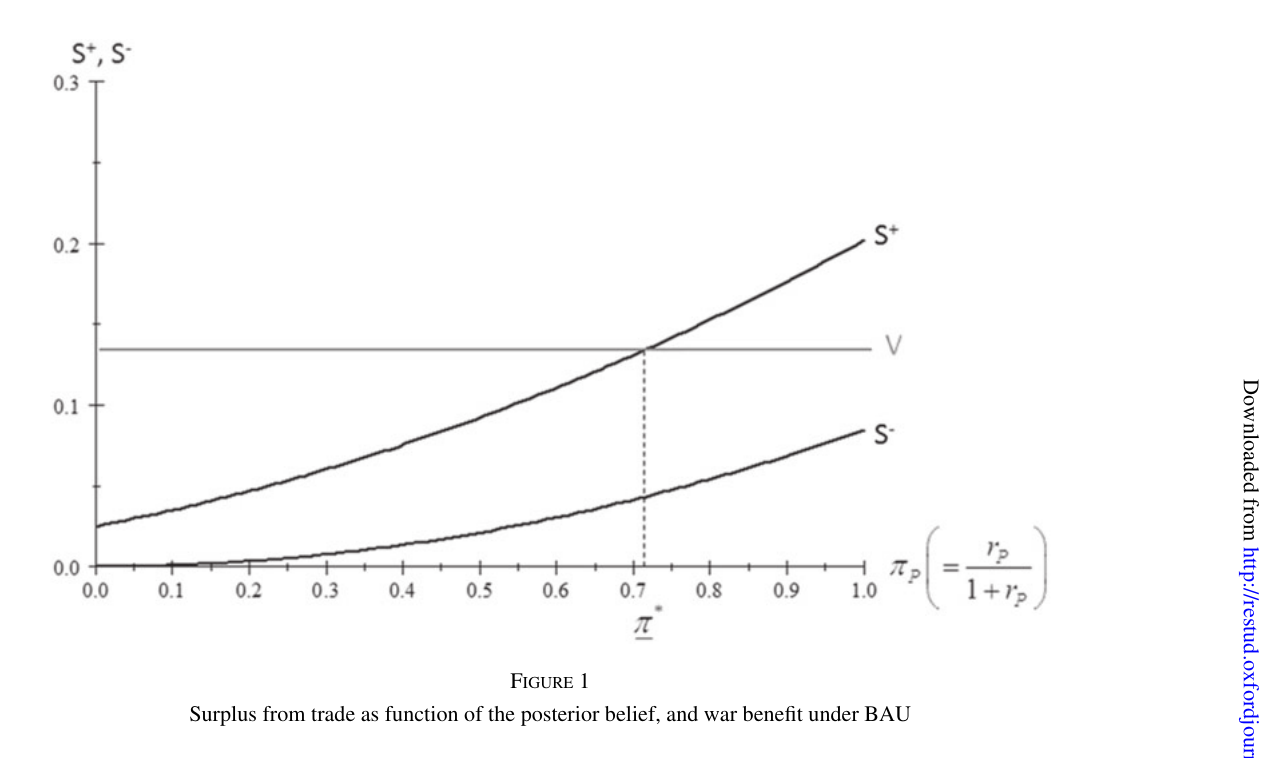
The setting is two groups, A and B, of unit mass. In peace, each member of A is randomly matched with a member of B to trade, and trade is a stag hunt: cooperate–cooperate pays each, defect–defect pays , and the cooperator who is defected on loses (payoff matrix (1), p. 1120). Every individual also has a psychological payoff from cooperating — civic norms if positive, hatred if negative — drawn from a group-specific distribution. Group A comes in two types, civic or uncivic, depending on which distribution its members are drawn from; B’s type is known, A’s is not. The paper offers a second reading of the same game that drops the psychology entirely: cooperation is a costly pre-trade investment, learning the other group’s language or building a cross-group network, and the heterogeneity is in the cost (p. 1121). Either way, cooperation is a strategic complement — the more of the other group you expect to cooperate, the more of yours do — so the aggregate trade surplus that A earns in peace increases with how trustworthy B believes A to be (Proposition 2, eq. 5, p. 1125). Trust has a social value, and that value is the opportunity cost of war. Figure 1 draws it: two rising curves, one for each type of A, against B’s belief that A is civic.
Before trading, A decides whether to attack. The payoff to war, , is stochastic and private to A — morale, resources, whether the outside world will impose sanctions (p. 1121) — and war destroys the period’s trade. takes three values: a peace shock in which nobody attacks, a war shock in which everyone does, and a middle state the paper calls “business as usual” (p. 1122). The maintained case throughout is that under business as usual an uncivic A always attacks, whatever B believes, while a civic A attacks only when trust is low enough that its trade surplus falls short of (pp. 1126–1127; the case where the uncivic type mimics the civic one is banished to a supplementary appendix). That is the signal in the title: B observes war or peace and updates, by Bayes’ rule, its belief that A is civic, and that belief is what the next generation inherits as its prior — the model is overlapping generations, and the young learn the history of war rather than the history of trade (Section 5, p. 1127).
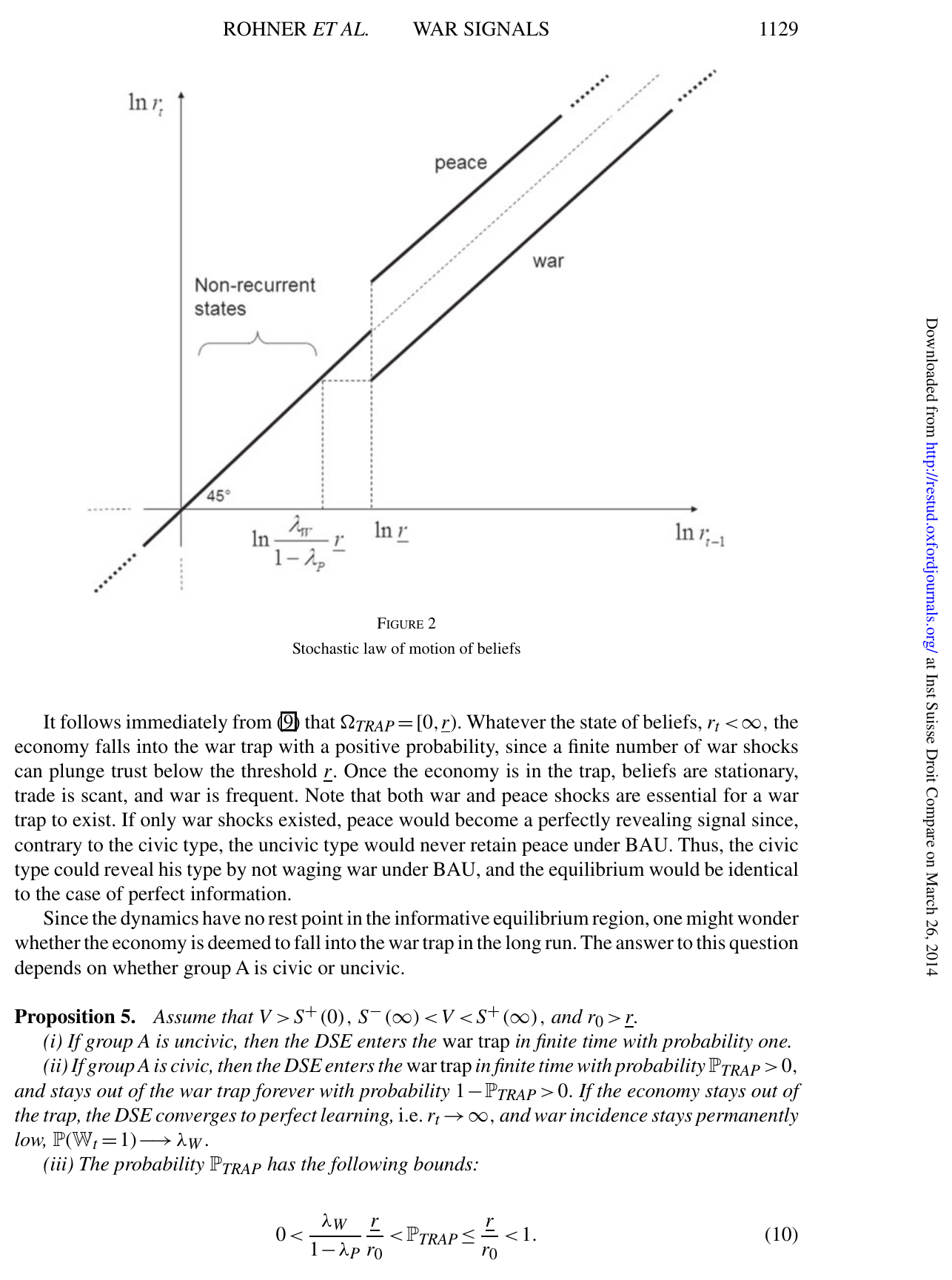
The key twist is that the updating only works in the high-trust region. Write for the likelihood ratio that A is civic. Above a threshold , peace under business as usual is something only a civic A would keep, so peace raises and war lowers it. Below , trade is so thin that even a civic A prefers war whenever business is as usual, so a spell of peace is rationally attributed to a peace shock, and beliefs stop moving (eq. 9, Proposition 4, p. 1128):
Here is one in a war year, and are the probabilities of the war and peace shocks, and where is the belief at which the civic surplus equals the war payoff. Two things about this are easy to miss. First, you need both shocks. With only war shocks, an uncivic A would never keep the peace under business as usual, peace would perfectly reveal the civic type, and the whole thing collapses to the perfect-information benchmark; the peace shock is what jams the signal (p. 1129). Second, for priors just above the threshold there are three equilibria, one uninformative and two informative, and the paper selects the most informative one (Lemma 1, Assumption 3, p. 1127), which for a result about societies falling into uninformative equilibria is the conservative choice.
The war trap
Proposition 5 is the paper (p. 1129). Starting from trust above the threshold, an uncivic A drives the economy into the trap with probability one; a civic A falls into it with a probability strictly between zero and one — a run of unlucky “accidental” wars (p. 1115), driven by shocks to that had nothing to do with fundamentals, pushes trust below , after which no peace spell, however long, can restore it, because nobody attributes peace to character any more. If the civic A escapes, it escapes for good: beliefs converge to certainty and war happens only when the war shock does. With symmetric shocks, , the trap probability has a closed form (Corollary 1, p. 1130):
where counts how many more wars than peace spells it takes to cross the threshold from the initial belief . Each war shortens that count, so each war raises the long-run frequency of conflict — the paper’s “war is endogenously persistent” (p. 1130). Be a little careful with the short-run version. In the benchmark, with on three points, the probability of war next period jumps after a war only when beliefs sit just above the threshold, so that this war is the one that tips the economy in; the authors say so, call it an artefact of the discrete support, and show that with drawn from a continuous distribution every war strictly raises next-period war probability (eq. 13, pp. 1131–1132). Persistence is, in their phrase, a hard prediction; the step shape is not.
There is a welfare twist worth pausing on. When A is civic, the trap is bad for everyone — too many wars and, on top of that, less cooperation than under full information. When A is uncivic, the trap “may yield higher welfare than the perfect information equilibrium” for both groups (p. 1130). B never fully learns how uncivic A is, so B cooperates more in the peace spells than it would if it knew, and since cooperation in a stag hunt is underprovided anyway (Section 3.1), ignorance raises the surplus. Not knowing your neighbour is a bad partner can make you a better one.
So where do institutions go? Not away. The paper’s own answer, in the extension where A’s type can switch stochastically (Section 6.1, pp. 1132–1135), is that the economy lands in one of three regimes — trapped for sure, cycling between war and peace, or never trapped — depending on where the threshold sits relative to the long-run odds that A is civic, and that structural factors “can determine which of the three regimes prevails” (p. 1135). What they cannot do is explain the dynamics inside the middle regime, where “societies that are fundamentally identical may behave differently for prolonged periods.” The persistence in Table 1 is endogenous learning gone wrong on top of the structure, not instead of it. That same extension is one of two places war cycles come from; the other is Section 6.2, where traders acquire private information from their own dealings and beliefs are always at least slightly informative, so there is strictly no trap, only a region where wars are frequent and every one of them sinks the economy deeper (p. 1138).
The third group
The result that matters most for a geoeconomics reader is a two-page extension (Section 6.3, pp. 1138–1139). Add a group C that A can trade with during a war with B, with no informational friction but lower productivity. If, from A’s point of view, C-trade is a substitute for B-trade, then “opening a trade link with a third group increases the range of beliefs such that A wages war on B.” The logic is just the opportunity cost again: if you can replace the trade a war destroys, the war costs you less, and you attack at beliefs you would previously have tolerated. If instead C-trade is a complement to B-trade — B’s members act as middlemen between A and C — then the A–C link is collateral in any war with B, and it becomes a deterrent. The worked example is labour: A’s entrepreneurs who can hire either B or C workers with the same skills are less deterred; A’s entrepreneurs who reach C through B are more so. A footnote adds a competition motive, where C prefers B as a partner and a successful attack on B forces C into A’s arms (footnote 26, p. 1139). The interstate reader’s instinct is that diversifying your suppliers is a hedge. In this model it is a hedge for you and a permission slip for your war.
The case evidence in Section 7 is organised around exactly that distinction. Horowitz’s (2001) middleman minorities in Indonesia, Myanmar, Malaysia and India are shielded from violence because they provide services the majority cannot replace; Jha’s (2013) medieval Indian ports, where Hindus and Muslims supplied complementary services, show less religious violence than other towns to this day; and Bardhan’s (1997) account of the 1980 Moradabad riots is the substitution case run in reverse — Muslim brass entrepreneurs began taking export orders directly, the Hindu middlemen they cut out rallied to the Jan Sangh, and the riots followed (pp. 1139 and footnote 27). Olsson’s (2016) Darfur is the same mechanism with weather as the shock: the 1982–83 drought led the Fur to sell the herds the Arab nomads reared for them, which was read as a severance of economic relations, and conflict followed the collapse of trade (p. 1139, footnote 28). For the reverse channel, war destroying trust, the authors point to their own Uganda paper (Rohner, Thoenig, and Zilibotti 2013), where fighting in 2002–05 triggered by the post-9/11 shift in us policy toward insurgents cut trust most where the fighting was heaviest and for the groups doing the fighting (p. 1118), and to Rwanda, where inter-ethnic trust stayed high through the 1980s, plummeted from 1990 after localised fighting in the north, and was followed by fading trade until cooperation stopped altogether in 1994 (p. 1140).
What you would do about it
The policy reading follows from the mechanism, and the paper is unusually explicit about it (Section 8, pp. 1140–1142). Anything that raises the surplus from cross-group trade — contract enforcement, bilingual education, human capital, affirmative-action programmes of the kind Horowitz credits in Malaysia — shifts both curves in Figure 1 up, moves the threshold left, and shrinks or eliminates the trap. Anything that raises the windfall from war, an oilfield or a diamond mine, does the reverse, and does it only in low-trust economies; the same discovery is harmless in Norway. International sanctions appear here, but only as a shifter of — an embargo on a regime that took power by ethnic war lowers the payoff of having done so (p. 1141) — and never as a strategic choice by anyone in the model. Policies aimed at beliefs directly, publicising successful cooperation or outlawing hate propaganda, help when A is in fact civic and distrust has no basis; when A really is uncivic, what is needed is a campaign that shifts the distribution of itself, and the paper notes that even a successful one can fail if B thinks a change of type very unlikely and refuses to update (p. 1142).
Peacekeeping is where the paper’s own summary sells it short. The abstract says coercive peace has “no enduring effects”; the body says the implications are “ambiguous” (p. 1141). In the benchmark, a peace that everyone attributes to the foreign troops carries no information about A, beliefs do not move, and the intervention “may even be detrimental” if it teaches the groups to stop updating. But in the learning-from-trade extension “even an externally imposed truce can be useful if it restores some inter-ethnic trade” — the trade itself generates the signal that the ceasefire cannot. So the nature of the intervention is everything: keep the groups apart and you get nothing durable, and may do harm, since separation stifles the trade that would otherwise seep back during a peace spell (p. 1116); stop the shooting and then hand over to trade- and trust-building measures and it can work. The authors read Sambanis’s (2008) finding that un missions help mainly in the short run and mainly while the peacekeepers stay as consistent with both halves.
Where it sits
Context in 2.5. The mechanism the presented papers borrow is the one-line version: conflict is a signal, signals are persistent, and so the cost of a war includes the trade that distrust forgoes long after the fighting stops. The reason it stays context rather than presented is scope: the model is about two communities inside one country, with no state and no terms of trade, and sanctions enter only as an exogenous shock to the payoff of war rather than as anything anyone chooses. What survives the move to the interstate setting is the shape of the thing — dependence is built on beliefs that are cheap to destroy and expensive to rebuild — and the third-group result, which says that the diversification everyone recommends as insurance against coercion is also, from the other side of the table, a reduction in the price of using it.