Notes on:
Do Countries Default in "Bad Times"?
Journal of the European Economic Association
20 January 2023
sovereign debt · default · economic history
Paper · PDF
Written by Fable 5
Michael Tomz and Mark L. J. Wright, Journal of the European Economic Association 2007. Read here in the longer Federal Reserve Bank of San Francisco Working Paper 2007-17 version (May 2007). No seminar recording of this paper exists; the included stand-in video is a 2018 University of Minnesota public lecture, “Lessons from Sovereign Debt,” by Manuel Amador and co-author Mark Wright, which covers the surrounding evidence and is quoted below. There is no discussant.
The two theory papers before this one in the reading list fought over why sovereigns repay. This paper asks the logically prior question that, astonishingly, nobody had answered with data: when do they stop? The theories agree on the prediction. If default is the escape hatch of a country that cannot make state-contingent promises — costly insurance exercised when the insured event happens — then defaults should cluster tightly in bad times, when output is low and repayment hurts most. Every quantitative Eaton–Gersovitz-style (1981) model is built to deliver exactly that. Tomz and Wright assembled the data to check: a new panel of sovereign borrowing, defaults, and output covering 1820 to 2004 — 175 sovereign entities, 9,244 borrower-years of output data, 169 default episodes totaling 1,597 years in default. (The definitional care alone is a contribution: a default is a missed payment past grace, or a restructuring on “terms less favorable than the original issue”; private creditors only; national governments only.)
The answer: yes, but barely
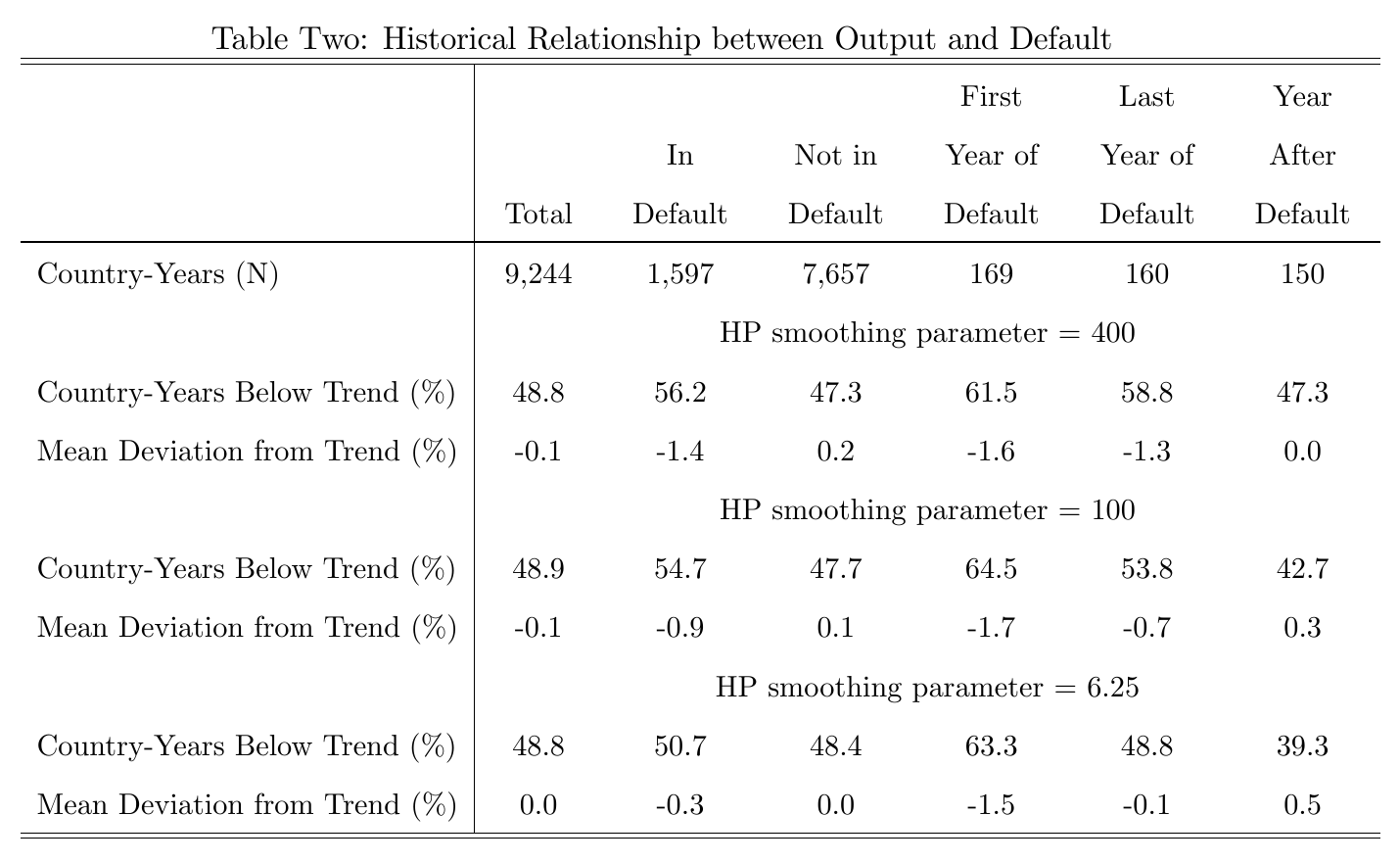
The headline numbers are almost comically weak. The correlation between being in default and the output cycle is −0.08 (−0.11 among countries that ever default). Defaults do lean toward bad times — 62 percent of episodes begin with output below trend, and output in the first default year averages 1.6 percentage points below trend — but the lean is slight. More than a third of defaults begin in good times. In 39 percent of all observations, countries with output below trend kept paying; in 44 percent of default-years, countries stayed in default with output above trend. Severity helps but doesn’t rescue the theory: in the worst recessions (output more than 7 percent below trend), only a third of debtors defaulted, while a fifth of countries defaulted during booms with output more than 10 percent above trend.
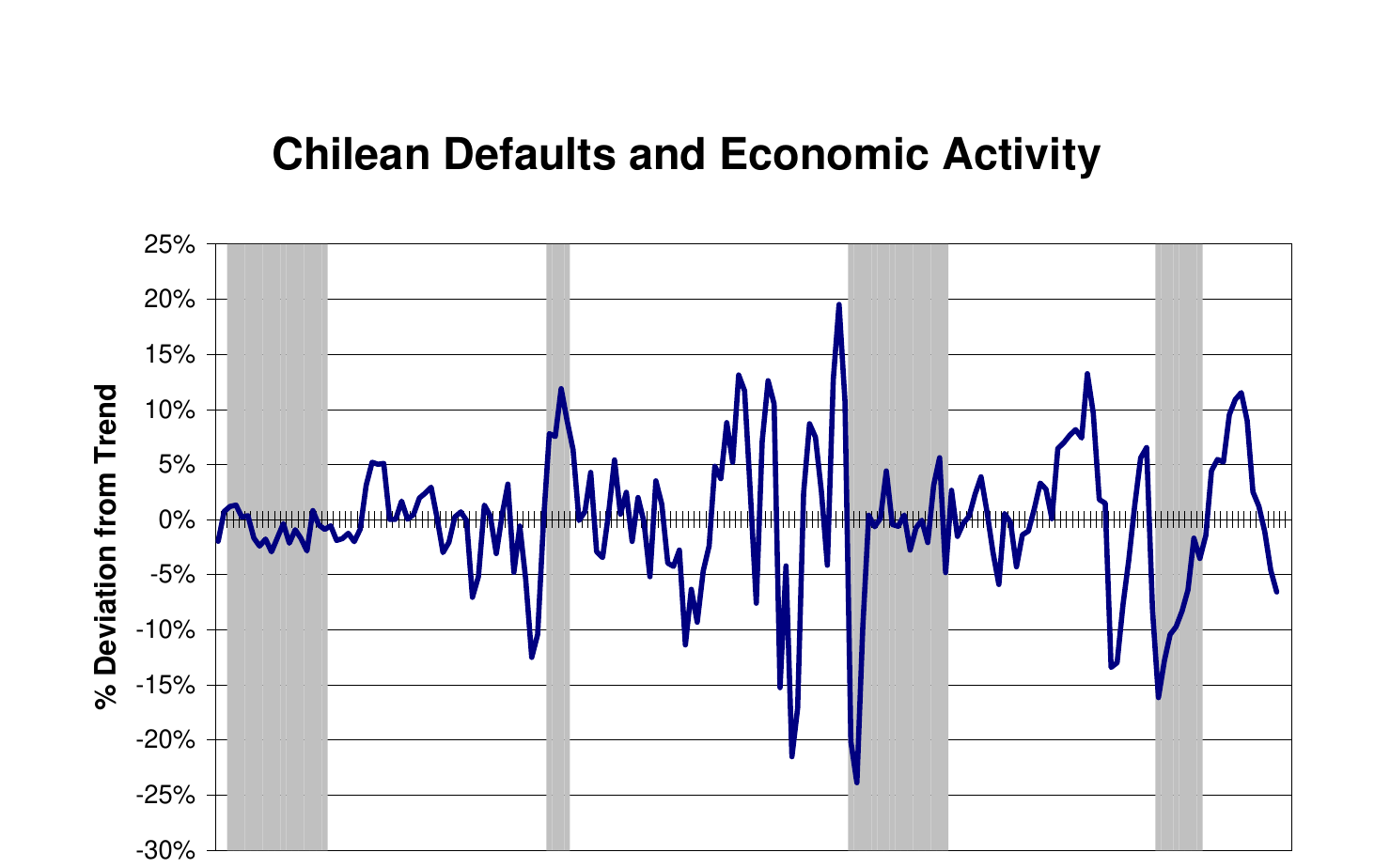
The country portraits make the point better than the moments. Chile defaulted in 1826 and 1880 with output above trend (1880: more than 10 percent above), yet sailed through downturns of 20-plus percent below trend in 1921 and 10-plus percent in 1877, 1903 and 1975 without missing a payment. Argentina never defaulted in its very worst years — not at −21 percent in 1881, not at −24 percent in 1917 — and its 1982 default preceded the trough by eight years.
Turning the data on the models
The paper’s second half runs the standard quantitative default machinery — the Aguiar–Gopinath (2006) implementation, in both its transitory-shock (Arellano-style 2008) and trend-shock versions, the same “cycle is the trend” apparatus that reappears as entry 21 of this reading list — and scores it against these moments. The failure is not subtle. The transitory-shock model defaults about once every two millennia, and when it does, output at default is a cartoonish 41 percent below trend; every model default begins in bad times, against 62 percent in history. The trend-shock model gets the default frequency about right (twice a century) but still ties default to the cycle far more tightly than the data: correlation around −0.2, twice the historical value, with 85–100 percent of defaults starting below trend. And the standard calibration’s 2-percent direct output cost of default implies in-default output of 15–20 percent below trend, against 1.5 percent in the data; recalibrating the output cost a hundredfold smaller and the exclusion length to the historical mean of 10.1 years collapses equilibrium debt and drops defaults to once every 150 years. The models can match the frequency of default or its cyclical signature, not both: the insurance mechanism “hard wires” a tightness the last two centuries simply do not show.
The authors’ three proposed exits became the field’s next decade of work. Maybe default insures something narrower than gdp — exports, fiscal revenue, or the cost of capital (so world interest-rate spikes, not domestic recessions, trigger waves — which fits the observed clustering of defaults in the 1820s, 1870s, 1890s, 1930s and 1980s, when creditor-country conditions turned). Maybe the relationship is contingent: countries borrow through recessions when global markets are flush and default when the same recession meets a credit crunch. And maybe — the political scientist’s contribution — models need “not only good and bad times, but also good and bad governments”: many good-times defaults coincide with new coalitions taking power with ideological or opportunistic reasons to repudiate.
What the lecture adds
The Amador–Wright lecture, given a decade later, is the survey wrapped around this evidence, and its texture is worth keeping. Wright’s five lessons open with the base rates — about 250 default episodes by roughly 110 countries in 200 years, with Venezuela “seizing the lead with its ninth default” — and then turn to enforcement, where he supplies the perfect Bulow–Rogoff-era (1989) anecdote: creditors did once seize an Argentine naval vessel, which made headlines, and “a couple of months later the ship was released and the creditors went home empty-handed,” which did not. His third lesson — “be very skeptical of governments and the data they release” — comes with a demonstration that measured Greek debt in 2014 could be defended as anywhere from 42 to 180 percent of gdp depending on accounting choices, a sobering footnote for anyone (including this paper) regressing default on measured fundamentals. The lecture’s through-line, that sovereign lending survives on remarkably thin legal recourse and remarkably murky information, is exactly the environment in which Tomz and Wright’s loose default-output relationship stops being a puzzle and starts looking like the equilibrium.