Notes on:
The Targets of Geoeconomic Coercion
NBER Working Paper 35343
2026
geoeconomics · coercion · firms · power
Paper · PDF
Made with AI: Fable 5 (reading), Fable 5.1 (writing)
Christopher Clayton (Yale), Matteo Maggiori (Stanford gsb), Jesse Schreger (Columbia). nber Working Paper 35343, June 2026, revised July 2026; 28 pages, prepared for the proceedings of the Central Bank of Chile’s centennial conference. No talk video was found, so this is a pdf-only digest. Figure 1 is cropped from the paper.
Whom do you threaten
If the United States wants asml to stop selling lithography tools to China, it has two ways to get there. It can threaten asml directly — cut it off from American inputs unless it stops — or it can threaten the Dutch government until the Dutch government imposes the export control on asml itself. That is the paper’s opening example, and it is careful to present it as a fork rather than a history: the U.S. “could either directly pressure the Dutch firm asml” or “pressure the Dutch government to impose export controls on asml.” The question this short paper asks is why a hegemon would ever choose one over the other, given that the threat (suspension of access) and the demand (stop doing the thing) are the same in both cases. The answer is a tradeoff between two advantages, each of which is lost when you take the other.
The setup
The hegemon sells an input to a small open economy with two sectors. Sector 1 needs the hegemon’s input and nothing else. Sector 2 can use the hegemon’s input or an alternative — sold, say, by the hegemon’s rival — and using has an external economy of scale: each firm in sector 2 is more productive with the more of sector 2 is already using it. The paper’s illustration is Huawei network equipment in a small European country, adoption by more firms making the technology more attractive to the rest, with a footnote to Farrell and Newman’s Underground Empire (2023) for background. The hegemon dislikes the small economy’s use of ; formally there is a negative externality per unit on the hegemon from adoption, large enough that the hegemon would rather see no used at all, which is what makes “stop using ” a costly action worth demanding rather than just a transfer. The small economy’s government has domestic wedges it can use to tax or subsidize either input, and the hegemon can demand either transfers or wedges of its own.
The game has two stages, a Beginning and an End, and the choice of target is also a choice of when to show up. In the Beginning the small economy’s government sets its wedges; in the End firms buy inputs and produce. Coercing firms means arriving in the End, after the government has set its wedges, and taking them as given. Coercing the government means arriving in the Beginning and writing the wedges into the contract. Both setups follow the modelling framework of the team’s earlier papers, A Framework for Geoeconomics (2026) and A Theory of Economic Coercion and Fragmentation (2024); the definitions of power below are the Framework’s. One assumption in the firm environment does quiet work: the government is taken to be passive, setting all its wedges to zero, which the authors concede “is not innocuous,” because it rules out a government that sees coercion coming and pre-empts it with anti-coercion policy — the subject of the Coercion paper, and deliberately left out here.
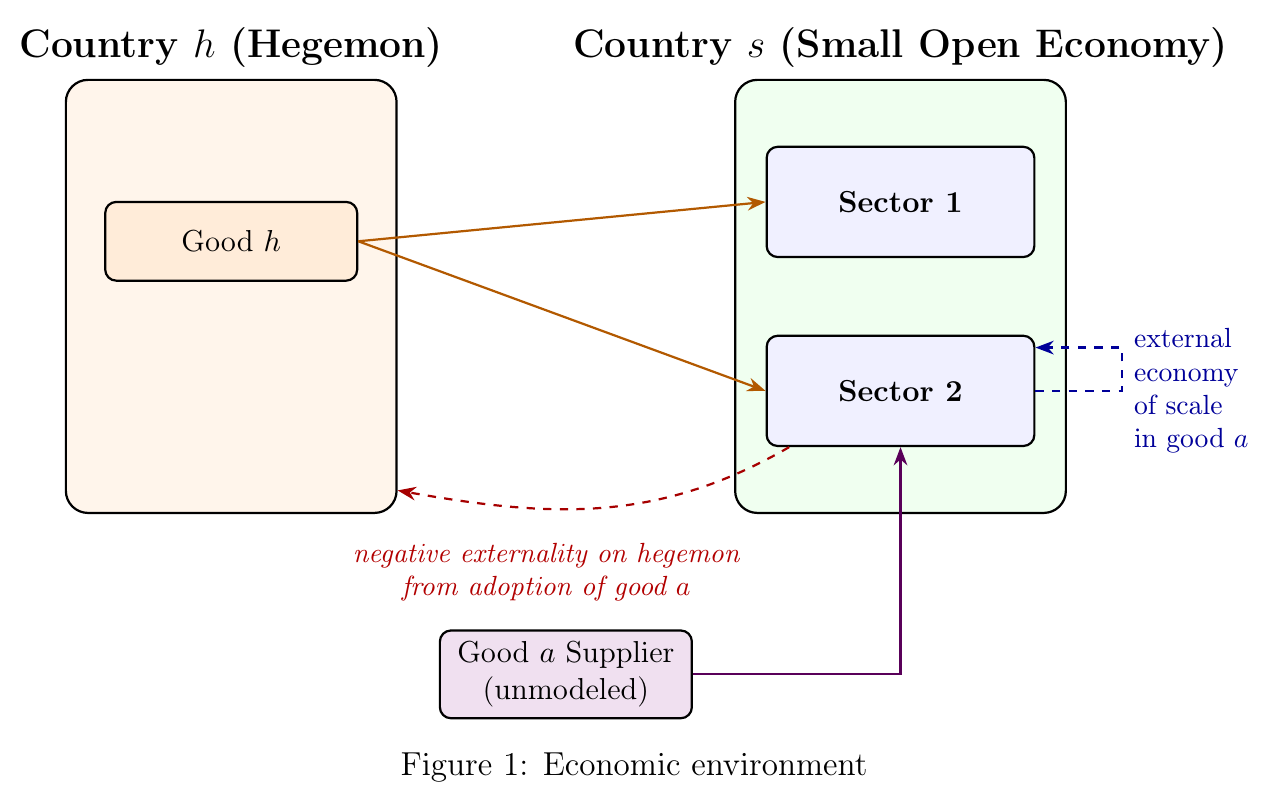
Two environments are then compared. In the first the hegemon contracts with firms, one representative participation constraint per sector, demanding wedges or transfers from each firm in exchange for continued access; a firm that refuses is cut off alone, and its neighbours keep their supply. In the second it contracts with the government, one participation constraint for the whole country, threatening to cut off every sector at once and demanding transfers or changes in the government’s own domestic wedges.
Targeting firms: exploiting what firms don’t internalize
The paper recycles two definitions from the Framework. Micro power is the most a target would privately pay to keep access, holding all equilibrium aggregates fixed; macro power is the social value to the hegemon of the actions it can demand. When the hegemon coerces sector-2 firms one at a time, each firm that agrees to drop considers only its private cost of doing so. It does not internalize that its own withdrawal lowers the productivity of for every other firm in the sector, which lowers their outside option, which lets the hegemon demand more of them. The paper’s rewritten participation constraint for sector 2 (its equation 5) puts the two sources of power side by side:
Here is the transfer demanded of sector 2, the use of the hegemon demands, the sector’s capacity in , its profit from at capacity and its profit from the hegemon’s good. The left side is what the hegemon spends power on; the right side is where power comes from. The first term on the right is the plain threat. The second is the externality: the productivity that disappears from the outside option because everyone else has been made to cut back too. The hegemon rides it — firm-level coercion is a way of playing firms against each other through the equilibrium, and the hegemon’s power in total exceeds its direct hold over any firm. That is the advantage of targeting firms.
The cost shows up in Proposition 1. Because the externality exceeds the per-unit margin sector 2 earns on , the hegemon always prefers to trade transfers for reductions in ; if it has enough power over sector 2 it shuts down entirely and then collects transfers with whatever slack is left. If it does not have enough power, it spends everything on suppressing as far as it can and collects nothing. Meanwhile its best use of its power over sector 1, which has nothing to do with , is simply to collect transfers. So in the interesting case, the second branch, a unit of power over sector 1 is worth exactly one (a dollar of transfer) and a unit of power over sector 2 is worth more than one, because it buys a further reduction in the use of and exceeds the margin on . The paper’s way of putting it is that the hegemon would be happy to see a sliver of profit migrate from sector 1 to sector 2, trading a smaller transfer for a smaller footprint of . It has power where it doesn’t need it and needs it where it doesn’t have it. The paper calls this a power mismatch.
Targeting the government: slack sharing
Coercing the government removes the mismatch. The country-level participation constraint adds up the losses to both sectors from exclusion, so the hegemon can relax its transfer demand on sector 1 and use the slack thus created to demand that the government deploy its domestic wedges to suppress in sector 2 — a sector over which the hegemon itself had little direct hold. The paper’s equation 6 is equation 5 with the last term swapped out:
The uninternalized externality is gone and sector 1’s uncollected profit has taken its place. Proposition 2 has the same two-case structure as Proposition 1, but with a single power budget and a single marginal value of power: either is shut down and transfers are collected from the country, or is suppressed as far as the budget allows and no transfers are collected from anyone. The paper links this to Bernheim and Whinston’s (1990) multimarket contact, where the threat of competition in one market sustains collusion in another. The extra ingredient here is that the entity being threatened can do something firms cannot: legislate over its own economy. (The model assumes the government faces no participation constraint of its own with respect to its firms — it simply imposes wedges — which the authors call a convenient abstraction for the fact that governments have direct powers over domestic firms that a foreign hegemon lacks.)
What the hegemon gives up is the externality. A government internalizes the scale economy in across its firms, so it will not be tricked into a race in which each firm’s defection lowers the others’ outside options; the macro-power advantage of firm-level coercion is gone.
When to do which
Section 4 closes the model with a step-function economy of scale — productivity in jumps to a high level only when sector 2 runs at full capacity — to get closed forms, and Proposition 3 collects the results. The hegemon prefers firms when its hold over sector 1 is weak (there is little slack to share) or its hold over sector 2 is strong (it can shut down directly and slack sharing buys nothing). The region in which it prefers the government grows with the externality , because then suppressing matters more than transfers and aggregating power at the country level is worth more; and the region in which it prefers firms grows with the size of the scale economy, because then the divide-and-conquer channel is worth more. If you want to run asml through this — the paper offers the example and then leaves it — the two comparative statics pull in opposite directions: a strong direct hold over the firm says go to the firm, a large externality from the sales says go to The Hague. That is the essay’s reading, not the paper’s. The paper’s own remark on the real world is that hegemons adopt a mixture of both, which is precisely the case its discrete choice rules out.
What it is and isn’t
The authors call it a short paper and it is: one mechanism, three propositions — two characterizing the optimal contract against firms and against the government, the third the comparative statics — and a page of extensions. No empirics. Two of the extensions are worth more than their length. One flips the sign of the whole thing: if sector 2 had an external diseconomy of scale, each firm’s forced cut in would make more productive for the others, raising their outside options, and the hegemon would lose power from the uninternalized externality rather than build it (the authors point to Horn and Wolinsky 1988 on how merging into a bargaining unit can reduce bargaining power). Divide-and-conquer is not a generic advantage of targeting firms; it is an advantage of targeting firms whose externality runs the right way. The other extension relabels the model: read the firms as individual European countries and the government as the eu with a utilitarian welfare criterion, and the question becomes whether a hegemon should coerce coalition members bilaterally or the coalition as a unit — the same tradeoff between playing members off against each other and consolidating power at the top.
It belongs on the list alongside the team’s other papers because it answers a question they left open and practitioners care about: the Framework’s hegemon contracts with entities, the Coercion paper’s governments choose anti-coercion policy, but real coercion is aimed at asml, hsbc, Swift, or The Hague, and the choice is strategic. For the reading group it is also the cleanest small model in the block: readable in an hour, and a good first presentation for someone who wants the cms machinery at its most compact. Its lesson, in the coalition reading the authors themselves offer, is that you go to the members when you can turn them against each other and to the collective when it can deliver what the members can’t; the government’s value to the hegemon, in the end, is that it can do to its own firms what the hegemon cannot.