Notes on:
The Fragmentation Paradox: De-risking Trade and Global Safety
CEPR Discussion Paper 20564
2025
geoeconomics · de-risking · trade and conflict · fragmentation
Paper · PDF · Transcript
Made with AI: Fable 5.1 (reading and writing)
Thierry Mayer, Isabelle Méjean and Mathias Thoenig. Presented at the nber Summer Institute meeting on International Economics and Geopolitics on July 10, 2025; that session was not recorded, so its discussion is not on tape. The recording used here is Mayer’s twenty-minute talk at the Kiel-cepr Conference on Geoeconomics in Berlin on October 17, 2024, followed by a discussant the recording never names and a floor Q&A. The paper is the June 25, 2025 draft; the Summer Institute slide deck is drawn on once. The figures below are cropped from the June draft rather than taken from the 2024 slides, for a reason explained partway down.
Hostages are a form of insurance
Here is the oldest argument for trade: countries that sell to each other do not shoot at each other, because war would cost them the business. Here is the newest argument against it: if your rival can hurt you by cutting you off, you should cut yourself off first, on your own terms, and call it de-risking. Mayer, Méjean and Thoenig’s paper is what happens when you make both arguments talk to each other in one model, and the result is the thing in the title. De-risking lowers what you would lose in a war, which makes a war cheaper, which — holding fixed the reasons countries fail to settle their disputes — makes a war more likely. You wanted to stop being a hostage. The hostage was the thing keeping the peace.
The diplomatic game
Two rivals have a dispute. The model does not care what about, and nobody is the aggressor. Each leader’s payoff is the log of the country’s real consumption plus something the paper calls geopolitical valence: a state-controlled good that can be handed from one government to another, whether a strip of territory, control of a waterway, or just prestige. In war the valence takes a hit of uncertain size, the “war shock”, and here is the whole trick: that shock is private. Each leader knows how badly a war would go for them and the other does not. So there are two costs of war. One is public — the real consumption you give up by going from peace, the inside option, to war, the outside option, which the paper calls the opportunity cost of war and which a trade model can compute from trade data. The other is the private shock on top. Both leaders know peace is better than war in total, and they still may not get there.
The (second-)best protocol, borrowed from Compte and Jehiel’s (2009) mechanism design for bargaining you can walk out of, is disarmingly simple. Both leaders announce their cost of war simultaneously; if the two announcements add up to something positive, there is peace, and the leader who announced the higher cost pays the other half the difference, in valence. If the announcements are incompatible, talks break down and there is war. Announcing a low cost wins you a bigger concession, so everyone shades. The optimal announcement is equation 9 in the paper:
Here and are the two public opportunity costs of war and is leader n’s private war shock. Notice what is being shaded: only the private part, by a third. (On tape Mayer summarized this as announcing “two-thirds of the true cost”, which is the shorthand and not the formula; your trade exposure is public knowledge and there is no lying about it.) Wars happen when both shocks are small, because the other side cannot tell a small true shock from a strategic understatement, and the announcements fail to clear the bar. That is the paradox of war — rational leaders, enormous costs, and still a war neither wanted — rendered as a bargaining protocol, and it yields three objects that all depend on the two opportunity costs, equations 11, 13 and 14:
The probability of de-escalation, , rises in the sum of the two opportunity costs and falls in , the dispersion of the private shocks: the more there is jointly to lose, and the less noise, the more often you settle, and with little enough noise you always settle. The peace-keeping cost, , rises in the difference — whoever has more to lose pays. The true cost of war, , is what n actually loses conditional on war breaking out; it rises in n’s own opportunity cost but sits well below it, because wars only happen at the bottom of the shock distribution and diplomacy screens out the worst ones (the paper calls the last term “war intensity mitigation”). The expected geoeconomic loss is then equation 16:
This is the tension that runs the paper: levels keep the peace, asymmetries set the price of it. And a detail that is genuinely new in the policy conversation, which Mayer stressed on tape: if the noise vanished and diplomacy never failed, would collapse to . The concessions are paid whether or not war ever happens. A probability of war near zero does not mean geopolitics is free. It means you are paying the premium on time.
Anyway, the trade model
The contribution is to compute the opportunity cost of war from a full quantitative trade model with input-output linkages, rather than assert it. The trade side is Baqaee and Farhi’s (2024) network model — nested ces, one factor per country the authors call equipped labor, solved in exact hat algebra on the oecd’s TiVA tables for 1995 to 2020. (Mayer said “sixty countries I think” on tape; the Summer Institute slides say 64 countries and 40 sectors; the paper gives no count.) War is a symmetric conventional conflict: country-specific tfp shocks calibrated so that real output falls 13 percent, the discounted value of the Federle et al. (2026) estimates of what wars do to gdp, and trade frictions from the Glick–Taylor (2010) estimates, bilateral trade between belligerents down 85 percent and trade with neutrals down 12 percent, which as iceberg costs are and . The model has a slot for lost workers and capital; the baseline sets it to zero, on the grounds that it only shifts the level of every opportunity cost and not how trade moves it. (The claim that ten years of peace put trade back on the gravity line is in the talk, not the paper.) Put the shocks in, let wages and trade flows resettle worldwide, and the log difference in real consumption is the opportunity cost, which equation 22 decomposes into economic damages weighted by Domar weights, trade frictions arriving directly and through inputs, factor losses, and wage adjustments.
Two things the model makes clear that a simpler one would not. Openness cuts both ways: trade is insurance against your own wartime productivity loss, since you substitute toward foreign goods when domestic ones get expensive, and exposure to the trade disruption, and which dominates depends on how bilateral versus multilateral your dependence is. And input-output linkages amplify. With them, the elasticity of real output to a domestic tfp shock runs from 1.1 to 2.7 across the largest economies, against about 0.8 without; and America’s exposure to a Chinese productivity shock, counting what arrives through inputs, is more than three times its final-goods exposure by 2020. When the discussant asked what the linkages change relative to Martin, Mayer and Thoenig’s (2008) paper, Mayer’s answer was that the old paper had no welfare calculation, no general equilibrium and no inputs, and that the input channel magnifies your rival’s tfp hit because you use its output to make your own.
Then the time series. The China shock raised the American opportunity cost of a bilateral war from 14.1 percent of real consumption in 1995 to a peak of 14.4 in 2014 — most of that the tfp shock, with a still-substantial 1.3 points from trade interdependence. China’s ran through exports rather than imports: it spiked to 15.1 percent around 2004, when Chinese export dependence on the American market peaked (in levels it runs about twice the reverse), and then fell back to slightly below its 1995 level by 2020. So the sum rose, which made peace more likely, and the asymmetry narrowed. The paper calibrates the noise parameter so that de-escalation is certain in 2018, and with that choice the probability is essentially one for most of the period, dipping to about 98.5 percent at either end. The transfer is the interesting line. In the mid-1990s China was conceding the equivalent of 0.2 percent of American real consumption to keep the peace; the concession deepened to about 0.45 percent at the 2004 peak, shrank through the 2000s as the two opportunity costs converged, and was essentially zero from about 2015. Over twenty years, the paper says, the United States lost around 0.2 percent of real consumption to declining bargaining power. Note what did not happen: the sign never flipped. China’s concession fell to nothing; it did not become an American concession.
This is the place to say why the pictures below are cropped from the paper. Mayer’s Berlin slides ran an earlier calibration — he says “3 percent of loss of tfp” on tape, where the paper targets a 13 percent output contraction — and in that version the opportunity costs came out around 4 percent, the probability of peace hovered between 0.6 and 0.8, and, as he put it, “after 2010 usa has to pay China”. The June 2025 draft has none of that: opportunity costs near 14 percent, peace near certain, and China paying until the bill reaches zero. The mechanism on tape is the paper’s; the numbers are not.
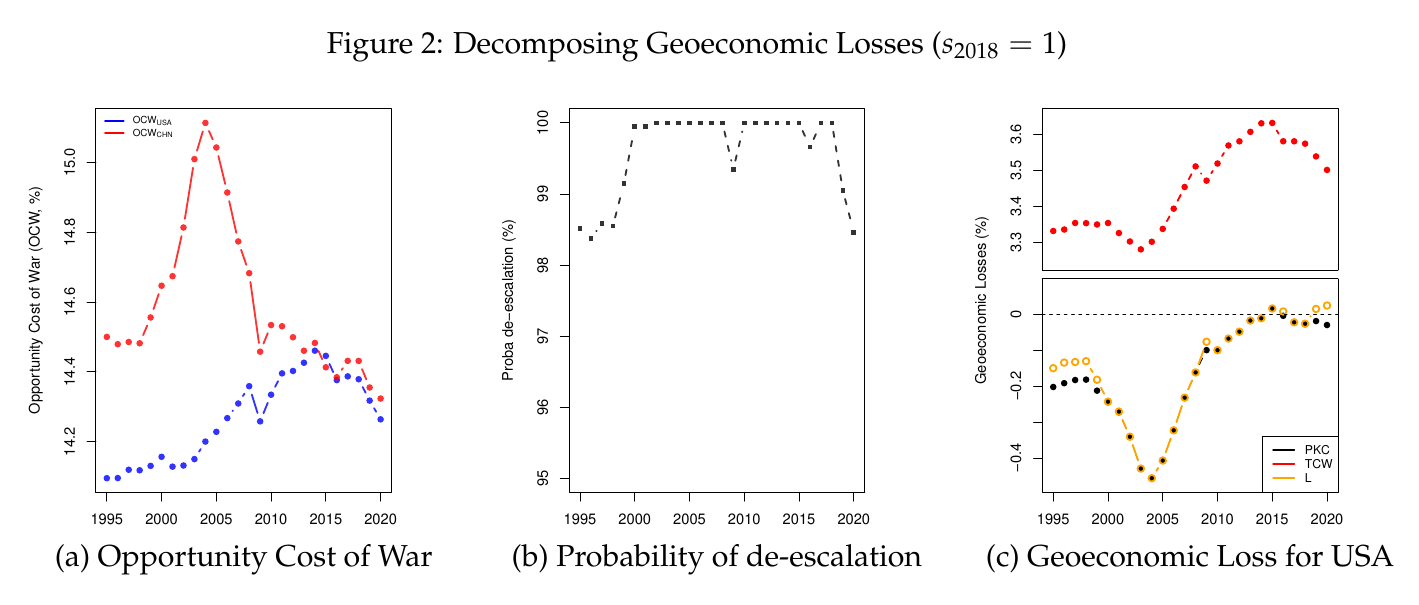
The paradox, priced
Now take 2018 and raise American tariffs on China so that trade costs rise by anything up to 50 percent, in five-point steps. (On tape it was 5 to 25.) A 25 percent step cuts Chinese sales to the United States to about a third. The theory, in section 4.1, lists five things that happen. America’s opportunity cost of war falls; that lowers both the true cost of war and what America would have to concede, both good for America; it also lowers the probability of settling, which is bad; there is the ordinary terms-of-trade effect on peacetime consumption; and — the one that gets forgotten — China’s opportunity cost falls too, because losing the American market pushes Chinese wages down, makes Chinese goods cheaper everywhere including in China, and lets China diversify, all without any retaliation. That last effect claws back most of the bargaining gain and deepens the fall in the probability of peace.
The calibrated numbers do exactly that. Both opportunity costs fall, from about 14.4 to 14.1 percent. The probability of de-escalation falls from one to 0.965 at a 50 percent increase, about three points at the 25 percent mark. The true cost of war falls from 3.57 to 3.43 percent. The peace-keeping cost, which in 2018 is China’s small concession to America, stays within a few hundredths of zero, at about minus 0.03 — de-risking does not buy the United States a better deal, because China’s position weakens as fast as America’s strengthens. And the geoeconomic loss rises: it passes through zero at around a 5 percent trade-cost increase and keeps climbing, because a war that costs 3.5 percent is being made more likely in order to shave a concession worth a rounding error. The paper’s sentence is that “the geoeconomic losses are made worse by the policy.” (On tape, under the old calibration, Mayer said the opposite, that the United States “will have a little bit less losses”. This is the one place the two versions disagree on a sign.)
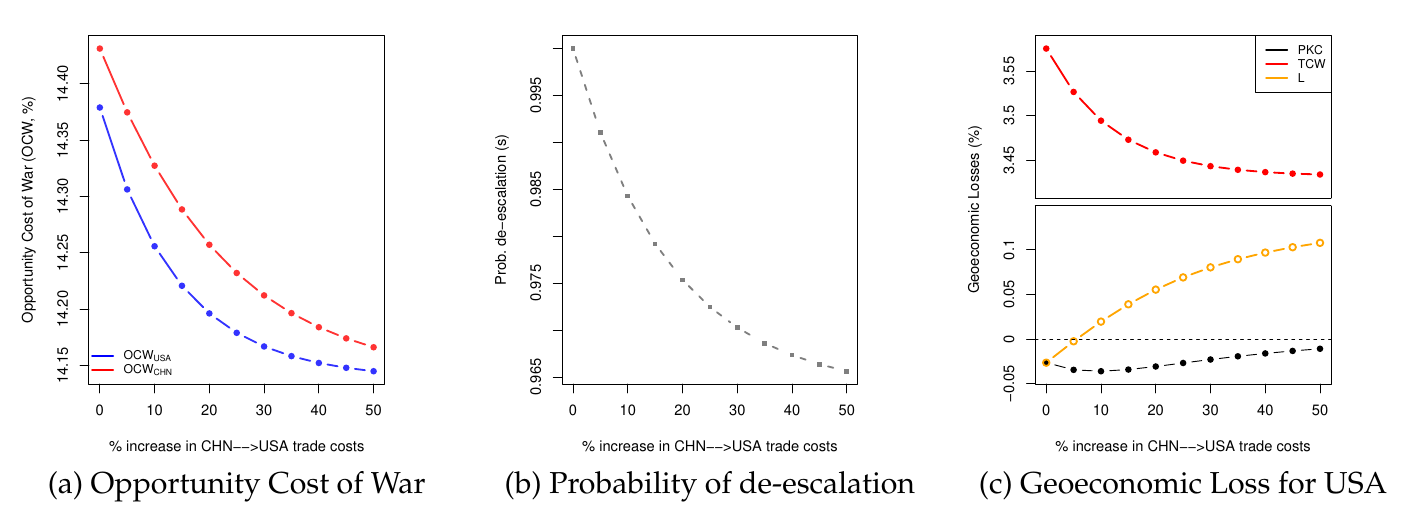
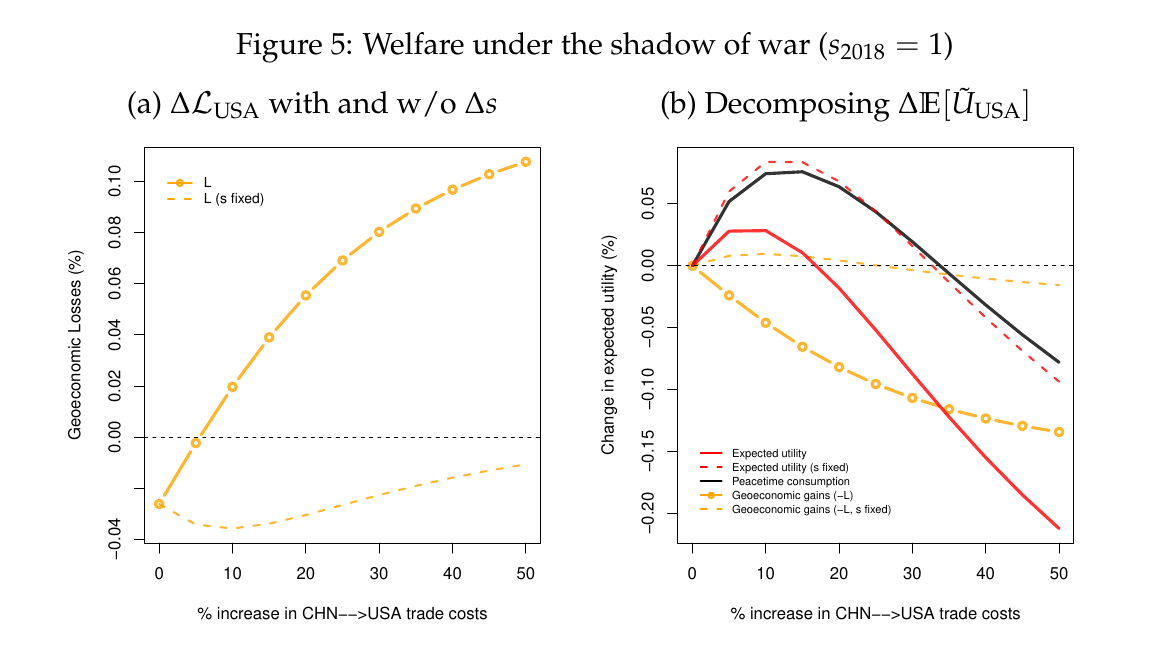
Whether that is a bad trade overall is equation 28: the welfare change from decoupling is the peacetime consumption change minus the change in geoeconomic loss,
Peacetime consumption first rises with the tariff — revenue is rebated, so the optimal tariff is positive even with no geopolitics in the model — and peaks at about 0.075 percent at a 13 percent increase in trade costs. Expected utility peaks earlier and lower, around 0.03 percent, and Figure 5 also draws the line a planner would see if they forgot that the probability of war moves: with that probability held fixed, de-risking looks as if it adds a geoeconomic bonus on top of the terms-of-trade gain, because all you see is the concession shrinking. The entire fragmentation paradox lives in the gap between the dashed line and the solid one.
How bad depends on a parameter the authors are honest about not knowing: the informational noise , which they read as global safety, the probability that a dispute in 2018 would have ended peacefully. The baseline sets it to one. Recalibrating for a 2018 probability anywhere from one down to 0.6 gives the paper’s Figure 6, in which de-risking produces any geoeconomic gain at all only once the baseline probability of peace is 0.7 or lower, and even at 0.7 the gain turns negative again beyond a 20 percent trade-cost increase. The headline is Figure 7. When peace is certain, the optimal increase in trade costs is 8 percent, well below the 13 that pure terms-of-trade logic recommends. Geopolitics argues for less protection, not more. The optimal tariff rises monotonically as safety falls — 9 at 0.9, 10 at 0.85, 11 at 0.8, 12 at 0.7 — and reaches the ordinary 13 only when the probability of peaceful de-escalation is down to 0.6. The authors call the ideal version of this an intel-fed calibration: you would want the intelligence services to tell you where on that axis you are, and absent that they report the whole axis. (The Berlin talk predates this figure; the optimal-tariff exercise is not in the video at all.)
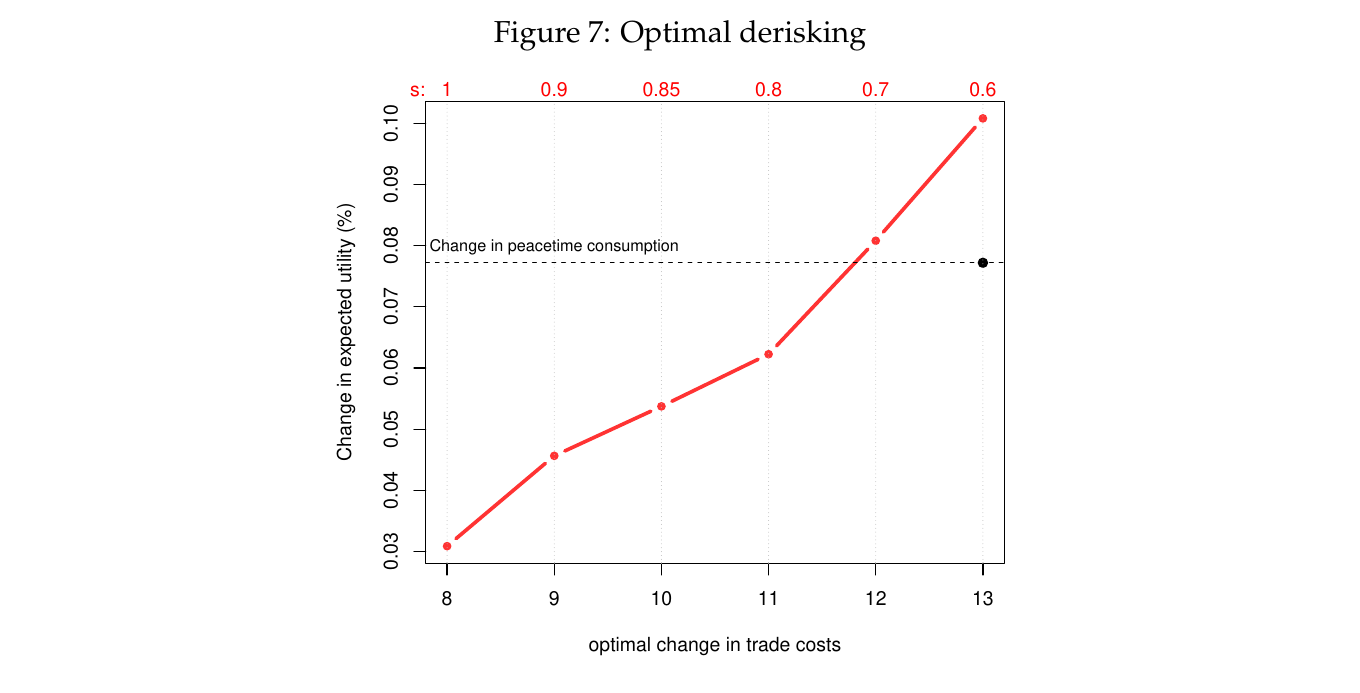
It is worth keeping the scale in view. The whole argument is conducted in hundredths of a percent of real consumption — a 0.03 percent gain against a 0.075 percent gain — sitting on top of a war that would cost 13 percent of output. That is not a weakness; it is the point. The peacetime stakes of the tariff are tiny, so a small movement in the probability of a very large loss is enough to dominate them.
What the Kiel room did with it
The discussant — the recording never gives a name, and the transcript lists none — read the paper as a negative feedback loop from de-risking to conflict, said the key takeaway is that de-risking states do not internalize the escalation probability, and then asked for more model. Loss of life and capital enter only through the economic channel; leaders might weigh them directly. Autocrats might weigh them very differently from democrats: put zero weight on economic losses and full weight on personal risk, and the importance of trade “becomes quite small” for the autocrat. And what, quantitatively, do the input-output linkages change relative to the 2008 paper? Mayer agreed the weights could go in and added the harder point: an autocracy may be noisier — harder to read, and may want it that way — which would change rather than the opportunity costs. The discussant’s sharpest question was Russia and Ukraine, which the discussant said was in the draft under review but not in the talk, and which is not in the June 2025 draft either, beyond a sentence in the conclusion naming “the evolving eu–Ukraine–Russia nexus” as a future application. The premise was that bilateral trade was rising before 2014 and the conflict happened anyway. Mayer’s reply contradicted the premise: bilateral Russia–Ukraine trade “was actually decreasing”, while Russia was trading more with the rest of the world, which in this class of models is insurance and makes escalation more likely; and third-party trade losses from war are small — 12 percent here, “not even 5” in the 2008 paper — so the rest of the world is not much of a hostage. He called the Russia–Ukraine exercise “a very very sort of reduced form” of the full apparatus.
From the floor, a journalist from Euractiv (the captions give “Jonathan Pak”; the room, he noted, was a ministry) asked the only question a ministry cares about: is European de-risking from China a mistake? The answer was that the us–China asymmetries do not carry over to Europe and China, the authors have not run that case, and “mistake” requires believing the model’s escalation probability, which is the one number they cannot pin down — but for the United States and China, “the economic costs are way dominating the geoeconomic gains”. Jesse Schreger asked what kind of good a country should buy more of to raise the opportunity cost of war; the answer is Baqaee and Farhi’s, high dependence and low substitutability weighted by Domar weights, and it is next on the list. A questioner from Tübingen (the captions say Pinger) asked how the opportunity cost is disciplined empirically and whether the cost of a full us–China war would not simply be infinite; Mayer’s answer was procedural — take the trade matrix and the gdp vector, impose the shocks, and let the model recompute wages and flows for everyone until nothing moves, with no retaliation — and the infinity half went unanswered. Someone from Rochester (Hamid, surname garbled) asked whether the whole thing could be relabeled as a trade war; yes, Mayer said, if you switch off the tfp and factor-loss channels, and then the threat on the table is “100 percent of everything you do”. Someone else, self-described as provocative, said the single best predictor of peace is that both sides are democracies, and the West’s problem with Russia and China is precisely that it cannot assume the other side has the utility function in the model. Mayer’s answer was that the model already has a place for this: the private war shock can carry non-economic motives and can even be negative for an autocrat — “it’s good to be a chief of war” — and he tightened the democratic-peace claim to what political scientists actually find, no top-intensity war between two full democracies, alongside “a lot of wars between democracies”. And a last questioner asked whether the model can explain peace at all, given that most countries do not fight and a big country facing a small one has so much less to lose. It can, Mayer said, because the asymmetry shows up as deference rather than war: small countries that depend on the United States “obey the usa when asked”, and, he added, the same goes for France.
The wink is in the title’s own logic. Every argument for de-risking is an argument that you are currently vulnerable, and the model’s reply is that your vulnerability was purchased jointly with your safety and you cannot return one without the other — unless you already know the peace is not going to hold, in which case you should de-risk, and fast, and you should probably not be reading a trade paper to find out.