Notes on:
The Economics of Sanctions: From Theory into Practice
Brookings Papers on Economic Activity
2024
geoeconomics · sanctions · Russia · survey
Made with AI: Fable 5.1 (reading and writing)
Oleg Itskhoki (Harvard) and Elina Ribakova (Peterson Institute). Brookings Papers on Economic Activity, Fall 2024, pp. 425–470; comments by Robin Brooks and Rory MacFarquhar and the general discussion follow on pp. 471–497. The version used is the published article with the discussion, and the figures are cropped from it. No recording of the bpea session could be found; Itskhoki’s 2022 Markus’ Academy lecture on sanctions is a precursor and is the talk digested with Sanctions and the Exchange Rate.
Two authors, two halves
This is a sanctions survey with an unusual division of labour: a trade-and-macro theorist sets out what sanctions can do in principle, and a practitioner who has tracked the Russia sanctions month by month since 2014 reports what they did. The paper’s argument runs through the join. In theory the Western coalition held a strong hand in February 2022; in practice it played the cards in the wrong order, kept the strongest one (energy) in reserve for ten months, and enforced the rest loosely enough that Russia adjusted within a year. The title’s “theory into practice” is a diagnosis, not a promise.
The theory in one formula and three violations
The trade half starts from the gains-from-trade sufficient statistic: a country’s welfare loss from losing trade depends on its import share and the trade elasticity, and nothing else. Three things follow. Costs go both ways, inversely proportional to size — a coalition times larger than the target bears costs times smaller, but never zero (“no pain, no gain”), and Russia, a tenth of eu gdp but its hard-to-replace energy supplier, was not a small country for this purpose. Third countries that keep trading dilute the effect in proportion to how well their goods substitute for the coalition’s, which for rerouted goods is nearly perfectly. And because it is the aggregate import share that matters, Russia’s reshuffling of sourcing to China, Turkey and the former Soviet states restored most of the welfare within a year even though its bilateral trade with the West never recovered. Lerner (1936) symmetry says import and export sanctions of equal size are allocatively equivalent, and the paper is pointed about the use made of that result in 2022 to argue that sanctioning Russian imports made an energy embargo unnecessary (a footnote calls those arguments “misleading”): the equivalence fails when sanctions are temporary (imports are delayed rather than forgone) and when there are foreign-currency balance sheets for the exchange rate to act on, and in both cases import sanctions are the weaker instrument, because the appreciation they cause relaxes the very financial pressure that financial sanctions are trying to apply. Becko’s (2024) optimal-sanction formula and Alekseev–Lin’s (2026) network-centrality Pigouvian term are cited as the normative counterparts.
The financial half classifies instruments by the budget constraint they tighten. Financial sanctions bite when the target borrows abroad, is dollarized, or runs deficits, by turning a sudden stop into a bank run; Russia in 2022 met none of these conditions — “Fortress Russia” was built after 2014 precisely against this — and its soaring export revenue under restricted imports produced a surplus of foreign exchange, what Itskhoki elsewhere titled a “crisis in abundance” (Itskhoki 2023). Payment-system sanctions are the understudied instrument: in standard models they do nothing, but in practice they disrupt trade even when it is balanced, and their enforcement is cheap because the due diligence falls on banks rather than on the corporate sector. The optimal mix the authors propose is swift and comprehensive financial and payment sanctions plus a broad export embargo plus targeted import controls on dual-use goods, with the warning that import sanctions are a poor complement to financial sanctions while export sanctions are a good one. What was done in 2022 was two legs of the three: the financial leg broadly as prescribed, an asset freeze and central-bank sanctions within days; the import leg broad where it should have been granular; and the export leg, the one the other two needed, missing altogether. The authors call the absent energy embargo “a missed opportunity” that could have limited the central bank’s ability to stop the bank run then under way.
What happened
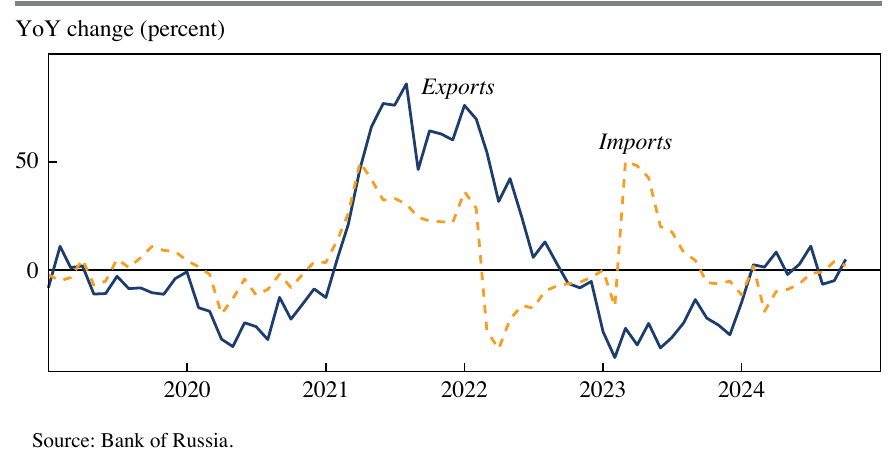
Russian gdp contracted modestly in 2022 (1.2 percent) and grew 3.6 percent in 2023, with war-related spending of nearly 10 percent of gdp, inflation that spiked in 2022 and stayed elevated, and an economy at the limit of its labour supply. The ruble crashed, was propped up by capital controls and a 20 percent policy rate, then appreciated on a record current-account surplus as imports collapsed — the mechanism Itskhoki and Mukhin formalised in their 2026 paper, cited here for the appreciation channel. The import share fell by nearly half on impact, with third countries initially as frightened of secondary sanctions as the coalition, then recovered through rerouting once “trial and error” showed that enforcement was weak. The oil price cap and the eu embargo, which came only in December 2022, cost Russia an estimated 85 billion dollars in export earnings, but the discount on Urals narrowed from 30 to 10 dollars a barrel as the shadow fleet grew and attestation fraud spread, and over 90 percent of Russian crude now ships without G7 intermediation.
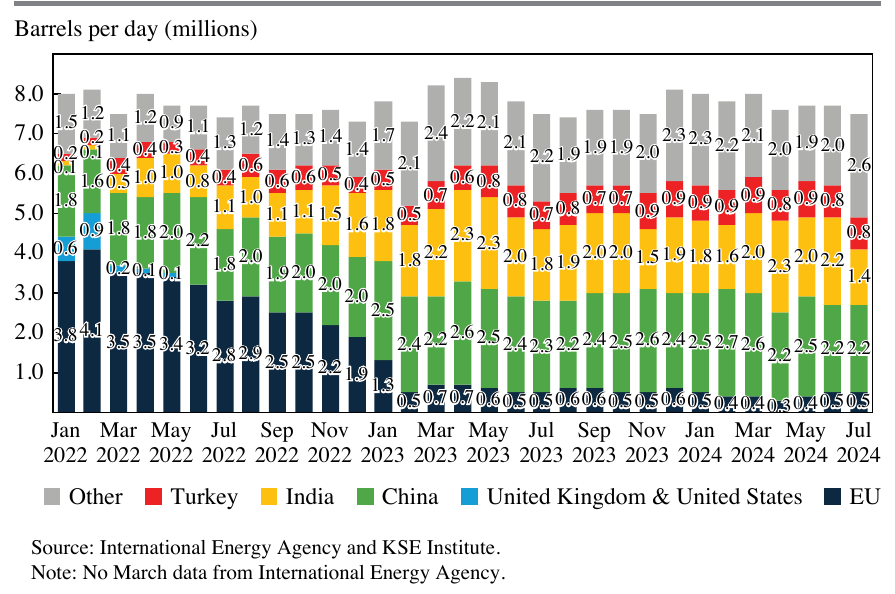
That last figure is the surprising thing, and the authors say it themselves, in a footnote: “one area where sanctions were remarkably successful is at ensuring a constant flow of Russian oil to the world market.” Read that twice. The sender’s declared objective for its energy sanctions was that the target’s main export should not stop, and on that criterion the policy was a triumph. The cap was designed to square the circle of keeping barrels flowing while cutting the price Russia received; the barrels part worked.
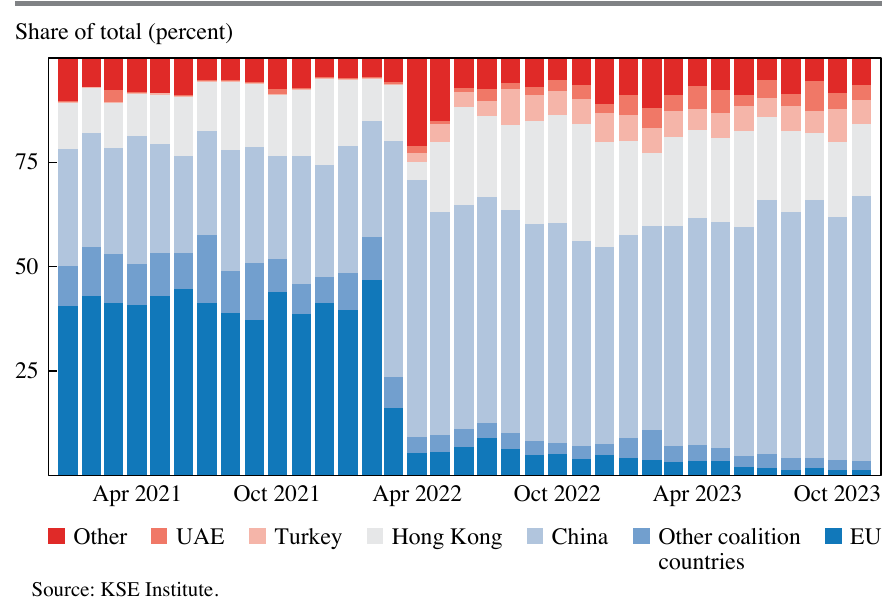
The battlefield-goods figure shows the same pattern for the inputs that matter most: 70 to 90 percent of the components in Russian weapons are still Western-made, and they reach Russia through China (which the authors describe as functioning primarily as a transshipment hub), Turkey and the uae, with Turkey emerging as the second-largest chip exporter to Russia despite producing none.
The verdict and its hedges
The conclusion is that sanctions are a containment tool, not a magic wand; that their effectiveness depends on clear objectives, comprehensive rather than piecemeal imposition, and enforcement with secondary sanctions; that the 2014 round and the eight years of public debate about an “escalation ladder” gave Russia a blueprint for what to insulate; and that against a large commodity exporter with willing “black knights” the exercise looked more like mutual decoupling than coercion. Whether a decisive 2022 package would have ended the war they call debatable, though they see “no reason not to have imposed all possible decisive measures” from the outset, and they note that smaller targets would feel the same instruments far more.
What the discussants pushed on
Brooks goes further than the authors: “If Russia is doing well, it is primarily because the West is allowing that to happen.” His two exhibits are the cap and the tankers. The 60-dollar cap was floated when Urals was near 90 and took effect when Urals had fallen to about 60, so “on inception, the G7 cap was near the least onerous end of the spectrum”; and no ban on selling Western tankers to the shadow fleet was ever imposed, because shipping lobbied against it. He contests the paper’s “no condition for a financial crisis was satisfied” directly: a 30-dollar cap would have cut the surplus, sunk the ruble and forced emergency hikes, so the surplus “was at the mercy of the West”, and the authors “make too much of Russia’s official reserves”, which are a stock, when the ruble is set by flows. His enforcement exhibit is German exports of cars and parts to Kyrgyzstan, up 5,100 percent between 2019 and 2023.
MacFarquhar’s comment is the practitioner’s reconciliation. What the paper calls “financial sanctions” — limits on borrowing — is not what practitioners mean; a blocking designation freezes assets and bars all transactions, which is most of what the paper files under payment-system sanctions, so the theory’s “financial sanctions do nothing to a surplus country” is partly a terminology gap. Judged by their foreign-policy goal, the 2014–15 sanctions worked: Russia halted in early 2015 and the line held seven years, until Russia believed it was insulated. Russia’s one preparation flaw was moving its reserves out of dollars but not euros. And the arithmetic: at around 8 million barrels a day, even 60 dollars a barrel earns almost 500 million dollars a day. He closes with the note that size, preparation and cost-to-sender “will apply to an even greater degree in any future conflict with a peer competitor like China.” In the floor discussion Mehrotra asked whether a full embargo at the outset would have stopped the war; Itskhoki’s answer was that the models treat sanctions as limits on intertemporal trade and miss the inability to use spot currency to buy goods at all, and that in 2022 substitution turned out to be easier in the real sector than in finding a financial intermediary — with no guarantee that holds next time. Ribakova called the paper “a first pass” and said feasibility and institutional capacity decide the instrument, which in practice favours the more heavily regulated financial sector.
Where it sits
Context in 2.3, paired with Felbermayr, Morgan, Syropoulos and Yotov (2025): that survey is the gravity-and-gsdb view across hundreds of episodes, this is the macro-policy view built on one. Its value to the reading group is as the plain-language version of three results the presented papers make formally — the sufficient-statistic logic of Becko and Baqaee–Farhi (2024), the failure of Lerner symmetry under temporary sanctions and foreign-currency balance sheets that Itskhoki–Mukhin and Lorenzoni–Werning (2023) model, and the payments channel, for which the paper’s own pointers are Livdan, Schürhoff and Sokolov (2024) and Clayton, Maggiori and Schreger (2024), with Bianchi–Sosa-Padilla (2023) on optimal financial sanctions and Ghironi–Kim–Ozhan (2025) on the quantitative side. It stays context because it is a survey and a policy assessment; it is the paper to read the week before the sanctions theory, and the one to hand a policymaker — together with Brooks’s comment, which is the version the policymaker will not enjoy.