Notes on:
Supply Chain Resilience: Should Policy Promote International Diversification or Reshoring?
Journal of Political Economy 131(12): 3462--3496
2023
geoeconomics · supply chains · resilience · reshoring
Paper · doi · PDF
Made with AI: Opus 5 (reading and writing)
Gene M. Grossman (Princeton), Elhanan Helpman (Harvard) and Hugo Lhuillier (Princeton). Published version: Journal of Political Economy 131(12), December 2023, 3462–3496, doi 10.1086/725173, edited by Andrew Atkeson. It supersedes nber Working Paper 29330 (October 2021), and not lightly: the numerical section was re-simulated on a new baseline and the sign of its headline policy recommendation flipped. No talk recording exists; pdf-only digest, from the published version throughout. The journal edit also inserted the word “International” into the title, which is the distinction the paper is about. The multitier sequel is Grossman, Helpman and Sabal, “Optimal Resilience in Multitier Supply Chains,” qje 139(4), 2024.
If you read the working paper, the answer has changed
Start with the correction, because it is the most useful thing this revision has to say. In the working paper’s simulations all three single instruments came out as subsidies, the planner wanted more diversification than the market chose, and a welfare panel ranked the diversification subsidy first. In the published version that welfare panel does not exist, and at the new baseline the sign is the other way: with the market over-diversifies and the second-best policy is a tax on diversification (p. 3490). Only at does it become a subsidy (p. 3491). Same model, same theorems, re-simulated numerics, opposite recommendation. If you carried away “the model says subsidize diversification,” you carried away a parameter, not a result.
The executive order, taken at its word
President Biden’s supply chain executive order of 24 February 2021 asserts that America needs “resilient, diverse, and secure supply chains” and that resilient supply chains “will revitalize and rebuild domestic manufacturing capacity” (p. 3463). Those are two different policies — pay a firm to keep a second supplier, or pay it to keep a domestic one — and the order runs them together as one commitment. The authors set the two clauses side by side on p. 3464 with domestic italicised, which is roughly how a jpe paper raises an eyebrow.
The underlying problem is real. McKinsey’s (2020) supply chain interviews report disruptions of one to two weeks hitting a given company every second year on average, one-to-two-month disruptions every 3.7 years, and expected losses per decade averaging 42% of annual pretax earnings (p. 3463). But notice whose losses those are. Firms already hate disruptions and already pay to avoid them, so the policy question is never whether shortages hurt; it is whether a firm’s private appetite for a backup falls short of society’s or exceeds it. The answer here is that it can be either, and that which one it is has almost nothing to do with geography.
The model, deliberately tiny
A unit mass of home firms each make one nontraded differentiated variety from one customised critical input, one-for-one (p. 3467). A firm forms a supplier relationship at home, abroad, or both, paying a sunk each time; foreign inputs are cheaper, (p. 3468). Every relationship survives its own idiosyncratic shock with probability and its country’s economy-wide shock with probability , home being safer, (pp. 3468–3469). Two independent country draws give four states — only home working, only foreign, both, neither (p. 3469). Firms choose onshore only, offshore only, diversify, or exit, and the shares are what the planner is really picking; every instrument is a lump subsidy paid for pursuing strategy (p. 3478).
Three distortions live in there (p. 3464). A firm that stays available creates consumer surplus it cannot charge for, which argues for too little resilience. A firm that stays available while its rivals are dark steals their profits, which argues for too much. And differentiated goods are marked up over marginal cost while the numeraire is not, which argues for too little of everything differentiated.
Why the demand system is the whole paper
Under ces the first two externalities cancel exactly — not approximately, exactly, in every state (p. 3480). Investing in a backup supplier is investing in being available, and the two availability externalities are equal and opposite, so the planner has nothing to correct. Choosing ces would therefore answer the question before asking it. The authors use instead the Matsuyama–Ushchev (2017) homothetic-with-a-single-aggregator class, which nests ces and admits Marshall’s second law of demand (Mrázová and Neary 2017) — a variety’s demand elasticity rising with its price (pp. 3465, 3471). The translog case carrying the numerics has share function on , with (p. 3471).
The cancellation then fails, and in a determinate direction. Adding a variety in state H moves the price index , which measures consumer surplus, and the demand aggregator , which governs rivals’ profits, and under msld it moves the first proportionately less than the second (p. 3479):
Under ces vanishes identically; under msld everywhere, business stealing dominates consumer surplus, and private incentives for resilience exceed social ones (pp. 3478–3479). Which is to say: the reason a firm might over-buy a backup supplier is that it wants to be the one still selling when everyone else is down. That is a markup story, markups are set by demand, and nothing in demand knows where the supplier sits.
The first best, and a number that depends on nothing
Give the planner state- and product-contingent consumption subsidies to kill the markup distortion and she still has to price the availability externalities. Under symmetric translog the answer is startlingly clean: both wedges equal exactly, for every configuration of costs and risks (p. 3480). The first best is a tax on diversification of exactly 100% of the cost of a relationship, with ; or equivalently leave diversifiers alone and pay single-sourcing firms the full . Watch that sign, because it is easy to invert: the instrument on the exclusive strategies always carries the opposite sign to the instrument on diversification. It is exactly because of a knife-edge property of symmetric translog — the consumer surplus lost by removing a variety is always precisely half the operating profit lost, at every price (p. 3480) — so the halves cancel into the fixed cost and the parameters drop out. Proposition 1 (p. 3481) collects it: ces means hands off entirely, msld means discourage diversification, symmetric translog means tax it at .
Proposition 1 also tries to say which country the first best should favour, through the shape of a function , and here the published version contradicts itself on one page. The body text on p. 3481 says the government should encourage the safer home investments if is decreasing; Proposition 1, a few lines below, says it encourages onshore relative to offshore sourcing if . Since the paper also shows , those are opposite claims, and the lemma that settles them is in the online appendix. Take only what survives either reading: the direction of first-best national bias is a fact about the shape of , not about which country is riskier.
The second best, where the markup comes back
Consumption subsidies that vary by state and by where a firm’s supplier lives are not a thing any government does, so the honest problem is the constrained one, and the wedge becomes equation (19), p. 3485:
First term business stealing, second consumer surplus, and the sign of the sum is the entire policy question: means subsidise diversification, means tax it (p. 3485).
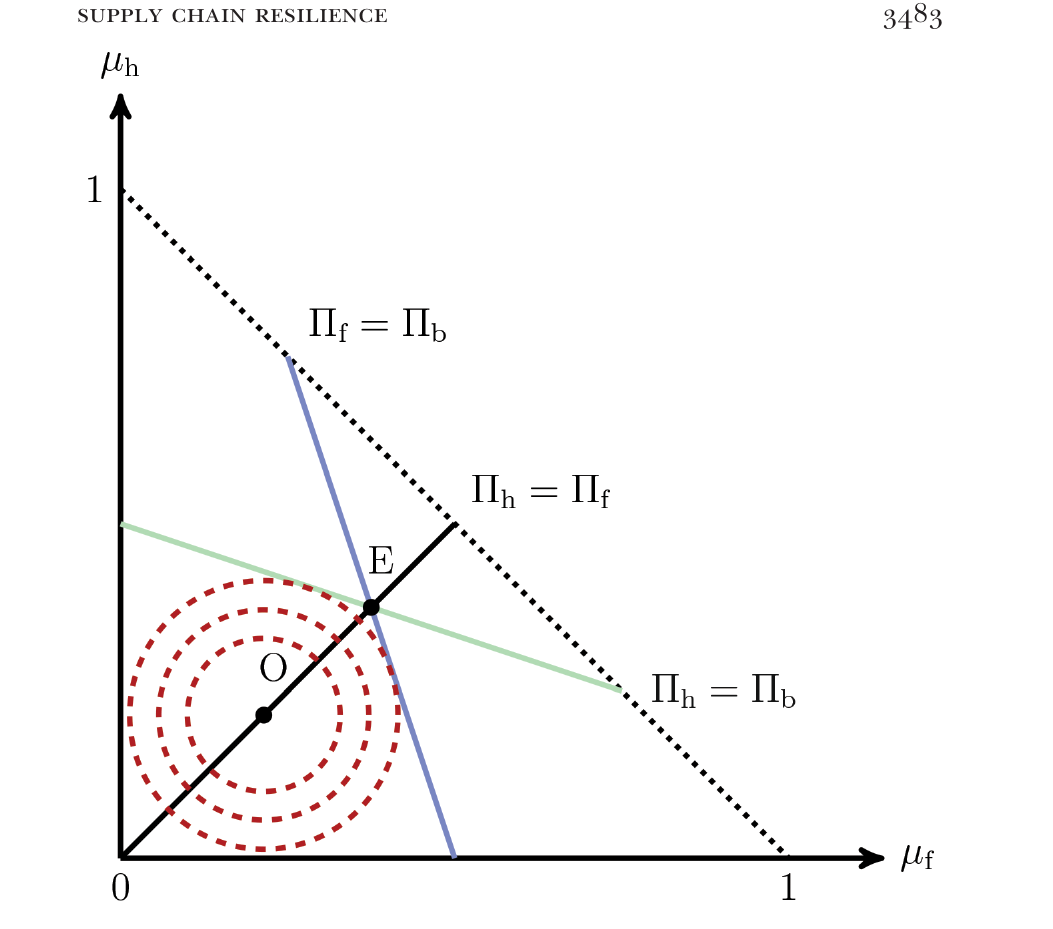
With both countries symmetric the equal-profit locus for the two exclusive strategies is the 45-degree ray and the optimum sits on it (pp. 3482, 3484), so one instrument suffices and the only question is which way it points. Under ces it always points the same way: the optimum satisfies just as the equilibrium does, so the planner never wants to tilt location, and O always lies below E, for every configuration of costs and risks (p. 3488). Markups are all that is left, more varieties in every state is the only lever against them, so the answer is a subsidy for diversification — or, per footnote 24 on p. 3485, equal taxes on the two exclusive strategies. Diversify, don’t reshore, and that half of Proposition 2 (pp. 3488–3489) is genuinely parameter-free.
Outside ces the two forces fight, and which wins turns on , the elasticity of demand for the differentiated group as a whole. Proposition 2 gives the symmetric translog thresholds (p. 3486, restated pp. 3488–3489):
Elastic group demand makes the consumption distortion expensive and the planner subsidises resilience anyway; inelastic demand mutes it and she goes after business stealing instead. Worth noticing, though the paper does not print it: at the simulation baseline of and these read as roughly for a subsidy and for a tax, and both simulated values fall in the gap between them. The sufficient conditions do not cover the interesting region, which is why the numerics exist.
The numerics, on a baseline symmetric in both cost and risk
Section V assumes symmetric translog and sets , , , , with of 1.2 and 1.7 and chosen so the diversified share starts near zero, giving 0.13 and 0.37 (p. 3490).
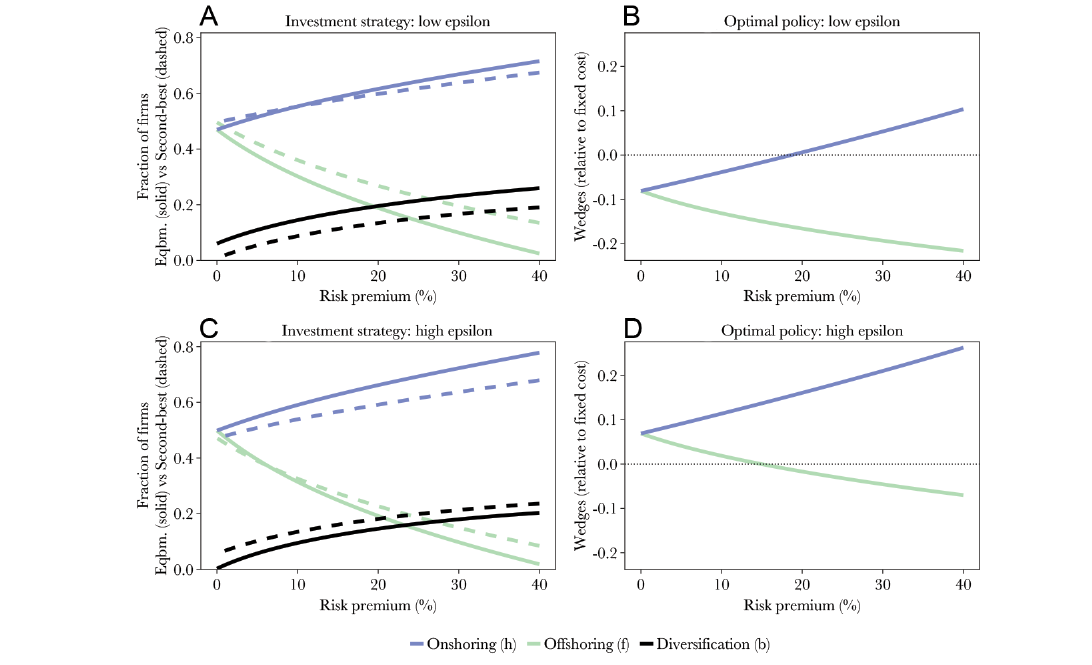
At exact symmetry with — the left edge of panels A and B — the market puts too many firms into diversification and too few into exclusive relationships, and , and both wedges are negative (pp. 3489–3490). The constrained optimum is reached with a tax on diversifying firms, or equal subsidies to firms sourcing only at home or only abroad. At , in panels C and D, the markup distortion weighs more and the same symmetric baseline wants the opposite: a net subsidy to diversification, as or as (p. 3491). Two values of a demand elasticity, one model, opposite policies, and nothing about the two countries changed between the top row and the bottom.
(A note on the printing. Figure 4’s caption describes its horizontal axis as a cost discount computed from the ’s, while the panels are labelled “Risk premium (%)”; the companion figure on cost differences, p. 3492, carries the mirror-image slip. Go by the axes: Figure 4 varies risk, Figure 5 varies cost.)
The thing that should bother the executive order
Now walk rightward along panel B. As the foreign country gets riskier the equilibrium does the expected thing — more onshoring, more diversification, the offshore-only share collapsing toward zero (p. 3490). The wedges do not. The onshore wedge rises and the offshore wedge falls, so with the second-best subsidy for an exclusive relationship abroad grows while the subsidy for one at home shrinks, and past a risk differential of about 20% it becomes an outright tax on onshore relationships paired with a larger subsidy for sourcing abroad (p. 3491).
The riskier the foreign supplier gets, the harder the planner pushes firms toward it. This is not risk tolerance. Firms respond to foreign risk by crowding into home sourcing, which makes state H competitive and drives down relative to ; the monopoly markup does its worst damage where the price index is high; so the consumption shortfall concentrates in state F, the state where products are already scarce (p. 3491). The planner buys availability where it is scarcest, which means paying for the supply line that is about to be cut. An instinct reading “riskier abroad, therefore reshore” has the sign backwards here. The logic runs in reverse for costs: as the foreign cost discount deepens, falls relative to and the planner tilts the other way, subsidising onshore more than offshore, with the offshore wedge turning positive at a high enough discount (pp. 3492–3493). When costs and risks both differ, the ranking of the two price indices, and so the sign of the location policy, is indeterminate (p. 3493). Note the scale too: the first-best translog tax is 100% of regardless of parameters, while the second-best wedges run an order of magnitude smaller, because the urge to tax business stealing and the urge to subsidise consumption partly cancel (p. 3491).
Two instruments, and why one generically will not do
With foreign cheaper and riskier and preferences outside ces, the constrained optimum generically lies on none of the three equal-profit curves, so no single instrument reaches it (p. 3486).
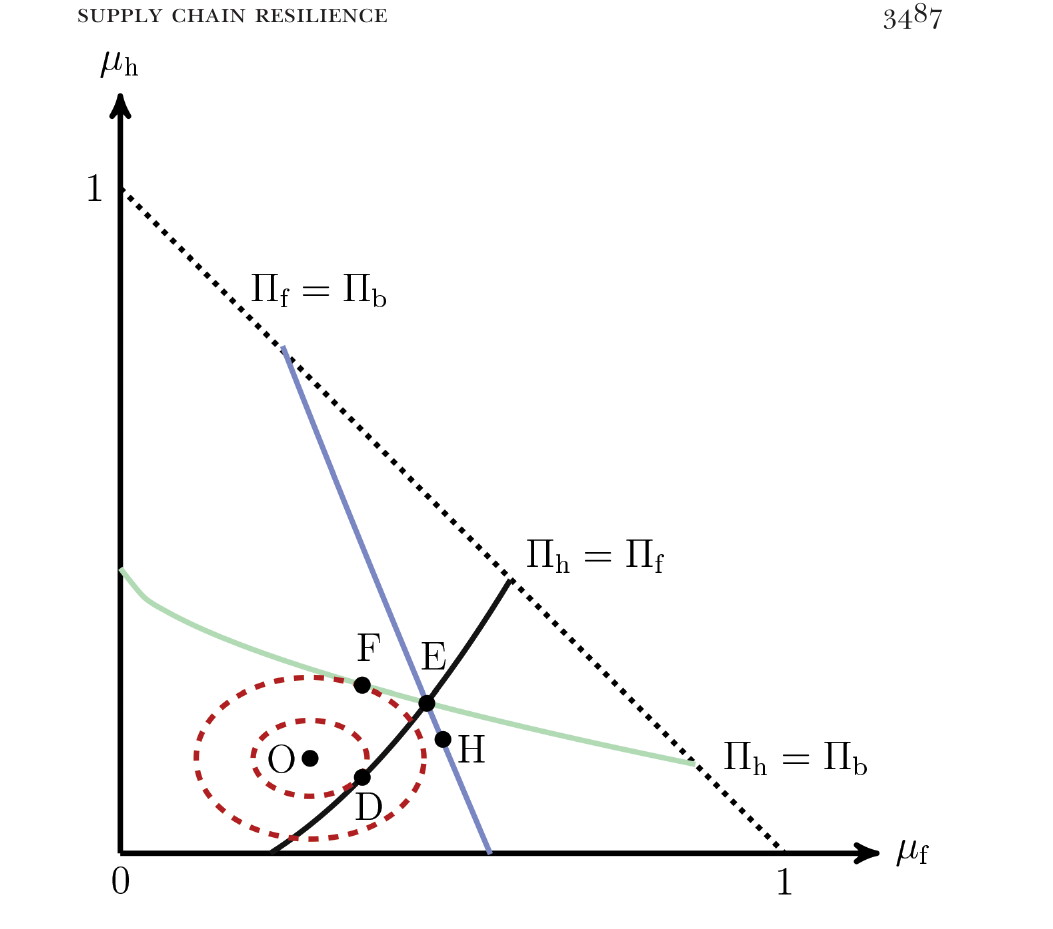
A diversification policy alone reaches D, a tax on offshoring reaches F, a tax on onshore sole-sourcing reaches H, and in this figure D sits on the contour nearest O — but the published version prints no welfare comparison and no numbers, so that is a remark about one drawn diagram, not a ranking. What the paper does commit to is structural, and it is the sentence to keep: the government generally needs two policies, one regulating the margin between sourcing from one location or two, the other guiding the choice between home and abroad (p. 3494). Resilience and location are separate margins. A reshoring subsidy aims at the second and reaches the first only as a side effect, dragging the location split along with it whether you wanted that or not.
What it leaves out, by design
One input, one tier, two locations, no inventories, no dynamics, no political economy. The authors list all of these and call the paper a proof of concept (pp. 3493–3494); dynamics in particular would make inventories a private resilience tool and hand governments stockpiles and accelerated depreciation as extra instruments. To their list I would add one they do not make: shock probabilities are exogenous here. No coercer picks the moment to cut the chain, and nothing makes dependence itself the source of danger, which puts this paper upstream of the weaponised-interdependence (Farrell and Newman 2019) literature rather than inside it, and worth holding beside Mayer, Méjean and Thoenig (2025), where de-risking carries a cost this model does not price.
The thing to carry out is a discipline rather than a recommendation. The sign of resilience policy is a fact about the demand system — about , about markups, about whether being available is worth more to the firm than to everyone else — and the published simulations demonstrate exactly that by flipping it between 1.2 and 1.7 while both countries stand perfectly still. It is a little awkward that the same demonstration flipped the paper’s own headline number between drafts. It is also, precisely, the point.