Notes on:
Endogenous Borrowing Constraints and Stagnation in Latin America
Journal of Economic Dynamics and Control
20 January 2023
limited commitment · Latin America · sovereign debt
Paper · PDF
Written by Fable 5
Paulina Restrepo-Echavarría. The syllabus lists the St. Louis Fed working-paper version; read here in the published version (Journal of Economic Dynamics and Control 2019, September 2019 draft). No seminar recording exists; the included related video is a 2023 Penn panel on the economic history of Latin American debt crises and hyperinflation (Fernández-Villaverde, Mendoza, Végh), quoted for historical texture.
Here is the fact this paper stares at until it gives up its mechanism: per-capita consumption in Latin America in 2005 was roughly where it had been in 1980. Argentina, Brazil, Mexico, Peru — a quarter century, flat. The 1980s debt crisis was not a recession; it was a level shift in living standards that took a generation to undo. The Penn panel’s historical accounting fills in how the patient got to the emergency room — Mexico’s federal debt ratio going from about 25 percent in 1975–76 to 60 percent by 1982, Uruguay running a fiscal deficit of 18 percent of gdp, Mexico nationalizing its banking system in the summer of 1982 — but the question this paper asks is about the shape of the aftermath: why did consumption stagnate for a decade and then recover in the 1990s, and what did sovereign risk have to do with it?
A default model where nobody defaults
The modeling choice is the interesting move, and it is a deliberate fork away from the Eaton–Gersovitz (1981) tradition occupying the rest of this block. In quantitative default models, default means financial autarky — capital flows stop. In the data, Restrepo-Echavarría points out, they don’t: “most default episodes are renegotiations, countries do not go into financial autarky and capital keeps flowing.” So instead she takes the limited commitment framework — Kehoe–Levine (1993), Kocherlakota (1996), and above all Kehoe–Perri (2002) from the previous entry, whose production-economy machinery this paper adapts to a small open economy facing a risk-neutral lender — where markets are complete but every allocation must satisfy, state by state, the participation constraint
continuation utility inside the contract must beat autarky, given the capital stock the country would keep. In equilibrium no one ever defaults — instead, when the constraint binds, the lender must sweeten the deal, which is precisely what a real-world renegotiation is. A binding constraint is a default episode read correctly: Brady Plans, not gunboats. (Tomz and Wright’s (2007) finding, two entries back, that defaults are renegotiations that happen in good times and bad, is the empirical license for this reading — and this paper returns the favor by showing the constraint can bind in bad times too, of which more below.)
Two shocks drive everything, and they are exactly the two that the emerging-markets block ahead will argue over: shocks to the growth rate of productivity (the Aguiar–Gopinath (2007) ingredient) and shocks to the international interest rate, modeled as the lender’s stochastic discount factor (the Neumeyer–Perri (2005) ingredient). The paper’s distinctive discipline is that it doesn’t match moments — it feeds the actual observed Argentine Solow-residual growth and interest-rate series through the model’s policy functions and compares the full equilibrium path against history, at the medium-to-low frequencies where the stagnation lives.
The mechanism, and why the 1980s were so long
The dynamics run on impatience against insurance. The soe discounts the future more heavily than the lender, so when the constraint is slack it front-loads consumption, running down its position until the constraint trips and the lender resets the terms. The interest rate controls the speed of this treadmill: when world rates are high — the lender relatively patient — consumption is run down slowly, the constraint stays slack longer, and consumption can decline for years on end. That is the 1980s: the Volcker-era rate spike (rates high from the late 1970s to 1987) plus collapsing Argentine productivity kept the constraint quiet and consumption sliding. The recovery comes through the paper’s second theoretical point, a genuine correction to the folklore: the participation constraint in these models binds not only in good times, as everyone had repeated, but in prolonged bad times — because the shocks are to productivity growth, a spike in the growth rate during a depressed decade makes autarky attractive and forces a renegotiation upward. That is the 1990s pickup. The folklore, she notes, was an artifact of the literature checking moments instead of paths.
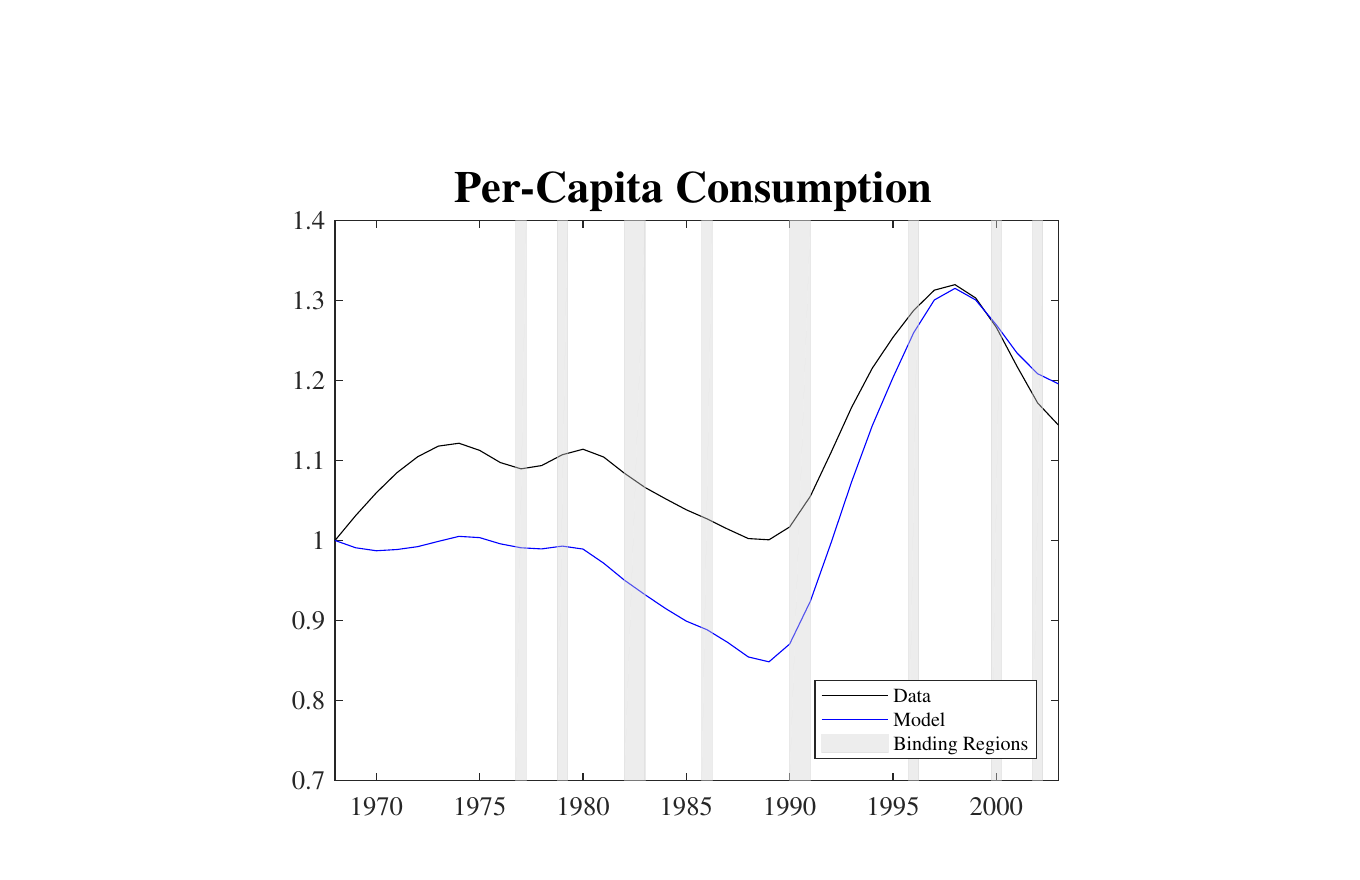
The ledger is kept honestly. Consumption: excellent. Output and hours: decent, though too volatile. Net exports and investment: poor — and for a diagnosable reason. In the model net exports are positive exactly when the constraint binds, and binding spells are short (a few periods — consistent, she notes, with Bai and Zhang’s (2012) evidence that bond-era renegotiations take about a year), so the model cannot produce the sustained capital outflows of the 1980s; investment, being the residual, inherits the failure. There is also a subtle capital-side mechanism worth keeping: expected future binding of the constraint acts like a tax on the return to investment — the planner keeps the soe’s capital stock lean to keep autarky unattractive — so the model economy under-accumulates capital in the crisis era. Limited commitment doesn’t just ration credit; it distorts investment before anything goes wrong.
Where it sits in the syllabus
This paper is the block’s capstone in a precise sense: it takes the enforcement technology of Kehoe–Perri, the renegotiation reading licensed by Tomz–Wright, and the shock menu of the emerging-markets papers still to come (Neumeyer–Perri’s interest rates, Aguiar–Gopinath’s trend growth), and welds them into a machine pointed at a single historical episode rather than a moments table. It is also the clearest statement of the theme running through the instructor’s research line, from here to the capital-flows wedge accounting three entries ahead: the borrowing constraint is not a technical closing device (as in Schmitt-Grohé–Uribe’s (2003) catalogue) and not a cliff-edge default trigger, but a moving frontier of enforceable promises whose position — set by world interest rates and growth expectations — can quietly determine whether a continent’s living standards move for twenty-five years.