Notes on:
Rationalist Explanations for War
International Organization
1995
geoeconomics · trade and conflict · bargaining · political science
Made with AI: Fable 5.1 (reading and writing)
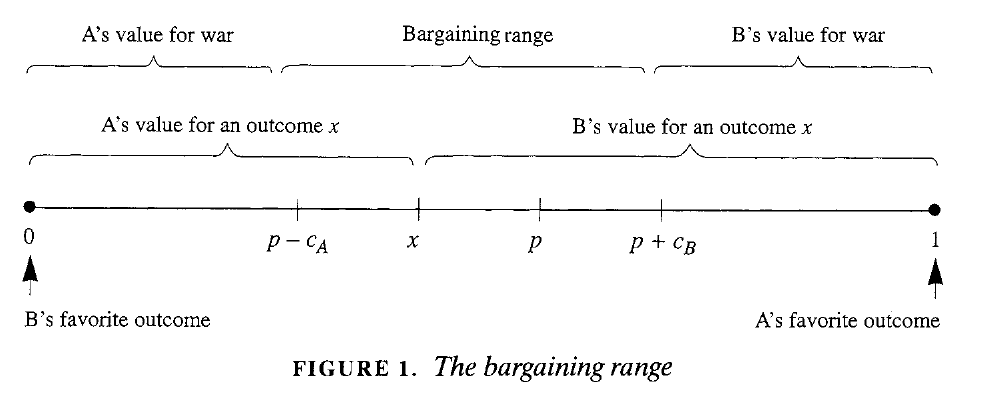
James D. Fearon (then Chicago, now Stanford). International Organization 49(3), Summer 1995, pp. 379–414; the pdf used is the jstor scan. No talk recording exists; pdf-only digest. Figure 1 is cropped from the pdf. A political-science article, and the one piece of the ir canon every trade-and-conflict paper on this list builds on.
The puzzle is not why states fight but why they fail to settle
The first sentence of the article is its whole method: “wars are costly but nonetheless wars recur” (p. 379). The literature Fearon is writing against had made its peace with this by sorting wars into wanted and unwanted, with the wanted ones — the leaders judged the gamble worth taking — needing no further explanation. Fearon’s move is to say that whether a war was wanted is beside the point. As long as fighting costs anything at all, “war is always inefficient ex post” (p. 383): whatever the outcome, both sides would have preferred to reach it without paying for it. So there should have been an ex ante deal both preferred to the lottery, and the question is not why anyone wanted to fight but what stopped them finding that deal.
The formalisation on p. 387 is deliberately small. The issue is a line from 0 to 1; B wants 0 and A wants 1. If they fight, A wins with probability and the winner takes its favourite point. A risk-neutral A values war at and B at , where the costs are net of whatever winning is worth, so two states with little to gain from beating each other have large costs even if the fighting would be cheap. Since both costs are positive, every settlement with
leaves both strictly better off than fighting (p. 387; Claim 1 in the Appendix). Here is A’s probability of winning, and the two states’ costs of war net of the value of winning, and the share of the issue that goes to A. That interval is the bargaining range, and under three mild assumptions — a true exists, the states are not risk-loving, and the issue can be divided — it always exists. Fearon’s illustration on p. 388: two players dividing a hundred dollars, with the outside option of a coin-flip war that costs each of them twenty. War is worth thirty to each, so every split from thirty-one against sixty-nine to sixty-nine against thirty-one beats it. The costs of fighting open a “wedge” of settlements that only a compulsive gambler would refuse (p. 388; Hitler is named as the possible exception).
Five explanations, of which three do not address the question
Against this wedge Fearon lines up the five standard rationalist arguments (p. 381): anarchy, expected benefits exceeding expected costs, preventive war, miscalculation from lack of information, and miscalculation or disagreement about relative power. The first three, he says, “simply do not address the question”. They describe why a state might prefer war to the status quo, not why two states could not locate a point in the range that both prefer to war. The fourth and fifth do address it, but as usually stated they fail to explain why the states do not simply talk; and “when fully developed, they prove to be one of the two major mechanisms” of the article (p. 383). So the article is not a list of things that fail. It is an audit in which two of the five survive, in altered form.
The named target is Blainey (1973), whose rationalist-sounding claim is that “wars usually begin when two nations disagree on their relative strength” (quoted p. 391). Fearon’s objection is Harsanyi’s (1968): two rational agents with the same information reach the same estimate, so a disagreement about must come from private information (p. 392), and private information is exactly what rational states have every incentive to share, since sharing it reveals the range. Worse for Blainey, disagreement about power is not even necessary. In the take-it-or-leave-it game on p. 394, A picks a point and B accepts or fights; with complete information A demands exactly and there is no war. Now let B’s cost be private, keep common knowledge, and A’s optimal grab produces a positive probability of war whenever A’s own costs are not too large (Claim 2, p. 394). War “can occur despite complete agreement on relative power” (p. 394). A bigger grab is worth a bigger risk, and A takes it.
Friction one: private information with an incentive to misrepresent it
That game has no talking in it, so the obvious fix is to let B speak first. Fearon adds a foreign-policy announcement and shows it changes nothing: whatever B’s true resolve, B says whatever makes A grab least, so A learns nothing and demands what it would have demanded anyway (p. 396; the Proposition in the Appendix). Cheap talk is worthless not because diplomats lie but because in equilibrium everyone knows they would.
What can work is a signal that costs something. Fearon lists five: building weapons, mobilising troops, signing alliances, stationing troops abroad, and creating domestic audience costs (p. 396, with the aside that the last of these “lies outside a purely unitary rational-actor framework”). It is worth being precise here, because the whole reading list treats this as background. Costly signals do not make war the price of a noisy screening process. Fearon’s point on p. 397 is sharper and stranger: a costly signal “will not in general completely eliminate all risk of war by miscalculation — indeed, it may even increase it.” To be informative, a signal has to be one a less resolved state would not send, and “actions that generate a real risk of war” satisfy that constraint very naturally, because a resolute state minds the risk less. So the signals that carry information are precisely the ones that court war, and “a rational state may choose to run a real risk of (inefficient) war in order to signal that it will fight if not given a good deal in bargaining” (p. 397). The later literature calls the receiving end of this screening. Fearon’s own framing is that talking is free and useless, and the useful alternative is dangerous by construction.
The two set pieces divide the mechanism by what is private. July 1914 is about resolve: German leaders had secretly endorsed Austria’s plan to crush Serbia, and Russian warnings that Russia would fight were discounted in Berlin because, as Jagow cabled, “there is certain to be some blustering in St. Petersburg” (p. 397). Russo-Japanese 1904 is about capabilities: Japan knew what its forces could do, Russia did not believe it, and Japan could not credibly explain how it planned to win without changing the odds of winning (pp. 398–400). Two corollaries follow (p. 400). States fight losing wars to build a reputation for being hard to subjugate — Finland against the Soviet Union, the Chechens against Russia — and a rising state may seek out a war simply to demonstrate a strength no announcement would convey.
Friction two: commitment problems
The second mechanism has no uncertainty in it at all, and Fearon insists on the point (p. 406): the states “understand each other’s motivations perfectly well”, neither is “ineluctably greedy”, and the distrust comes from a structure of incentives rather than from doubts about intentions. He gives three cases.
The one the geoeconomics papers use is preventive war (pp. 404–408). Make the game repeat forever with a per-period discount factor ; A makes a demand each period and B either acquiesces or fights. A’s chance of winning is now and rises to from the next period on. Under anarchy A cannot promise not to use its future leverage, so from period 2 it demands , the most B will swallow (p. 405). The best A can offer B today is to demand nothing at all, and B compares that to attacking while it is still relatively strong. B attacks in period 1 whenever
(p. 406). Here is A’s current probability of winning, its probability from the next period on, and the discount factor; the square is real, and it is one the pdf’s text layer drops, so the transcription here is from the rendered page. In words, roughly, if B’s expected decline in power is large relative to its cost of war, A’s inability to bind itself makes preventive attack rational for B. Three things follow that the standard story gets backwards. Preventive war happens “despite (and in fact partially because of)” agreement about relative power, so Blainey misleads here too. The declining state “attacks not because it fears being attacked in the future but because it fears the peace it will have to accept after the rival has grown stronger” (p. 406); Fearon’s example is that an Iraq holding Saudi Arabia would never have invaded the United States, but would have been an oil hegemon with considerable bargaining leverage, and that is what the Gulf War was about (p. 406 and fn. 60, on Bush’s first National Security Council meeting after the invasion). And the problem dissolves if power can be transferred: the rising state may want to give some of it away, which is how Fearon reads “compensation” in classical balance-of-power politics (p. 407). On 1914 he is careful. German fear of Russian growth is a preventive motive, but German leaders hoped at the start that Russia would accept the Austrian demarche, so “it is hard to argue that the preventive logic itself produced the war”; it made Berlin more willing to risk one, in combination with private information (pp. 407–408).
The second case is preemption and offensive advantage, the two gunslingers who would each rather live in peace but cannot promise not to shoot first (p. 402). Fearon separates three things people mean by “offensive advantage” (p. 402): better odds if you strike first, which does create a commitment problem; lower costs for the attacker, which narrows the range but involves no commitment problem; and higher variance in outcomes, which lowers the value of war for both sides and can widen the range. Under the first reading, with A winning with probability striking first and striking second, the de facto range shrinks to , and no self-enforcing peace exists once (p. 403). Empirically he doubts the pure version — even in 1914 “we do not find leaders thinking in these terms” (p. 404) — and argues that first-strike advantages matter by narrowing the range and so making the other mechanisms bite harder.
The third case is strategic territory (pp. 408–409): a concession that shifts future leverage, the Golan Heights being the example, cannot be accepted even by a side that would prefer some concession to war, because the recipient cannot commit not to exploit it. The Winter War is the illustration. Finland refused Stalin some tiny islands in the Gulf of Finland because it could not trust him not to use them to press for more, and fn. 67 admits the formal condition is restrictive: the smallest feasible transfer has to produce a discontinuous jump in the odds.
Friction three: indivisibility, demoted to domestic politics
Some issues cannot be split. Fearon grants the logic and doubts the practice: issues are multidimensional, side payments and linkage are usually available, and states could in principle alternate or randomise among a finite set of outcomes (p. 382). When indivisibility does seem to bind, “the cause of this indivisibility lies in domestic political and other mechanisms rather than in the nature of the issues themselves” (p. 382; again p. 390, where nationalism is why twentieth-century leaders could not trade territory the way the Congress of Vienna did). The one place he reads apparent indivisibility as a commitment problem in disguise is the strategic-territory case above (p. 408). So the demotion is to domestic politics in general, and to commitment only for land that is itself a source of power.
The admission at the end
The conclusion is “essentially two mechanisms, or causal logics” (p. 409), and Fearon then immediately undercuts half of one of them. If private information about capabilities were often what drove wars, leaders should update about relative power when an adversary refuses to fold: a tough stand would mean the other side is stronger than you thought. “I do not know of a single clear instance of this sort of updating in any international crisis, even though updating about an opponent’s resolve, or willingness to fight, is very common” (p. 409). His inference is that bounded rationality may explain disagreements about power better than private information does, so the information mechanism survives on the resolve side, and Blainey’s mutual optimism may be irrational after all, just not for the reasons Blainey gave. The second anticipated criticism is the one the reading list should keep in mind. Anarchy and private information are constants, so neither mechanism explains why war here and not there; Fearon agrees, and says the mechanisms are foundations on which specific models then let variables — power shifts, cost-benefit ratios — do the explaining (p. 410).
What the economists took from it
The article is a taxonomy, not a model, and that is why it has travelled. Any quantitative paper that wants war to happen with rational governments has to pick one of Fearon’s frictions and attach a cost of war to it, and in the geoeconomics literature the cost of war is trade. Martin–Mayer–Thoenig (2008) take the private-information friction, make the protocol endogenous, and let bilateral and multilateral trade move the bracket in opposite directions. Mayer–Méjean–Thoenig’s (2025) Fragmentation Paradox uses the same friction to show that de-risking, by lowering , narrows the range. Kooi’s (2025) Power and Resilience and Becko–O’Connor’s (2025) Strategic (Dis)Integration live on the commitment side: dependence is valuable to a hegemon precisely because the target cannot commit, and a target invests in resilience to change what it can credibly threaten. Liu–Yang’s (2025) “shadow of conflict” bargaining is Fearon’s range with trade elasticities as the costs.
Where it sits
Context in 2.5, and the first thing to read in it: thirty-six pages, a handful of inequalities in the body and a short appendix of proofs, and the vocabulary — bargaining range, costly signal, commitment problem, preventive war — that the block’s presented papers use without defining. It stays context because it is not an economics paper and has no trade in it; its job on the list is to make clear that “trade deters war” is a claim about the width of an interval, and that the two frictions that shrink the interval respond differently to economic dependence. (Though the one worked example of the commitment mechanism, in footnote 60, is a war fought over oil prices and a rival’s economic leverage. The geoeconomics was already there; it just took the economists thirty years to notice the footnote.)