Notes on:
Breadwinning Norms: Experimental Evidence from India
Working paper
29 July 2026
gender · social norms · field experiment · India
Talk · Paper · PDF · Transcript
Written by Opus 5
Part of NBER Summer Institute 2026 — Gender in the Economy
Kailash Rajah and Ishaana Talesara (mit) — “Breadwinning Norms: Experimental Evidence from India,” presented by Talesara at the nber Summer Institute, Gender in the Economy, on 29 July 2026. A fifteen-minute egg-timer slot with questions held until lunch, so no Q&A. Written from the October 2025 draft.
There is a famous histogram. You plot the distribution of couples by the wife’s share of household income, and you find a step at fifty percent: a pile of couples where she earns just under half, a hole where she earns just over. Bertrand, Kamenica and Pan put it in the Quarterly Journal of Economics in 2015 and argued it was the breadwinner norm — the idea that it is socially unacceptable for a wife to out-earn her husband — showing up in the data as a cliff.
It has been replicated more than twenty times in over thirty-five countries. It has also been attacked: the step could be assortative matching in the marriage market plus a gender wage gap, or couples working at the same firm, or income misreporting, or minimum wages compressing both spouses to the same floor.
But underneath that fight is a problem neither side can fix. The cross-sectional distribution is an equilibrium object. It is the joint product of labor supply, labor demand, and who married whom. So the presence of the discontinuity does not prove the norm exists, and — the part critics tend to skip — its absence would not prove the norm doesn’t. You cannot read a behavioral constraint off an equilibrium.
What you would actually need
Trace out an individual woman’s labor supply curve, in wages, around her husband’s income. If the norm binds, something should happen at his income: a jump down, a flattening, a change in elasticity. Rajah and Talesara sketch all three shapes and pre-register a test for each.
To do that you need randomized wage offers, a lot of them clustered near the husband’s income, and — this is the design constraint that makes the paper hard — the jobs have to be real enough that complying with the norm actually costs something. A hypothetical vignette asks a woman what she thinks she would do; the norm binds on what she does.
So: partner with Pratham, an Indian ngo whose vocational training arm has put over 300,000 people through training and placement. Recontact graduates and offer them placement services materially identical to what they received on completion. Placement is how most of these women find their first job, so it is a high-stakes channel, not a career office nobody visits. In the survey, first elicit the husband’s income in front of the wife — so you know she has the reference point, and you know it is the one she is using. Then present forty job opportunities, one at a time, apply or don’t.
The trick that makes it work: real and hypothetical jobs are mixed. Every decision is in expectation high-stakes, because it might be a real job; but the wage on any given offer can be randomized, because it might not be. Offers are oversampled near the husband’s income for power, and choices are implemented through an incentive-compatible mechanism — a placement fee charged only to women who are actually matched.
The setting is the one where you would find it
India is the right place to look. Female labor force participation is 32 percent against 77 percent for men, and working women earn about a third less. In the experimental sample, the wife’s income-share distribution reproduces the national picture — the same missing mass above fifty percent, and Gupta (2022) finds it especially pronounced in the North Indian states where these centres are. Thirty-one percent of the sample agrees with the World Values Survey statement that a woman earning more than her husband is “almost certain to cause problems,” which is right at the national average. Only about 19 percent of the women were working when contacted, so these are people genuinely on the margin.
If the norm binds anywhere, it binds here.
It doesn’t
Labor supply is monotonically increasing in the wage offer, straight through the husband’s income, with no visible event at the threshold.
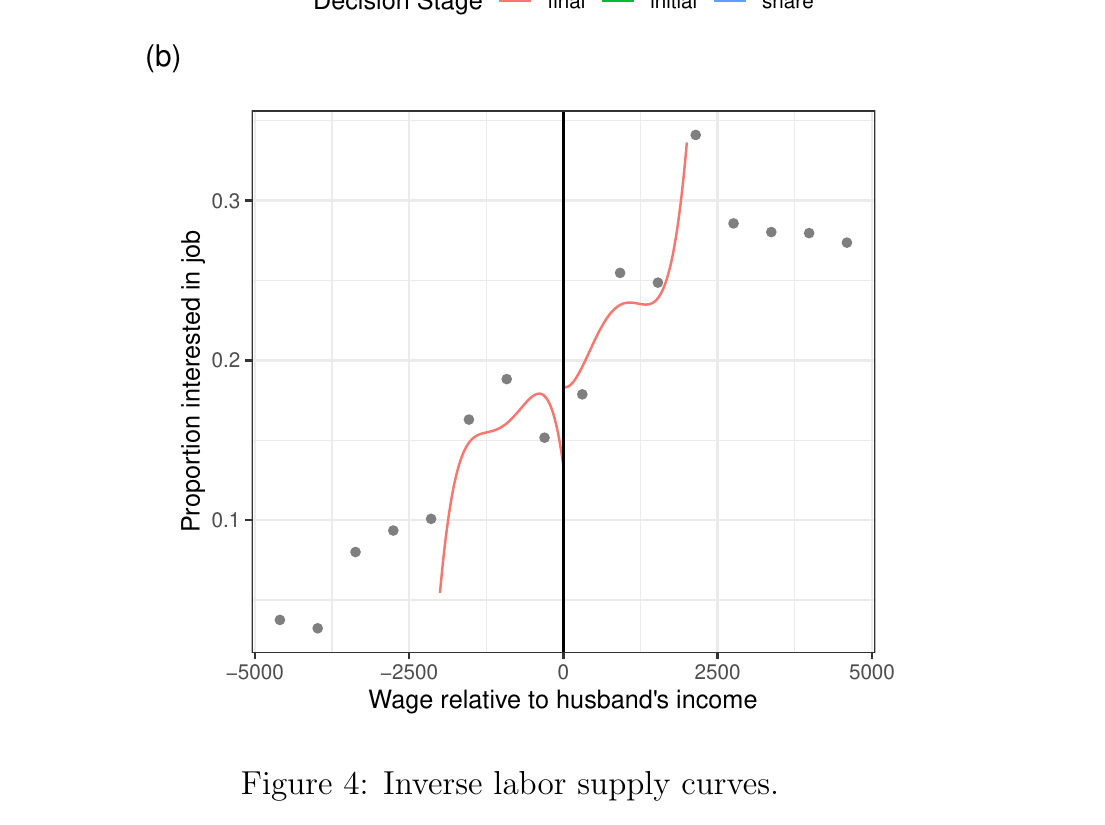
The elasticity is large: a 1 percent increase in the offered wage raises the probability of applying by about 2 percent. In the pre-registered regression discontinuity, the point estimate is positive — 5.95 percentage points at the tightest bandwidth, significant at 5 percent — and the paper can reject negative discontinuities as small as about 2 percentage points in the main specification, 1.5 in the abstract’s framing. For scale, the cross-sectional discontinuity Gupta (2022) documents for India is 30 percentage points.
Women were given a few days to discuss the offers with their families and withdraw applications. Labor supply shifts down — the level falls — but the shift is uniform. Nothing happens differentially around the husband’s income. Whatever the household conversation is doing, it is not enforcing a threshold.
And it holds in every subsample where you would expect it not to: women who agreed with the World Values Survey statement, women who practise purdah or veiling, women whose husbands are salaried (where the comparison is cleanest to make). Positive estimates throughout, rejecting negative discontinuities of a few percentage points each time.
So where does the histogram come from?
The paper does not claim to explain the cross-section, but it does check whether the usual suspects can. Take the national survey data and start peeling.
Remove couples reporting exactly a fifty-fifty split — a pattern that could come from shared wage floors or from reporting behaviour rather than from norms — and the discontinuity shrinks a lot, though the remaining population still shows about a 10 percentage point step. Then remove couples in the same industry and occupation, a rough proxy for working at the same firm, and it shrinks further.
Which is the honest version of the result. Not “the norm doesn’t exist” but: the labor supply channel the norm is supposed to operate through is closed, the equilibrium distribution has plenty of other things that could generate a step, and two of them account for a good deal of it.
The thing worth sitting with
The policy stakes here are not subtle. If female labor supply in a low-participation, conservative setting is norm-constrained, then raising wages is the wrong lever — you might raise a woman’s wage past her husband’s and push her out of the labor force, and the right instruments are informational or attitudinal. If it is wage-responsive, the ordinary lever works, and works well: an elasticity of two is not a marginal effect.
The authors are careful to say what they haven’t ruled out. There may well be effects on marital quality, or on the subjective well-being of either spouse — a woman may take the job and pay for it in ways this design cannot see. What they can say is that when a real, well-paid job is put in front of a married woman in North India whose husband earns less than it pays, she applies.
(It is a small irony of the literature that a norm named for a histogram turns out to be, at minimum, harder to find when you stop looking at histograms. The cross-section was never going to settle it — that was the methodological point all along, and it took a field experiment with 4,834 women and forty job offers each to make it stick.)