Notes on:
Power and Resilience: An Economic Approach to National Security Policy
Working paper
2025
geoeconomics · national security · resilience · industrial policy
Made with AI: Fable 5.1 (reading and writing)
Olivier Kooi (University of Chicago). Job market paper; the pdf used is version 1.4, dated 21 March 2025 (the paper is revised often). No talk recording could be found, so this is a pdf-only digest with no discussant or Q&A. Table 2, Table 3 and Figure 5 are cropped from the pdf; page numbers are pdf pages.
Why would a market fail to price national security
The chips Act and the national defense industrial strategy both assume that markets left alone produce too little of something called resilience. Kooi’s starting point is that this needs an argument: a shrinking defense base might be the efficient response to lower military spending, and dependence on Taiwan for chips might be the efficient way to capture gains from trade. The paper’s contribution is the externality that makes the policy coherent, and it is not the one the cms (2026) framework uses. cms get power from limited contract enforceability between a hegemon and foreign firms. Kooi gets it from bargaining in the shadow of conflict, Schelling’s idea that strategy is mostly the exploitation of potential force rather than its use.
The mechanism has two layers. Two countries have a dispute and bargain over its resolution; the outside option is conflict, which both would rather avoid; the more resilient a country — the smaller the fall in its welfare if talks collapse — the better its share of the bargain, because it can more credibly walk away. Resilience is a function of the economy: which capital was installed where, what is imported from whom, through which technology. Those decisions are made by private agents, and here is the part worth getting exactly right. In the baseline model nobody ever fights. The bargain always succeeds, so conflict is off the equilibrium path, and the firms that install capital know it: they price capital at what it earns in peace (equations 19 and 20), which is the correct price for every state of the world that actually occurs. What goes unpriced is what that capital would earn in the war that is never fought — and that counterfactual price is precisely what sets the terms of the peace. Markets price resilience’s value in use, insurance against a state of nature that arrives with positive probability, like an earthquake; they do not price its value in diplomacy. Kooi’s line for the market outcome is that it “overemphasizes efficiency at the expense of bargaining power.” That missing market is the national security externality, and its sign is that markets underprovide domestic resilience and overprovide an adversary’s.
Industrial policy: subsidize what appreciates in war
The first set of results concerns investment subsidies. Capital is sticky, chosen before the bargain and fixed once the state of the world is known, and conflict shifts the demand for it — defense demand, a trade cut-off, destruction of a technology. By an envelope argument, the conflict-state rental price of a capital good is a sufficient statistic for how much a marginal unit of it raises resilience. The planner therefore wants investment to satisfy a first-order condition that blends the two states’ prices, while atomistic investors satisfy one that uses the peace price alone; the subsidy that closes the gap on capital good is
where and are the rental price of the good in conflict and in peace, and is the Adversary’s Nash bargaining weight (eq. 25 and Proposition 1 in the two-sector closed-economy version, p. 16; the same form survives as eq. 45 and Proposition 3 in the general open-economy model, p. 28, applied per capital variety and with rentals corrected for the marginal utility of income). The subsidy is the proportional appreciation of the capital good’s price in conflict, scaled by a political parameter.
That parameter repays a second look, because its label is easy to read backwards. It is the Adversary’s weight, but in the Nash split it multiplies the Sovereign’s own resilience; in the ultimatum-game reading it is the probability that the Adversary is the one making the offer, and the more often you are the one receiving offers, the more your walk-away value is what protects you. So is the weight on the defensive motive, the value of your own resilience. The offensive motive, degrading the adversary’s resilience, carries the Sovereign’s weight and shows up in the trade-policy results below, not here. And since the weights lie between zero and one, setting to one turns the price ratio into an upper bound on the optimal subsidy, which is how the quantification later reads its numbers.
Three targeting implications follow. Which sectors to subsidize depends on the anticipated shock — a demand shock for defense output points at the defense base, a trade-disruption shock at whatever replaces the lost imports. Policy should favour technologies that can adjust: capacity that scales up under stress, or an lng terminal over a pipeline, though the paper is careful that the terminal earns its subsidy only if the switch is actually exercised in conflict, that is, only if the adversary is the cheap supplier in peace and the dear one in conflict so that the Sovereign genuinely changes source. And the sectors that gain most are those with high import exposure, inelastic final demand and few substitute suppliers, an effect the paper calls extremely non-linear in the import shares, which is the economist’s version of why semiconductors are “critical.”
Trade policy: friendshoring as a terms-of-trade play, and why not protection
The second set uses trade policy to move foreign capital. If the United States expects to lose Taiwanese chips in a conflict and to import from Korea instead, importing more from Korea in peacetime builds the Korean capital stock, shifts out Korea’s short-run supply, and lowers the price the us will pay in conflict. Friendshoring, in this model, is pre-positioning a friend’s capacity so the terms of trade move in your favour when it counts.
The classical argument that national security justifies protecting domestic capacity — Adam Smith’s exception for the Navigation Acts, which the paper notes lives on in the Jones Act — does not survive, and it fails on its own terms. Production capacity does have strategic value. But the link from trade to dependency runs through investment, and a direct investment subsidy reaches that stage without distorting the import price, so a small open economy’s optimal trade taxes are exactly zero even with the externality present (Corollary 1, eq. 53). Kooi’s phrasing is that dependency is not destiny and policy should pay for what it wants to buy. The corollaries are pleasingly concrete: Germany should not have reduced its dependence on Russian gas by targeting gas imports but by taxing investment in capital that relies on cheap gas; the eu should not tax Chinese solar panels but subsidize its own production. Cheap imports are not the problem; cheap is good.
Against the adversary: reverse industrial policy
The mirror image is trade policy aimed at an adversary’s resilience rather than your own. Optimal policy toward an adversary improves its terms of trade in peace and worsens them in conflict, which means the externality does not imply less trade: in peace the tariff sits below the terms-of-trade optimum, making peace attractive, and in conflict it sits above it, a sanction scaled up by the ratio of the offensive to the defensive weight (eq. 54). The paper notes this is not time-consistent — once actually in conflict the Sovereign would revert to plain terms-of-trade maximization — and that conditional on the political weights the sanction depends only on the adversary’s economy, so it would not exempt natural gas even if gas is critical at home.
The third term is the interesting one: pull the adversary’s capital into sectors whose prices collapse in conflict. Russia selling gas cheaply to Germany induced German investment in gas-intensive industry and made Germany more exposed to losing the gas — the block-1.0 gas episode seen from Moscow. The same logic covers selling weapons components to an adversary to crowd out its own defense-base investment. On positioning, Kooi describes Becko and O’Connor (2025) as using a bargaining framework to study trade and investment policy when trade is a point of leverage, but without developing the national security externality: their focus is coercing the adversary where his is domestic resilience, and in their baseline there is no role for investment policy at all. Sturm’s (2024) sanctions paper derives a similar expression for conflict tariffs from a different rationale.
The price of the peace
Here is the result that reorganizes the rest. In the baseline, conflict has probability zero, and policy is still justified, because the counterfactual price of a war nobody fights is what markets fail to charge for. An extension with asymmetric information lets bargaining fail with positive probability, and the optimal subsidy becomes (eq. 31, p. 19–20) the baseline formula multiplied by the probability that bargaining succeeds — so the subsidy falls as war becomes likelier. Two things are true of that expression. The effect of investment on the probability of war drops out entirely, by the envelope theorem, because governments choose that probability when they choose which offers to reject. And bargaining power only pays off when the bargain is struck, so the missing market is worth less as the peace gets shakier. Kooi draws the inference the other way round: a low observed probability of conflict is not evidence that national security policy is unneeded, since “if one thinks conflict is unlikely for some country, one needs to ask what concessions it had to make to ensure this. What was the price of the peace?” The footnote is the sharpest line in the paper. Germany’s gas dependence was defended on the grounds that even at the height of the Cold War the gas kept flowing, an argument that “fails to ask what Germany had to give up to ensure it did.”
A war game in a trade model
The optimal subsidy depends on a counterfactual price — how rentals would move in a conflict that has not happened — which is unobservable for the same reason the externality exists: countries bargain rather than fight. Kooi’s answer is the economist’s war game. A four-country quantitative trade model (us, China, Taiwan, rest of world) with 241 sectors, the 2017 us input-output structure and sector-specific trade elasticities is hit with an iceberg shock that cuts the us off from China and Taiwan together, or from Taiwan alone, and sectors are ranked by the strategic value of a marginal unit of capital, evaluated at the observed allocation with set to one. Since nobody knows the political weights, the honest reading of every number is as an upper bound on the ad-valorem subsidy, and the ranking needs no weight at all.
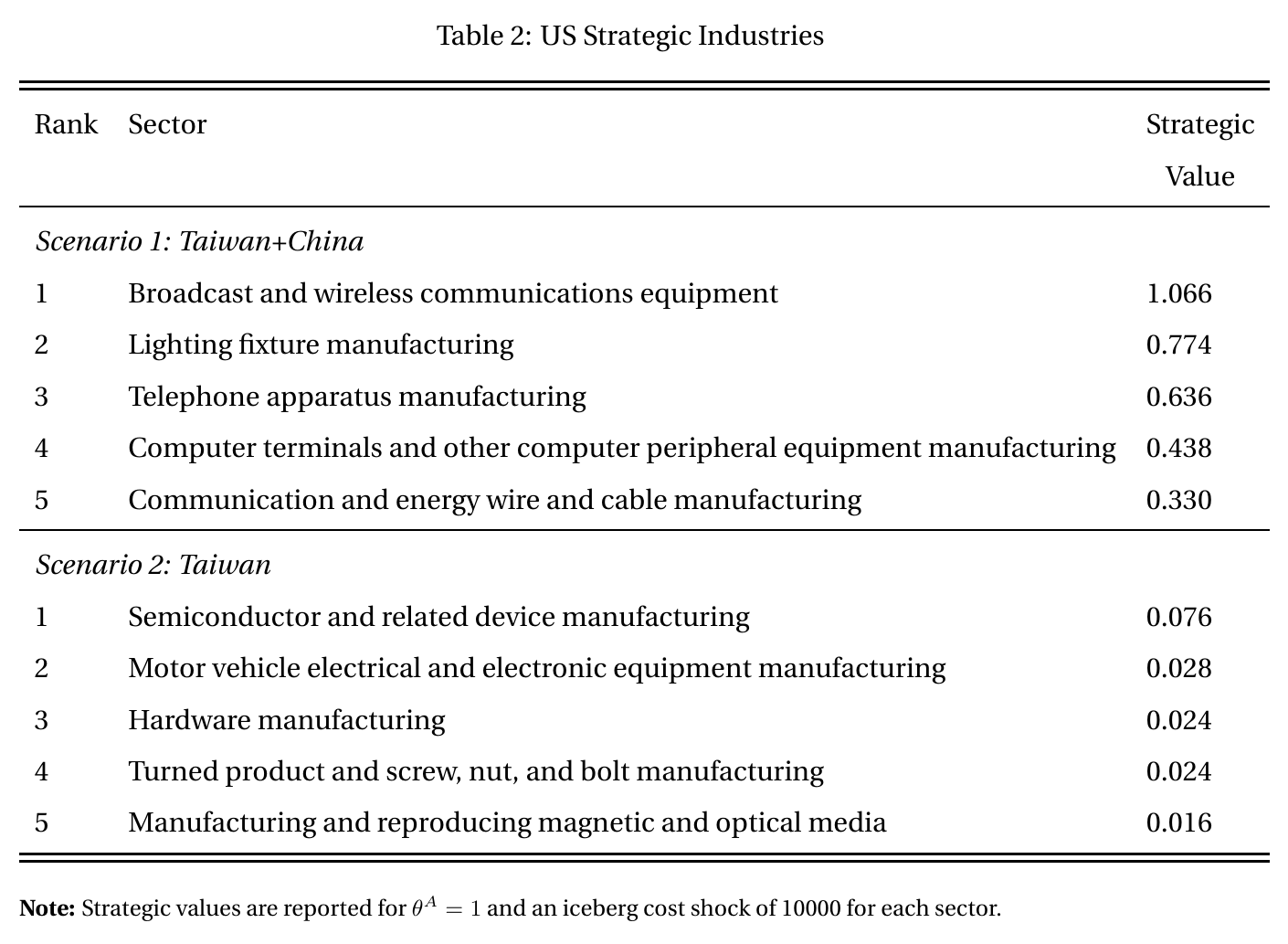
The results cut both ways for the chips Act. In the Taiwan-only scenario semiconductors rank first of 241 sectors, which is not a test of the theory but is a nice alignment with current policy — and the value is 0.076, an upper bound of about a 7 percent subsidy, which as the paper says does not make a strong case for large subsidies. In the joint China-plus-Taiwan scenario semiconductors fall to sixteenth, behind broadcast and wireless communications equipment, lighting fixtures, telephone apparatus and computer peripherals, where the top sector supports a subsidy of up to 106 percent; China is simply a lot bigger than Taiwan. (Lighting fixtures at number two is the kind of result that says the ranking is about exposure and elasticity, not prestige.) An appendix recalibrates the semiconductor import shares, since the naics code includes photovoltaics and many Taiwanese chips reach the us via Malaysia and Vietnam; that lifts the sector to fifth in the joint scenario and its bound to about 30 percent.
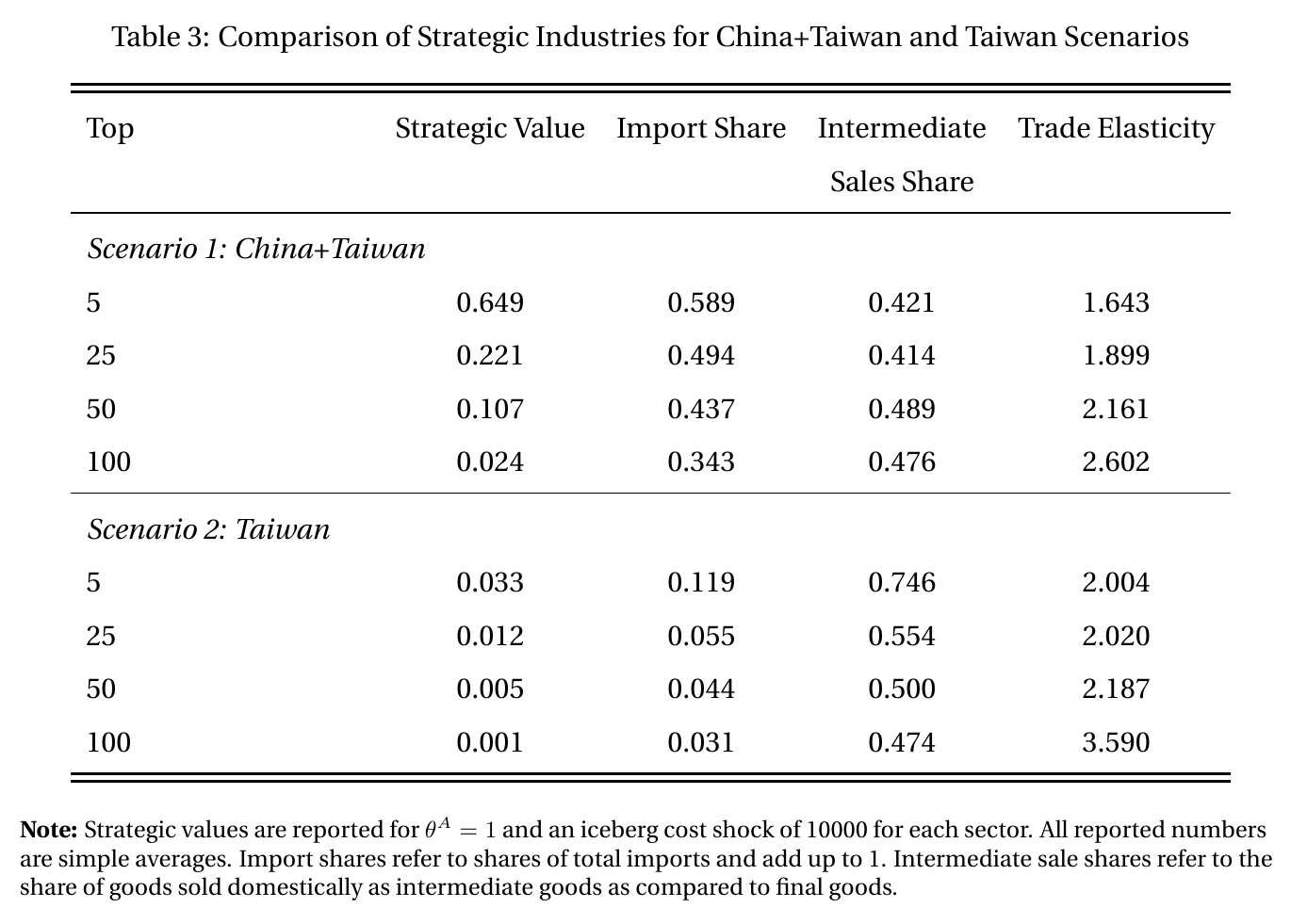
Should policy be narrow? Table 3 says yes and no. Average strategic value drops by about two-thirds from the top five sectors to the top twenty-five, and the sectors at the top are exactly the ones theory picks out, with low trade elasticities and high import shares. But six-digit naics codes are still very large sectors, so a policy that targets a handful of them can touch a substantial part of the economy.
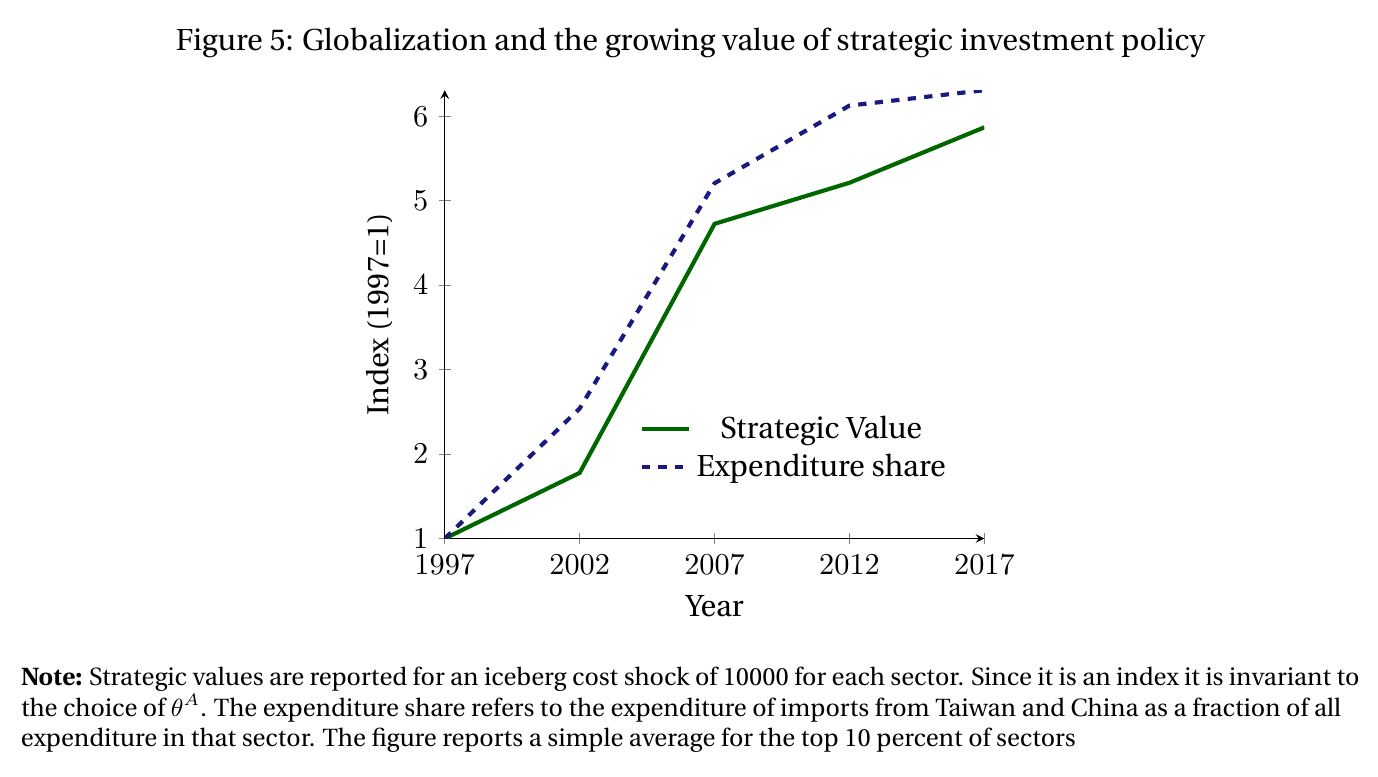
Figure 5 is the paper’s historical claim. The average strategic value of capital in the top decile of sectors by strategic value rose more than fivefold between 1997 and 2017, ending just under six on the index, and it tracks the share of those sectors’ expenditure that goes to imports from Taiwan and China, with the steepest rise in the five years after China’s wto accession. The paper’s own gloss is measured: the externality was always there, but its importance may have grown with trade, because the share of resilience-relevant decisions made by private firms rather than governments grew with it, and the index holds the bargaining weight fixed, so if tensions raised that weight over the period the figure is a lower bound.
Where it sits
This is the third formal theory of geoeconomic power on the list after cms (contract enforceability) and Liu–Yang (2025) (ex-post hold-up on import plans), and the one built on the conflict-bargaining tradition that the new sub-block 2.5 collects (Fearon (1995); Martin–Mayer–Thoenig (2008); Thoenig’s (2024) toolkit). Its comparative advantage over cms is that it runs on spot markets with sticky capital, so it speaks directly to industrial policy and to the resilience debate of block 1.0: Grossman–Helpman–Lhuillier (2023) ask whether resilience should be subsidized given exogenous disruption risk, Kooi says what resilience is for when the disruption is the off-path threat that sets the terms of the bargain, and why the answer is subsidies rather than tariffs. Read it after Coercion and Fragmentation (2024) and before Becko–O’Connor. And keep the footnote about the gas in mind the next time somebody points out that a war everyone predicted never came; in this model that is what a bill looks like.