Notes on:
Micro-enterprise Saturation: Critical Mass or Overcrowding?
Working paper
27 July 2026
development · microenterprise · scaling
Talk · Paper · Slides · PDF · Transcript
Written by Fable 5
Part of NBER Summer Institute 2026 — Development Economics
Moritz Poll (Rice University), presented as a nine-minute lightning talk at nber Summer Institute Development Economics, July 27, 2026. Paper: July 2026 draft, and the slides. Timestamps refer to the session video.
Every scaling decision for an anti-poverty program hides a spatial question nobody usually answers: given a budget, do you treat everyone in a few villages (cheap per household — the trainers and coaches are already there) or a few people in many villages (expensive, but spread out)? The answer depends on the sign of a spillover. Maybe entrepreneurship is complementary — a critical mass of new businesses creates thick markets, mutual customers, a local multiplier, and treatment effects rise with saturation. Or maybe 26 women in one village all opening the same shop is exactly what it sounds like. The literature’s optimistic reading of cash-transfer ge effects (Egger et al.’s (2022) Kenya multipliers) leans toward the first story. Poll ran the experiment, and the answer is the second.
The design: 1,872 ultra-poor mothers in 72 clusters in southern Malawi receive a full graduation-style package — business training, one-on-one coaching, savings groups, and a large lump-sum cash grant — with cluster-level saturation randomized: one-third, one-half, or all eligible households treated. On top, a deliberately light-touch “diversification” nudge encouraging treated women to consider sectors other than the default. The default needs no encouragement to be predicted: petty trading — buy goods in town, resell from your porch, watch your kids — is already ubiquitous (“when I ask households why they pursue the kinds of livelihoods they do, the modal answer is: my neighbor makes money this way and I also want to make money” — a sound strategy, Poll notes, if you’re the only one executing it).
Sixteen months in, the program itself works the way graduation programs work: treated women exit casual agricultural labor (the day-labor of last resort) and enter retail. But saturation poisons it:
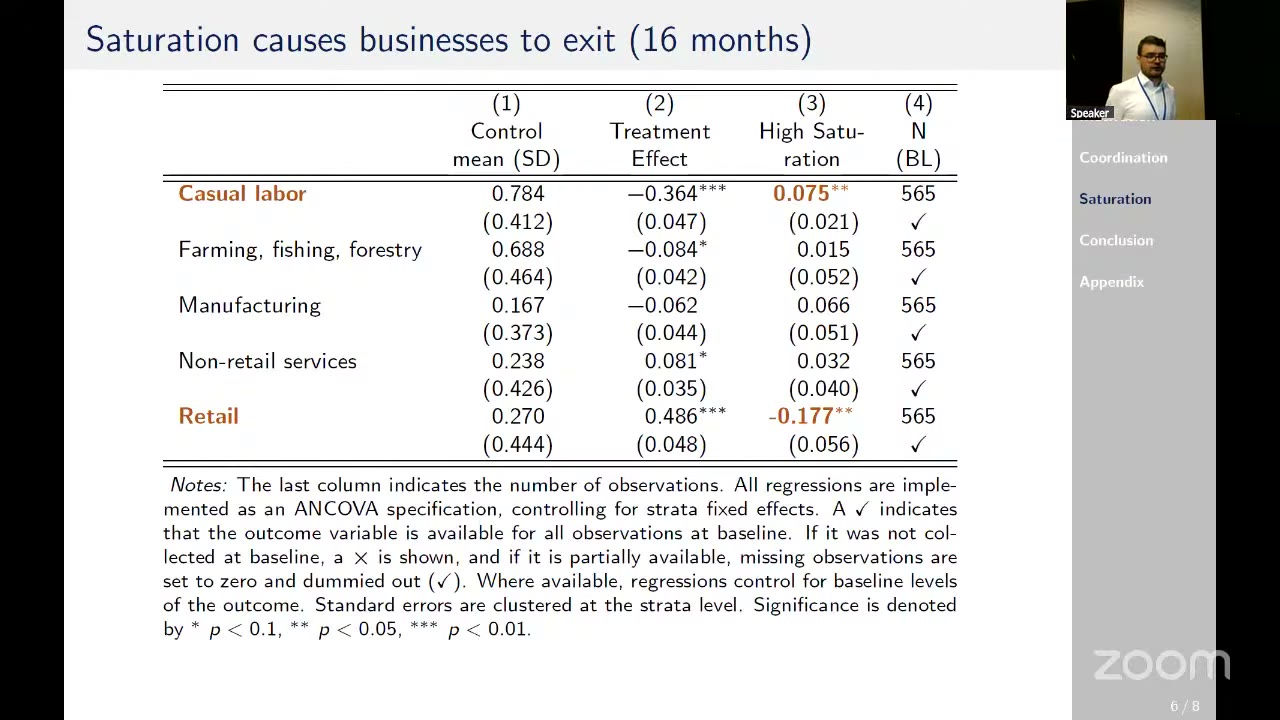
At high saturation, earnings run about 20% below the low-saturation group (imprecisely estimated, but consistent across outcomes), retail entry partially reverses, and treated women drift back into the casual agricultural labor the program was designed to lift them out of. The starkest overcrowding symptom: while low-saturation women stay put, high-saturation women use their remaining funds to pack up and migrate out — the local market simply cannot absorb that many new near-identical firms, so some of the newly capitalized entrepreneurs take their working capital somewhere less treated. The diversification nudge, the cheap fix that would have rescued the scaling logic, was too light-touch to move sectoral choice much — porch retail remained the overwhelming choice.
The mechanism contrast with the cash-transfer multiplier literature is the paper’s sharpest analytical point. Pure cash recipients mostly consume the money, and consumption is a demand shock that ripples outward as a multiplier. A bundled entrepreneurship program does exactly what its designers intend — it pushes the money into investment in micro-firms — and thereby converts a demand-side stimulus into a supply-side glut. The better the program works at the individual level, the worse it competes with itself at scale. (Poll’s external-validity caveat is refreshingly concrete: this hinges on the retail default; a context where new firms spread across sectors would suffer less.)
For the ngo or government planner the takeaway inverts the standard cost accounting: the per-household savings from saturating a village are partly an illusion, paid for by the treated competing each other back into day labor. Sparse treatment across more villages buys market slack with the logistics budget. There is a Malthusian neatness to the whole thing — the program’s binding constraint turned out to be the number of neighbors who can profitably sell each other tomatoes — and a rare honesty in a field that usually measures its interventions one treated household at a time, in finding that the program’s chief enemy, at scale, is the program.