Notes on:
Optimal Tariffs under Geopolitical Risk: A Theory of Strategic De-risking
Working paper
2026
geoeconomics · tariffs · de-risking · geopolitical risk
Talk · Transcript
Written by Fable 5
Part of NBER Summer Institute 2026 — International Economics and Geopolitics
Ina Simonovska and Ahmad Lashkaripour; discussed by Matilde Bombardini. nber si International Economics and Geopolitics, July 16, 2026 (video 02:32–03:32).
Source note: the paper (dated March 2026 on the authors’ cvs) is not publicly posted as of August 2026, so this is built entirely from the presentation, the discussion and the Q&A. Numbers below are as stated on the slides; the written paper may differ.
The externality of buying from someone who might stop selling
Here is a thing an individual firm does not think about when it decides where to buy its inputs: whether, in aggregate, all the firms like it are making the country so dependent on one supplier that the supplier acquires the power, and the temptation, to squeeze. Each firm is small. Each takes the foreign supplier’s market share as given. But the supplier’s market share is the sum of their decisions, and — this is the paper’s premise — the supplier’s willingness to weaponize that share rises with it. The firm buying a marginal container of rare earths from China does not internalize that it has made China’s eventual export tax slightly larger and slightly more likely. That is an externality, and where there is an externality there is a Pigouvian tax, and where the externality runs through imports the Pigouvian tax is called a tariff.
Simonovska and Lashkaripour’s contribution is to write this down inside the most standard model in trade and see what it does to the most standard formula. The formula is the one every trade economist can recite: the optimal tariff equals the inverse of the foreign export supply elasticity — you tax imports to the extent you have monopsony power over what foreigners sell you, because it pushes their price down. In a one-factor model that is a terms-of-trade effect operating through relative wages, and a known embarrassment of this theory is that it predicts a nearly uniform tariff across sectors; there is just not much sectoral variation in an economy-wide wage effect, a point both authors returned to repeatedly in the Q&A when asked why they needed anything more.
Anyway, the game
The setup is two countries, ces demand with trade elasticity epsilon, roundabout production (firms use a bundle of inputs that includes imports), monopolistic competition so everyone is atomistic, balanced trade. Two policy wedges: the home import tariff and a foreign export tax. The twist is the timing and the uncertainty. Nature draws the foreign country’s type, a non-pecuniary cost of “non-cooperation” — a reputational or political penalty for being the kind of country that restricts exports. Home commits to a tariff knowing only the distribution of this cost. Then the type is realized and the foreign country picks a regime: cooperative, meaning no export tax, or adversarial, meaning the export tax that maximizes its own real income, which by Lerner (1936) symmetry looks exactly like the familiar optimal import tariff seen from the other side. The foreign country goes adversarial whenever the welfare gain from taxing exports exceeds the drawn cost. Two results follow under reasonable parametric assumptions: both the size of the optimal foreign export tax and the probability of imposing it are increasing in home’s import share from foreign. More dependence means more foreign market power in the bad state and a bigger prize for defecting.
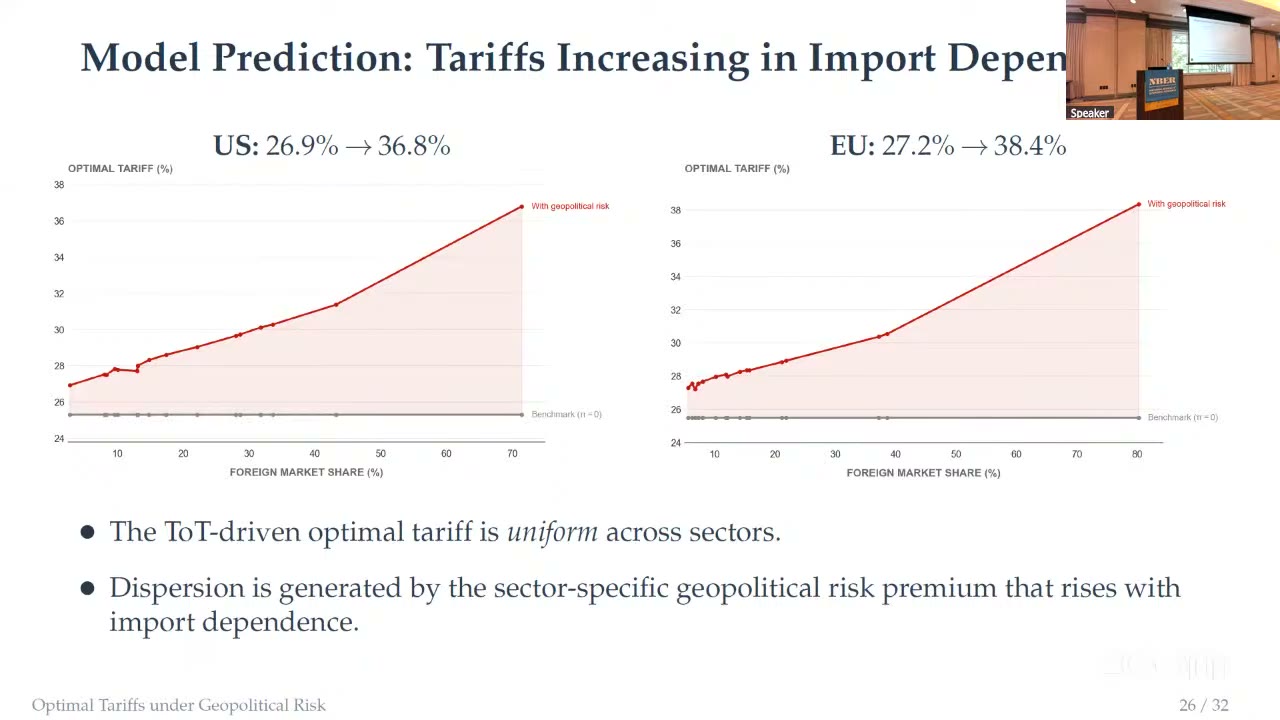
Home then solves its problem in certainty-equivalent terms — find the deterministic export tax that leaves it as well off as the lottery — and because the certainty-equivalent wedge rises with import dependence, home wants to lower that dependence ex ante, and the instrument available is the tariff. The optimal tariff has two pieces. One is the old terms-of-trade term, uniform across sectors. The other is a geopolitical-risk correction, proportional to the import demand elasticity (the exporter’s market power, an object that never appears in classical optimal-tariff formulas) times the sensitivity of the certainty-equivalent wedge to dependence. When you go to many sectors everything goes through, and the punchline that surprised the authors is that the first term stays uniform and only the second varies across sectors, with the sector’s trade elasticity and its import share. All of the cross-sector variation in the optimal tariff is, in this model, de-risking.
Putting a number on it
The one new parameter is zeta, the geopolitical-risk elasticity: how fast the hazard of a foreign export restriction rises with the home country’s import share. The distributional assumption makes the hazard a power function of the share, so zeta is a regression coefficient — log hazard on lagged import share, with importer-sector and time fixed effects — estimated from the Global Trade Alert export-restriction counts aggregated to HS6. For 2018 and sixteen aggregated sectors it comes out at 0.29 for the United States and 0.23 for the European Union. Feed that into the model with import shares, a trade elasticity of four and input-output shares, and the terms-of-trade tariff for both the U.S. and the eu is about 26 percent; the geopolitical correction adds about five points on average, a sixth of the total. Across sectors the uniform 26 percent becomes a range from 27 to 36 or 37, rising with the foreign market share — the risk term delivers up to a fifty-percent kick in the most dependent sectors, and it is the only thing in the model that delivers any cross-sector variation at all.
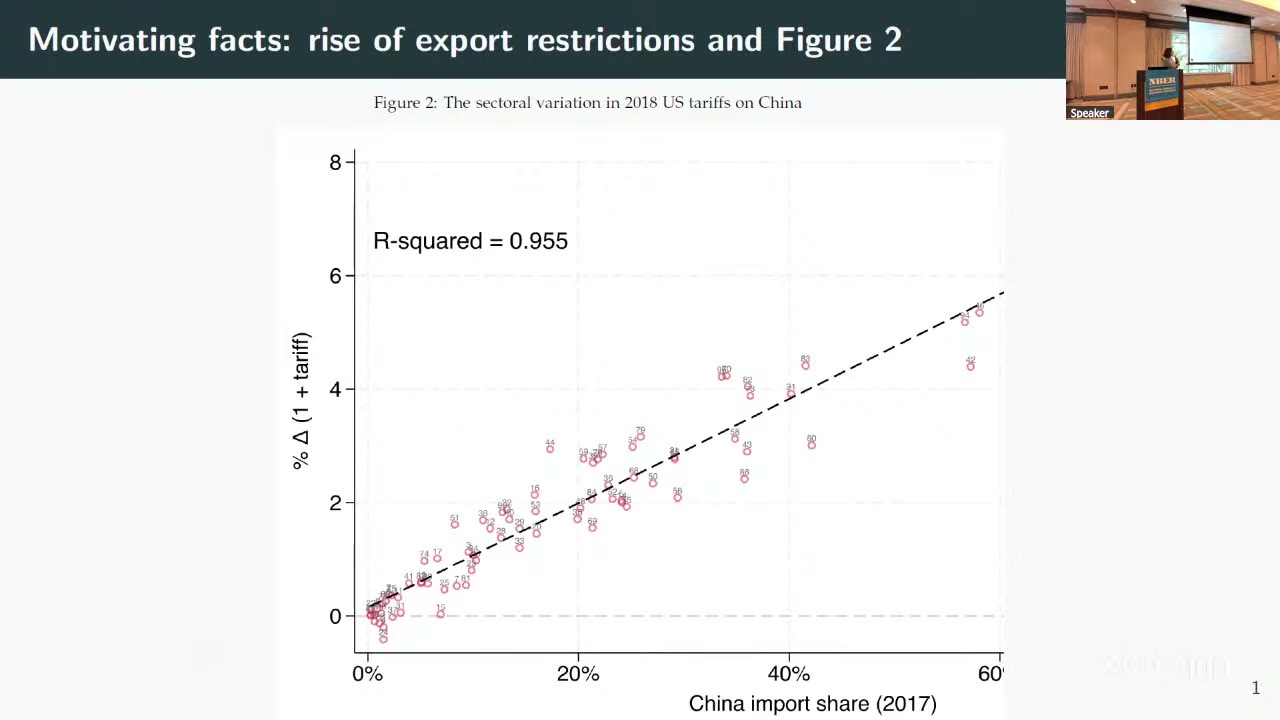
Then the positive test, which is the motivating fact. Take the Section 301 tariffs on China in 2018–19 — the China-specific tranche, as opposed to the Sections 232 and 201 tariffs that hit everyone — and regress the change in the tariff on the growth of China’s share of U.S. imports over the prior five years, controlling for the export supply elasticity (which the terms-of-trade theory says should matter) and the import demand elasticity (which protection-for-sale (Grossman and Helpman 1994) says should matter). The China import-share growth is positive and significant; the two elasticities are small and insignificant, at both HS10 and HS4. A “placebo” — the authors were still arguing about the word — looks at tariff changes on the same goods from non-China suppliers and finds nothing, as it should. Adding back the non-China tranches weakens the coefficient, as it should. And a pass through ustr press releases from 2010 to 2025, classified into six frames, finds mentions of geopolitical risk and strategic exposure jumping four- or five-fold in 2018, concentrated between the Section 301 announcement in March and the first tariff list in July. Yellen’s line about not letting countries use “their market position in any one raw material” to exercise leverage is, on this reading, a Pigouvian statement.
The discussant’s Stackelberg premium
Bombardini’s discussion was the useful kind: she tried to find the smallest model that produces the paper’s headline, and found one that is smaller than the paper’s. Strip out intermediates, strip out the hazard, forget the extensive margin, let foreign set an import tariff instead of an export tax (Lerner again), and keep only the timing — home moves first, foreign second. Foreign still sets the inverse of home’s export supply elasticity, that elasticity still depends on home’s import dependence, and home, moving first, still raises its tariff more in sectors where it anticipates a bigger foreign tariff. So you get the paper’s figure without any risk: consumers are atomistic by definition, which is why there is a terms-of-trade motive in the first place, and the rest is a first-mover premium that is absent under Nash. (She said she had asked Claude to solve the toy model and draw the figure, and the slope looked similar.) Her question was whether “geopolitical risk” is the right name for what is really a Stackelberg premium, in which case the whole thing is about timing and commitment — and whether the timing is right, given that Chinese rare-earth restrictions arguably came before the tariffs. She also noted that the outside-option models from Maggiori’s group (where a hegemon threatens to withhold inputs and you reduce dependence ex ante) deliver the same comparative static, but with a difference worth exploiting: there the threat is off-path and costly to execute, whereas here the export tax is a welfare-maximizing choice that actually gets levied, which is what lets the authors estimate a hazard in the first place. On-path versus off-path aggression might be how you tell the theories apart. Her smaller points: the probability and the size of the export tax both rise with dependence and then get collapsed into a certainty equivalent, and it would be good to know whether the extensive and intensive margins play different normative roles; “cooperative” is a strange word for a regime with a tariff in it; and with three countries, friend-shoring becomes an option and the relevant share is imports from the adversary over what friendly countries can produce, which her toy calculation suggests would shrink the risk premium when China is only a third of foreign supply.
The authors’ reply was that Bombardini’s stripped-down model is indeed where they started, that the input-output structure is there for quantitative realism (and for the side result that input-output loops lower the optimal tariff), but that the extensive margin — the probability — is doing real work. Without it, Lashkaripour said, you cannot rationalize tariffs on goods that never actually received an export restriction, which is most of them, and you cannot generate meaningful sectoral variation; with specific factors and heterogeneous input shares you get quasi-uniformity, which “in my experience is difficult to break.”
The room
A questioner the chair called only “Andre” (the captions don’t resolve which Andre) wanted direct evidence that the sectors Trump tariffed were the ones where China was actually playing with export restrictions, and asked whether a repeated-game cooperative equilibrium with free trade exists and whether its breakdown in 2018 could be rationalized by a shift in China’s cost distribution — a question Lashkaripour was deputed to answer and, amid some back-and-forth about the microphone, did not quite get to. Someone pointed out that Section 301 rates were uniform within each list, so the cross-good variation is mostly which list you landed on, and asked about percentage versus percentage-point changes. Emily Blanchard suggested a horse race against Chinese comparative advantage and labor intensity, which the authors accepted as a missing control. Giovanni Maggi’s question was the sharpest empirical one: the model’s dependence concept should be imports over absorption, including domestic production, but the fact is about China’s share of imports — and perhaps what is really going on is that politicians, in Europe as in America, fixate on how much is imported from China irrespective of domestic capacity, which would generate the correlation without the mechanism. Simonovska said the import-over-absorption version also works in their Panel B. A political scientist — Peter, from the chair’s call; Peter Rosendorff, if the morning’s introductions are a guide — raised the domestic politics of the 2018 tariffs — the exclusion process, in which connected firms in Republican districts got their inputs exempted — and asked which way ignoring this biases the result; Simonovska said the exclusion data exist and she intends to put them in the model. Someone who had worked with the Global Trade Alert data warned that many export restrictions, like Indonesia’s palm-oil bans, are imposed on all destinations because domestic prices rose, not because of any one importer’s dependence, which would attenuate zeta; the authors said excluding agriculture did not change much.
So the claim, stated carefully, is narrower than “Trump’s tariffs were optimal.” It is that a government with no protectionist preferences at all, valuing only real income, would still want a sector-varying tariff on an adversary whose willingness to restrict exports rises with your dependence, and that the variation you get from this motive looks a lot like the variation in the 2018 China tariffs, whereas the variation you get from the two older theories looks like nothing. Whether to call the extra term risk or a first-mover premium is, as the discussant suggested, partly a question of who you think moved first.