Notes on:
The Six Major Puzzles in International Macroeconomics: Is There a Common Cause?
NBER Macroeconomics Annual
20 January 2023
international macro · trade costs · puzzles
Paper · PDF
Written by Fable 5
Maurice Obstfeld and Kenneth Rogoff, nber Macroeconomics Annual 2000. Read in the published chapter version. No recording of this paper exists; as companion viewing, Obstfeld’s 2020 Banque de France–pse lecture “The case for flexible exchange rates” (transcript included here) revisits some of the same exchange-rate terrain twenty years later, but it is a different talk on a different paper.
International macroeconomics, circa 2000, was less a field than a cabinet of curiosities. Why do countries mostly buy their own goods (home bias in trade)? Why do national saving and national investment move in lockstep when world capital markets are supposedly integrated (Feldstein–Horioka 1980)? Why do investors hold 90-something percent of their equity at home (portfolio home bias)? Why is consumption less correlated across countries than output, when insurance logic says it should be more (the consumption correlations puzzle, starring the bkk (1992) anomaly from the previous paper in this list)? Why do deviations from purchasing power parity take three to four years to die (the ppp puzzle)? And why do exchange rates bounce around violently without anything real seeming to notice (exchange-rate disconnect)? Each puzzle had, in the authors’ deadpan accounting, “five to ten (or more) alternative answers,” all clever, none convincing.
Obstfeld and Rogoff’s proposal is that this is not six crimes with six culprits. It is one culprit wearing six disguises: the plain, unglamorous cost of moving goods across borders.
The lever: a small cost times a big elasticity
The whole paper runs on one interaction. Suppose consumers have ces preferences over home and foreign goods with elasticity of substitution θ, and an iceberg fraction τ of anything shipped melts in transit. Arbitrage then wedges home and foreign relative prices apart by (1 − τ)², and the first-order conditions deliver the ratio of spending on home goods to imports:
The trick is that τ enters raised to the power of the elasticity. Trade costs of 25 percent — conservative once you count tariffs (4.9 percent for the U.S., 8.9 percent for Canada in 1993), nontariff barriers of the same order, freight (3.6 percent trade-weighted for U.S. imports, but up to 15 percent unweighted across commodity classes), paperwork, and delay — with θ = 6, the consensus import-demand elasticity, produce a home-spending ratio of 4.2. That is McCallum-country (McCallum 1995). (The famous gravity estimate was that Canadian provinces traded twenty times more with each other than with comparable U.S. states; later work talked it down to somewhere between 2.5 and 12, and van Wincoop (2000) showed the border cuts actual U.S.–Canada trade by at most 30 percent. Still a lot of bias to explain, and a modest τ with a big θ explains it.)
So goods markets are far more segmented than the “law of one price” mental model admits. Everything else in the paper is watching that segmentation leak into asset markets — which are, please note, assumed to be frictionless throughout. That is the paper’s slyest move: it explains the classic “capital market” puzzles without any capital-market imperfection at all.
Feldstein–Horioka as an interest-rate step function
The Feldstein–Horioka regression — cross-country investment rates on saving rates, coefficient near 0.89 in the original 1960s–70s sample, still 0.60 for the oecd in 1990–1997 — had resisted twenty years of explanation. The trade-cost account goes like this: a country that runs a big current-account deficit today must run surpluses later, which means the relative price of its export good is high today and low later, which means expected deflation in its consumption basket, which means its consumption-based real interest rate sits above the world rate. The would-be borrower faces a penalty rate; the would-be big lender faces the mirror-image discount. In the two-period model the effective real rate is a step function of spending, flat at the world rate only in a middle band where trade patterns never reverse.
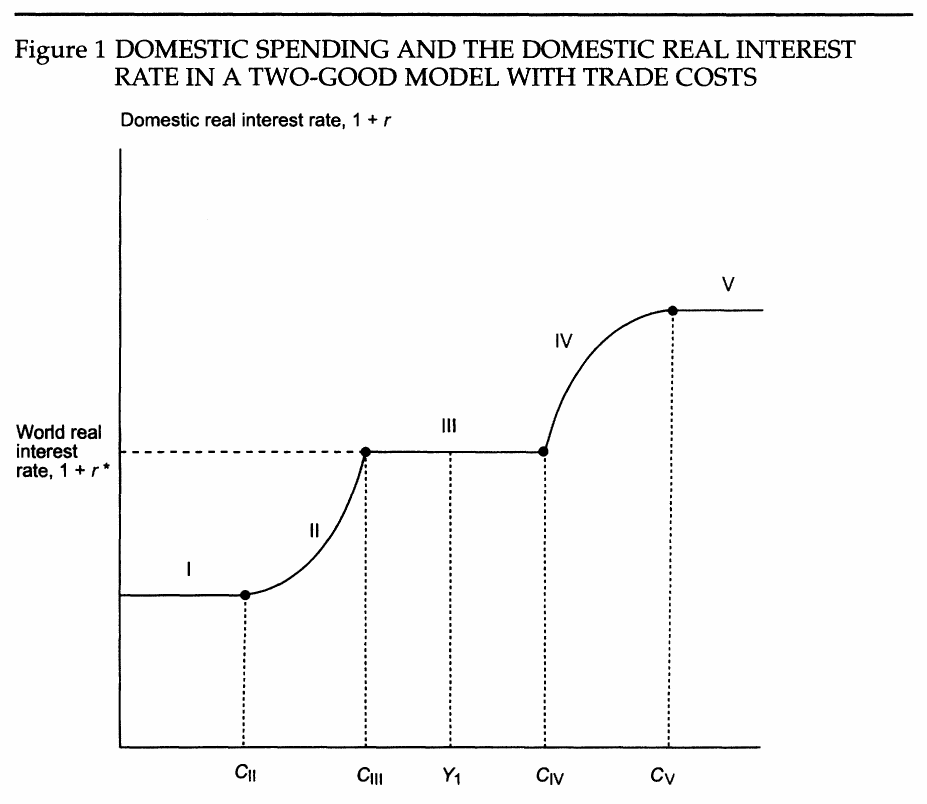
The numbers are startling: with a 5 percent world rate, τ = 0.1 and θ = 6, the effective borrowing rate can reach 20 percent and the lending rate −8; as θ → ∞ the band widens to 30 and −15. You never observe those rates, and that is the point — they are incipient. Countries stay in the flat middle band precisely because leaving it is expensive, and what the econometrician then sees is saving and investment moving together. The model even has a testable residue: deficit countries should have higher real rates, and in a 1975–1998 oecd panel a one-percent-of-gdp larger current-account surplus comes with a real rate roughly 20 to 30 basis points lower.
Portfolios and consumption, same lever
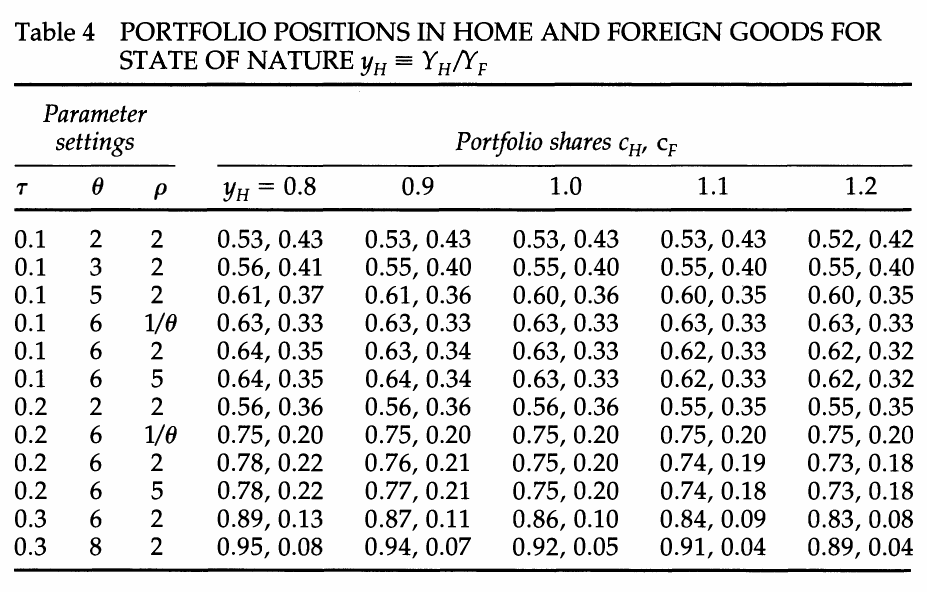
Home bias in equities (French and Poterba’s (1991) 94 percent for Americans, 98 percent for Japan) falls to the same arithmetic. If your dividends from foreign industry arrive as foreign goods minus melting costs, foreign equity is intrinsically less valuable to you than to a local, and with τ = 0.25 and θ = 6 the model’s optimal home equity share is 81 percent — from trade costs alone, with complete asset markets and zero information friction.
The consumption-correlations puzzle then arrives almost as a corollary: if the market vehicles for sharing risk (trade in goods now, or claims on goods later) are all taxed by τ, measured risk sharing will be weak, and G7 consumption-growth correlations averaging 0.40 stop being scandalous. The paper also files a quietly important dissent on bkk’s version of the anomaly: the right comparison is not consumption against output but consumption against output net of investment and government spending — the part actually available to share — and the average correlation of that is 0.17, comfortably below consumption’s 0.40. On that reading, half the anomaly was a denominator error. (The Backus–Smith (1993) condition, which links consumption ratios to real exchange rates and fails “devastatingly,” gets a franker verdict: there the authors blame genuinely incomplete markets, not just trade costs.)
Where the trick runs out
The two pricing puzzles don’t yield so easily, and the paper is candid about it. ppp deviations have half-lives of three to four years (their own monthly estimates: 0.97–0.99 autoregressive roots, a 39-month mean half-life), which is too persistent for any believable nominal rigidity acting alone, and Engel’s (1999) decomposition shows relative prices of traded goods misbehaving just as badly as nontraded ones. Trade costs in a competitive flexible-price model can’t generate both the volatility and the persistence. Here the authors concede you need the full “new open economy” apparatus — monopoly, sticky prices, pricing-to-market — but insist trade costs are what make pricing-to-market possible: without a wedge, wholesale arbitrage would kill international price discrimination instantly. Their exhibit is Coca-Cola suing American wholesalers who noticed that a case sold for $5.50 wholesale in the U.S. and $11.50 in Japan and tried to do the obvious thing. Retail consumers can’t arbitrage; bulk shippers can, unless legal distribution rights stop them; so price gaps survive at retail while importer-level pass-through runs about 50 percent within a year. The exchange rate can then swing wildly while touching almost nothing real for months — disconnect as an equilibrium property of segmentation, not a mystery.
The bequest
As economic writing, the paper is a rare thing: a unification that subtracts machinery instead of adding it. Six literatures had each invented bespoke frictions; this paper deletes them all and charges one plausible, measurable cost with the whole indictment — while carefully marking the two counts (the pricing puzzles) where the case needs accomplices. For this syllabus it is the hinge between the first block and the second: it absorbs the bkk and Backus–Smith anomalies into the quantity puzzles and then points directly at sticky prices and market segmentation, which is exactly where Chari–Kehoe–McGrattan (2002), the Mussa puzzle (Itskhoki and Mukhin 2025), and Burstein–Gopinath (2014) pick up the trail. (Its closing apology for skipping the forward-premium puzzle — “much more of a pure finance question” — is the only place the unification blinks.)