Notes on:
Business Cycles in Emerging Markets: The Role of Interest Rates
Journal of Monetary Economics
20 January 2023
emerging markets · interest rates · business cycles
Paper · PDF
Written by Fable 5
Pablo Neumeyer and Fabrizio Perri, Journal of Monetary Economics 2005. Read here in the nber Working Paper 10387 version (March 2004). No talk recording exists; written from the paper alone.
Mendoza’s 1991 paper, back in block one, ran interest-rate shocks through the small-open-economy model and found them nearly irrelevant — and told us exactly when that verdict would expire: it holds for a country like Canada, whose debt service is 2 percent of gdp, and would fail “in economies with a higher debt-service ratio, such as the heavily indebted developing countries.” Neumeyer and Perri’s paper is where that promissory note gets cashed. Their subject is the emerging-market business cycle as a distinct object — and their data section is the famous taxonomy. Compare five small open emerging economies (Argentina, Brazil, Mexico, Korea, Philippines) with five small open developed ones (Australia, Canada, Netherlands, New Zealand, Sweden): emerging economies have roughly twice the output volatility; consumption more volatile than output (relative volatility above one — impossible in the standard model, where consumption is the smoothed variable); net exports strongly countercyclical; and, the signature fact, the real interest rate is countercyclical and leads the cycle — rates rise, and output falls a few quarters later — where developed-economy rates are acyclical and lag.
The transmission: working capital turns the interest rate into a labor tax
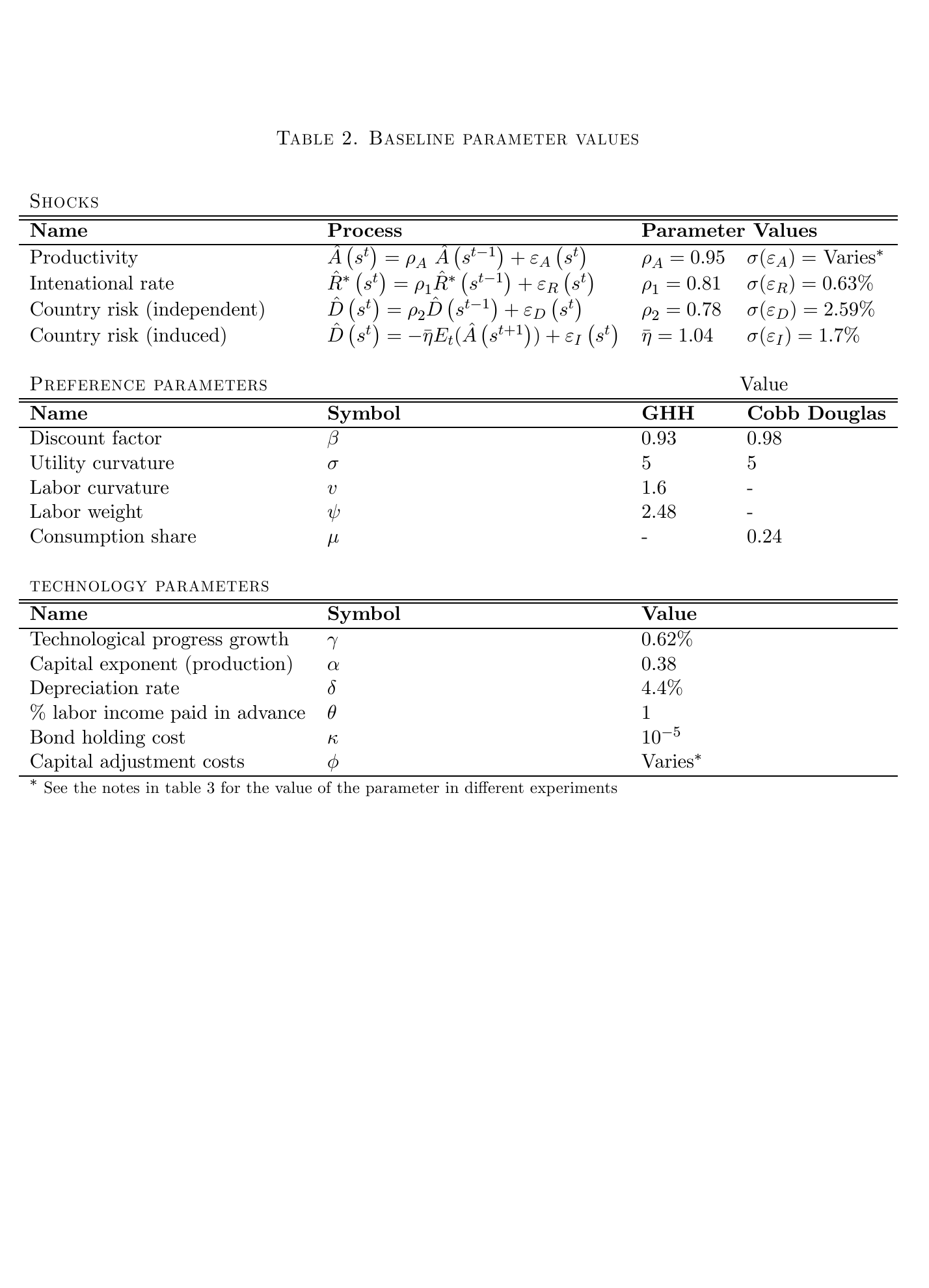
The modeling problem is that in the standard soe framework (Mendoza’s, or the sgu (2003) closing-device catalogue) an interest-rate rise mainly shifts the timing of consumption; it has no good lever on current output. Neumeyer and Perri install two parts. First, working capital: firms must pay a fraction of the wage bill before revenue arrives, so they borrow it, and the effective cost of labor becomes W(1 + θ·r-ish) — the interest rate walks straight into the labor demand curve. Second, ghh preferences (no wealth effect on labor supply — another Mendoza 1991 fixture): labor supply depends only on the wage, so when a rate spike shifts labor demand down, equilibrium hours and output fall one-for-one with the demand shift instead of being cushioned by wealth effects. An interest-rate increase is thereby transformed from an intertemporal price into something operationally like a payroll tax — recessions arrive through the labor market, at business-cycle speed, without waiting for the capital stock.
The second ingredient is a decomposition of the rate itself: the rate an emerging economy faces = international rate (measured as the U.S. non-investment-grade bond rate) + country risk spread. And the spread is where the economics lives. Two polar cases: spreads driven by external factors (contagion, politics, world rates), independent of domestic conditions; or spreads induced by domestic fundamentals — productivity shocks that simultaneously cause the recession and blow out the spread. Calibrated to Argentina 1983–2001 (chosen for its long rate series, and spanning the Austral Plan, the Currency Board, and assorted catastrophes), the verdict favors induction: the model where tfp shocks drive country risk, which then feeds back through working capital, reproduces the full U-shaped cross-correlation structure between output and interest rates, consumption more volatile than output, and countercyclical net exports. Even the model with only interest-rate shocks generates output tracking the Argentine data with a correlation of 0.73 — but it overshoots consumption and employment volatility, which is the tell that rates amplify fundamentals rather than replace them.
The policy arithmetic
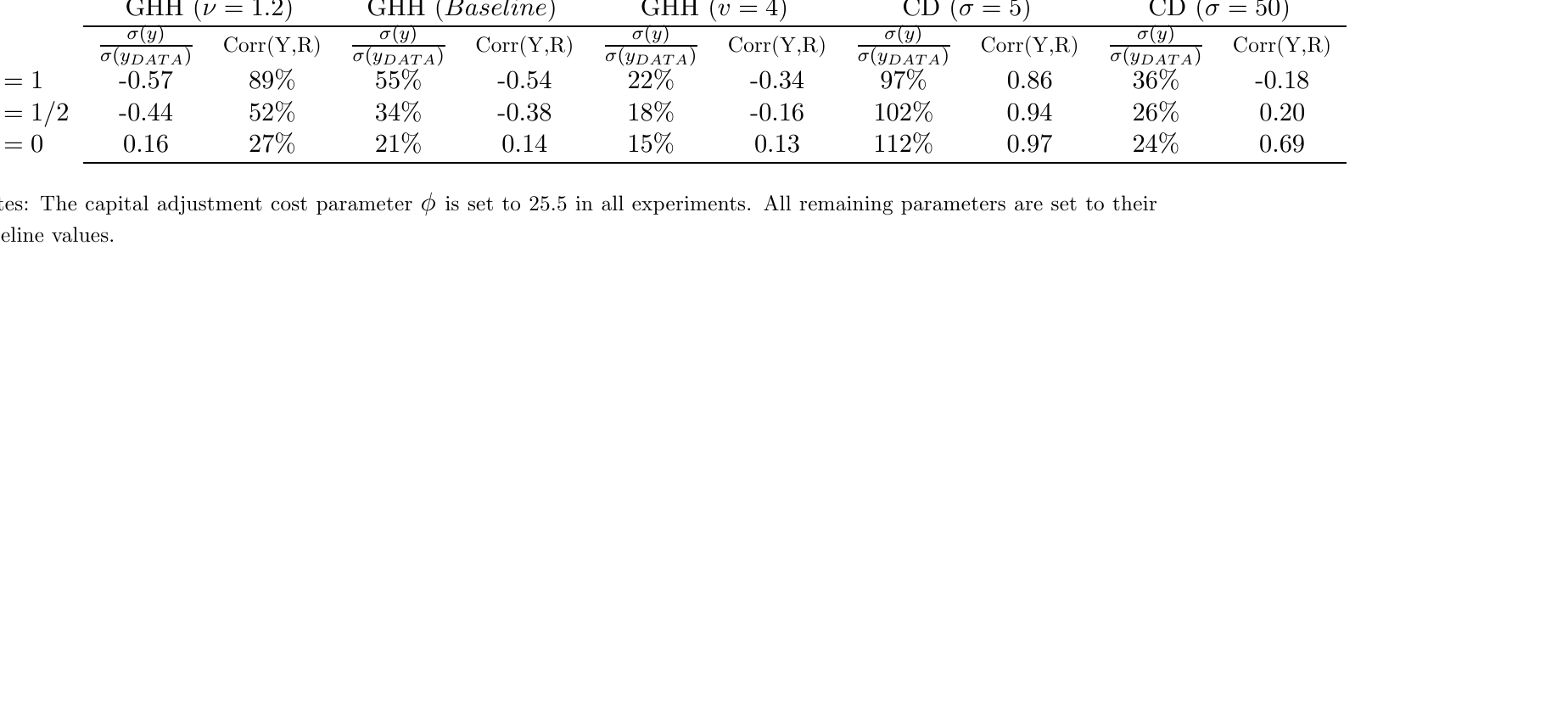
The counterfactuals are the headline, and they are constructed to answer a live policy question of the era — proposals to stabilize international credit conditions for emerging markets. Eliminate fluctuations in the international rate: Argentine output volatility falls by less than 3 percent. Eliminate fluctuations in country risk: volatility falls by about 27 percent. The financial weather in New York is nearly irrelevant; the pricing of Argentina’s own risk is a quarter of the Argentine cycle. And since the spread is itself induced by domestic fundamentals, the deep policy object is the mechanism converting domestic shocks into borrowing costs — which is to say, everything block three of this reading list was about. The paper’s spread is a reduced-form stand-in for the default premia that Eaton–Gersovitz (1981)-style models (Arellano’s (2008) and Aguiar–Gopinath’s (2006) implementations, the resource-curse paper (Hamann et al. 2023)) produce structurally; Neumeyer–Perri measure the transmission belt those models need.
Within the syllabus’s arc the paper also closes a loop with entry three: the debt-elastic interest premium that Schmitt-Grohé and Uribe certified as an innocuous 0.0007 closing device is here re-provisioned — Neumeyer and Perri are, in fact, the paper sgu cite for the portfolio-cost variant — as a large, volatile, fundamentally-driven object that is the emerging-market cycle’s engine. Same equation, three orders of magnitude more economics. The remaining puzzle they flag — the model’s rate-output correlation (−0.29) is only half the data’s (−0.63) unless risk is induced, and even the “productivity shocks” doing the inducing are suspiciously large and volatile for a measured fundamental — is precisely the opening for the next entry, where Aguiar and Gopinath (2007) will propose that what looks like huge transitory productivity shocks in emerging markets is actually shocks to the trend.