Notes on:
Intermediaries and Supply Chain Distortions
Working paper
28 July 2026
development · agriculture · market power
Talk · Transcript
Written by Fable 5
Part of NBER Summer Institute 2026 — Development Economics
Dilip Mookherjee's invited lecture, NBER Summer Institute Development Economics, July 28, 2026 (with Pushkar Maitra, Sandip Mitra and Sujata Visaria). **Source note:** the new work presented here has no public draft; this piece is written from the talk transcript. The published precursor is Mitra, Mookherjee, Torero and Visaria, "Asymmetric Information and Middleman Margins" (Review of Economics and Statistics, 2018). All numbers below are from the lecture.
Dilip Mookherjee’s invited lecture, nber Summer Institute Development Economics, July 28, 2026 (with Pushkar Maitra, Sandip Mitra and Sujata Visaria). Source note: the new work presented here has no public draft; this piece is written from the talk transcript. The published precursor is Mitra, Mookherjee, Torero and Visaria, “Asymmetric Information and Middleman Margins” (Review of Economics and Statistics, 2018). All numbers below are from the lecture.
A potato in West Bengal roughly triples in price between the farmer who grew it and the shopper in Kolkata who eats it, and the interesting question is not “why do middlemen take a cut” — middlemen do real work; someone has to inspect, store, and truck potatoes — but where in the chain the cut lives. Mookherjee has been chasing that question, off and on, for two decades, and his summary of the experience is that “the more we work on it, the less we understand.” This is the honest version of a research agenda, and it makes for a better lecture than most triumphant ones.
Start with the institutional setup, because it does a lot of work. Small farmers in eastern India do not sell in the wholesale markets — the mandis — a few kilometers away. They sell at the farmgate to village traders, who sell (sometimes through another layer) to mandi traders, who sell to buyers from the cities. Why can’t the farmer just go to the mandi? Partly tradition-cum-cartel: trader associations guard entry, and there are no auctions inside — prices are set in closed-door negotiations (“the representatives go into a room, something happens in that room, ten minutes later they decide on a price”; the research team learned the daily prices by paying the traders’ assistants to leak them, which is one way to build a dataset). Partly land fragmentation: holdings in eastern India are so small that a wholesale buyer facing thousands of tiny sellers would rather delegate to a local aggregator. There are no farmer co-ops, no contract farming, no relational contracts — just spot deals with the trader who shows up at your gate.
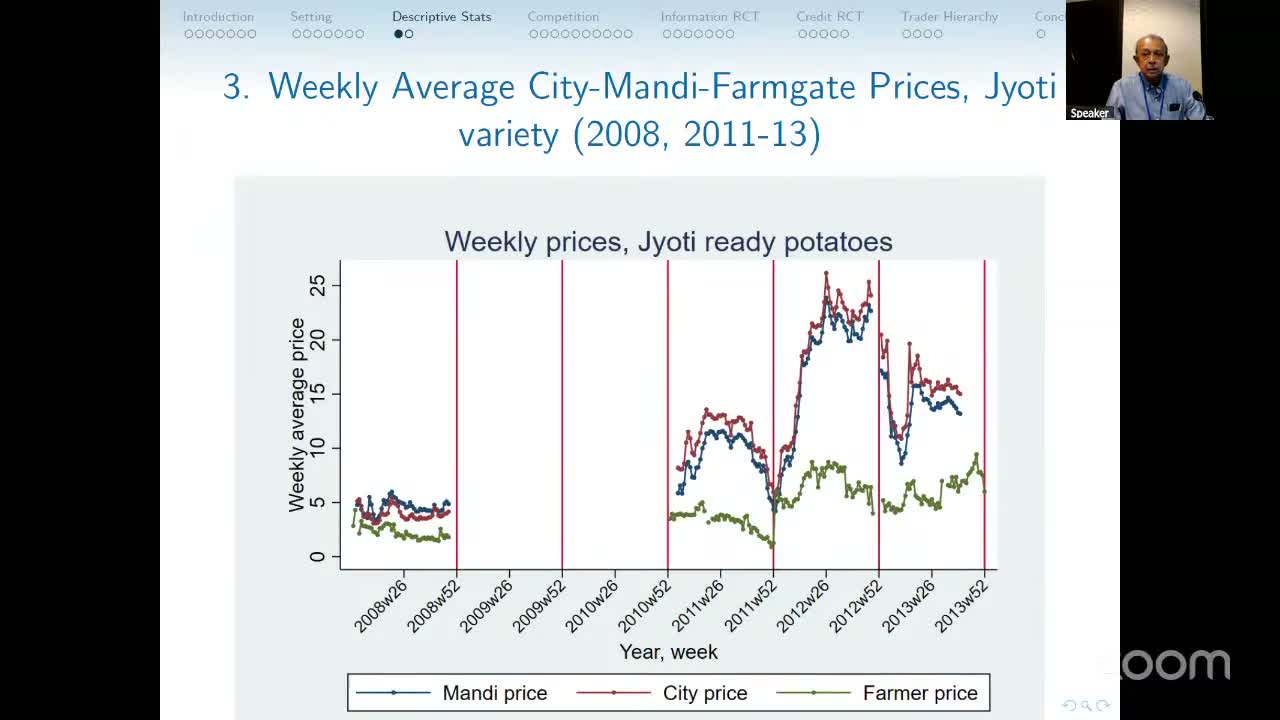
The picture above is the whole lecture in one chart. The city price and the mandi price track each other nearly one-for-one. The farmgate price sits at a fraction of both and responds only weakly when they boom. In 2008 the farmer got about Rs 2.14 per kilo while the mandi transacted at Rs 4.85 and the city retail price was Rs 6.38 — a 2:1 mandi-to-farmgate ratio, 3:1 retail-to-farmgate, in a low-price year; typically retail runs three to four times farmgate. And when the team surveyed both sides in 2013 and netted out every transaction cost the traders would admit to — transport, storage, loading, handling — the margins came out lopsided:
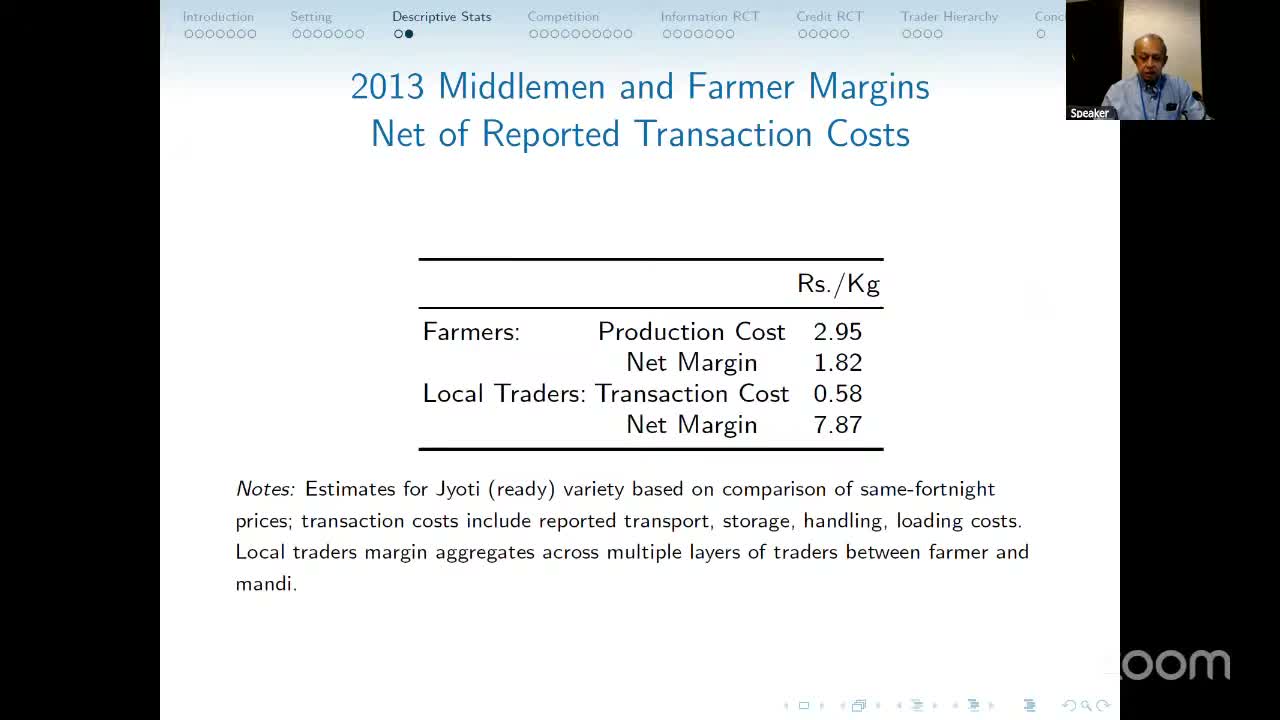
The traders’ collective net margin is more than four times the farmer’s, on costs less than a fifth of the farmer’s. The standard caveat — maybe the traders have large unobserved costs, effort and risk and reputation — is real and the authors live with it, which is why the sharper evidence comes from pass-through. If village traders competed hard for potatoes, a boom in downstream prices should be bid through to the farmgate. It isn’t:
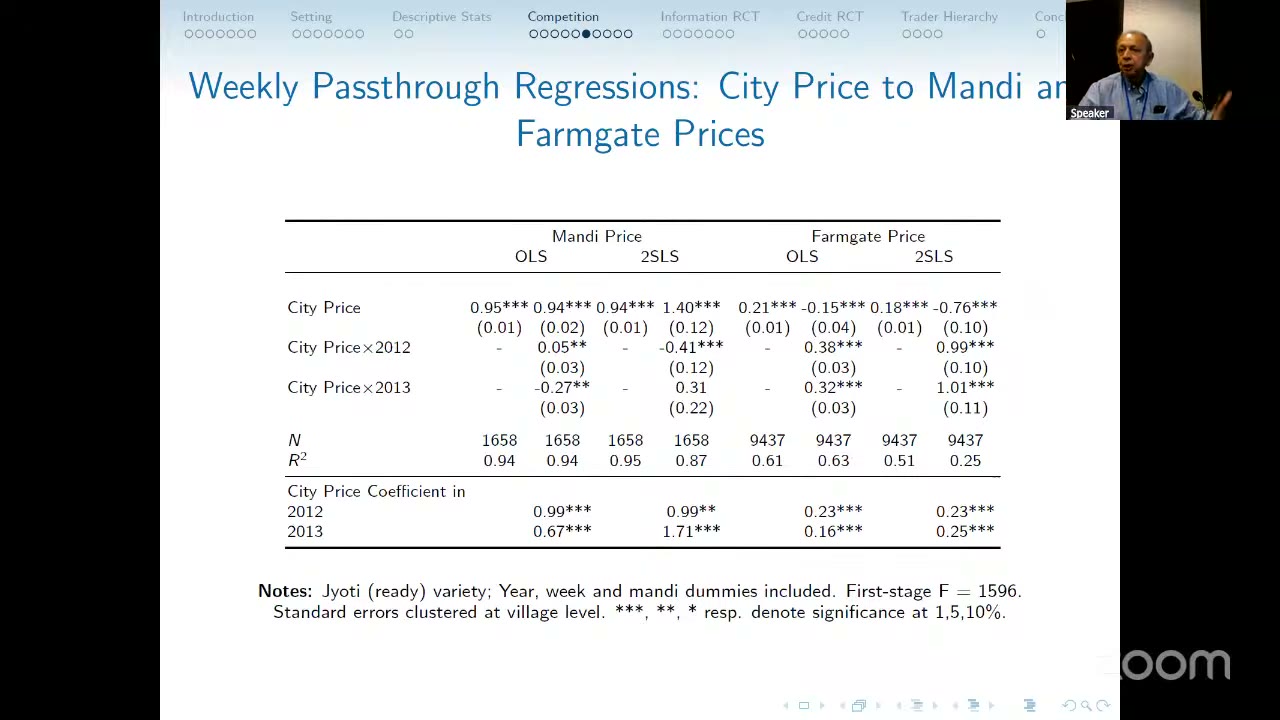
Pass-through from city to mandi: about one. From city to farmgate: about 0.2. For calibration, comparable estimates elsewhere run from 0.2 in Kenyan maize retail (a setting the literature reads as collusive) up to 0.9 for cocoa in Sierra Leone, where farmgate markets look genuinely competitive. West Bengal sits at the frictional extreme — and, here is the puzzle that gives the lecture its “receding boundary” flavor, it does so without concentration. The average village has about 150 selling farmers and 14 buying traders; the median trader’s market share is 8%. Fourteen buyers is not a textbook monopsony. It is, however, quite consistent with tacit collusion — more than half of traders cheerfully told surveyors they keep track of and discuss each other’s prices — and Mookherjee sketches a Salop (1979)-style model plus the Rotemberg–Saloner (1986) logic under which collusion is easier to sustain in low-price years (when deviating is less tempting), which would make pass-through procyclical. The data gesture that way; a clean test failed to reject much of anything, and he says so.
The policy levers that did nothing. Now the part that stings. If the farmer’s problem is that he doesn’t know the mandi price (farmers underestimate it by roughly 40%; their best guesses track the local haat price instead), tell him the price. The team ran exactly this rct twice — in 2008 and again in 2011–13, 36 treated villages with publicly posted daily mandi prices, 36 controls — and got nulls both times, in low-price and high-price years alike. The theory section explains why this isn’t even surprising: with two or more competing traders, price competition itself reveals the resale price in equilibrium (believe the highest offer; the low-ballers are the ones short-changing you), so a public notice board adds nothing. If instead the problem is credit — farmers dump 80% of the crop at harvest because they can’t afford to wait — lend them money. Three microcredit designs (trader-intermediated, local-government-intermediated, classic group loans), harvest-timed, four-month renewable terms built so a farmer could delay sales. Effect on farmgate prices: “Nothing.” (One arm shows a negative effect he explicitly declines to explain, which is the kind of reporting one wishes were more common.)
The resolution of the puzzle — tentative, this being ongoing work — is that everyone has been staring at the wrong layer. When the team traced the full hierarchy in 2013, the pass-through from local trader to farmer was 0.55; from mandi to local trader it was 0.44; and the mandi traders — “the fat cats,” whom the survey team “did not dare even approach” — collect Rs 6.16 of that Rs 7.87 aggregate margin while incurring essentially none of the physical costs. The potatoes arrive in the afternoon; they resell them that evening. The binding distortion sits between traders, upstream of the farmgate, which is why every intervention aimed at empowering farmers against their village trader was aiming at the smaller friction.
The Q&A sharpened rather than softened this. One audience member (the chair named several questioners; captions being captions, I’ll attribute cautiously) noted that null effects of farmer information are “a very general finding” across Africa, and that the celebrated Kenyan credit-for-storage result is the exception, not the rule — in Sierra Leone traders simply shut the same intervention down. Asked why farmers don’t organize a cooperative, Mookherjee told the story of a farmer who fed him dinner when he was stranded and, pressed on why the farmers don’t band together to approach the mandi buyers, looked away and said there would be blood in the streets. The chair then announced the coffee break, which is the correct amount of ceremony for learning that the last remaining policy lever is the one enforced by the threat of violence.
So the two-decade summary: the frictions are enormous, they are not about information, they are not about credit, they are probably about competition — and the competition problem is guarded by a political coalition (trader associations have been reliable partners of every West Bengal government in living memory) and, below that, by transaction-cost fundamentals so stubborn that even Reliance, and reportedly Chinese retail conglomerates before it, tried to buy directly from farmers and gave up. The elephant in the room has a lobby.