Notes on:
Real Business Cycles in a Small Open Economy
American Economic Review
20 January 2023
small open economy · business cycles
Paper · PDF
Written by Fable 5
Enrique G. Mendoza, American Economic Review 1991. Read from the published article (a scanned copy, ocr-extracted). No talk recording exists; written from the paper alone.
Backus, Kehoe and Kydland (1992) built the two-country laboratory; this paper, published the year before theirs, built the one that most of the field actually ended up working in. The small open economy is the limiting case where the rest of the world collapses into two numbers — a world interest rate and a willingness to trade any amount at it — and Mendoza’s question is whether the real-business-cycle mechanism survives the trip. Take the Kydland–Prescott (1982) engine, let households hold foreign bonds at an exogenous rate r* alongside domestic capital, calibrate to Canada (the textbook small open economy: no capital controls, financially fused to the United States), and ask: can technology shocks alone reproduce not just the domestic stylized facts, but the two distinctly international ones — the positive correlation between national saving and investment, and the countercyclical trade balance?
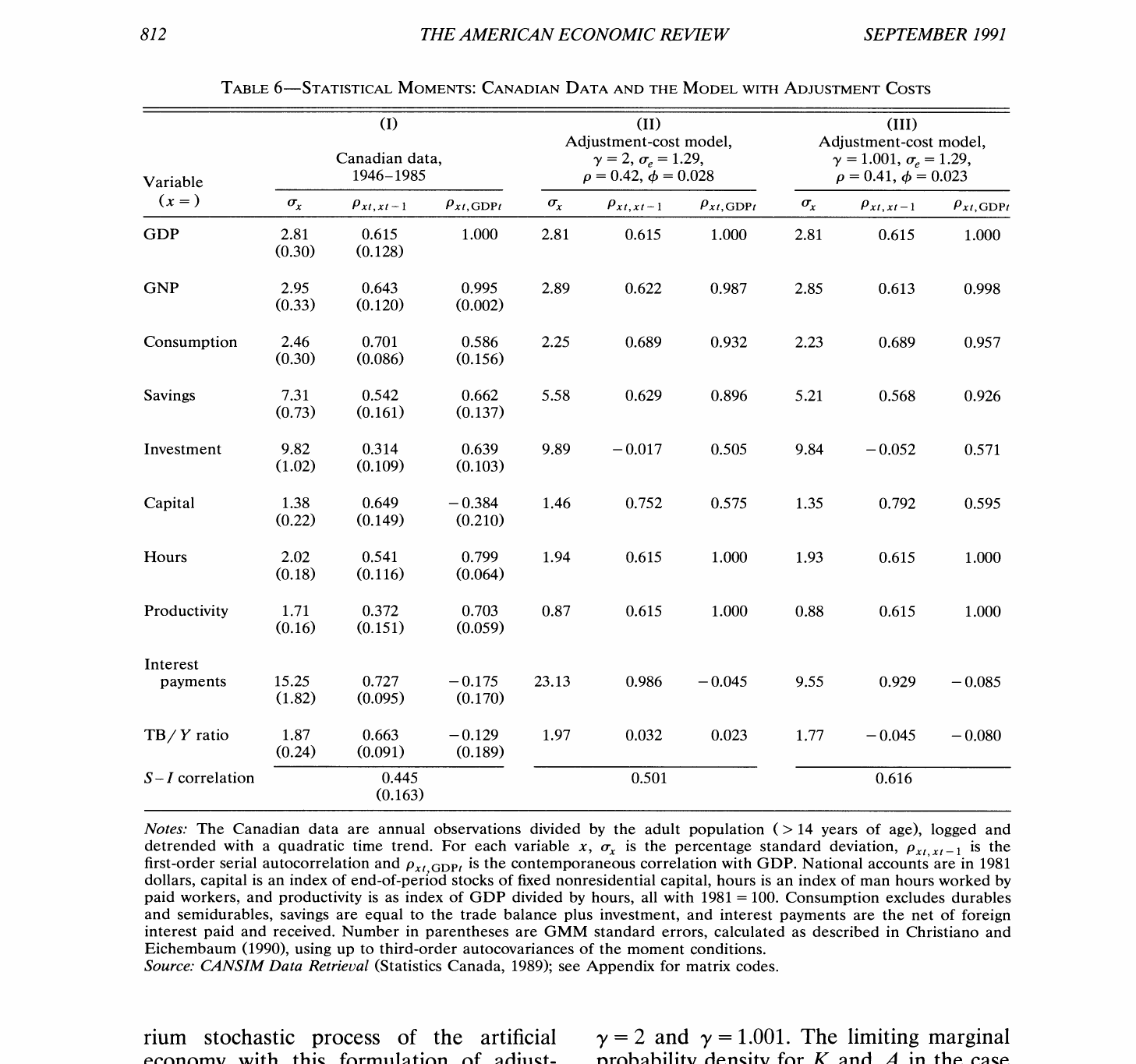
The saving–investment fact is the loaded one. Feldstein and Horioka (1980) had famously read the near-lockstep movement of national saving and investment as evidence against capital mobility: if capital could really flow freely, why would each country’s investment be financed so overwhelmingly at home? Mendoza’s model is a direct counterexample factory: capital is perfectly mobile in it, and the S–I correlation comes out positive anyway, at 0.50 to 0.62 against 0.445 in Canadian data, because a persistent productivity shock raises the return to domestic capital and the desire to save at the same time. The correlation measures the persistence of shocks, not the friction in capital markets. (Push the persistence parameter to 0.99 and the correlation hits 0.8.)
The one moment that breaks, and the cheap part that fixes it
Before it earns that headline, the model has to survive its own open-economy pathology, and here Mendoza finds — independently, in the small-economy limit — the same disease bkk found in the two-country lab. In the frictionless benchmark, investment’s job is to keep the expected marginal product of capital equal to r*:
(equation 13 in the paper), and nothing else. Consumption smoothing runs entirely through the current account, so investment is free to slam the capital stock around to track every shock. The result: investment volatility of 21 percent in the model against 9.8 in the data, with a negative autocorrelation (−0.32 against +0.31) — the capital stock overshoots and snaps back — and the trade balance 4.66 percent volatile against 1.87. The stationary distribution of capital is literally bimodal: two humps, one per productivity state, because agents freely leap between them.
The fix costs almost nothing. Add a quadratic capital-adjustment cost with parameter ϕ between 0.023 and 0.028 — a number consistent with Craine’s (1989) estimate of 0.025 for the U.S., implying average adjustment costs of about 0.1 percent of gdp — and the model snaps into place: investment volatility 9.89 against 9.82 in the data, trade-balance volatility 1.97 against 1.87, savings and investment procyclical, the S–I correlation at 0.50, and the bimodality gone. Financial capital is perfectly mobile; physical capital is merely cheap-but-not-free to move. That distinction, borrowed from Dooley, Frankel and Mathieson (1987), is doing all the work.
Two quieter findings with long afterlives
The paper also runs interest-rate shocks through the model — fluctuations in r* six times larger than Kydland–Prescott’s estimate of risk-free rate variability — and finds them almost perfectly neutral: raising the interest-rate shock from 1 to 5 percent moves gdp volatility from 2.8 to 2.9. Mendoza is careful to say why, and the why matters more than the result: Canada’s net foreign interest payments are 2 percent of gdp, so the wealth and substitution effects have almost nothing to bite on. “It is likely that in economies with a higher debt-service ratio, such as the heavily indebted developing countries, fluctuations in the world’s real interest rate play a more significant role.” That sentence is a fourteen-year-early abstract for Neumeyer and Perri’s (2005) emerging-markets paper at the end of this reading list, where interest-rate shocks stop being a robustness check and become the star.
The second quiet innovation is in the plumbing. The small open economy with a constant discount factor has no well-defined steady state for foreign assets (the random-walk problem that Schmitt-Grohé and Uribe’s (2003) paper in this list later catalogues), and Mendoza closes it with Epstein’s (1983) stationary cardinal utility — impatience rising with consumption — solved by honest-to-God value function iteration on a 22×22×4 grid, on a supercomputer, in 1991. The paper thereby introduced both the most venerable of the “closing devices” and the exact Canadian calibration that Schmitt-Grohé and Uribe would reuse as the common benchmark for their five-way horse race. (Their verdict — the devices are interchangeable — is, among other things, a retroactive blessing of this paper’s choice.)
What the model still cannot do, Mendoza reports without flinching: consumption comoves with output too tightly (0.93 against 0.59), hours are perfectly correlated with output by construction (his ghh preferences shut off the wealth effect on labor supply), and measured productivity in the model is just scaled output. The honest scorecard — two international stylized facts explained, one moment fixed by a small real friction, a list of failures attached — is the template the small-open-economy literature has been filling in ever since.