Notes on:
Mars or Mercury? The Geopolitics of International Currency Choice
Economic Policy 34(98): 315--363
2019
geoeconomics · reserve currencies · alliances · economic history
Paper · PDF
Made with AI: Opus 5 (reading and writing)
Barry Eichengreen (Berkeley), Arnaud Mehl and Livia Chiţu (European Central Bank). Economic Policy 34(98), April 2019, pp. 315–363, presented at the 68th Economic Policy Panel Meeting, Vienna, 4–5 October 2018, with invited comments from Ralph De Haas (ebrd and Tilburg) and David Hémous (Zurich) and a floor panel discussion. This published version supersedes nber Working Paper 24145 of December 2017, and it is the source of every number below; several of them moved a long way in revision. No recording of the session exists, so this is a document digest, discussants included.
Two gods, one reserve portfolio
A foreign exchange reserve is a portfolio, and the standard way to explain a portfolio is to ask what the holder gets paid for holding it. Economists answer in pecuniary terms: you hold the currency that is big, liquid, credible, cheap to transact in, and that everyone else already holds. That is the god of commerce, and the paper calls it Mercury. Political economists and international relations scholars answer differently: you hold the currency of the state that guarantees you will still exist in ten years, and that state, being a state, will notice whether you do. That is Mars. The interesting move here is that the paper does not choose. It puts both sets of variables in the same regression and lets them fight, which is a more honest and much more annoying research design than picking a side.
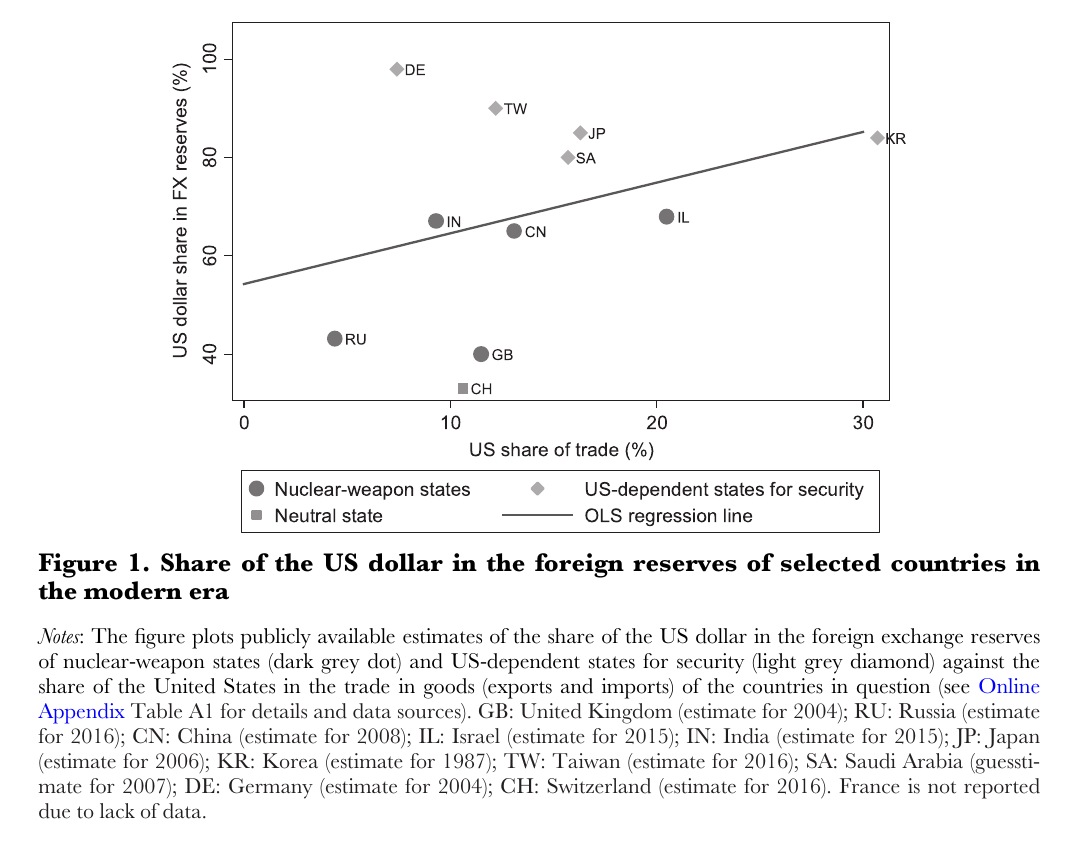
The advertisement for Mars is the opening figure, which plots the dollar share of reserves against the us share of a country’s goods trade and then notes who sits where relative to the fitted line. States that depend on the United States for their security — Japan, Germany, Saudi Arabia, Korea, Taiwan, Israel — scatter above it. States with their own nuclear deterrent scatter below. Switzerland, added in revision as a third category labelled neutral, sits well below, and the authors spend a footnote insisting this is not merely an artefact of Swiss National Bank euro-pegging intervention, since the dollar was about a third of snb reserves before the crisis as it is now. The gap between the nuclear states and the dependent states is, the paper says, over thirty percentage points; later it is measured at thirty-one. France, which the working paper’s version of this figure plotted, is absent here for lack of data, so you cannot read a France comparison off the picture, only out of the text.
Then there are the anecdotes, which are excellent and prove nothing. The 1967 Blessing letter, in which the Bundesbank president privately promised the Fed that Germany would go on holding dollars rather than converting to gold, against its own interest, with American troops on German soil as the unstated consideration. Marshall Plan lending running into Nato. The 2008 Fed swap lines going to close allies. Iraq, Iran and Venezuela shopping for euro or oil-backed pricing. Every one of these runs in both directions, which is the paper’s actual problem, and modern data will not help you solve it: the imf publishes only aggregate cofer, and the country-level composition data, the paper notes in a footnote, have been used by exactly two internal imf staff studies.
Why 1890–1913
So the authors go somewhere the data exist. Nineteen countries, twenty-three years, five reserve currencies — sterling, the French franc, the German mark, the us dollar, the Dutch guilder — digitised from Lindert (1969). Before 1914 governments did not treat reserve composition as a secret, and where they did the menu was short enough to back out. Central banks had only recently started holding foreign exchange at all, so habit had not yet hardened; the eightfold rise in the foreign assets of the leading banks of issue, from 102 million dollars in 1880 to 814 million in 1913, was still a new practice. And the alliance map was being redrawn every few years in the run-up to the war. As the paper puts it, “This was an era when currency choice was, well, a choice.”
Mercury does fine, in a slightly embarrassing way
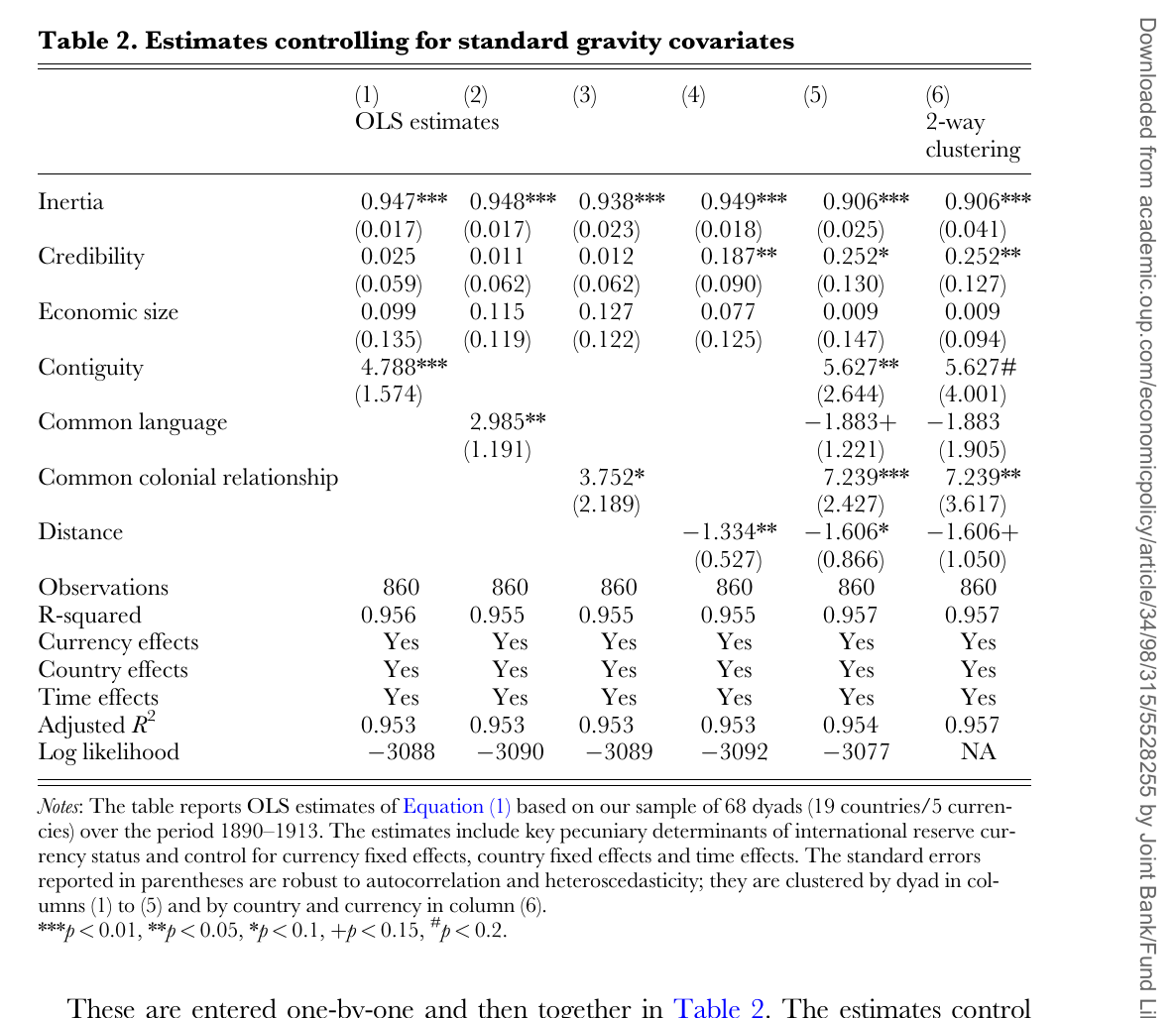
The benchmark is a dynamic panel of currency shares on lagged shares, the issuer’s economic size, its credibility measured as years on the gold standard, and gravity covariates. With dyadic fixed effects, persistence runs 0.48 to 0.54 and an extra year on gold is worth about half a percentage point of reserve share in the short run and almost a full point in the long run — enough, the authors say, that Britain having been on gold fifty-six years longer than France by 1899 explains a large part of the forty-eight-point gap in their reserve shares. Drop the dyadic effects for currency, country and year effects and inertia jumps to 0.91–0.95, and the transaction-cost proxies take over: sharing a border is worth more than five points in the short run, a common colonial relationship seven, with long-run effects of fifty to seventy points, and a year on gold about two points in the long run. Economic size is positive throughout and never significant at conventional levels, which is a slightly awkward result for the hypothesis that size is what makes a reserve currency.
Mars, in four layers
The Mars specification is the benchmark plus one dummy, equation (2) of the published version:
with the five issuers, the nineteen holders, the twenty-three years, the gravity covariates, and equal to one when a defence pact, non-aggression treaty, neutrality treaty or entente is in force between issuer and holder. Everything hangs on .
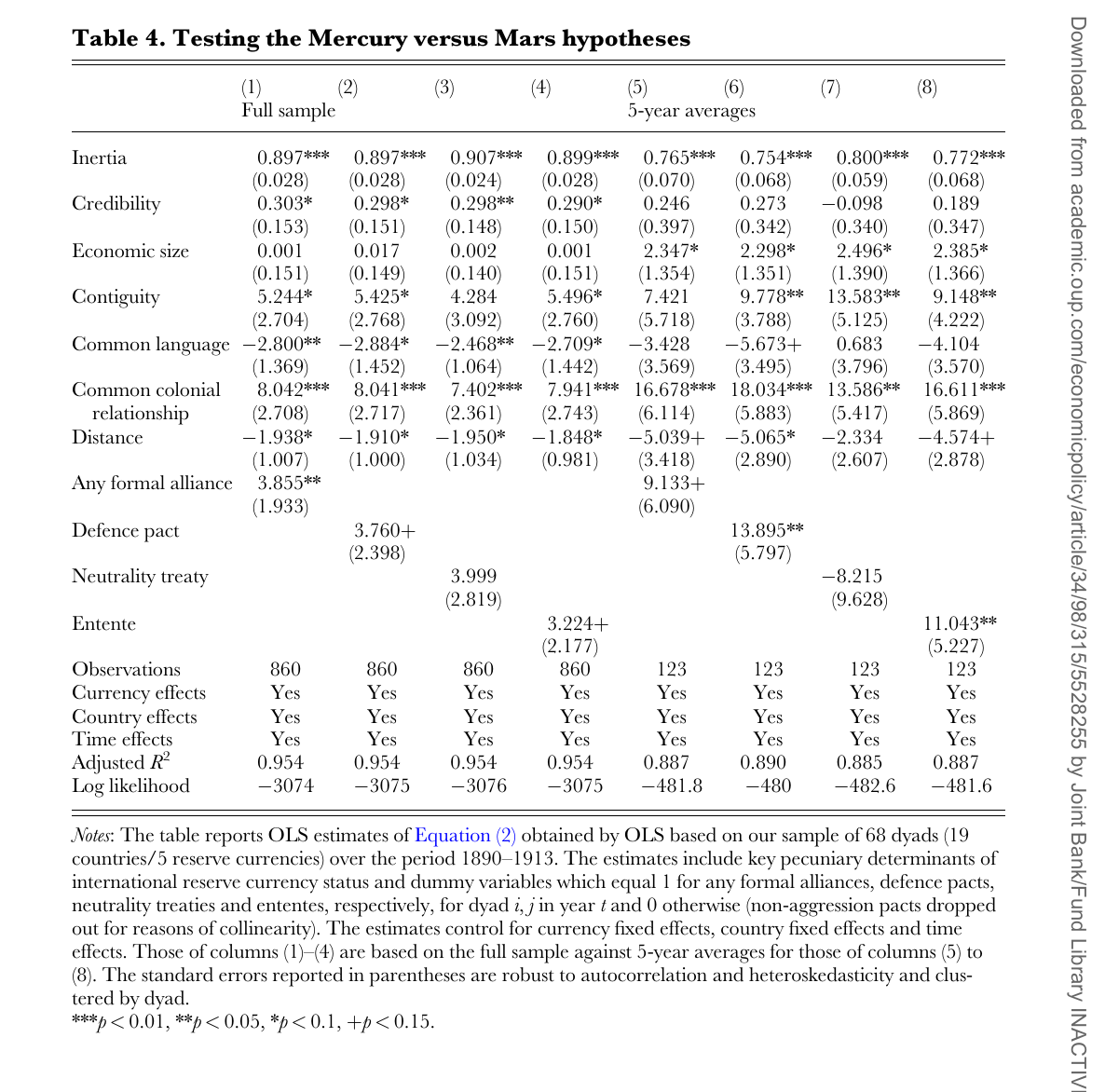
In ols, any formal alliance enters at 3.855 and is significant at the 5% level — the paper says so in terms, that this is “in line with the Mars hypothesis.” Defence pacts get 3.760 and ententes 3.224, both hovering at the 12–14% level, and the dummy that fails is the neutrality treaty, which the published version points out three separate times. (If you read the working paper, this is the reverse of what you saw there, where the alliance dummy was insignificant and neutrality treaties were the ones that held up. The published table is the one to cite.) These are small numbers in levels because persistence is high; run them through the long run and defence pacts are worth thirty-seven points. Drop the colonies — Australia, Ceylon, India, the Netherlands Indies, the Philippines, all of which held their master currency and nothing else — and the coefficients get bigger, not smaller.
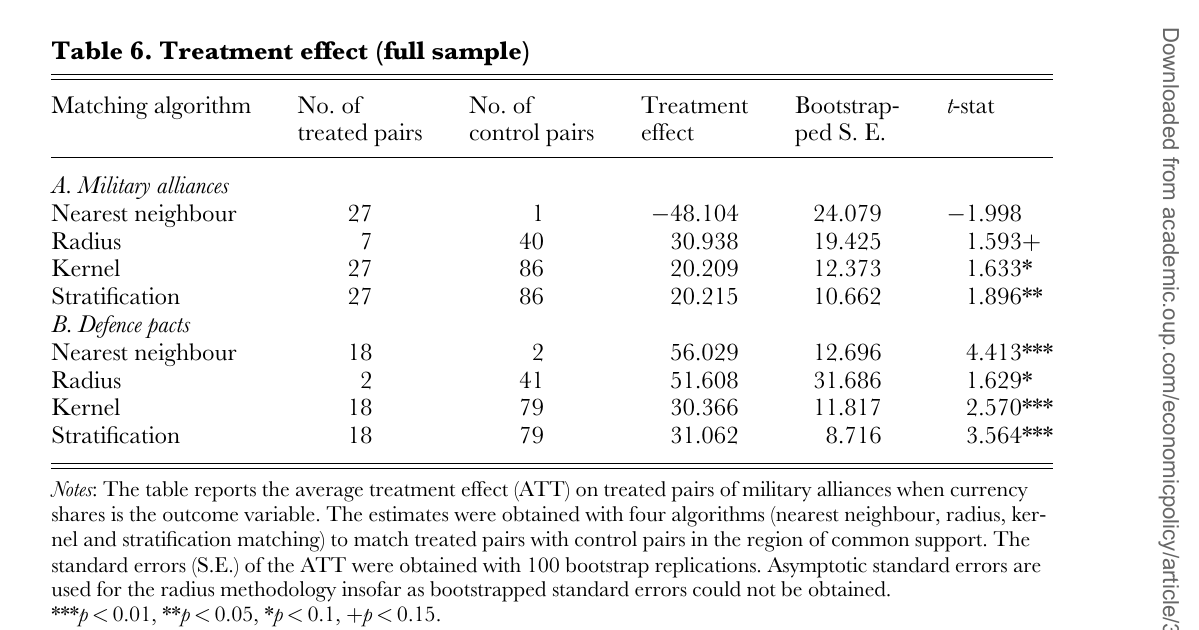
New in the journal version is a propensity score matching exercise: model the probability of being allied on diplomatic presence and rank, size, population, distance, genetic distance and military spending and personnel, then compare matched allied and non-allied dyads. Military alliances come out at twenty to thirty points, defence pacts at thirty to fifty. One nearest-neighbour estimate is discarded because the control group has a single observation in it, which is the sort of disclosure that makes you trust the rest more.
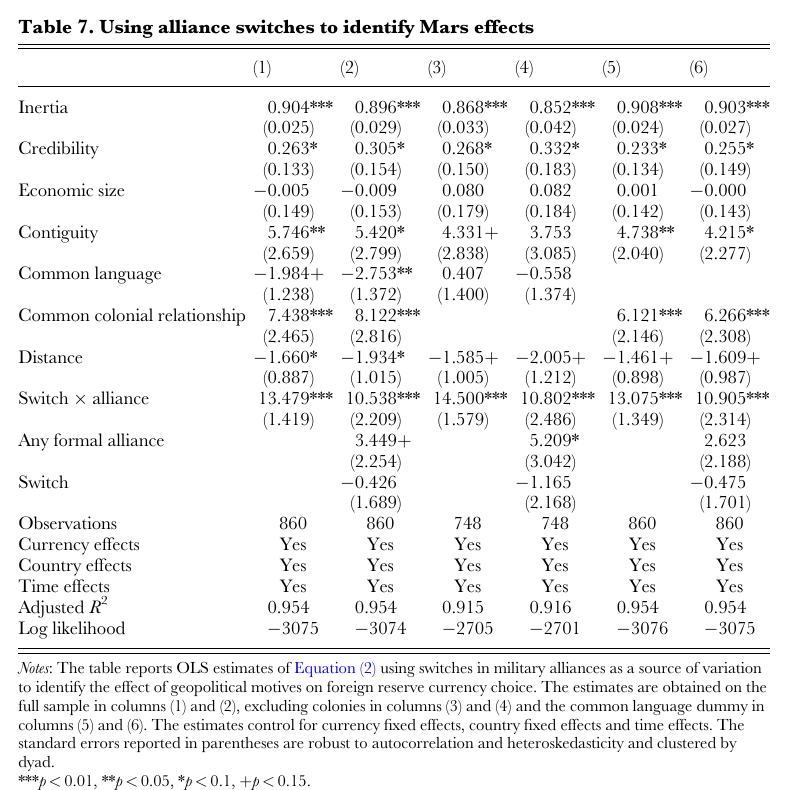
Also new, and the best thing in the paper, is identification off alliance switches: a dummy for a country forging an alliance with an enemy of its former ally, or terminating one to move toward that enemy, interacted with the alliance dummy. Russia’s rapprochement with France in the early 1890s at the expense of its entente with Germany; Austria–Hungary and Italy leaving their British ententes in 1897; Japan’s 1911 turn toward the United States. The interaction runs 10.5 to 14.5 and is significant at 1% in all six specifications — the only Mars coefficients in the paper that are both large and precise.
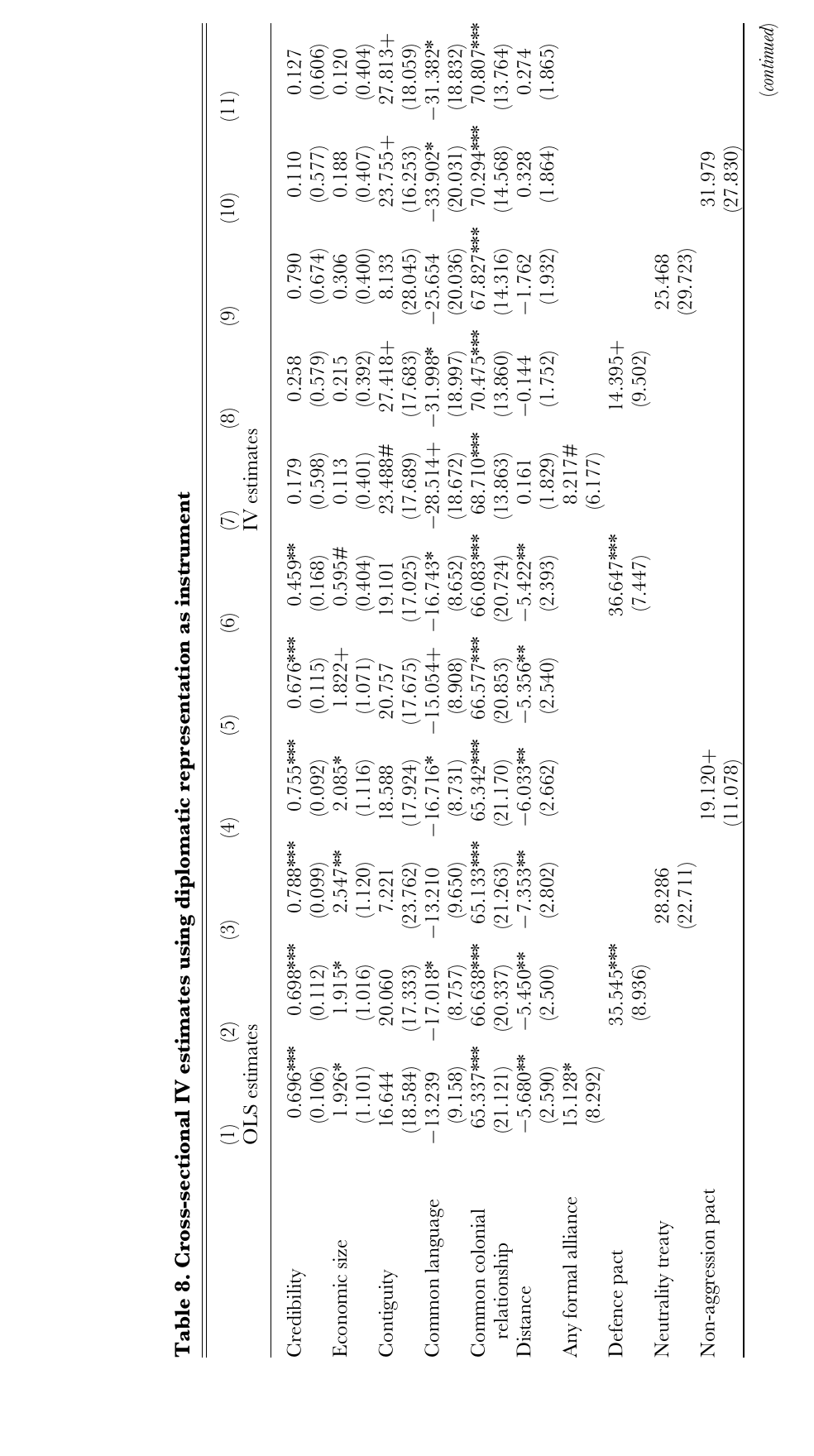
And then there is the instrument, which is the layer everyone remembers and the weakest of the four. Alliance is instrumented with diplomatic representation — nothing, chargé d’affaires, minister, ambassador, colony — on the argument that diplomats are posted and expelled for broad foreign policy reasons rather than reserve management. In cross-sectional ols, on eighty-one dyad averages, the coefficients are enormous: 15.1 for any formal alliance, 35.5 for defence pacts. In the instrumented columns, on fifty observations and thirty-eight degrees of freedom, any formal alliance falls to 8.217 with a standard error of 6.177, significant only at the 20% level, and defence pacts to 14.395 at the 13% level. Hansen passes and under-identification is typically rejected, but the first-stage F is 6.3, below ten and below the Stock–Yogo critical values, and the authors say so themselves. An alternative instrument built on differences in military capabilities gets an F of about six, which is not an improvement.
Where “about thirty percentage points” actually comes from
Not from the instrument. This matters, because in the working paper it did: the IV coefficient there was 29.884, with a standard error of 19.5, a rounding error away from the abstract’s headline, and it was natural to read the paper as one big imprecise IV number. That estimate did not survive re-estimation. It is now 8.217 at the 20% level. What survived is the headline, and it survived because the authors added the matching and the switches and then averaged across everything: “Accounting for model uncertainty by averaging the estimates obtained with the various methodologies, we find that defence pacts boost the share of international units in foreign reserve holdings by 33 percentage points.” That thirty-three, rounded, is the “about 30 percentage points” in the abstract and the conclusion. It is a model average across four methods that disagree by a factor of four, which is a defensible and unusually candid response to a referee, and also a different kind of number than a coefficient.
The paper’s own honesty about the split is worth noting. Mercury variables alone give an adjusted R-squared of about 38%; Mars variables alone about 4–7%; the authors’ gloss is that almost a fifth of the predicted variation in currency choice is Mars alone. Japan makes the point concretely: sterling was 96% of its pre-war reserves, pecuniary factors alone predict 31%, and adding the 1902 Anglo-Japanese defence pact takes the prediction to 67%. That decomposition uses the cross-sectional ols coefficient rather than the IV, because, the authors explain in a footnote, ols is closer in magnitude to what the matching gives. Which is true, and is also the sound of a paper quietly declining to use its own instrument.
The scenario, and what it is worth
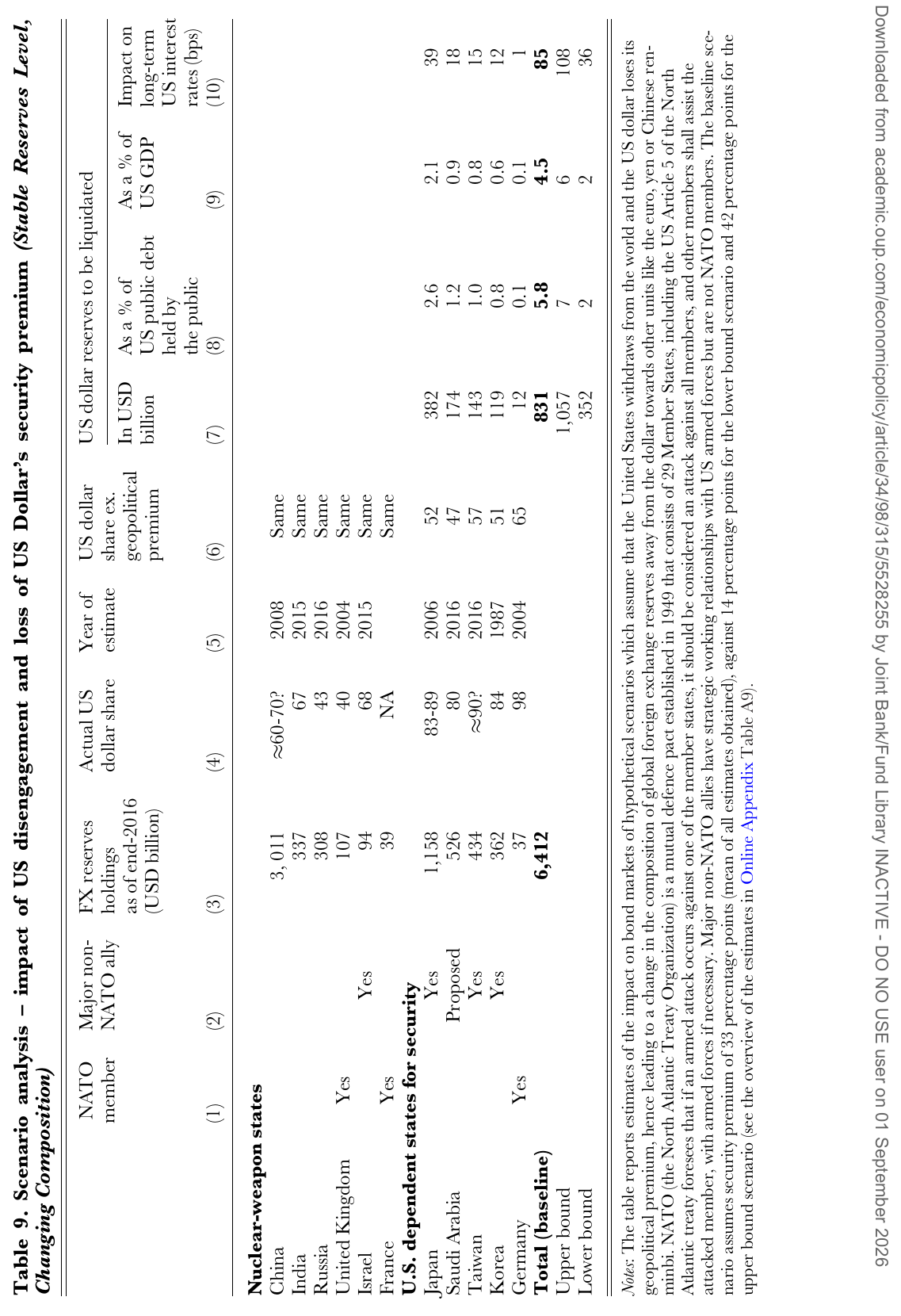
Take the thirty-three points to the present. If the United States withdrew its security guarantees and the states that depend on them rebalanced accordingly, holding the level of world reserves fixed, 831 billion dollars of Treasuries get liquidated — 5.8% of publicly held us debt, 4.5% of gdp — and, via Warnock and Warnock’s (2009) estimate that twelve-month foreign flows of 1% of gdp move long rates 19 basis points, us long-term rates rise 85 basis points. Japan alone is 382 billion dollars and 39 basis points. The bounds, taken from the largest and smallest Mars estimates in the paper, are 108 and 36 basis points. Relax the fixed-level assumption and let world reserves grow 30%, and you still get more than 40 basis points. The dollar depreciates about 5% over ten years on a long-horizon uip coefficient of 0.6. And the punchline: roughly 115 billion dollars a year of extra interest on more than 14 trillion dollars of debt, against an overseas military presence costed at 10 billion a year by a Senate estimate or 100 billion by a critic. A modern thirty-eight-observation cross-section, run as a sanity check, puts the defence-pact effect at up to 23 points and finds a coefficient of about 0.5 per thousand us troops, which for Germany’s 76,000 troops in 2004 implies a dollar share 38 points higher than otherwise. Germany’s actual dollar share is close to 100%.
What the discussants pushed on
Ralph De Haas liked the paper and made three objections. The colonies are dead weight — Australia, Ceylon, India, the Dutch East Indies, the Philippines and in effect Brazil held 100% of reserves in their master currency with no time variation and no exposure to ordinary alliances, so the no-colonies table is the load-bearing robustness test rather than a footnote. The instrument fails three ways at once: it is weak, with F consistently below ten, “which may reflect that diplomatic representation is largely ‘cheap talk’”; the exclusion restriction is doubtful because diplomats promote trade; and diplomatic representation is plausibly endogenous to alliances, since states expecting hostility withdraw diplomats as a warning shot. His conclusion is that the instrumentation “lacks some credibility” and that the switching-alliance estimates are what rescues the result. And external validity: bilateral alliances matter less in a Nato world, the gold standard and the colonies are gone, and economics and politics have grown more entangled — “The concept of a ’trade war’ is, after all, the perfect amalgamation of Mercury (trade) and Mars (war).” He still buys the bottom line: further American isolationism carries a tangible cost to the United States and a benefit to China.
David Hémous opened with the modern numbers — 61.7% of allocated reserves in dollars at end-2018, ten points below 2001 — and then made the sharpest methodological point in the exchange. Mercury’s evidence is “more mixed”: the size and trade results vanish when shares are adjusted for gold, common language enters negatively, which is counterintuitive, and the gravity variables cannot be read as clean Mercury because colonial relationships are also a Mars variable and distance and contiguity both plausibly drive alliances. His conjecture is that Mercury looks weak because under the gold standard the exchange-rate-management motive for holding foreign exchange did not exist and 80% of reserves were gold anyway. On Mars, he ranks the three strategies explicitly: matching handles reverse causality but not omitted variables outside the matching set; the IV is interesting but confined to a cross-section and vulnerable because diplomatic ties depend on trade; and the switches are “third and perhaps most interestingly,” because conditional on an alliance the switch is plausibly exogenous — the collapse of the Russia–Germany alliance as Russia moved toward France is presumably uncorrelated with Russia–Germany trade. He wants the network exploited further, instrumenting a country’s alliances with those of its allies. On the scenario he says “somewhat heroic” and then endorses the order of magnitude: “The main lesson is provocative and very topical: Nato pays off!”
From the floor, Andrea Ferrero raised the same external-validity worry from the other side, that a mostly gold-standard sample is effectively one fixed exchange rate regime. Thorsten Beck observed that the result cuts for the euro as well: Juncker’s ambition to strengthen the euro’s international role may require the eu to build actual foreign policy and military alliances. Atish Ghosh asked how much currency choice could have mattered when everything was pegged to gold and foreign exchange was a small share of reserves, whether viable alternatives to the dollar exist today at all, and — this is the question that has aged best — whether holders worry about expropriation if they go to war with, or merely annoy, the issuer, citing the Spanish Civil War blocking of government accounts at the Midland Bank. Vincent Vicard noted that the value of an alliance depends on the level of threat, so the Mars premium should be state-contingent, and that Trump was arguably raising world uncertainty and hence the weight on Mars. Andrea Ichino asked whether sterling’s decline was Mars or Mercury, and pushed the authors toward Hémous’s identification. Arnaud Mehl replied that the sterling decline is Mars: the absolute stock of sterling reserves did not fall, French reserves rose, because the Franco-Russian alliance sent Russia to borrow in Paris and to leave part of the proceeds there. On gold, he answered that currency still mattered because a great deal of trade was invoiced in sterling rather than settled in metal. He accepted the alliance-index suggestion and explained that gold-inclusive shares cannot be computed for enough countries to matter.
What to weigh
The honest summary is that this is a small, old panel with four identification strategies that disagree, and a headline that is their average. The ols Mars effects are statistically solid and small in levels, large only after you run them through a lagged dependent variable with a coefficient near 0.9. The matching gives twenty to fifty points. The switches give the only estimates that are simultaneously big and precise, and they rest on maybe four diplomatic ruptures. The instrument gives eight points with a standard error of six and a first stage the authors themselves decline to defend. You can believe the thirty-three-point number, but you should know it is a weighted verdict on a disagreement rather than a measurement.
What survives all of that is the reframing, and it is worth the price of the identification problems. The dollar’s reserve role is partly a security arrangement, which makes it exposed to geopolitical shocks through a channel that models built on trade invoicing and safe-asset supply do not contain. Pflueger and Yared (2024) formalise the loop in one direction — hegemony lowers borrowing costs, cheap borrowing funds hegemony — and Ghosh’s expropriation question from the floor in Vienna in 2018 is precisely the other direction that Bianchi and Sosa-Padilla (2025) later priced, where the hegemon’s own willingness to freeze accounts erodes the convenience yield it is collecting. Read this paper as the empirical prior underneath both, and as the reason every de-dollarisation argument eventually stops being about payments technology and starts being about who defends whom.
(The authors also pre-empt the obvious objection to the scenario — that someone would simply buy the dumped Treasuries — with two precedents. In 1931 nobody picked up the sterling France was liquidating. In 1971–1973 global dollar aggregates did not fall, although, they concede, that may only be because most of the world still had capital controls and there was nothing else to buy.)