Notes on:
General Social Agents
NBER Working Paper 34937
7 May 2026
LLM agents · experimental economics · simulation
Talk · Paper · doi · PDF · Transcript
Made with AI: Opus 5 (reading and writing)
Part of AI and Economic Measurement, Spring 2026
Benjamin S. Manning and John J. Horton (mit), “General Social Agents.” Presented at the nber conference on ai and Economic Measurement, Stanford, 7 May 2026; discussant Matthew O. Jackson (Stanford), who took all three papers in the session together. Written from the nber working paper.
A game you can lose by winning
You and a stranger each ask for money. The amount has to be a whole number of shekels between 11 and 20, and you each get what you ask for, no questions. There is one wrinkle: if you ask for exactly one shekel less than the other person, you get an extra twenty. So 20 is the safe play, 19 beats a room full of people playing 20, 18 beats a room full of people playing 19, and if you keep going you arrive at 11, which is dominated by everything and which nobody sensible plays. The game has no pure-strategy Nash equilibrium. It was designed by Ayala Arad and Ariel Rubinstein (2012) precisely so that equilibrium would look silly and depth of reasoning would look like the thing actually being measured, and when they ran it on 108 Hebrew University students, about 74% asked for 17, 18 or 19, with the mode at 17.
Now ask gpt-4o to play. Manning ran it a thousand times at temperature 1 with no persona at all — just the rules and “what would you request?” — and it said 19 eighty-seven percent of the time. The forward kl divergence from the human distribution is 2.7, which in this business is the number you get when your model is wrong in the specific way of being confidently, monotonously wrong.
That is the whole problem the paper is about, and it is worth sitting with, because the failure is not ignorance. The Arad–Rubinstein paper is in the American Economic Review. gpt-4o has certainly read it. Contamination, here, would have helped.
Anyway
The fix is ten sentences. Manning wrote ten candidate personas out of level-k theory — “You vary between a 1, 2, and 3-level thinker,” “You are generally a 0-level thinker,” “You randomly pick between lower numbers because you think that’s the best way to win,” and, in a nice touch, “You are Homo Economicus.” Every one is prefixed with “You are a human being with all the cognitive biases and heuristics that come with it,” plus a one-line gloss of what k-level reasoning means. Each persona plays the basic game a hundred times, producing a response distribution. Then a small nonlinear program finds the blend of those ten distributions that sits closest to the 108 students:
Here is the observed human distribution, each is one of the ten persona sentences, is what gpt-4o does while wearing it, is the share of simulated players assigned to it, and is a distance — absolute difference between the two cdfs in the fitting, kl divergence in the reporting (the objective is on p. 11 of the working paper; the personas and the fitted weights are Table 1, p. 16).
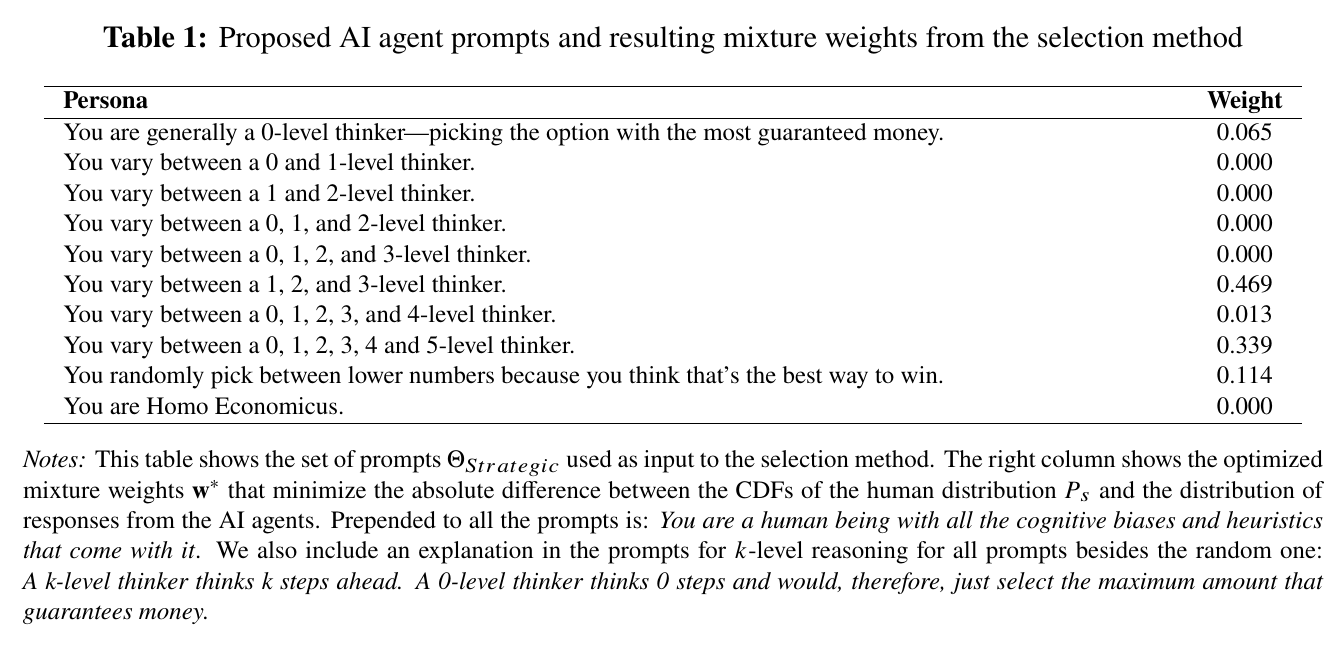
That is the entire fitted object. Ten numbers, of which five are zero, including the one on Homo Economicus. Nothing is fine-tuned; no weight inside the model moves; the prompts themselves are not even rewritten. What is estimated is a probability vector over ten English sentences, on 108 observations from 2012. The in-sample kl falls from 2.7 to 0.3, an 89% improvement, which is what you would expect of a ten-parameter fit to one histogram and is not, on its own, interesting.
What makes it interesting is what happens next, which is nothing. The mixture is frozen and handed the two other 11-20 variants Arad and Rubinstein ran — the “costless” version, where undercutting is cheap, and the “cycle” version, where picking 20 against an opponent’s 11 also earns the bonus. Humans play these quite differently: the human basic-versus-costless kl is 1.26, basic-versus-cycle 1.00, each more than three times the distance between the humans and the fitted agents. The frozen mixture lands at 0.15 on costless against the baseline’s 0.93, and 0.28 on cycle against 0.95. The modes shift where the human modes shift.
The authors are careful about why this is the test that matters. A train-test split inside one dataset cannot catch the failure mode they care about, because a prompt reading “you randomly choose numbers between 6 and 9” will pass every split of a $20 dictator game and then die on a $5 one. It has overfit not to the training sample but to the entire data-generating process, and only a different process can expose it — invariant risk minimization (Arjovsky et al. 2020), transplanted from machine learning onto English sentences. To prove the point they ran the same optimizer on deliberately stupid hypothesis classes. Twenty historical figures collapses to 89.1% Julius Caesar and a kl of 2.16, barely better than doing nothing. Sixteen Myers-Briggs types collapses entirely onto enfp at 2.36. Ten agents of the form “You always pick N” achieve a perfect in-sample kl of exactly 0 and are worthless everywhere else. All three are strictly worse than the untouched baseline on both validation games. The paper’s own gloss: if covaries with , then may fit a range of pairs, but cannot.
Then they made 883,200 games
Here is the part that turns a demonstration into a statistic. Take the 11-20 game and parameterize it into six components — lower bound, upper bound, bonus size, a “gap” parameter, six rules for awarding guaranteed points, and eleven rules for awarding the bonus, some competitive, some mutual, some coordination, some effectively zero-sum. The naive Cartesian product is 20 × 16 × 4 × 20 × 6 × 11 = 1,689,600. Seven of the eleven bonus rules ignore the gap parameter, so varying it produces mechanically identical games; collapsing those leaves 883,200 unique ones. (Manning rounds it to “800,000” throughout the talk. Same number.)
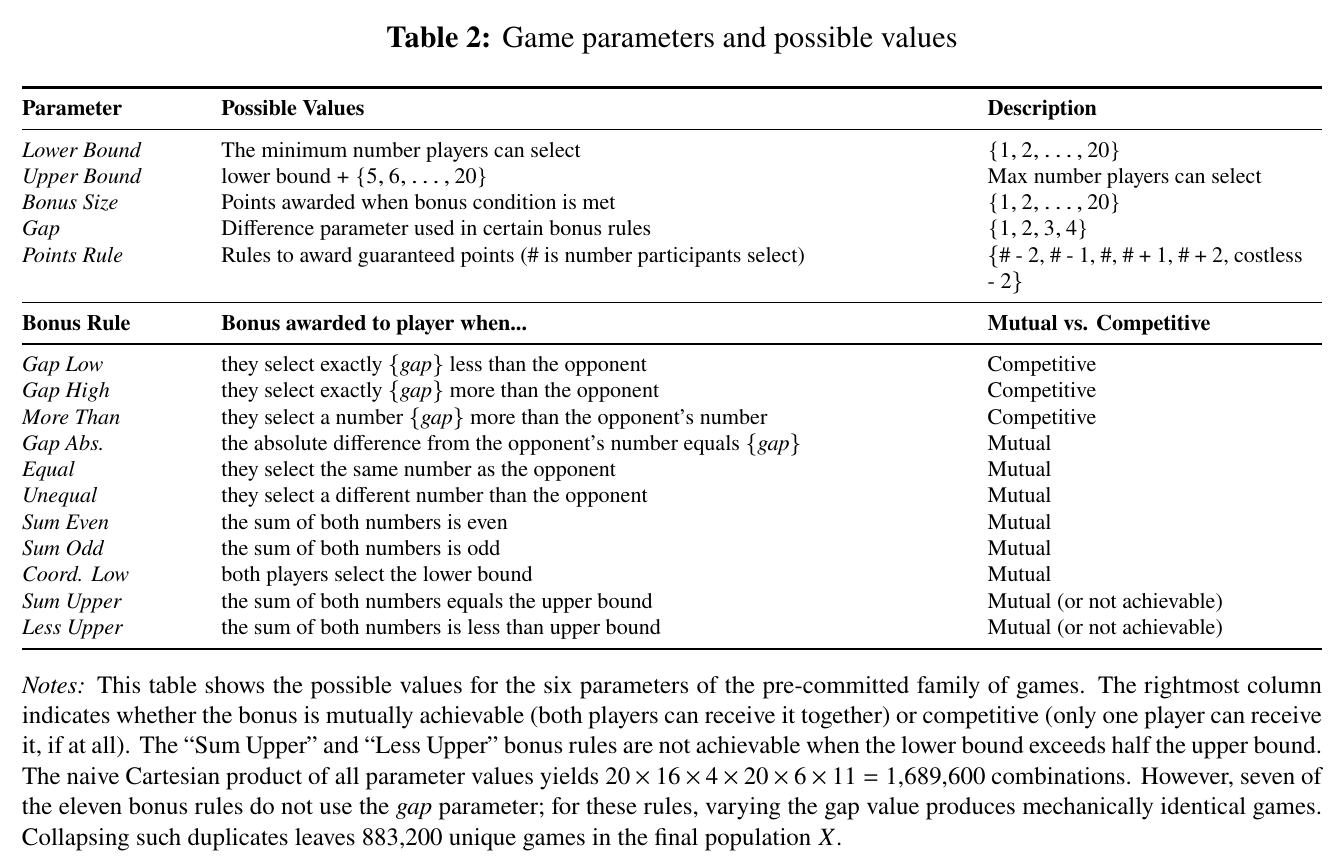
They sampled 1,500 of these, had the frozen agents play each one, and put 4,500 Prolific workers into them, roughly three humans per game, one game each. Preregistered filtering leaves 4,249 people across 1,490 games. Payment was $0.50 flat, with 1% of participants paid their points at a dollar each; those bonuses averaged $23 and topped out at $48. About 300,000 individual agent responses in total. And the crucial fact, which the paper states plainly on p. 26: the agents were built months before this population of games existed.
Because the games were drawn from a pre-committed family under a known sampling distribution and humans were randomly assigned to them, the comparison has a standard error attached that is externally valid for all 883,200. The statistic is a per-observation log-likelihood ratio:
where is one game, a human’s choice, the strategic agent mixture and a benchmark; a positive means the agents put more probability than the benchmark on what people actually did, and averaging over randomly drawn games gives , whose exponential is the “54% more probability” style number (equations on p. 22). One housekeeping detail that deserves a line, since it is the sort of thing that quietly decides results: pure-strategy Nash predictions assign probability zero to actions humans sometimes take, which sends the log-likelihood to , so every model is smoothed as
with the number of feasible actions and in the main results (p. 30). Note the direction: this helps the benchmarks, not the agents, and the authors justify the 20–30% range from Arad and Rubinstein’s own estimate that 32% of their subjects chose at random. Results hold at 0.05, 0.1 and 0.3.
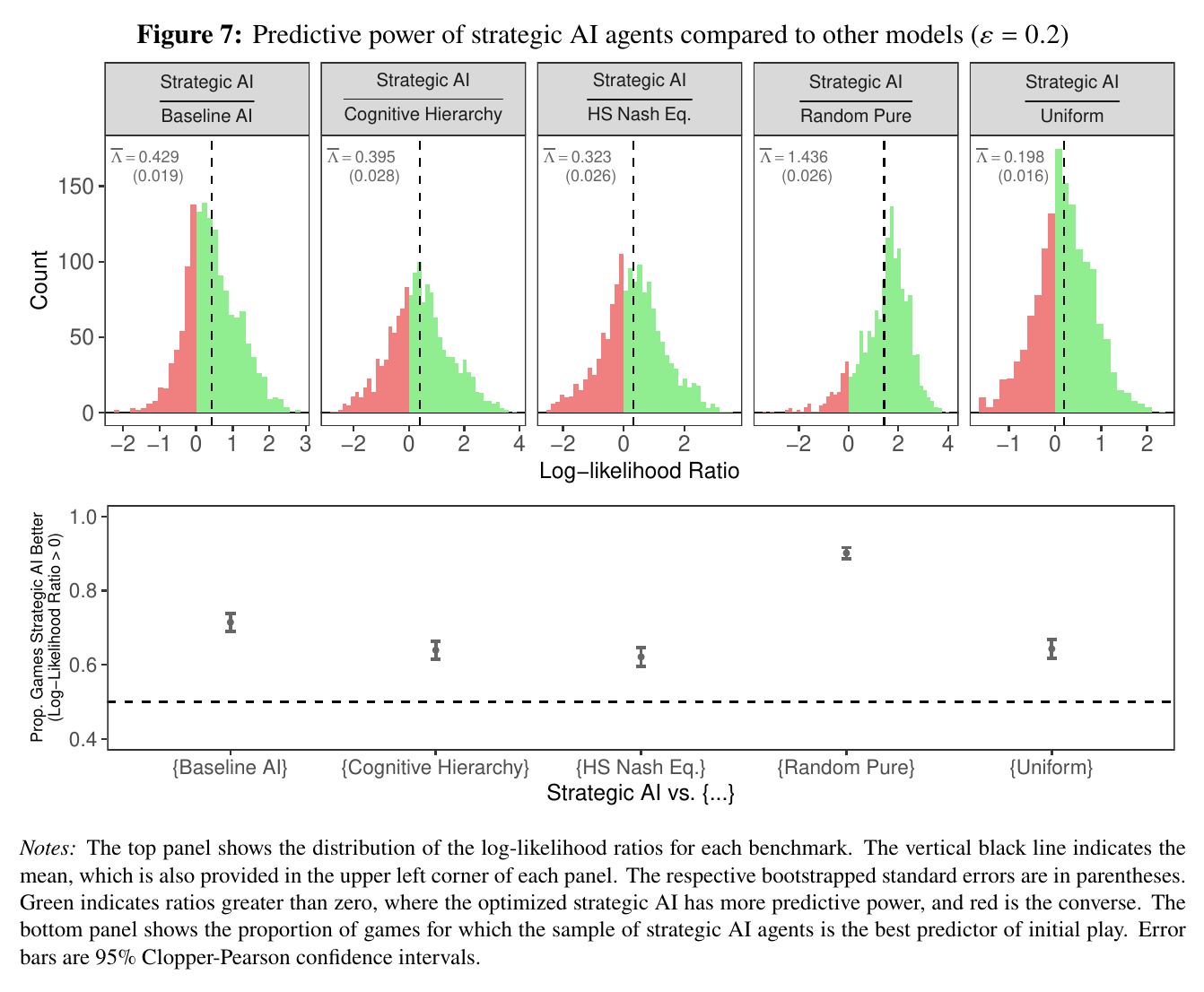
Against baseline gpt-4o, with a bootstrapped standard error of 0.019, so 54% more probability on the actions humans took, and the best predictor in 71.5% of games. Against the cognitive hierarchy model of Camerer, Ho and Chong (2004), 0.395 (0.028), 48% more, best in 64%. Against Harsanyi–Selten (1988)-selected symmetric Nash equilibria — computed with Gambit, resolving 1,487 of the 1,500 games, one of which had 10,051 symmetric equilibria — 0.323 (0.026), 38% more, best in 62.2%. All p < 0.001. The cognitive hierarchy comparison used τ = 1.5, taken from Camerer et al.’s own meta-analysis rather than fitted here; calibrating τ on the three Arad–Rubinstein games instead gives τ̂ = 2.35, and the agents still win by 121%. Worth flagging: the cognitive-hierarchy and level-k comparisons were added after the paper was posted, in response to suggestions, and the paper marks them as exploratory rather than preregistered.
The thing that should bother you
Two things in there are strange. The first is that the agents beat the cognitive hierarchy model by a wider margin than they beat Nash. Nash equilibrium is the benchmark everyone already agrees is bad at predicting initial play in one-shot games. Cognitive hierarchy is the incumbent champion, the model that exists specifically, in its authors’ words, to “explain why equilibrium theory predicts behavior well in some games and poorly in others.” The ten sentences beat the good model by more than they beat the model we all knew was wrong.
The second is stranger. On the four novel small-range games — basic, costless and cycle rebuilt for 1 to 10, plus an entirely new 1-7 game, run on 955 Prolific participants who passed screening — the agents cut prediction error by 53% to 73% versus baseline, and hit a kl of 0.16 on the brand-new 1-7 game. But in the basic and cycle versions, the agents predicted the 2025 Prolific sample better than Arad and Rubinstein’s actual 2012 human responses did, in one case halving the kl divergence. A mixture of ten English sentences fitted to 108 Israeli undergraduates outperformed those same 108 undergraduates at forecasting a different set of humans playing the same game with the numbers shifted down by ten. The paper’s explanation is the honest one: a fixed set of k-level reasoners would play the 11-20 and 1-10 games identically, so the human-to-human gap has to come from setting-specific factors — “precisely the kinds of factors that otherwise make theory difficult to apply. In the end, even highly relevant human data prove to be an imperfect predictor.”
The discussant inverted it
Matthew Jackson did not attack the paper. He did something more useful, which was to run it backwards. Level-k worked here, he pointed out; suppose instead you had tried to test whether people are risk averse, or fair, or altruistic, by writing those into the personas and seeing how well the 11-20 game came out. “It probably would have failed miserably. And so that allows us to say actually there’s something about the depth of strategic reasoning that is present in these kinds of settings.” The method, on this reading, is not a simulator. It is a hypothesis test in which the thing under test is the theory, and the evidence is what you had to write on the prompt to make the machine behave like a person. He extended it with a metaphor borrowed from earlier in the session: we learn about human disease from what kind of lab rat we had to build to test the medicine.
This converges rather than collides. Manning had put the same thought on his own open-questions slide fifteen minutes earlier — what does it mean when theoretically motivated prompts improve predictive power, given that the llm is a black box and “it’s hard to know how those actually went through” — and the paper’s conclusion says outright that a theory-grounded prompt matching human data across many related settings “might be evidence that the theory has a lot of explanatory power.” There was no author reply on the recording; the discussion ran straight into general Q&A.
Jackson also left two cautions lying around that land on this paper without being aimed at it. One is that llms are temporary — “five years from now, we’ll probably be talking about a different form of ai” — so the durable content had better be the method, not gpt-4o. The other is a finance analogy: the 1980s brought minute-by-minute stock data and, with it, the day-of-the-week effect, the January effect, the index effect, an avalanche of shiny facts. “We have to start disciplining ourselves.” His conclusion, that theory in the age of ai is still useful for guiding deployment, is more or less the thesis of the paper he was discussing. There is also an unremarked irony in his closing chess-and-Go worry about ai that predicts better than we can explain: the object fitted in this paper is ten sentences of English and ten weights, which is about as far from an uninterpretable black box as an llm method is likely to get.
The frictions
The Q&A got sharper. The session chair — the recording never names him, and the caption transcript mangles names badly enough that I would rather not guess — took moderator’s privilege and asked where the power actually comes from. He was, he said, “disappointed to learn that it’s not magic after all,” and surprised at how badly the model did out of the box on 11-20 “because the answers were right in the corpus and they could have just looked it up.” Then the real question: as models get better, they will read all of your papers too, learn the four steps to building a good simulator, and know the relevant theories, including some you didn’t think of. Will the out-of-the-box version simply be better than anything you can prompt?
Manning: “I’d love for my paper to be obsolete. I think that would be kind of cool.” Then a distinction he offered without claiming to have solved it — bad memorization is a student who memorizes that defect is the pure-strategy Nash you should always play; good memorization is a student who memorizes that a Nash equilibrium is when everyone is best responding to one another. “I don’t have a perfect answer of how I would differentiate.” Other panelists added that knowing something is not the same as using it, and that in past work where they knew a model had been trained on the data, measured memorization ran maybe 10 to 20%.
Two more caveats matter, and the paper is fairly honest about both. Nobody has run this on a frontier model on these games. Everything here is gpt-4o at temperature 1, chosen — per footnote 6 — because it was the default in the authors’ own software. Asked directly about gpt-5-class models, Manning said he hasn’t tried them on these games, and that in other settings he sees no clear pattern of better models predicting humans better “unless human responses are like more rational,” which the 11-20 game specifically is not, since the rational play depends on knowing who you are playing. Asked about the variance of the simulated responses rather than the mean, he said he hasn’t checked it and would be happy to see the procedure extended to match more moments.
And the last questioner asked the sharpest one: fine, the fancy model beats the off-the-shelf model on average — but how good is it in an absolute sense? The paper does have numbers here, on p. 33 and without any smoothing: 24% of humans picked the single action the agents put the most mass on, 53% picked one of the agents’ top three, and in 86% of games every human respondent chose something inside the agents’ support, in games whose action spaces run from 5 to 20 options. (Manning’s spoken answer included an “80%” figure that matches nothing in the paper and is probably a garbled recollection of that 86%; ignore it.) What he actually conceded is the interesting part: the games are so variable that “traditional distance metrics are not really interpretable over the vast majority,” and how to give one interpretable number across a million games with different action spaces is “a little bit of an open question. We’re still working on it.” The paper says the same thing in the language of econometrics — the log-likelihood-ratio framework provides no absolute benchmark.
Which leaves the honest summary of the thing, which is smaller and better than the title suggests. Nobody built a general social agent. Somebody fit five nonzero mixing weights to 108 college students from 2012, froze them, and dropped them into a million games nobody had ever played, where they beat the best available behavioral model. The paper is not a demonstration that large language models understand people. It is a demonstration that a very small amount of correct theory, written in plain English and attached to a large model, travels further than a large amount of curve-fitting — and that the optimizer, offered the chance, assigned Homo Economicus a weight of exactly zero.