Notes on:
Make Trade Not War?
Review of Economic Studies
2008
geoeconomics · trade and conflict · deterrence · gravity
Made with AI: Fable 5.1 (reading and writing)
Philippe Martin (Paris 1, pse), Thierry Mayer (Paris 1, pse, cepii) and Mathias Thoenig (Geneva, pse). Review of Economic Studies 75(3), 2008, pp. 865–900; this digest works from the published version. No talk recording exists for a 2008 paper; pdf-only digest. Tables and figures are cropped from the pdf. Cited by eleven of the presented papers on this list, more than any other work in the pool.
Montesquieu, with a footnote
The liberal claim is that trade pacifies: two countries that trade become reciprocally dependent, and dependence makes war expensive. The European project was built on it. Martin, Mayer and Thoenig open with the awkward fact that the first globalization ended in 1914, and that the 1990s, a decade in which trade flows “increased dramatically” (p. 866), were not a notably peaceful one. Their answer is not that Montesquieu was wrong but that he was only talking about bilateral trade. What the post-war world got was multilateral openness, and the model says those two things push the probability of war in opposite directions.
War as a bargaining failure with a price tag
The theory has two pieces. The first is a rationalist model of escalation in the Fearon (1995) tradition: a dispute over how to divide the surplus of peace, private information about each side’s payoff from fighting, and a negotiation protocol chosen optimally by the two countries. Because no institution can stop a sovereign from walking out, and because war payoffs are negatively correlated (one side’s territorial gain is the other’s loss), the Myerson–Satterthwaite (1983) result does not apply directly; following Compte and Jehiel (2005), the authors show the optimal protocol is Nash bargaining and that it fails — war happens — whenever the two sides’ outside options are close enough to the peace payoff. The probability of escalation then has a closed form (eq. 3, p. 871):
where indexes the asymmetry of information and the bracket is the total opportunity cost of war, the surplus of peace over the surplus of war. More fog, more war; a bigger price of fighting, less.
The second piece puts that opportunity cost in terms of trade. Countries produce differentiated varieties in a Dixit–Stiglitz (1977) world with iceberg costs; a war between and destroys a share of both countries’ effective labour and raises bilateral trade costs by and multilateral ones by . A Taylor expansion around a symmetric pair turns the escalation probability into a function of observable import shares (eq. 9, p. 873):
Bilateral imports raise the cost of a war with and so lower its probability (as long as war actually raises bilateral trade costs, ). Multilateral imports do the opposite: a country that sources its varieties from many partners loses little variety when one of them is cut off, so the insurance provided by the rest of the world lowers the price of a bilateral fight. The sign condition is that war does not raise multilateral trade costs much, , which is a testable statement and is tested. Result 1 (p. 874) then says that globalization, a uniform fall in trade costs among many countries, raises the probability of every bilateral war while lowering the probability of a war between two large coalitions — more local conflicts, fewer world wars — and that the increase is concentrated where disputes are frequent, that is, between neighbours.
The evidence, in two steps
The empirical work follows the theory’s order. Step one estimates and with a gravity equation on 1950–2000 trade and Correlates of War militarized interstate disputes (mids, hostility level 3 and up), with twenty lags and five leads of the conflict dummy.

A bilateral conflict cuts trade by roughly 22 percent in the plain gravity specification and 38 percent when everything is measured relative to imports from the United States to absorb the price index (Table 2, p. 878), and the coefficients stay significant for at least ten years afterwards. The preferred version, with 75 conflict dummies (25 bilateral, 25 for multilateral exports, 25 for multilateral imports), is not tabulated but plotted.
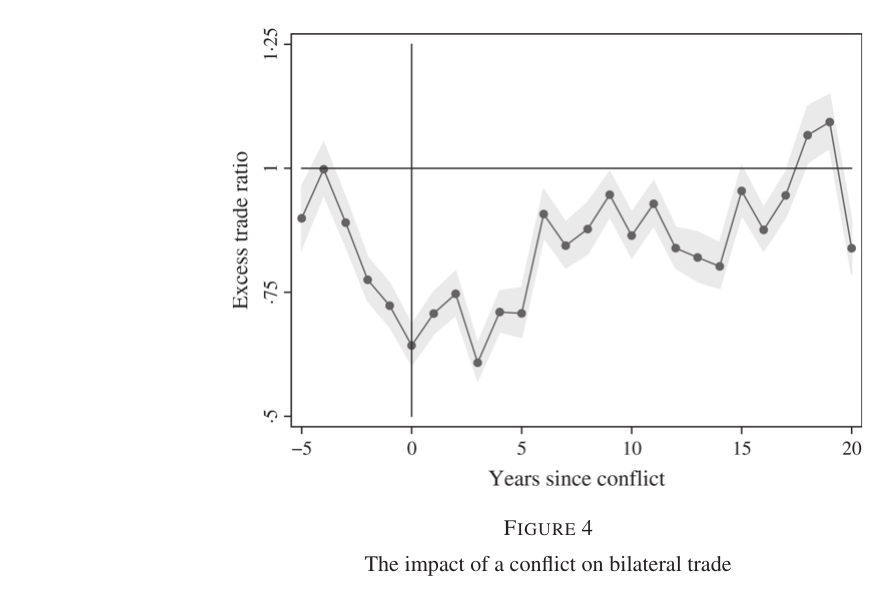
In that version bilateral trade sits more than 35 percent below its gravity norm in the year of the conflict and returns to the norm around year seventeen (Figure 4, p. 880). Multilateral exports are unaffected, and the effect on multilateral imports is “negative but very small” — “around 5% when significant” (p. 879). The conditions that sign the theory hold.
Step two runs the logit of eq. 14 (p. 880) — an mid dummy on bilateral and multilateral openness lagged four years, interacted with distance because the theory says trade works on escalation rather than on the incidence of disputes, which is a function of proximity.
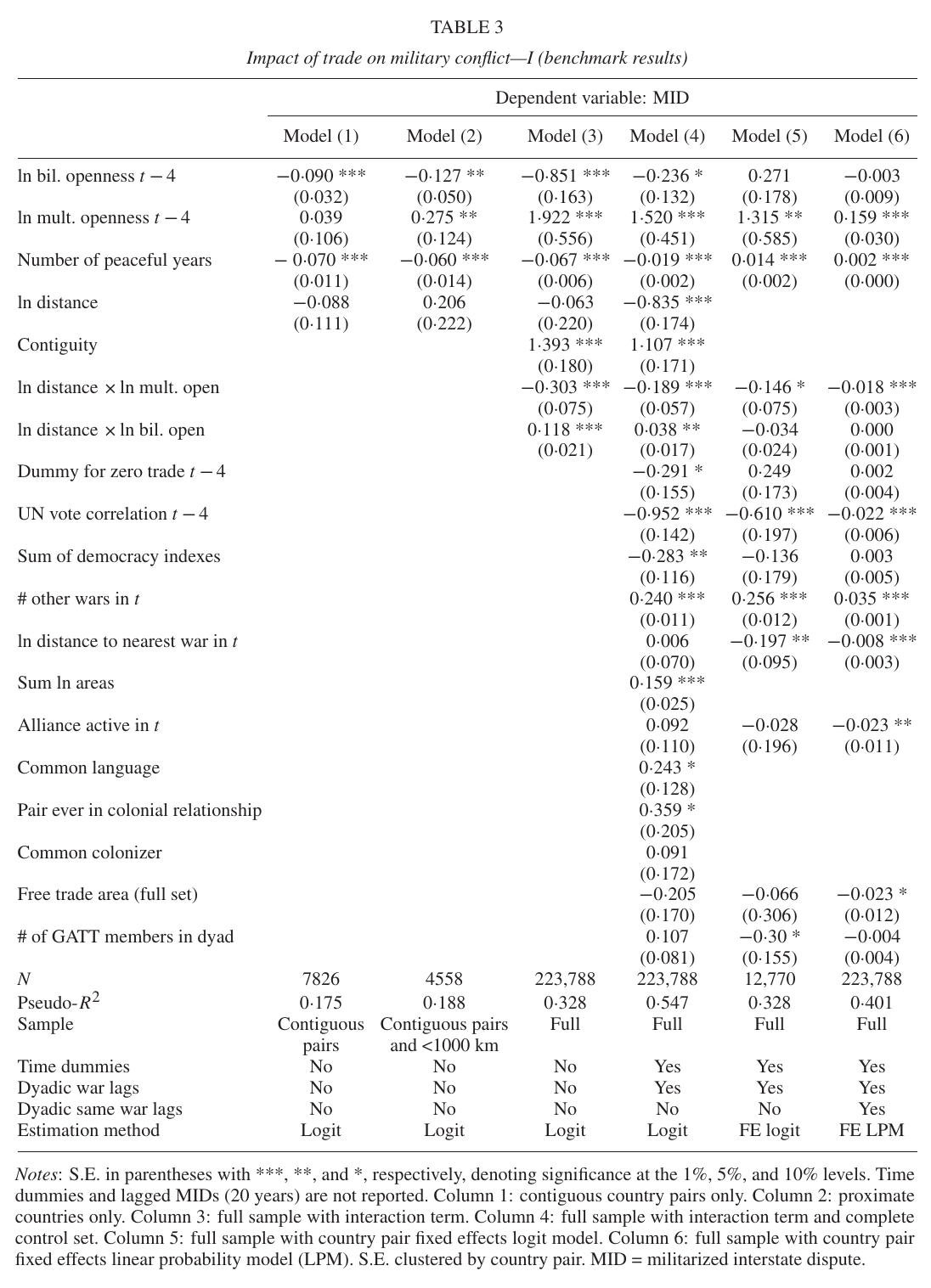
In the preferred column, bilateral openness lowers the mid probability and multilateral openness raises it, both at the predicted signs and with the predicted distance interactions, alongside controls for un-vote correlation, democracy, alliances, the count of other wars in progress and the distance to the nearest one. The two coefficients do not, however, arrive with equal confidence. The multilateral coefficient (1.520) is significant at 1 percent; the bilateral one (−0.236) is, as the paper says outright, “significant at the 10% level only” (p. 884). And the asymmetry widens from there. Across the robustness checks of Tables 4–5 (pp. 885–886) — dropping the milder hostility levels, adding Security Council and communist dummies, oil and primary-export shares by decade, trade sanctions, gdp per capita, military spending, two-way clustering — the multilateral effect is significant at 1 percent throughout, while the bilateral coefficient keeps its sign and size (between about −0.14 and −0.25) but earns a star in roughly half the columns. Under country-pair fixed effects it does not survive at all: the fixed-effects logit in column 5 gives a wrong-signed, insignificant 0.271 and the linear model in column 6 gives −0.003, while the multilateral coefficient stays at 1.315 and 0.159, both significant. The authors are candid about this. The fixed-effect columns, they write, “serve mostly to test the impact of multilateral trade on the probability of conflict in the time dimension” (p. 884), and their summary is that the multilateral result “is very robust” while the bilateral one “is somewhat less robust in terms of statistical significance, although the magnitude of the coefficient is very stable” (p. 887). Their diagnosis is measurement error in the bilateral trade of pairs that fight, which is exactly the kind of noise a within-pair estimator amplifies, and it is what the instruments are meant to fix.
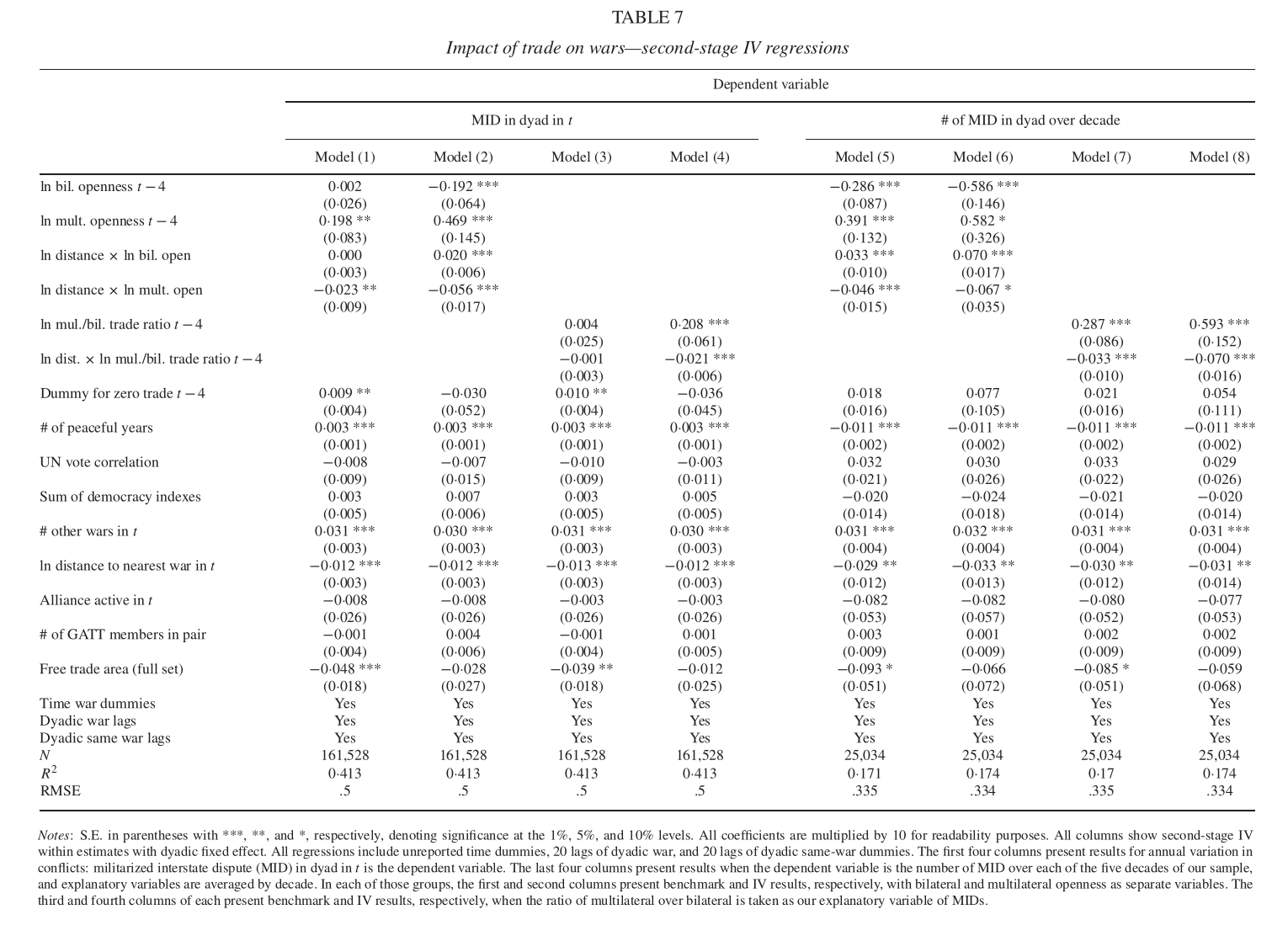
Section 3.5 does that with two time-varying instruments: the eu’s Generalized System of Preferences (a multilateral-trade shock to recipients, lagged eight years, with the donor countries dropped from the sample) and a remoteness index built from third countries’ gdp growth, which the first stage shows shifts bilateral trade far more than multilateral (Table 6, p. 892). The second stage is where the bilateral effect comes back. Without instruments, the within-pair linear model on this sample gives a bilateral coefficient of 0.002 — zero — and a multilateral one of 0.198, significant at 5 percent; instrumented, the bilateral coefficient becomes −0.192 and the multilateral 0.469, both at 1 percent, with the distance interactions signed as the theory predicts (Table 7, p. 893, all coefficients times ten). The authors read the contrast the same way: “while the coefficient for multilateral trade remains quite stable, the one for bilateral trade is quite different from its value found in the non-instrumented specification,” which “confirms our view that endogeneity bias and measurement error are more a source of concern for bilateral trade than for multilateral trade” (p. 891). The compact version that puts the multilateral-to-bilateral ratio on the right-hand side has two instruments for one endogenous variable, so a Sargan test is available; the statistic is 0.001, p-value 0.97 (p. 892). So the instruments rescue the Montesquieu effect in the time dimension — but even rescued it is well under half the size of the multilateral coefficient pushing the other way, which is the ordering the quantification below turns on.
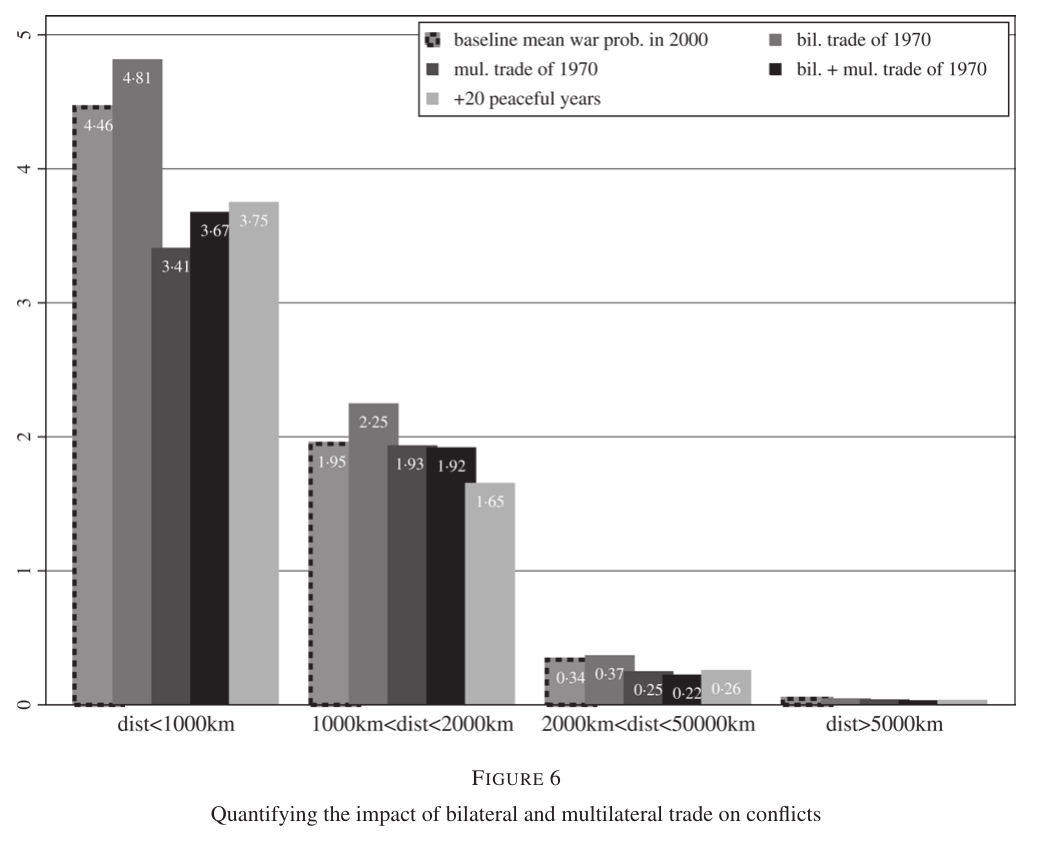
The quantification is the paper’s memorable number. For pairs closer than 1,000 km, the 2000 baseline probability of an mid is 4.46 percent; returning bilateral trade to its 1970 level would raise it to 4.81, returning multilateral trade would lower it to 3.41, and undoing both — undoing globalization — gives 3.67 (Figure 6, p. 889). Thirty years of globalization raised the probability of conflict between neighbours by about a fifth, roughly the effect of erasing twenty years of peace (p. 888). Notice the proportions: the multilateral counterfactual moves the probability by about a full percentage point, the bilateral one by a third of that. Beyond 2,000 km the effects are negligible, which is consistent with the paper’s other stylized fact, that the average distance between belligerents halved between 1950 and 2000 (Figure 2, p. 867).
There is a small irony in how the two halves of the result hold up. The half everyone already believed, that trading partners fight less, is the one that is significant at 10 percent in the headline column, disappears within pairs and needs instruments to reappear. The half nobody wanted, that an open, diversified economy is a cheaper place to start a fight from, is the one that survives everything the authors throw at it.
What the paper leaves open, and where the successors went
The authors flag two things. The Dixit–Stiglitz substitutes assumption is what makes multilateral openness an insurance policy; with complementary intermediate inputs the rest of the world cannot replace a lost partner and the multilateral effect could reverse (p. 874, and again in the conclusion, p. 894). And the model has no spillovers across pairs, so a war between and does not change anyone else’s escalation calculus (footnote 7, p. 871) — the empirics patch this with the count of other wars in progress and the distance to the nearest one, both of which matter, but the theory is silent on it. The first caveat is precisely what the production-network papers in 1.0 are about, and it is why the Fragmentation Paradox has to be quantified rather than signed.
Where it sits
Presented (empirical) in 2.5, and the sub-block’s anchor; the most-cited paper in the pool for a reason: it is the one place where the cost of war is derived from a trade model rather than assumed, and the result that came out — dependence on one partner deters, diversification emboldens — is the unwelcome inverse of the “resilience” agenda. Mayer–Méjean–Thoenig’s (2025) Fragmentation Paradox (1.3) is this paper with a modern quantitative trade model and de-risking as the policy; Thoenig’s (2024) handbook chapter (2.5) is the toolkit that generalizes its two steps; Glick–Taylor (2010) (2.5) is the long-run version of step one; Rohner–Thoenig–Zilibotti (2013) (2.5) replaces the private-information friction with trust. Read it before any of them, and read Fearon first.