Notes on:
Menstrual Stigma and Human Capital: Experimental Evidence from Madagascar
CEPR Discussion Paper 21167
28 July 2026
development · education · gender
Talk · Paper · PDF · Transcript
Written by Fable 5
Part of NBER Summer Institute 2026 — Development Economics
Karen Macours (pse), Julieta Vera Rueda (World Bank) and Duncan Webb (Princeton), presented by Webb as a nine-minute lightning talk at nber Summer Institute Development Economics, July 28, 2026. Source note: the pdf used is the May 2024 working-paper version (the current draft circulates as cepr DP21167, which is gated); where the talk’s numbers differ slightly from the 2024 draft, I flag it. Timestamps refer to the session video.
The economics of menstruation has, until now, mostly been the economics of stuff: give girls pads and toilets, the theory goes, and they’ll stop missing school during their periods, and attendance gains will become learning gains. It is a sensible theory with an inconvenient empirical record — the literature keeps failing to find the attendance effects. This paper’s contribution is to run the horse race properly and discover that the stuff-and-attendance theory has the mechanism backwards. The intervention works, rather dramatically — and it works through stress and social climate, not through toilets.
The experiment covers 140 secondary schools in Madagascar (N≈2,250 girls), where the team — working with care — deployed a bundle: sanitation infrastructure, menstrual products, and teacher-led sensitization sessions targeting the stigma itself, the taboo that makes menstruation unmentionable and menstruating girls fair game for harassment. A second treatment arm added “young girl leaders” — schoolgirls nominated and coached to speak openly against menstrual stigma among their peers.
The headline is a learning effect that has no business coming from a hygiene program: roughly 0.2 standard deviations on standardized tests combining math, literacy and cognitive skills — Webb places it at the 75th percentile of evaluated learning interventions — plus a jump in grade progression from about 52% to 63% of girls between year one and year two, in administrative data.
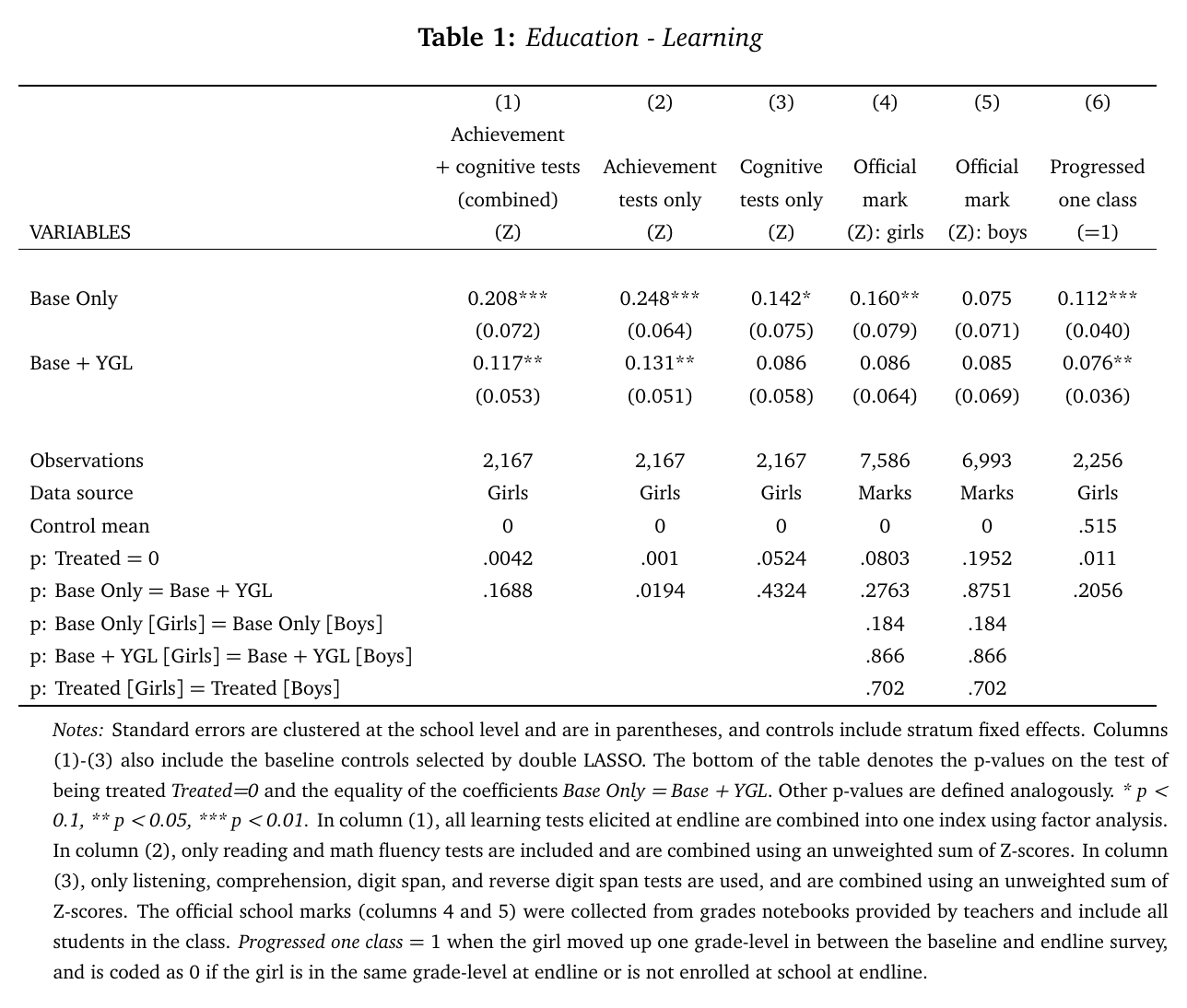
Now the detective work, which is where the paper earns its keep. If this were the textbook channel, you’d see attendance and health improve. You don’t: no measurable effect on enrollment, attendance, or physical health, and the grade-progression gains show up before the infrastructure was even fully in place. What does move is a cluster of psychosocial measurements the team had the foresight to collect: girls’ resting heart rate at endline is lower in treatment schools (a physiological stress proxy that is hard to self-report your way into), severe bullying falls, and girls’ integration into friendship networks improves. The interpretation: a schoolgirl managing a stigmatized biological event in a school with no toilets and active teasing is a schoolgirl under chronic stress, and chronic stress is bad for learning math. Remove some of the stigma and the fear, and the same girl in the same classroom learns more. The paper is appropriately careful that these channels are “possibly interrelated” rather than cleanly separated — but the null on health and attendance makes the conventional story hard to sustain.
The stigma outcomes themselves are enormous by the standards of attitude-change interventions — the 2024 draft reports hygiene knowledge and behavior indices up 0.33–0.56 sd and menstrual stigma down 0.74 sd for the combined program, with the young-girl-leader arm amplifying the knowledge and stigma effects. Interestingly, the leaders add nothing to learning (their arm’s learning effect is, if anything, smaller than the base program’s), and there is some evidence of crowd-out for the girls willing to publicly defy a taboo. And one genuinely uncomfortable result, reported with commendable directness: the base-only program raises pregnancy rates, an effect attenuated in the young-leader schools — which the authors connect to the improved school social environment, girls and boys simply being more likely to be friends. Destigmatization is not a free lunch; it changes the whole social equilibrium, not just the part you wanted.
The team is now working with the education ministry and the World Bank to scale the program to a majority of Madagascar’s secondary schools. Webb’s closing pitch is that menstrual stigma belongs on the short list of quantitatively serious barriers to girls’ schooling — not because girls are missing class, which was the story everyone assumed, but because shame turns out to be a tax on cognition, payable in test scores. As with most taxes, the surprise was in the incidence.