Notes on:
America's Risky Debt: What Markets See That Policymakers Don't
The American Economy in a New Era (Aspen Economic Strategy Group)
2026
Treasury markets · fiscal policy · safe assets · financial repression · Federal Reserve
Paper · PDF
Written by Fable 5
Hanno Lustig (Stanford gsb), a chapter in “The American Economy in a New Era” (Aspen Economic Strategy Group, eds. Melissa Kearney and Luke Pardue), August 2026, based on joint work with Roberto Gómez-Cram, Howard Kung, and David Zeke. Written from the published August 2026 chapter; no recorded talk for this specific piece was found — Lustig’s earlier recorded talks (the public-debt valuation puzzle, financial repression) cover the underlying research program, but this digest is pdf-only.
There are two models of United States government debt currently in operation, and the interesting thing is who is using which. Bond investors — the people with money at stake — have concluded that Treasuries are risky assets: claims whose value falls when Congress passes unfunded spending, exactly the way a corporate bond falls when the company levers up. The Federal Reserve and the financial regulators — the people who write the models and the rules — still assume Treasuries are safe: in their workhorse macro frameworks future taxes adjust to pay off whatever the government issues, so an unfunded spending shock is definitionally impossible, and in the prudential rulebook banks hold zero extra capital against even the longest-dated Treasury. Traders price the debt as risky; the officials supervising them assume it is not. Lustig’s chapter is about what happens at the seam between those two models, and his answer is that the seam has a name: “plumbing.”
The safe-asset scorecard. The safe-asset model made four observable predictions, and Lustig’s first move is to note that all four held before 2020 and all four have since failed. Treasuries used to be expensive relative to close substitutes — investors accepted a lower yield, the “convenience yield,” in exchange for safety and liquidity; on both of the standard measures that premium has compressed to zero or gone negative. The credit-risk-adjusted spread over aaa corporates (strip default risk out with cds prices and see what’s left) has fallen from 30–60 basis points pre-crisis toward nothing. The Du–Im–Schreger (2018) Treasury Premium — us yields against G10 sovereign yields swapped into dollars, so currency risk washes out — now averages minus 18 to 22 basis points at the 5- and 10-year points: global investors pay a premium for German bunds over Treasuries, not the reverse. The stock–bond correlation, reliably negative for two decades (bonds rallied when stocks crashed, which is what made them a hedge), flipped positive in 2020 and stayed there. The flight-to-safety reflex is gone: in March 2020 the 10-year yield rose 68 basis points in eight trading days while the world ended, and during the April 2025 tariff announcement stocks and long bonds sold off together. And foreign central banks, the classic price-insensitive holders, have let their share of foreign Treasury holdings fall from about 72 percent in 2010 to about 42 percent at end-2025.
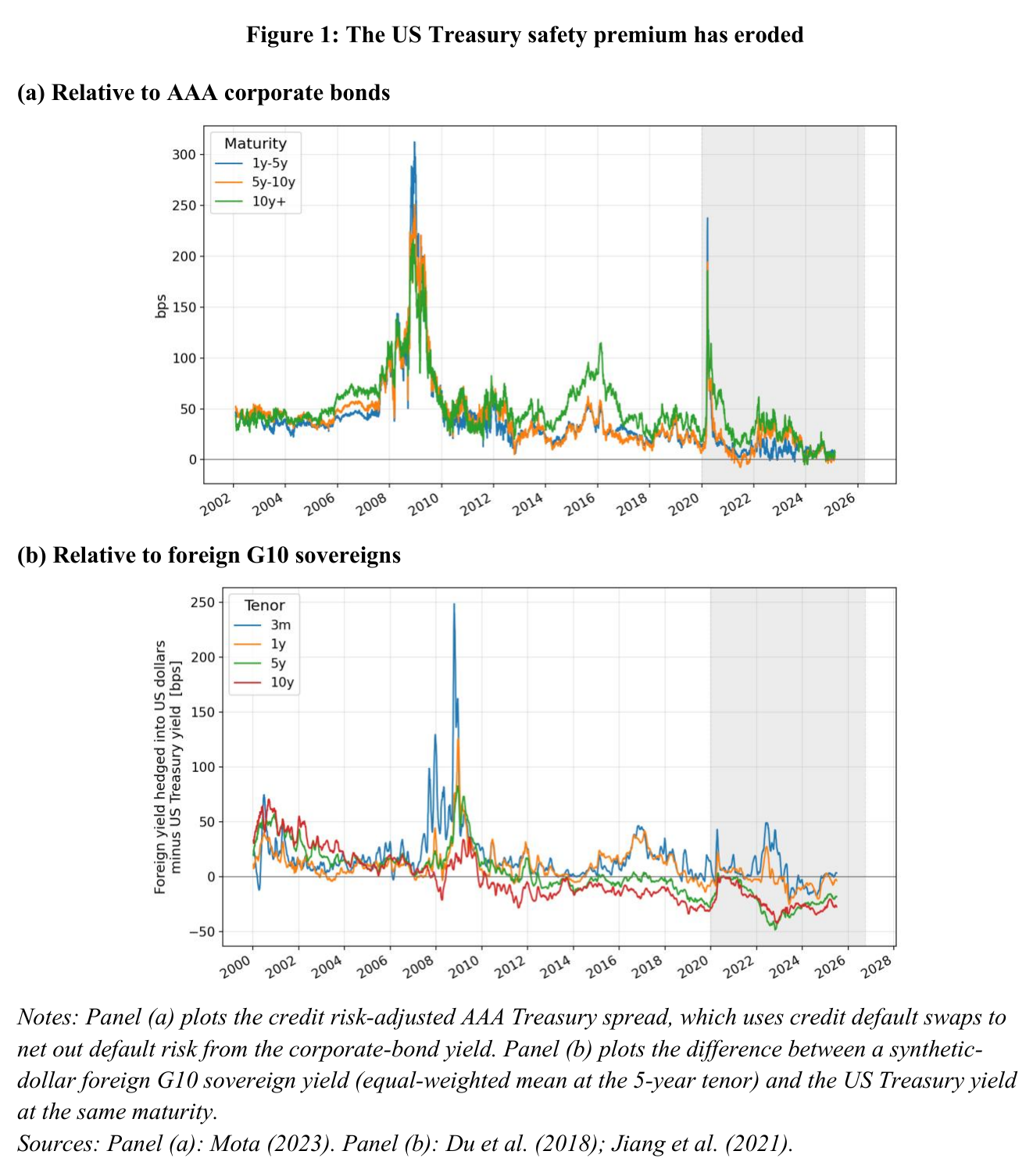
He is careful with the obvious objection — that the correlation flip just reflects a supply-shock-heavy decade, not a repricing of sovereign risk — and the rebuttal is the most technically satisfying part of the chapter: decompose the stock–bond covariance and the flip loads on the convenience-yield component, not on expected inflation or real rates where a shock-mix story would put it; and it is concentrated at the long end while the two-year keeps hedging fine, which a macro shock mix can’t easily produce but duration-specific fiscal risk produces exactly.
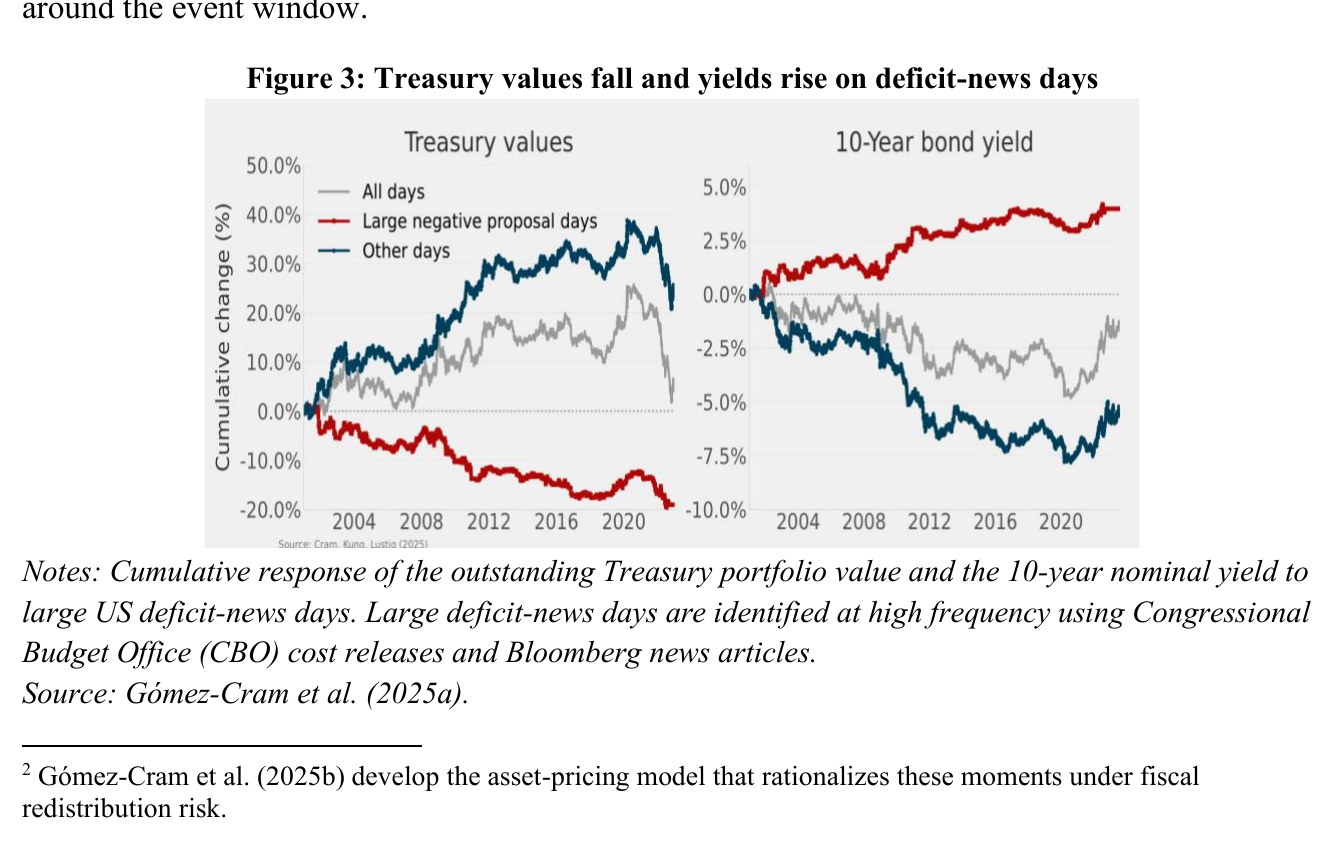
The direct evidence. The sharpest fact comes from the high-frequency work this chapter synthesizes: identify the days when investors learn about future deficits (cbo cost releases, Bloomberg headlines) and cumulate the bond-market response. On large deficit-news days, the outstanding Treasury portfolio lost roughly 21 percent of its value cumulatively over 1997–2022, and the 10-year yield rose about 4.33 percentage points cumulatively — with essentially all of the sensitivity coming after 2020. Through the 2010s, yields barely moved on deficit news, which is what the safe-debt model predicts; now they move a lot, through rising term premia, rising long-run inflation expectations, and falling convenience yields, and pointedly not through cds spreads — investors aren’t pricing default, they’re pricing being repaid in less valuable dollars. Bad fiscal news is absorbed by bondholders, not by future taxpayers. That is the definition of risky debt.
“Plumbing” is doing a lot of work. Here is the mechanism the chapter actually turns on. When Treasuries sell off, the two models generate opposite diagnoses. Under the risky-debt model, the sell-off is price discovery: investors read fiscal news, marked the bonds down, market working as intended. Under the safe-debt model, safe assets don’t sell off on fiscal news — so if they did sell off, something must be broken, and the Fed’s diagnostic vocabulary supplies the category: a plumbing problem, a dash-for-cash, dealer balance-sheet congestion, calling for the Fed to step in and buy. The same price move is either information or malfunction depending entirely on which model you brought to it, and one of the two diagnoses comes bundled with an instruction to make the price move go away.
The diabolical part — and Lustig is honest that this is what makes the problem hard rather than a simple morality tale — is that the plumbing crises are usually real. The uk’s September 2022 mini-budget is his worked example: an unfunded £45 billion tax cut sent 10-year gilt yields from 3.5 to above 4.5 percent in four days, which triggered genuine, mechanical margin-call cascades in pension funds’ leveraged liability-driven-investment positions, which the Bank of England genuinely had to contain. The plumbing distress was authentic; it was also entirely downstream of a fiscal shock. March 2020 in the us had the same anatomy: trillions in pandemic fiscal packages hit a market where leveraged hedge funds had replaced balance-sheet-constrained dealers as the marginal absorber of duration, margin calls forced unwinds, and the Fed bought 1.6 trillion dollars of Treasuries under a market-functioning rationale. The yield spike wasn’t even us-specific — gilts, oats, and bunds sold off in the same window, which no story about American repo microstructure can explain, but a global repricing of sovereign risk ahead of massive fiscal expansions can. The fiscal trigger and the plumbing crisis are one event; the Fed’s frame only has a name for the second half.
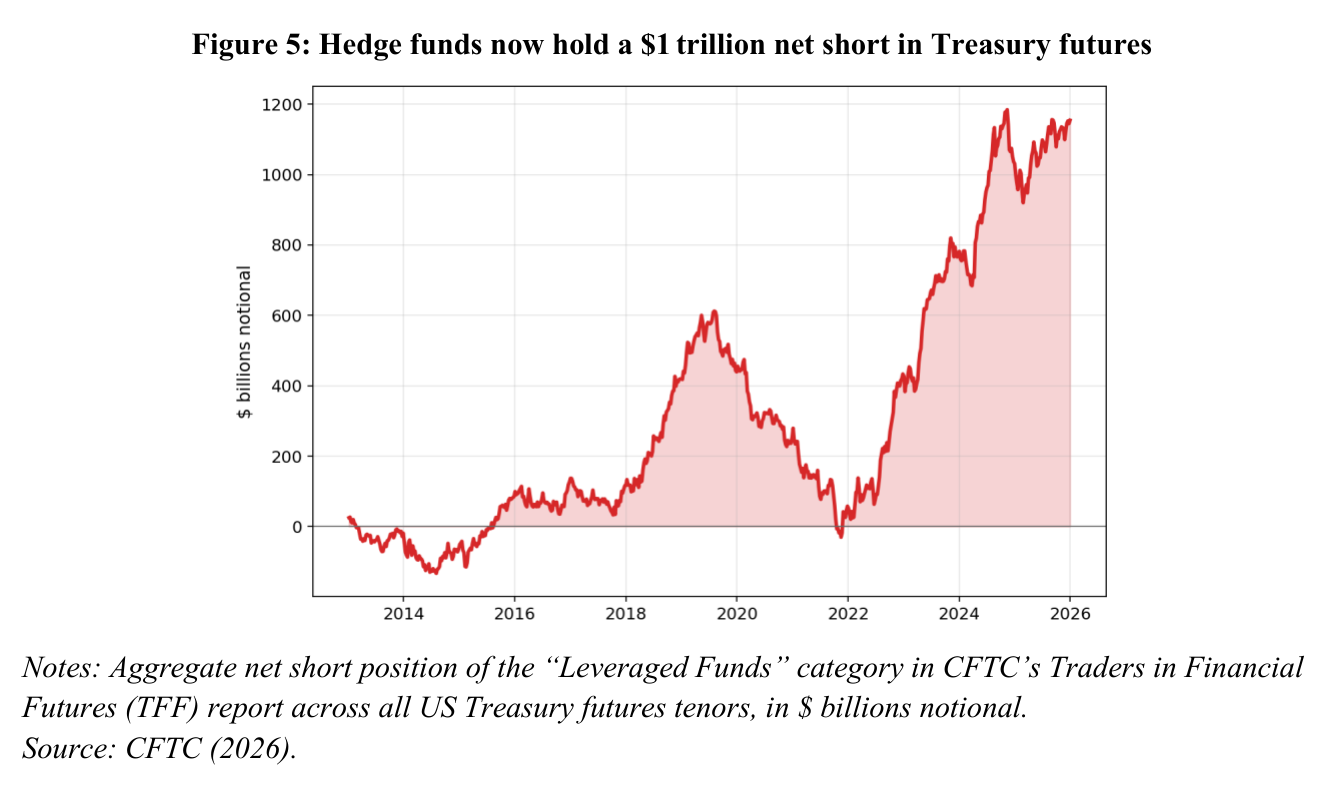
The moral hazard compounds. The March 2020 rescue made whole the hedge funds running the cash–futures basis trade — buy the bond, short the future, lever the spread fifty-to-one in repo — without conditions. Those funds learned the Fed will backstop their carry trade when it backs up, and behaved accordingly: the aggregate hedge-fund net short in Treasury futures, about half a trillion dollars on the eve of March 2020, stands at 1.15 trillion at end-2025. The next stress event arrives with a bigger version of the same accelerant, and the paper’s structural sections explain why the absorber got this fragile in the first place: the erosion of the long-end premium pushed Treasury issuance toward T-bills (25.2 percent of ex-Fed marketable debt, above the advisory committee’s recommended range), and post-2008 leverage rules pushed intermediation from dealers to leveraged funds. The plumbing fragility is itself a symptom of the fiscal repricing — which is why classifying the resulting stress as plumbing is not just wrong but systematically wrong, wrong in the direction that always recommends intervention.
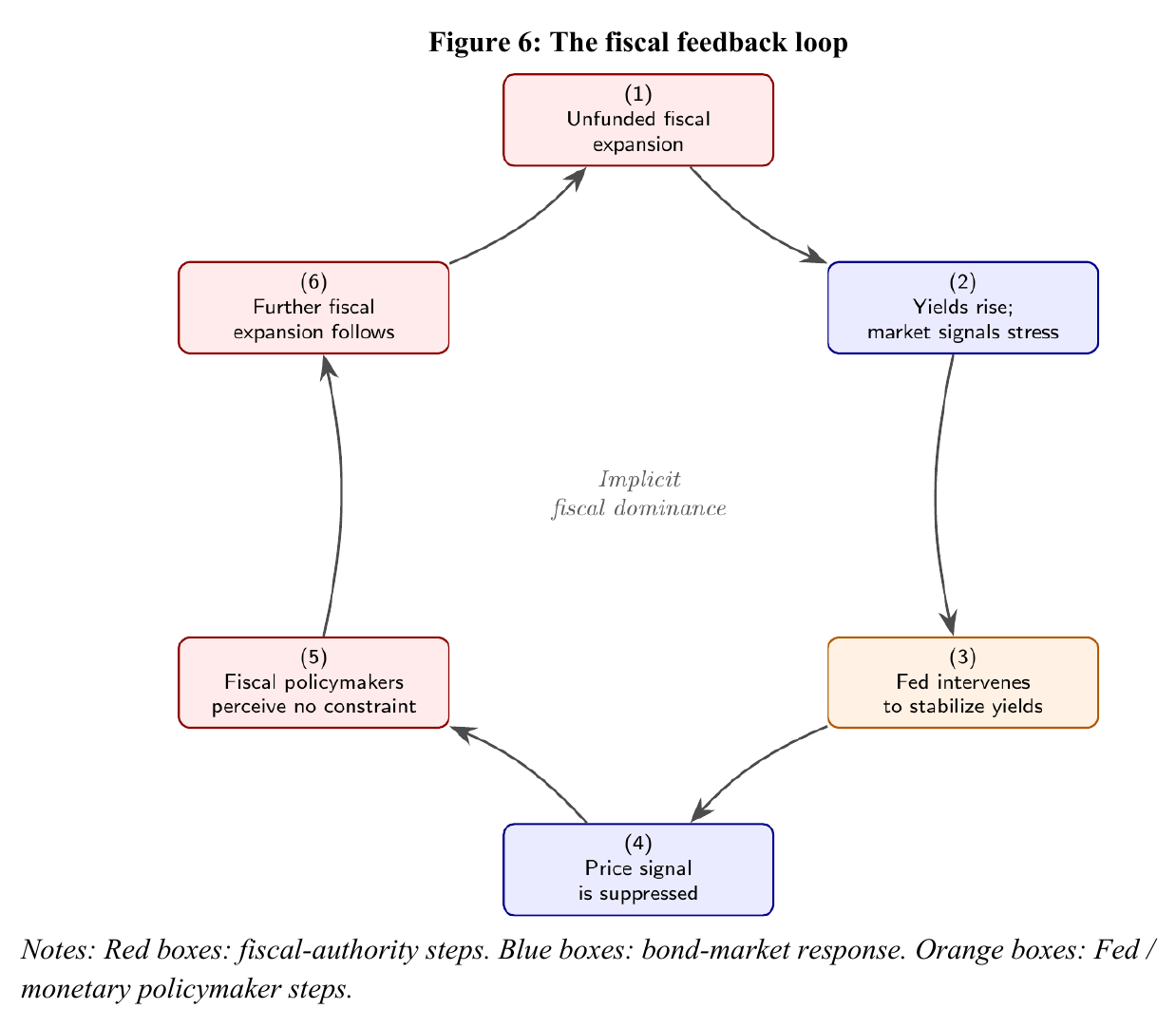
The feedback loop. Put the pieces together and you get the chapter’s central diagram, which is a perpetual-motion machine for deficits: Congress passes an unfunded expansion; yields rise as the market reprices; the Fed reads the spike as dysfunction and intervenes; the price signal is suppressed; Congress, seeing calm yields, perceives no constraint; repeat. Lustig calls the steady state implicit fiscal dominance — nobody ordered the Fed to finance the government, its mandate is unchanged, but if its operating doctrine reliably classifies fiscal-shock yield spikes as market malfunctions, the practical effect is identical to the explicit version. And he adds a genuinely uncomfortable institutional observation: central-bank independence with a narrow mandate makes this worse, not better, because the Fed has no institutional standing to say “this yield spike is about the deficit” — that would be commenting on fiscal policy, outside its lane — while “market functioning” sits squarely inside its Section 14 authority. The independence architecture that was supposed to prevent fiscal dominance biases the central bank’s diagnosis toward the one label that keeps the loop running. He argues the loop is already turning: the Fed’s decision earlier this year to halt balance-sheet runoff and reinvest into T-bills, justified as repo-market maintenance, is relieving funding pressure created by the basis trade, which exists at this scale because of the fiscal path.
The endgame, if the loop keeps running, is financial repression — the government borrowing at below-market rates because its central bank warehouses the debt — and Lustig insists this is a tax, with an incidence: it falls on savers in deposits and nominal claims, disproportionately the young, poor, and financially unsophisticated, levied by an agency with no taxing authority. The precedents are not reassuring. The Fed capped long yields at 2.5 percent from 1942 to 1951; when inflation hit 14 percent in 1947, bondholders lost roughly a third of their real wealth before the Treasury–Fed Accord ended the peg. The Bank of Japan owns over half the jgb market, and the yen depreciated some 45 percent in real terms between 1997 and 2023. Against a cbo baseline of 6–7 percent deficits and debt heading toward 190 percent of gdp by 2056, the menu is primary surpluses, inflation tax, or repression — and suppressing the bond market’s price signal quietly crosses the first option off the list.
What he wants. The prescriptions follow from the diagnosis: a new Fed–Treasury Accord, modeled on 1951, committing the Fed to stay out of the Treasury market except for narrowly defined money-market emergencies, and to a much smaller balance sheet; explicit ex-ante criteria for what counts as “dysfunction,” plus ex-post legislative review and disclosure of the distributional consequences of asset purchases (his Eurozone reading — the ecb has the strictest independence and narrowest mandate of any major central bank and still ended up running extensive quasi-fiscal operations, each reframed as monetary policy — is that mandates alone don’t bind without accountability); plumbing reforms that add resilience without re-encoding the safety assumption, notably central clearing of Treasury repo and a leverage-ratio recalibration that distinguishes holding Treasuries (real duration risk) from intermediating them (matched-book, not) rather than a blanket carve-out; and, most fundamentally, that regulators and the Fed simply abandon the safe-debt model their tools are built on, since the market they supervise already has.
A skeptical reader will note what the chapter concedes in passing: the liquidity-versus-fiscal distinction “may be unworkable in real time,” since in every worked example the fiscal shock caused the liquidity crisis — which means the narrow reform (better dysfunction criteria) doesn’t obviously survive contact with an actual crisis, and the strong reform (the Fed credibly watching a Treasury auction fail) requires exactly the kind of commitment that tends to dissolve at 2 a.m. on the bad night. Lustig’s implicit answer is that this is precisely why the commitment must be institutional — an accord, not a doctrine — because no committee, holding the current model, will ever choose price discovery over stability in the moment. The market has repriced America’s debt; the remaining question is how long its central bank can keep classifying that information as a leak in the pipes.