Notes on:
Now Hiring: Firm-Level Adoption of Generative AI in China
World Development Report 2026 background paper
23 September 2026
generative AI · technology adoption · job postings · China
Talk · Paper · Slides · PDF · Transcript
Made with AI: Opus 5.5 (reading and writing), GPT 6-Sol (reading), Fable 5.1 (adjudication), GPT 6-Astra (verification)
Part of Economics of Artificial Intelligence, Fall 2026
Lixing Li, Zhencen Liu, Anqi Wang, He Wang and Shu Yu; presented 23 September 2026 at the nber Economics of Artificial Intelligence conference (Fall 2026, Toronto), day 1; discussant Kristina McElheran; read from the 16 September 2026 conference draft, which is also a background paper for the World Bank’s World Development Report 2026.
“Now Hiring: Firm-Level Adoption of Generative ai in China” measures how far generative ai has spread through Chinese firms by reading their job ads. The rule is simple: a firm becomes a “GenAI adopter” in the month it first posts a vacancy that explicitly asks for a GenAI tool or a GenAI technical skill. The headline is that by the end of 2025, 21% of Chinese listed firms had done this, against 0.17% of non-listed firms. There was a large, visible jump when DeepSeek-R1 came out in January 2025. The rest of the paper is about who the 21% are, and the discussion was mostly about what the 0.17% actually counts.
Why count job ads
You would like to know whether firms are using a technology. You could ask them. The trouble, which the draft’s Section 2 sets out at some length, is that the answer depends on how you ask. China’s 2024 National Economic Census puts enterprise ai use at about 20%. The 2025 esiec survey of micro and small firms says 26% of owners use ai in their operations. In the us, the Census Bureau’s btos gets 18% firm-weighted and 32% employment-weighted for November 2025 to January 2026, and an executive survey with a broad definition gets 78%. The presenter summarised the respondent problem nicely. Workers say “of course everything is verified by myself, I’m not using it,” while owners, “for some strategic purposes,” overstate how important ai is to their production. So surveys are cheap talk in both directions. Patents find the firms that build ai, not the ones that use it. Keyword counts in annual reports find the firms that want investors to think they use it.
A job ad is different because it costs money. It commits the firm to screening, interviewing and paying someone. So a posting that says “familiar with using tools such as ChatGPT” (the example on the slide) is a revealed preference: the firm paid a small but real price to say it wants the capability. That is the whole case for the measure, and it is a good case. It also defines what the measure cannot see. A firm that just buys a DeepSeek subscription for its staff, or tells its existing accountants to start using Doubao, never posts anything and never gets counted. The authors say this up front: the measure misses off-the-shelf use, external providers and retraining, and a vacancy is an intended hire, not an actual one.
The plumbing
The draft covers about 72 million unique postings from 2015 to 2025. It takes all of 51job.com (67 million unique postings after deduplication), matches employer names to the saic business registry, and gets a non-listed sample of roughly 2.5 million firms. (In the talk this became “2.1 million”; the draft says about 2.5 million in several places, and the regressions use 2,438,447.) For just over 5,000 listed firms, it adds Zhaopin and Liepin, matching by stock id, and removes cross-platform duplicates with a character-bigram Jaccard rule. That rule is described slightly differently in the main text and the appendix, which fits the presenter’s opening line: “this is actually very much work in progress, we just rushed to submit the paper to the workshop.” The keywords come in three bins. GenAI tool covers product names (ChatGPT, DeepSeek, Qwen, Doubao, Ernie Bot, Claude, Midjourney). GenAI tech covers techniques (llm, rag, fine-tuning, prompt engineering, aigc). Earlier ai covers pre-ChatGPT terms (deep learning, computer vision, nlp), which serve as both a diffusion benchmark and a proxy for ai staff the firm already has. There is also a Chinese-specific false-positive problem, which is funny in the way only real data problems are: “llm” in a law-firm ad means a Master of Laws, and “gan” can be a pinyin syllable rather than a generative adversarial network. Removing false positives is described as “in progress.”
The bins carry more weight than the plumbing. Asking for ChatGPT is asking for a user. Asking for rag and fine-tuning is asking for someone who wires models into the firm’s own data. The draft calls tech-only or tool-plus-tech adoption more “sophisticated” than tool-only. That is fair as a statement about which skills are demanded. McElheran was careful not to treat it as settling the make-versus-buy question, and it doesn’t: a keyword tells you what the firm wants its new hire to know, not whether the firm builds or buys.
The DeepSeek moment
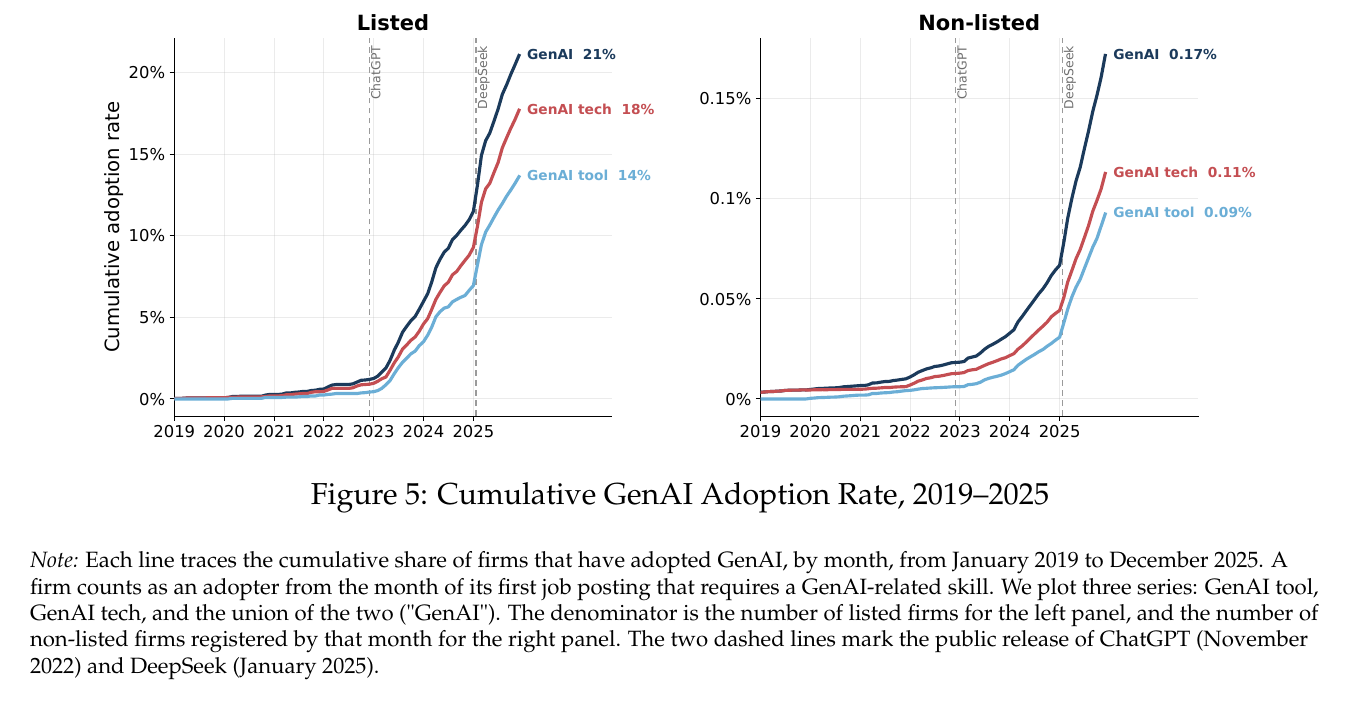
The picture is the paper. Listed-firm adoption is roughly zero at the end of 2022, reaches 11% by the end of 2024 and 21% by the end of 2025, and there is a near-vertical step at the DeepSeek line. In the talk, the presenter described the listed series as jumping “all the way to 15” around January or February 2025. The chart is consistent with that, though the draft never states a 15% figure. The draft calls the 2025 increase “the largest single-year increase that has been recorded so far, much larger than what is seen after the release of ChatGPT.” For non-listed firms the rate rose 2.7 times between 2024 and 2025. Tool adopters doubled among listed firms (7% to 14%) and roughly tripled among non-listed firms (0.03% to 0.09%). By 2025 DeepSeek was the second most-named tool in the ads, behind ChatGPT. One questioner noted, with some amusement, that ChatGPT is blocked in China.
The authors’ reading is that DeepSeek was domestic, cheap and easy to localise, so it lowered price and integration barriers, especially for smaller firms. That is plausible. It is also a time-series break on a single date, and several things happened around that date, which the Q&A took up.
A note on the right panel’s number. The chart label and the draft’s own text on the same page say 0.17%. The abstract, the introduction, the slides and the talk all round it to “0.2 percent.” The figure’s value is 0.17%. The rounding is harmless, except that it rounds up a number that is already very small and is the subject of the next section.
The surprise, stated carefully
The surprising thing is how small the non-listed number is. By this measure, only about one in six hundred non-listed Chinese firms had ever posted a job asking for GenAI skills by the end of 2025. The census says about a fifth of Chinese enterprises use ai. The obvious reading is “uses ai versus hires for ai,” a hundredfold gap, which suggests almost all Chinese ai adoption happens without anyone being hired to do it.
That comparison changes too many things at once to be taken literally. The census asks about any ai, not GenAI. It covers a different population: the draft’s appendix says the 51job-matched non-listed firms are about 4% of all enterprises. esiec surveys owners of micro and small firms. The dates and the measures also differ. The closer comparison uses the draft’s any-ai hiring rate for non-listed firms, which its appendix puts at 2.28% by the end of 2025. That is still about nine times below the census’s 20% and eleven times below esiec’s 26%, with the samples still mismatched. So the honest version of the surprise is one order of magnitude once you align the technology, and two only if you insist on GenAI-specific hiring. That is still a large gap. It says the hiring channel and the using channel are mostly different things for small firms, which makes sense: a firm with five postings in a decade is not going to create a “prompt engineer” role for a model its staff can just open in a browser.
The listed-firm number, 21% for GenAI hiring, sits inside the survey range. So the measure agrees with the surveys where firms are large and diverges where they are small, which is where you would expect a hiring-based measure to lose touch with use.
Who adopts
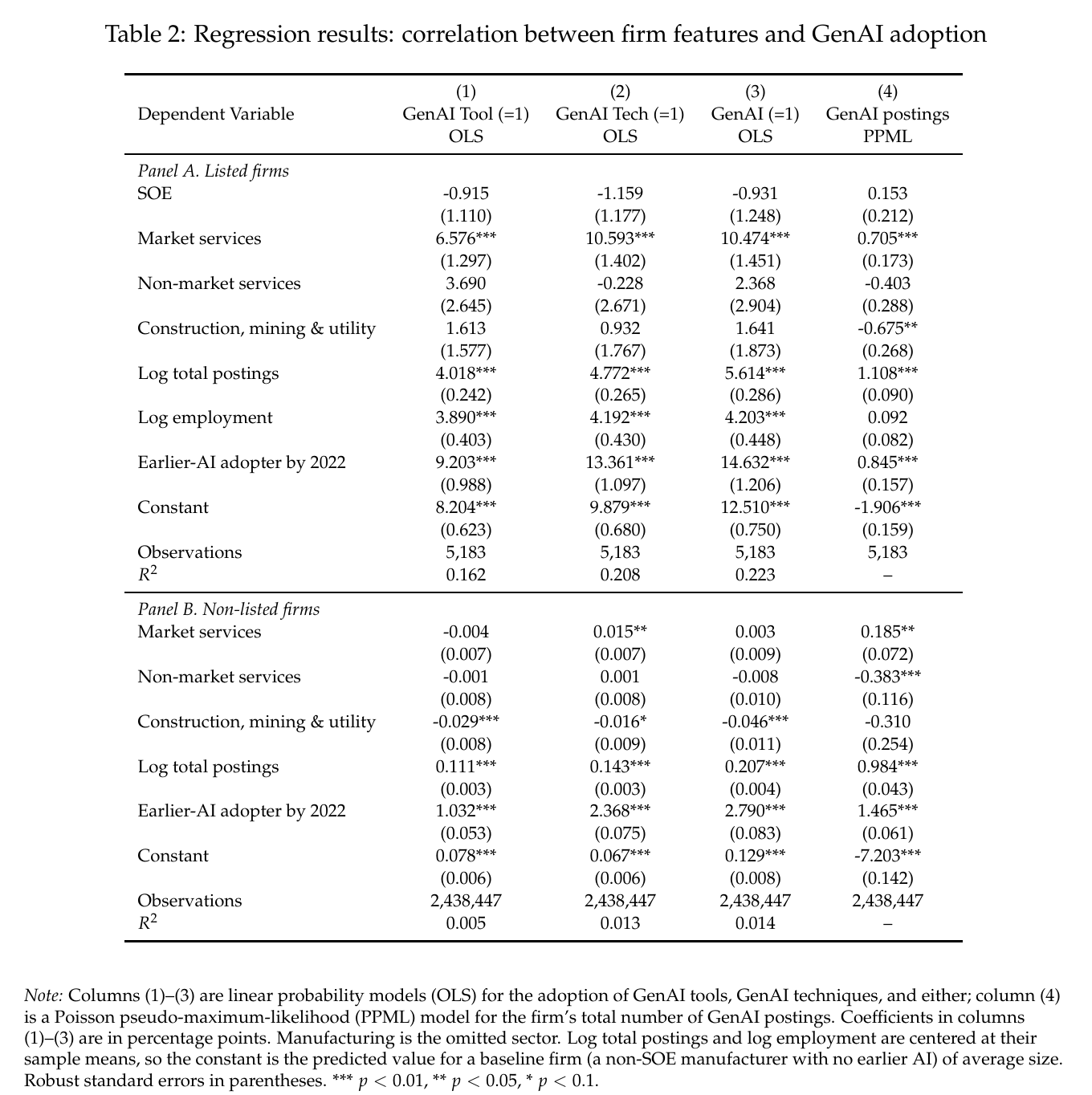
Table 2 is a cross-section of firms, and its title correctly calls it a correlation table. Columns 1 to 3 are linear probability models in percentage points. Column 4 is ppml on the count of GenAI postings. Manufacturing is the omitted sector, and the log terms are centred, so the constant is an average-sized non-soe manufacturer with no prior ai. For listed firms, column 3 has market services at +10.474 pp, log total postings at +5.614, log employment at +4.203, and having posted an earlier-ai vacancy by 2022 at +14.632. soe status is −0.931 with a standard error of 1.248, which is nothing. That matches Figure 11’s raw comparison (soes 21%, non-soes 22%) and the draft’s point that at about 12,000 employees non-soes adopt more (47% versus 38%), so soes keep up on average only because they are bigger. sasac’s February 2024 “ai+” meeting does not show up as soes out-hiring anyone.
Two sentences in the prose go further than the table. The draft says that for listed firms employment is “positively and significantly associated with” both adoption and adoption intensity. For intensity, column 4, log employment is 0.092 with a standard error of 0.082, which is not significant. The abstract says market services predicts both propensity and intensity. For non-listed firms, column 3’s market-services coefficient is 0.003 (s.e. 0.009), and it is significant only in the tech column and the ppml column. The draft’s own text concedes that “sector matters … but mainly among listed firms,” which is the accurate version.
The non-listed panel has an R² of 0.014, which is what you should expect when 99.8% of the outcome is zero. The earlier-ai coefficient there is +2.790 pp on a constant of 0.129 pp. The following is my arithmetic, not the authors’: the coefficient is about 22 times the baseline, so a non-listed firm that had posted a deep-learning job by 2022 is predicted to adopt at around 2.9% against about 0.13% for one that had not.
Having ai people already is the best predictor
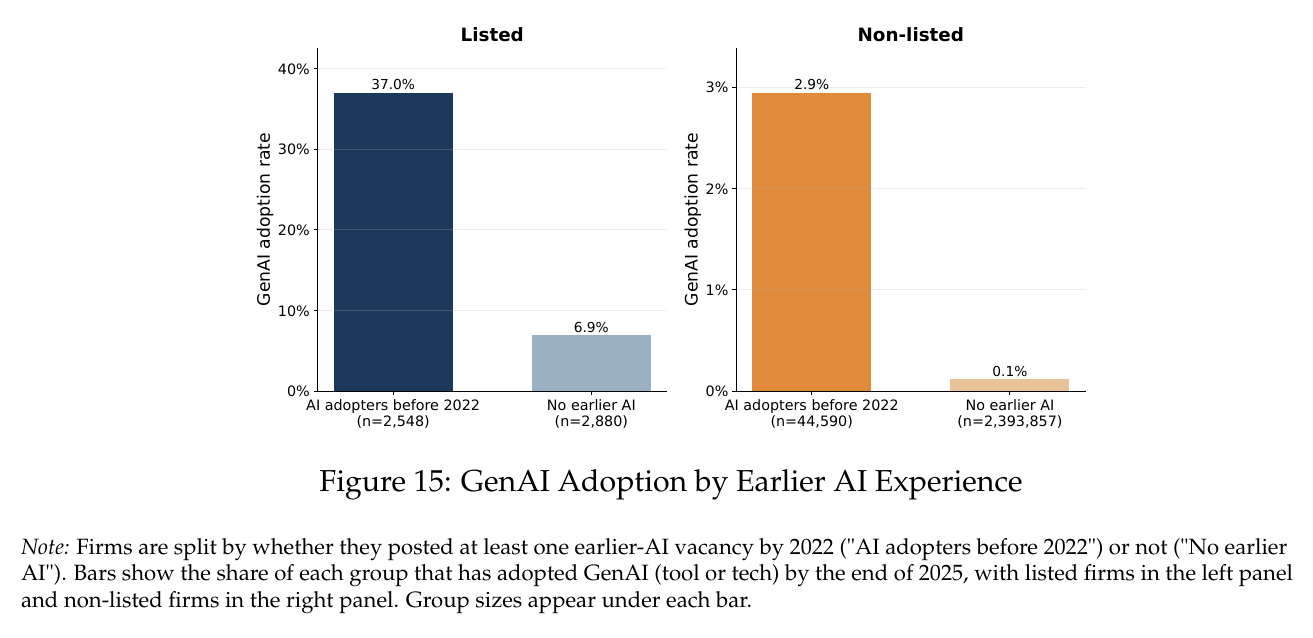
Figure 15 shows the raw version, and it is the most striking picture in the draft. Listed firms that had hired for earlier ai by 2022 adopted GenAI at 37.0%, against 6.9% for the rest. For non-listed firms it is 2.9% against 0.1%. The authors read this as existing ai staff lowering the cost of adopting the next ai technology. That is the complementarity story, and they also note that demand for earlier-ai skills rose after ChatGPT rather than falling, as you would expect if the two were complements. It may be true. It is also what you would see if some firms simply have a strong tendency to hire technical people and describe them in the vocabulary of the day. A firm that advertised for “deep learning” in 2019 and “rag” in 2025 might have adopted two technologies, or it might be one firm with one engineering team whose job ads follow the fashion. The paper can’t tell these apart yet, and at the end the presenter said something that leans toward the second reading (more below).
A bookkeeping note: the listed group sizes in Figure 15 sum to 5,428, while Table 2 has 5,183 listed firms and the Wind universe has “up to 5,182.” The non-listed group sizes add up exactly to Table 2’s 2,438,447. Something in the listed denominator hasn’t been reconciled yet.
The draft also shows that GenAI hiring is not only about ict. In postings asking for GenAI tools, the largest increase from 2022 to 2025 is for Operations Specialists, and in the plotted lines Software Developers come next, just above Algorithm Engineers (the prose reverses those two). ui designers, graphic designers and administrative clerks also appear. The tech postings are dominated by ict roles: algorithm engineers, software developers and large-model engineers. The presenter found the operations specialist “to me very interesting,” since it is the person “optimizing the day-to-day process so that ai can be implemented.” In other words, the first non-technical GenAI job is the person who makes the business process fit the model.
McElheran: numerators, denominators and yellow bananas
McElheran began by saying they wanted more of this (“we need firms, we need firms, we need firms”). McElheran welcomed DeepSeek as a second shock distinct from ChatGPT (“this literature loves a shock”), and hoped the data could eventually say something about make versus buy. Then came four points.
The first was about framing. Section 2 reads as if one measurement method should win. McElheran preferred the blind men and the elephant: surveys, patents, disclosures and postings each hold a different part of the animal, and “if we take section two seriously … we’re going to miss out on a lot of really important dimensions.”
The second was the sharpest. “All adoption rates are numerators over denominators.” The denominator problem goes like this: “how many chances do you have to cross the extensive margin of ai is fundamentally driven by how many job posts you can post and will post, and if we’re measuring firm size by posts I think we’re measuring the same thing.” Firm size here is total postings, because non-listed firms have no employment data. A firm with 3,378 postings (the median listed adopter) has made many more draws than one with 5 (the median non-listed non-adopter). If each ad carries some small chance of mentioning ChatGPT, the big firm ends up counted as an adopter partly because it bought more lottery tickets. Table 2 is suggestive here, and what follows is my reading, not the paper’s. The ppml elasticities of GenAI postings with respect to total postings are about one (1.108 listed, 0.984 non-listed). Conditional on the other covariates, then, bigger posters do not devote a larger share of their ads to GenAI; they just post more ads. That makes a mechanical “more draws” component in the 0/1 regressions plausible. It does not show that component is large. For listed firms, log employment stays at +4.203 pp conditional on log postings, so real size still matters. The draft offers no decomposition, so the right description is an unquantified hypothesis. McElheran also noted that manufacturing labour is under-represented in online postings, which matters for any statement about workforce composition.
The third point was about what the ai is doing. Desk workers imagine ai as a chat window next to them. In a factory it is built into the machine, and McElheran recalled that measuring ict in manufacturing plants by counting pcs “is not the right way to do it.” Industrial ai shows up “through different words, not so much ChatGPT and DeepSeek.” That bears directly on listed manufacturing at 17%, the lowest-but-one broad sector.
The fourth point is the best image of the day. “When we think of bananas we think of yellow without anyone ever saying the word yellow.” Routine skills disappear from job ads. Nobody now asks whether you can use email or search the web. McElheran expects “this is going to come very quickly to generative ai job posting data.” That is the other side of the costly-signal argument. A job ad is credible because it is costly, and it is only worth paying for while the skill is scarce. Once everyone can use DeepSeek, nobody pays to say so, and the adoption rate by this measure will level off or fall exactly when adoption is complete. McElheran closed by suggesting that survey people and job-posting people compare vocabularies.
The Q&A: is the DeepSeek effect about being local or being cheap?
The first questioner followed up on the yellow bananas. The numbers are “tiny,” below one percent, while cnnic reports about 43% of China’s population using ai. Manufacturing at 17% undercuts the idea of “ai turbo-charging China’s manufacturing.” soes not out-adopting after the sasac push “doesn’t suggest a system advantage for China.” Someone the chair called on as “aj” in the transcript (probably the organiser, Ajay Agrawal, though the transcript doesn’t say so clearly) said part of the conference’s purpose is to find how Chinese ai use differs from the West. They suggested mapping the paper’s occupation categories onto the usage reports published by Anthropic, OpenAI and Google. They added that all of that would still miss McElheran’s point about ai in robot control systems, “probably a first order point.” Two other questioners argued about whether the data could distinguish decentralised from state-directed innovation. The second of them objected that the state signal goes to local governments who allocate capital into fierce competition at the bottom, so there is no reason to expect adoption to concentrate in soes.
The most useful question came from a participant who named the two core facts, the listed/non-listed gap (which they called “21 and 1 percent,” misquoting the small number upward) and the DeepSeek jump, and said the second is “more robust to any complaints about measurement.” Then they asked the obvious question: did DeepSeek move adoption because it is Chinese or because it is open and cheap? Technology adoption is often local, cost is cost, and the data might separate them. Another speaker made it more complicated. R1 was also the first reasoning model many people saw, and because it showed its full chain of thought, “people for the first time realized just how smart these models were.” Open Meta models already existed, which partly separates “open” from “foreign.” At about the same time the Chinese government discouraged use of Anthropic and OpenAI models. That speaker also noted that “agents don’t have job postings,” and later that the bans on Claude are “extremely ineffective,” given how much Claude Code is used in China through vpns. A participant addressed as “Ben” suggested looking for an “agentic moment” in the posting language before the yellow-banana problem sets in.
How the authors answered
One author agreed that the reasoning display mattered, and added a softer mechanism. Before DeepSeek, Chinese open models like Kimi and glm were known to “a small circle.” Afterwards, small and medium enterprises realised Chinese open-source models were good. That was “a mindset change,” “not just because DeepSeek itself is quite good.” This is a coordination or attention story, not a price story, and it would be hard to separate from the others with a single break date. The presenter then said the team is working on identifying what drove the DeepSeek moment, and added that the earlier-ai skills, “a by-product of the project,” turn out to be informative: the GenAI rate is low “but the all ai it is about 50.” The draft’s appendix puts any-ai adoption among listed firms at 58% by the end of 2025. The skills, the presenter said, show firms moving “from like a robotic kind of technologies towards vision-sensoring and then towards generative ai.”
The denominator point, the yellow bananas, ChatGPT’s presence despite the block and the soe question did not get direct answers in the minute available.
The presenter’s last remark is a quiet answer to the Figure 15 question, and possibly more than intended. If the same firms move from robotics to vision to generative ai, and their job ads change vocabulary as they go, then a large part of “adoption” in this data is the ongoing technical hiring of a fixed group of firms, labelled by whatever the current technology is called. That is still worth measuring. It is a map of where China’s engineering capacity sits and how fast its job-ad vocabulary changes. By that reading the headline finding would be something like “the firms that were already hiring ai people now hire GenAI people, and they did so faster once there was a good Chinese model to name.” It is less exciting than a diffusion curve and probably closer to the truth. The 0.17% is the rest of the Chinese economy, which may be using the models every day without ever posting a job for it.