Notes on:
When Competition Compels Change: Trade, Management, and Productivity
Working paper
28 July 2026
development · trade · management
Talk · Paper · PDF · Transcript
Written by Fable 5
Part of NBER Summer Institute 2026 — Development Economics
Ananya Kotia (Stanford siepr), presented at nber Summer Institute Development Economics, July 28, 2026. Paper: August 2026 draft. Talk timestamps refer to the session video.
There is a photograph Kotia likes to open with: the top executives of an Indian firm, eight men, taken from the firm’s own website. “It’s not the most diverse picture,” he says. “If you look closely, they’re actually all called George.” George is a common family name in Kerala; the eight are all relatives. And this, he stresses, is not an exception but roughly the modal form of corporate governance in India and much of the world: the top of the firm is staffed from the founder’s family tree, not the national talent pool.
Why would an owner do this? The standard economist’s answers are contracting frictions — you can’t trust an outsider not to steal — or dynastic ownership stories. Kotia’s answer, which came straight from asking firm owners, is more disarming: they like it. Having your son, your siblings, your daughter around you as you run the firm is a consumption good. Formally (eq. 7 in the paper), a firm with productivity chooses between
where is the non-pecuniary private benefit of family management, and professionalizing scales productivity by but costs you forever (it’s an absorbing state: once the outside ceo and the governance apparatus arrive, going back to the cousins is reputationally ruinous, and in the data essentially nobody does it). Two more assumptions do the real work. Firms are hand-to-mouth: warm feelings pay no invoices, so a firm with negative monetary profits dies even if the owner’s total payoff, feelings included, is positive. That means there is a class of low-productivity family firms that are alive only because , enjoying their , and one bad shock away from a very specific dilemma: give up the family, or give up the firm.
Enter the shock. India kept near-total import bans (“quantitative restrictions”) on about 3,000 narrowly-defined products — 30% of tariff lines — long after the famous 1991 liberalization, using a wto clause available to self-declared developing countries with fragile balance of payments. In the late 1990s the us and eu took India to wto dispute resolution, the imf certified that India’s external position was in fact comfortable, India lost, and the bans came off on a staggered schedule, product by product, with no domestic discretion over which. This is about as good as trade-policy natural experiments get: externally imposed, defined at the 8-digit product level (so you can compare liberalized and non-liberalized products within an industry), hitting mostly final consumer goods (so it’s output-market competition, not cheaper imported inputs), and with no accompanying export reform. Imports of affected products rose about 30% relative to controls; exports didn’t budge.
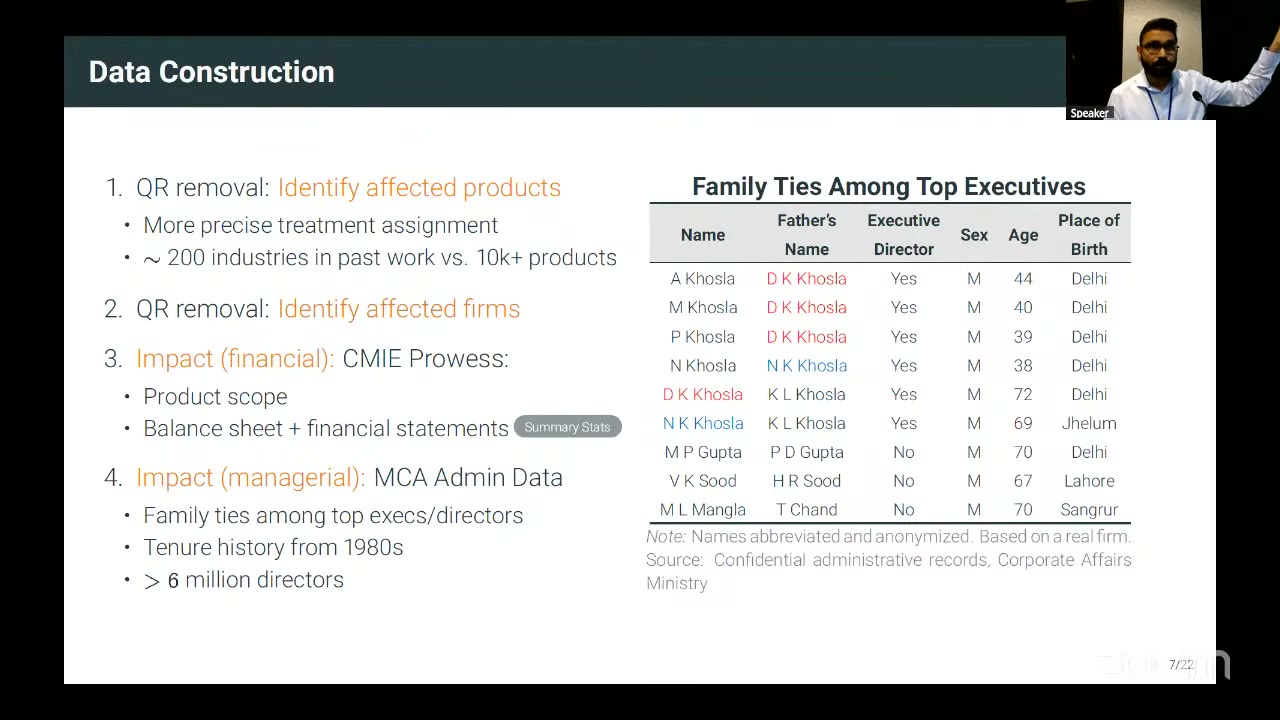
The data are the paper’s other marvel. India’s Ministry of Corporate Affairs requires every company director to file, alongside their own name, their father’s name — an administrative idiosyncrasy that lets Kotia reconstruct family ties for over 6 million directors across the universe of registered firms, and hence compute, for each firm, what share of its executive directors come from the founding family.
The event studies then tell a clean three-panel story. First, liberalization is genuinely bad for exposed firms: revenues fall roughly 28% over eight years, with profits, wage bills and assets following. Second, exposed family firms respond by professionalizing — the family share of executive directors drops 7–8 percentage points, about 15% of the baseline mean, and it is one-for-one replacement: family managers out, outsiders in (some poached, many promoted from within, a noticeable number foreigners). Third, and this is the part that separates the paper from the standard trade narrative, essentially all of the professionalization comes from the least productive tercile of firms.
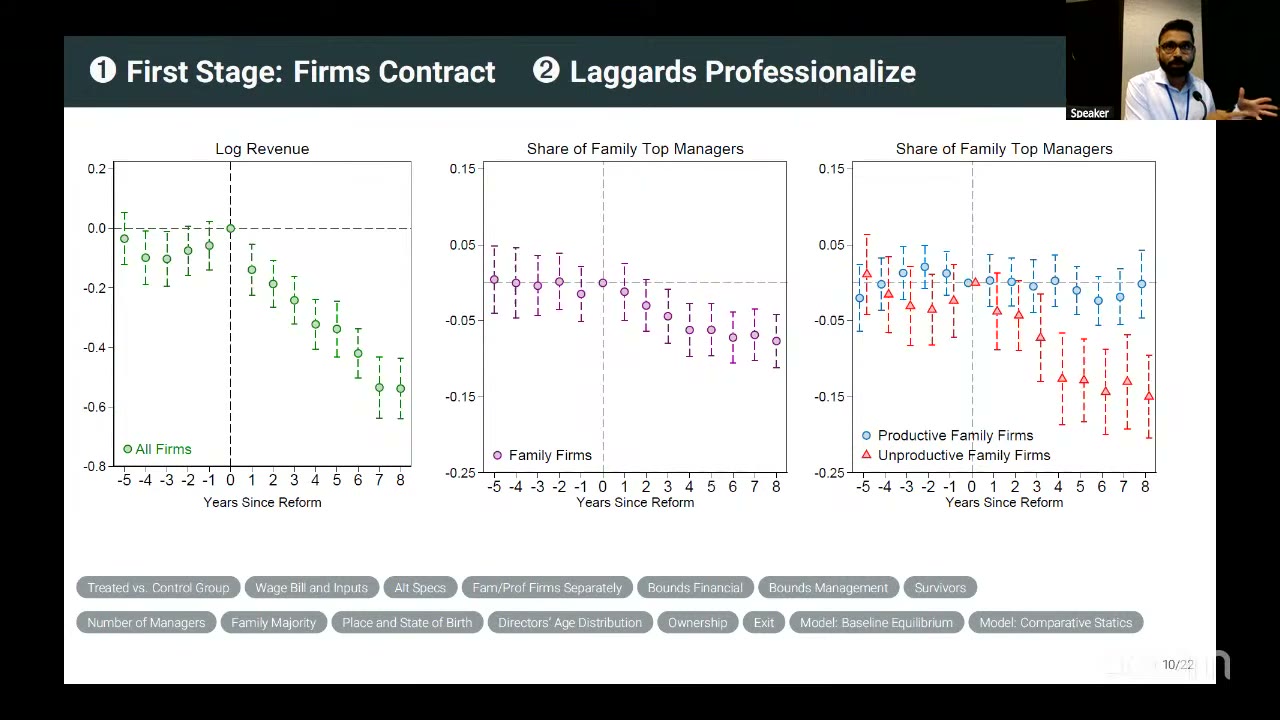
In the usual models, trade makes the frontier firms upgrade — export opportunities raise the returns to technology, the best get better. Here the action is at the bottom: the laggards professionalize to survive. Competition shrinks profits; the marginal family firm’s goes negative; it can no longer afford the luxury of employing the idiot son (Kotia’s age-distribution chart of who gets fired from family firms after the shock is bimodal — the very young and the octogenarian patriarchs — which is about as close as an event study gets to a family drama). Firms that professionalize post quantity-productivity (tfpq) gains north of 30%. He is appropriately careful that this split is endogenous and other adjustments (dropping loss-making product lines, most immediately) are bundled in; the audience — including, by name in the transcript, Ben Olken and Seema Jayachandran, though caption transcripts mangle names — pushed on exactly this timing question, and his answer was to treat the 30% as a catch-all for the management-change-correlated response.
The room also stress-tested the mechanism itself. Isn’t “private benefits” just trust and weak contracting institutions in disguise? Kotia’s reply is the neatest analytical moment of the talk: contracting frictions are a monetary cost of professionalizing, and a negative profit shock makes you less able to pay a monetary cost — so trust-only models predict less professionalization in bad times, not more. Only a non-monetary benefit, worthless to your creditors, produces the discontinuity where firms dump the family exactly when things get bad. Calibrated, comes out at about one-third of average firm profits, which is a large number to assign to the pleasure of running a company with your relatives, and implies a 23% revenue gap between family and professional management — and in the model, as in the data, about half of family firms professionalize after the shock.
The aggregate punchline is the sort of result that makes quantification worth doing because it embarrasses the intuition. Total productivity gains from the liberalization: about 11.45%. Contribution of all that dramatic within-firm professionalization: 0.83 percentage points — 7.5% of the total. The rest is old-fashioned selection. Worse, professionalization weakens selection: it lets marginal firms that should have died survive, so shutting the channel down entirely would raise aggregate productivity. Before you conclude that India should ban management upgrades, the welfare accounting flips it back — consumers value variety, the saved firms keep their products on shelves, and welfare is higher in the economy where laggards are allowed to save themselves. Productivity statistics prefer that weak firms die; consumers, on the whole, prefer that they shape up.
Kotia closes by noting that the mechanism is more general than family firms: absent competitive pressure, all sorts of taste-based arrangements — he name-checks Becker (1957) — are affordable, and competition is what makes meritocracy cheaper than nepotism. The paper’s contribution is to measure the price of the alternative: about a third of profits, payable in relatives.