Notes on:
Risk Aversion and Barriers to Firm Growth: Experimental Evidence from Small Retailers
Working paper
27 July 2026
development · firms · risk
Talk · Paper · Slides · PDF · Transcript
Written by Fable 5
Part of NBER Summer Institute 2026 — Development Economics
Grady Killeen (University of Chicago; the paper lists uc Berkeley), presented at nber Summer Institute Development Economics, July 27, 2026. Timestamps refer to the session video.
Development economics models small firms as small versions of firms: risk-neutral profit maximizers that happen to have one employee. This paper’s point is that a firm whose entire output flows to one uninsured household is not a small firm so much as a person — and people have concave utility. The owner’s consumption preferences leak into the production decisions, and suddenly a shop can be risk-averse the way a Domino’s franchisee betting their life savings is risk-averse, even when the bet in question is a box of motorcycle helmets.
The setting is a natural experiment in market failure. A helmet factory opened in western Kenya two years before the study, cutting the price of effective helmets to something ordinary motorcycle passengers could afford. Killeen’s prior research showed consumers value the helmets. And yet, screening about 1,500 suitable retailers, under 3% had ever tried stocking one. The beliefs data sharpen the puzzle into a hypothesis: 51% of shops report positive expected helmet profits at baseline, only 6% will stock without intervention, and a shop’s uncertainty about sales strongly negatively predicts stocking. Profitable in expectation, untried in practice, blocked by variance — that is risk aversion’s signature, and the paper’s two experiments are engineered to prove it’s really her and not her look-alikes (credit constraints, wrong beliefs, learning-by-doing).
The model’s core tension is between learning value and risk. A new product with unknown demand θ is an experiment: stock it, and a bad draw costs you little (exit) while a good draw pays forever (restock). Mean-preserving spreads in beliefs make experimentation more attractive to a risk-neutral firm — uncertainty is upside. Risk aversion flips the sign, and with it the whole diffusion process: nobody experiments, so nobody learns, so the market’s beliefs stay frozen at ignorant. The stakes aren’t trivial relative to firm size — the manufacturer’s minimum order runs one to two weeks of the median shop’s profits.
Experiment one tests risk aversion with a strictly-dominated insurance contract. Every shop is promised an unconditional future payment; treated shops may swap it for a contract paying 1,000 Kenyan shillings only if they stock helmets and fail to sell out. The unconditional payment is calibrated per firm (from elicited beliefs about sell-out probability) so the insurance is a mean-preserving contraction — then padded 10% so that a risk-neutral firm should strictly refuse it. The moral-hazard patches are thorough: no restocking after collecting a payout, a fifth of shops audited (binding — some shops declined payouts with one helmet left so they could restock), and both arms told about the contract and its randomization so no one learns anything from the offer itself.
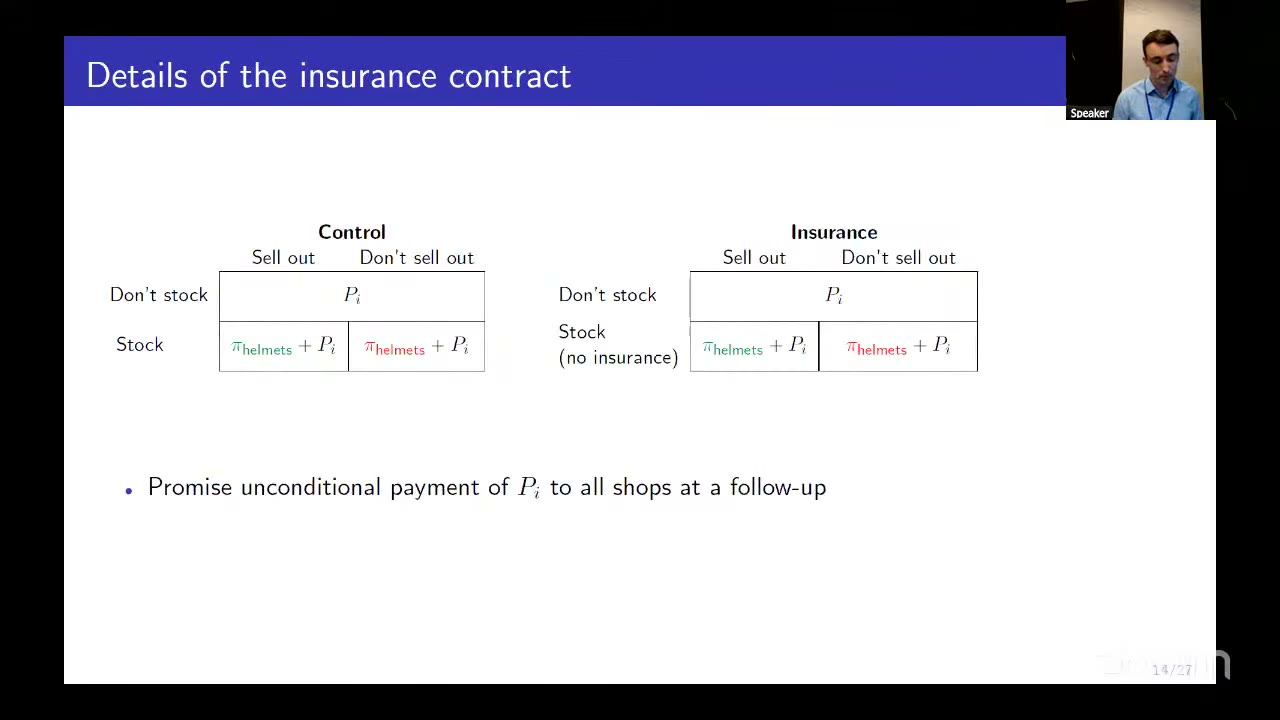
Result: the dominated contract doubles helmet stocking (2.5× within 24 hours; +50% after firms get two weeks to try pre-selling and settle down). That is a rejection of risk neutrality with a revealed-preference cleanliness rare in this literature. The heterogeneity cuts against the obvious deflation: larger, older firms respond more — they have fewer other binding constraints, and still won’t take the gamble unprotected. (Killeen’s policy gloss: cash transfers might buy much more upgrading if bundled with downside protection.) Calibration-wise, if firms are capital-constrained the required curvature is modest — crra around one, lab-consistent; if they could smooth over a lifetime you’d need loss aversion.
Experiment two asks whether this blocks learning, using shops near the factory (so supply access wasn’t the constraint) and three arms: a phase-one return policy (stock now, return unsold helmets for refund later); a “supplier commitment” (no risk reduction now, but a promise to keep the manufacturer relationship alive after the study — raising the future value of anything learned); and both. The model’s fingerprint prediction is the interaction: returns alone should raise experimentation (risk falls), commitment alone should raise it (learning value rises), but commitment should add nothing on top of returns — if stocking is riskless, every demand-uncertain firm already experiments. That’s exactly the pattern: control stocking 6.8%; returns more than double it; commitment alone +80%; both together ≈ returns alone.
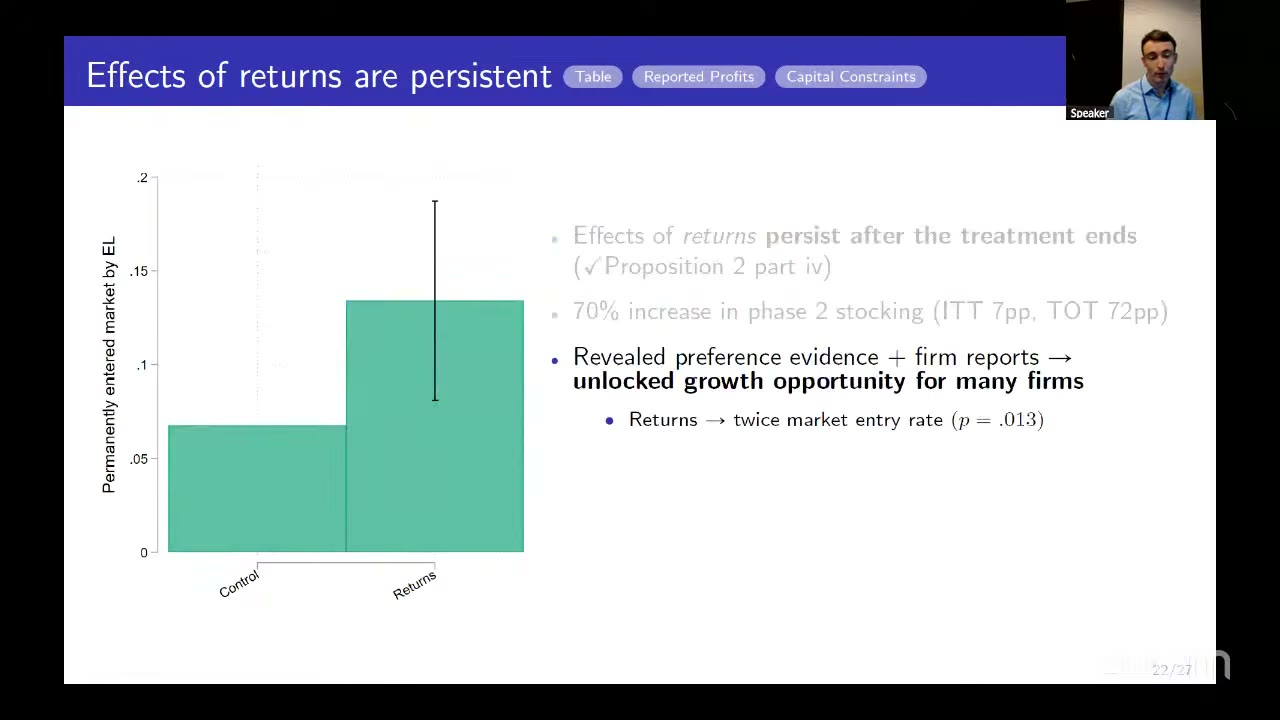
The persistence is the market-failure punchline: a one-time, seven-month return window raises stocking by 70% in a later phase where nobody can return anything, and doubles the share of shops permanently in the helmet business — two-thirds of phase-one adopters restocked, firms report helmets at ~10% of profits and plan 20%. And the beliefs data adjudicate between risk aversion and mere misperception on three margins, all pointing the same way: uncertainty predicts less stocking in control (misperception-plus-learning-value predicts more); returns crowd in the uncertain, not the pessimistic; and experience doesn’t raise expected profits (point estimate slightly negative) but collapses belief variance by ~73% — corroborated by adopters becoming much better forecasters of their own sales (~80% implied uncertainty reduction). Firms didn’t discover helmets were better than they thought. They discovered they could stop being afraid.
The Q&A pressed on why the market doesn’t fix this — Coca-Cola manages to get novel products into remote kiosks. The manufacturer’s answer, relayed from its ceo: with thousands of tiny, hard-to-find retailers, weak contract enforcement, and no addresses, offering returns invites theft in one direction and reputational catastrophe in the other (fail to find a shop you owe a refund, and word spreads that you don’t pay). Fewer than 15% of shops had ever been offered returns on any new product from a new supplier. The manufacturer did, mid-experiment, cut its minimum order from ten helmets to three — the treatment effects survived — but wouldn’t go to one. Another questioner invoked the old sharecropping literature’s risk aversion; Killeen’s second experiment is precisely the answer, separating static risk over known lotteries from the dynamic, learnable kind. And a Rodrik-flavored objection (Hausmann and Rodrik 2003) — the first mover bears the risk while neighbors copy the discovery — is conceded and quantified: information spillovers exist but die within about three city blocks, too local to substitute for own experimentation.
The closing implication runs upstream. Retailers who won’t experiment are a demand blockade against manufacturers: why invent or import products for a market whose shelf-keepers won’t take a flyer on stock? The literature’s risk-neutral small firm was always a modeling convenience; this paper prices the convenience, and it turns out to be a chunk of the missing growth. The helmets, for what it’s worth, were profitable all along. Everyone just needed someone else to find out first.