Notes on:
International Business Cycles with Endogenous Incomplete Markets
Econometrica
20 January 2023
international macro · limited commitment · business cycles
Paper · PDF
Written by Fable 5
Patrick Kehoe and Fabrizio Perri, Econometrica 2002. Read here in the Minneapolis Fed staff-report version, which matches the published text. No talk recording exists; written from the paper alone.
Ten years after Backus, Kehoe and Kydland (1992) labeled the failures of the frictionless international rbc model “anomalies,” Kehoe returned with Perri and a diagnosis: the model’s asset market wasn’t merely complete when it should have been incomplete — it was incomplete in the wrong way, whenever anyone tried to fix it. The literature’s standard repair was to restrict the menu of assets by fiat: allow only a single uncontingent bond, or nothing. Baxter and Crucini (1995a) had already shown this does embarrassingly little — the bond economy hugs the complete-markets allocation. Kehoe and Perri’s move is to stop legislating which assets exist and instead ask what promises are enforceable between sovereigns. The friction from the sovereign-debt papers earlier in this block — Eaton–Gersovitz’s (1981) willingness-to-pay, formalized in the Kehoe–Levine (1993) / Kocherlakota (1996) limited-commitment tradition — is dropped into the bkk production economy: any country can walk away from its obligations and live in autarky thereafter, so the planner can only choose allocations satisfying, state by state,
(equation 5 in the paper): continuation utility inside the arrangement must beat the value of autarky, where the autarky value depends on the capital the country would abscond with. Markets are as incomplete as sovereignty makes them — no more, no less. (Solving this is itself a contribution: the enforcement constraints contain future decisions, so ordinary dynamic programming dies; they extend Marcet–Marimon’s (2019) recursive multiplier method, carrying the countries’ relative Pareto weight — the accumulated history of binding constraints — as a pseudo-state variable.)
What enforcement does that bond-limiting doesn’t
Recall the two bkk anomalies: model consumption correlates across countries more than output (data: the reverse), and model investment and employment comove negatively across countries (data: positively — the fact Marianne Baxter’s (1995b) survey called “a major challenge to the theory”). The mechanism behind both is the frictionless flood of resources toward the country with the good shock. Enforcement constraints dam the flood at exactly the right spot: transferring a huge slug of capital to the lucky country would raise its autarky value (it keeps the capital if it walks), tightening its enforcement constraint and making the planner unwilling to send it. Risk sharing and resource shifting are both curbed endogenously, and — unlike an interest-rate premium of 0.0007 — the curb binds hard in exactly the high-transfer states that generated the anomalies.
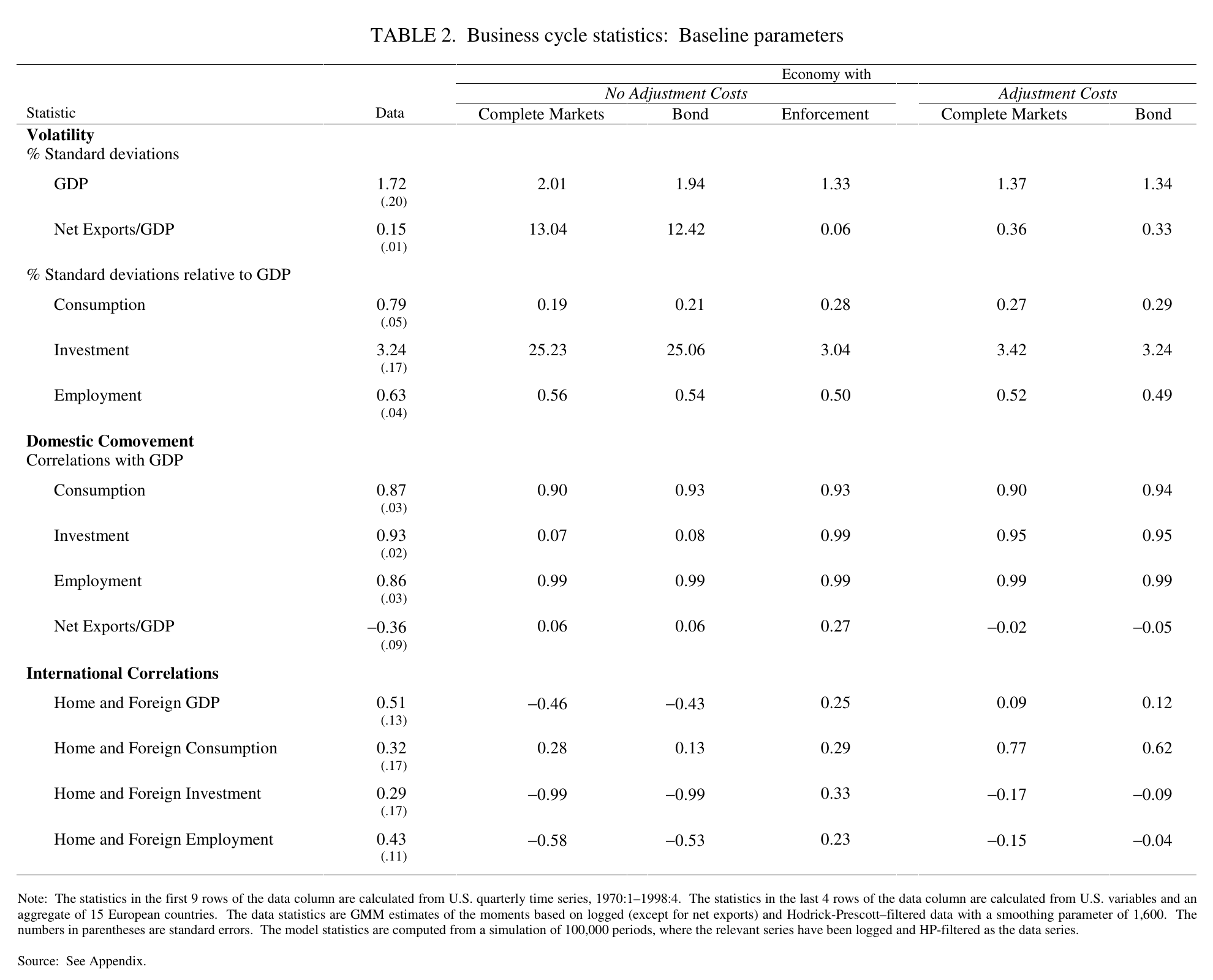
The scorecard, from the paper’s Table 2, is a rout of the alternatives. Complete markets: cross-country consumption correlation .28 versus output −.46 (ordering backwards), investment correlation −.99, employment −.58, net-export volatility 85 times the data. Bond economy: essentially the same. Enforcement economy: consumption .29 versus output .25 — the gap nearly closed — investment +.33 and employment +.23, both correctly signed at last, and net-export volatility tamed from 13.04 to .06 (data: .15) with investment volatility landing at 3.04 against 3.24 in the data, without adjustment costs. That last point carries a quiet dig at the literature: models bolt on capital-adjustment costs precisely to suppress the investment flood, but “once a model has enforcement problems, it does not need tacked on adjustment costs.” Even giving the rival economies their adjustment costs (last two columns), the anomalies persist there: consumption correlation .77 versus output .09 under complete markets.
The honest ledger
The confessed failure is the trade balance: enforcement constraints inhibit capital flows so effectively that net exports turn procyclical (+.27 in the model against −.36 in the data) — the model overcorrects bkk’s excessive flows into too few. And consumption remains too smooth relative to output (.28 versus .79 in the data), a domestic-insurance problem the international friction can’t touch. But the methodological verdict stood: how markets are incomplete matters enormously, and the right incompleteness is the one derived from the commitment problem rather than assumed on the asset menu. Exogenous restrictions leave the economy near complete markets; enforcement constraints “drive the economy far away from the complete markets allocation regardless of the parameters.”
In the arc of this reading list, this paper is where the two halves of block three fuse. The sovereign-default papers established that international promises are only as good as the incentive to keep them; bkk established that assuming otherwise wrecks the business-cycle predictions. Kehoe–Perri shows the first fact repairs the second — limited commitment is not just a story about Argentine bonds but the missing friction in the workhorse business-cycle model. It is also the direct methodological parent of the next entry: Restrepo-Echavarría’s (2019) paper takes precisely this endogenous-borrowing-constraint machinery and aims it at a growth question — why Latin America stagnated — where the constraint binds not over the cycle but over decades.