Notes on:
Cinderella No More: Night Shift Bans and Women’s Employment in India
GLO Discussion Paper
29 July 2026
gender · labor regulation · India
Talk · Paper · PDF · Transcript
Written by Opus 5
Part of NBER Summer Institute 2026 — Gender in the Economy
Sarvnipun Kaur, Anshika Arora and Prakarsh Singh — “Cinderella No More: Night Shift Bans and Women’s Employment in India,” presented by Kaur at the nber Summer Institute, Gender in the Economy, on 29 July 2026. A fifteen-minute egg-timer slot; the chair asked the room to hold questions until lunch, so there is no Q&A. Written from the September 2025 draft.
India’s Shops and Establishments Act is colonial-era legislation. It was written to regulate small shops, eateries and theatres, and among its provisions is a prohibition on employing women at night. As India grew, the Act’s scope grew with it, and it now governs the services sector — which is to say it governs multinational it firms, hotel chains, call centres, the entire white-collar economy that India’s growth has been built on. The provision about not employing women after dark came along for the ride.
This is not an Indian eccentricity. The World Bank’s Women, Business and the Law data counts 81 of 190 economies with night-shift restrictions on the books in the 1970s, and about 20 still carrying them in 2024. India was one. Different Indian states have been repealing theirs at different times, which is a difference-in-differences design if you can find the dates, and the authors found them by mining state gazettes.
The thing that is actually being tested
Call it deregulation and you make it sound like a constraint was lifted. It wasn’t, quite. The repeal is conditional: a firm may employ women at night provided it complies with a schedule of requirements — a security guard on the premises, a cab service home, and so on. Some states use this rules-based form. Others make the firm apply to a civil servant for permission, case by case.
So the reform is really two things at once. It removes a hard constraint on scheduling, which is worth something to employers, and it imposes a compliance cost, which is worth something negative. Employment goes up only if the first exceeds the second, and it is genuinely not obvious which way that goes.
There is also a prior worth taking seriously in the other direction. Haddad and Kattan (2024) find that when nineteenth-century American states passed night-work regulations, women’s likelihood of employment rose about 8 percent — the restriction was perceived as welfare-enhancing and made formal work more socially acceptable, so it functioned as protection rather than exclusion. The authors take this as their explicit starting point, which means the null hypothesis that repeal helps women is not the safe one.
What happens: nothing, and then something
Using five years of India’s Periodic Labour Force Survey — which starts in 2017, and so forces the exclusion of three states that deregulated that same year for want of a pre-period — the answer to the headline question is a null. Deregulation does not reduce women’s labor force participation, which rules out the protective story. It also does not raise aggregate female employment, which rules out the liberating one. No unemployed woman found a job because of this.
What moved was composition. Women left non-services for services, and the magnitudes are large relative to the base.
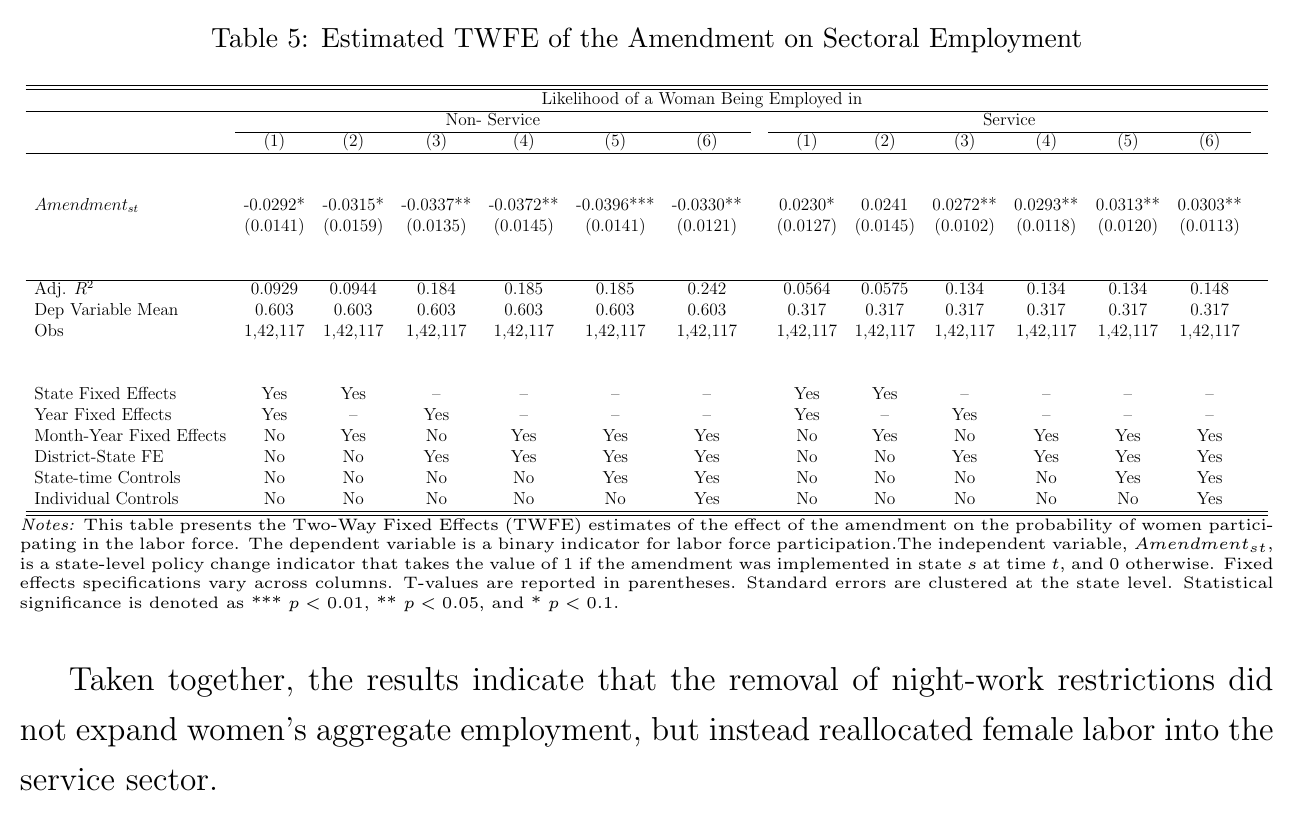
Within services, the gain is entirely in wage employment — up 2.9 to 3.4 percentage points on a base of 22.8 percent, a 13 to 15 percent increase — with no significant change in service self-employment. So the movement is out of self-employment and non-services, which in the Indian context means informal, and into wage work with a contract and social security.
Which is a more interesting result than a headline employment number would have been. The binding constraint was never how many women wanted to work. It was which jobs they were legally allowed to hold, and a law written for theatres in the 1940s was, in 2020, quietly excluding women from the sector where the good jobs are.
The part where the private cab doesn’t help
The reform’s design outsources women’s safety to the employer. Provide the guard, provide the taxi, and you may staff the night shift. Does that work?
Split districts by quartiles of reported crimes against women in 2015, and the answer is: only where the streets were already safe.
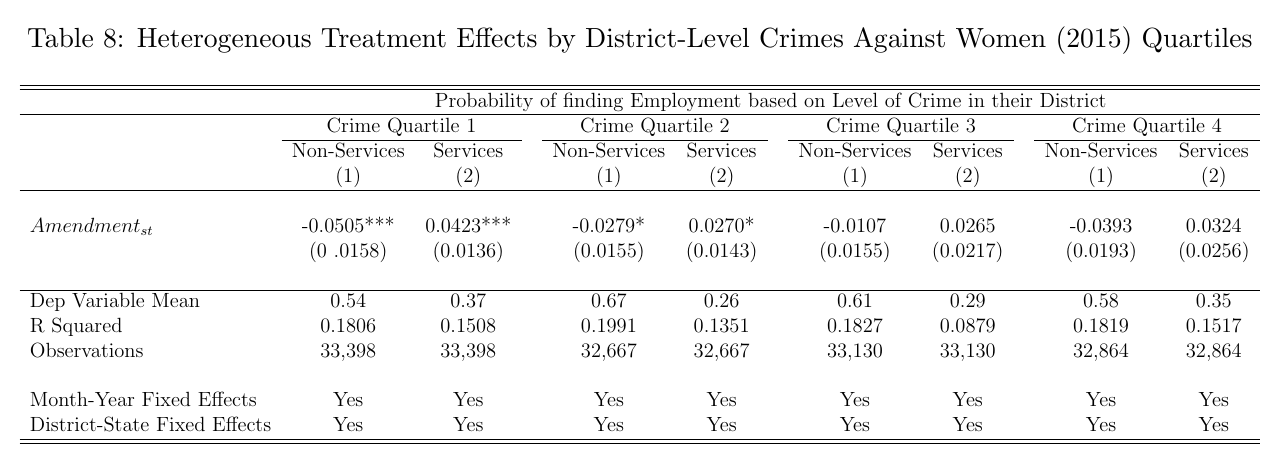
The Q4 coefficients are worth a caveat: −3.9 and +3.2 points are not small numbers, and they are insignificant rather than zero, with standard errors roughly a third larger than Q1’s. The honest reading is that the reform’s effect is precisely estimated where crime is low and cannot be distinguished from zero where it is high — not that it demonstrably vanishes. But the pattern across quartiles points one way, and it points at the obvious thing. A firm can put a guard at the door and a car at the kerb. It cannot make the road safe. If the woman does not believe the journey is survivable, the compliance package is a set of amenities attached to a job she will not take.
And the design of the permission matters
The last finding is about legal architecture, and it is the one a policymaker could act on tomorrow. Where deregulation is rules-based — meet these X conditions and you may proceed — the effect is much larger. Where it is discretion-based — apply to an official for a licence — it attenuates.
Which is not surprising once stated, and is the sort of thing that gets left out of the model. Both regimes nominally permit the same thing. One of them is a checklist and the other is a queue in front of a civil servant, and firms respond to the difference between a rule and a favour. The state repealed the same prohibition twice and got two different economies.
(The authors also note that the Factories Act, which governs manufacturing, was being deregulated over the same period — a nasty confound, since it would push in the opposite direction on the non-services side. They control for it and report the results hold. With state-level treatment, a handful of treated states and clustered standard errors, this is a paper whose identification rests on a small number of policy dates, and the Callaway–Sant’Anna (2021) estimates in the appendix are doing real work in reassuring you the two-way fixed effects aren’t an artifact of staggered timing.)