Notes on:
Jumpstarting an International Currency
Review of Economic Studies
8 June 2020
geoeconomics · Renminbi · swap lines · currency internationalization
Talk · Paper · doi · PDF · Transcript
Made with AI: Opus 5 (reading and writing)
Saleem Bahaj (University College London) and Ricardo Reis (London School of Economics), “Jumpstarting an International Currency”, Review of Economic Studies, advance access publication 27 February 2026, doi 10.1093/restud/rdag011. The article prints as “(2026) 00, 1–32”: no volume and no final pagination have been assigned yet, so every page number below is the pdf’s own. It first circulated in 2020, but the published version records “First version received August 2022; Accepted April 2025”, and it is the published version that governs everything here. Presented by Reis, with Bahaj answering alongside him, at the inaugural Online International Finance and Macro Seminar on 8 June 2020, chaired by the seminar’s organisers; no discussant, with questions from Pierre-Olivier Gourinchas, Fadi Hassan and Matteo Maggiori. The figures are crops from the published article, except where a 2020 slide is named as such.
Benjamin Strong’s trick, a century later
In 1912 the United States was the world’s largest exporter and its firms financed their trade in sterling, out of London. The Federal Reserve Act of 1913 let American banks open branches abroad, and Benjamin Strong, the first president of the New York Fed, made internationalising the dollar an explicit goal, chiefly by letting banks discount dollar-denominated trade acceptances at the Fed — a backstop so aggressive that “by some estimates, between 1923 and 1929, the Fed owned as much as half of all issued trade acceptances” (p. 29). By 1925 the dollar was an international currency; by the Second World War it was the dominant one. A century later China was the world’s largest exporter, its firms financed their trade in dollars, and between 2009 and 2018 the People’s Bank of China signed renminbi swap lines with thirty-eight countries (p. 5). The network’s notional limit is around three trillion renminbi, which the paper notes is “comparable to the usd 600 bn of peak drawings from the Fed’s swap line” (p. 4). Bahaj and Reis ask whether the second policy worked like the first, and why a facility that is mostly not drawn should change the currency in which firms invoice.
Working capital and invoicing are complements
You are an exporting firm in South Africa, and you make two currency choices, not one. The familiar one is the currency of your sticky price in each market you sell into: your own, your customer’s, the dominant currency, or the rising one. The new one, and the paper’s contribution, is the currency of the working-capital loan that pays for your imported inputs before you can produce anything. The two lean on each other. Borrow in the rising currency and you want revenue in it, so a bad exchange-rate draw does not blow up your markup; price in the rising currency and you want your costs there too. Firms here are risk-neutral profit maximisers, so what hurts them is not risk as such but ex-post deviation from a constant markup (p. 19), which is a different and more disciplined thing.
Notice what makes the dominant currency dominant in this model. It is not that it is cheaper on average. It is that its borrowing rate is known, while the rising currency’s rate is a draw from a distribution, and the width of that distribution “is a reflection of the more liquid, stable, and efficient capital markets in d currency. In our model, this is what defines d as the dominant currency” (p. 17). Dominance is low variance. Everything follows from that. Proposition 2 (p. 20) says a firm takes rising-currency credit when
where the left side is the concave-weighted cost of borrowing in and rises with the size of the rising currency’s own market and with how much of your invoicing is already in it. Below the threshold, nothing; above it, both choices flip at once. That is why the paper is about jumps rather than drifts, and also why almost no currency ever makes it: “If these countries were to try policies to jumpstart their currencies, Proposition 3 predicts they would fail as the thresholds would not be overcome” (p. 22). A Nigerian swap line does not internationalise the naira, and the model is honest about saying so.
A swap line enters as a ceiling. The local central bank can always get the rising currency from the issuer at a pre-announced rate, so the right tail of the cost distribution is simply cut off (Proposition 3a, p. 21):
Firms sitting near the threshold cross it (3b), and the ones that cross switch their invoicing too (3c). The elegant part is that this works without anybody borrowing anything: “By only cutting the right tail of the distribution of ε, the swap line may end up only being used infrequently and in small volumes. Nonetheless, result (a) notes that removing rare high rates affects firms’ inclination to borrow in the r currency ex-ante” (p. 21). Footnote 24 gives the policy its point. You could achieve the same shift with a straight subsidy on renminbi trade finance, “However, this would come with potentially large costs if the subsidy is paid on all overseas credit. Instead, the swap line serves as a backstop, ex-ante lowering the risk of very high rates, but only used infrequently ex-post.” A subsidy pays on every loan; a ceiling pays only in the tail. Whether the lines actually sit idle is a separate question, and the paper does not overclaim: there is “no systematic usage data, but there is scattered evidence that it is positive” (p. 2), and Horn et al. (2023) “argue that around half the lines have been tapped” (p. 4).
The renminbi, country by country
The evidence is monthly Swift data on cross-border payments by currency, October 2010 to October 2018, 11,058 observations across 114 countries of which 21 sign a line inside the sample. The baseline, equation (3.1), p. 11, is a linear probability model with country and time effects:
estimated by Borusyak–Jaravel–Spiess imputation with errors clustered by country. The controls are the obvious confounds: trade with China in several forms, and China’s other outreach — an rmb clearing bank, membership of the aiib, Chinese infrastructure investment flows, United Nations voting alignment — plus renminbi use among neighbours within a thousand kilometres (p. 11). The published version then says the thing the 2020 talk did not: “none of these are watertight identification strategies so our results should be read as documenting an association between the policy and rmb use.” Take that seriously when reading everything below.
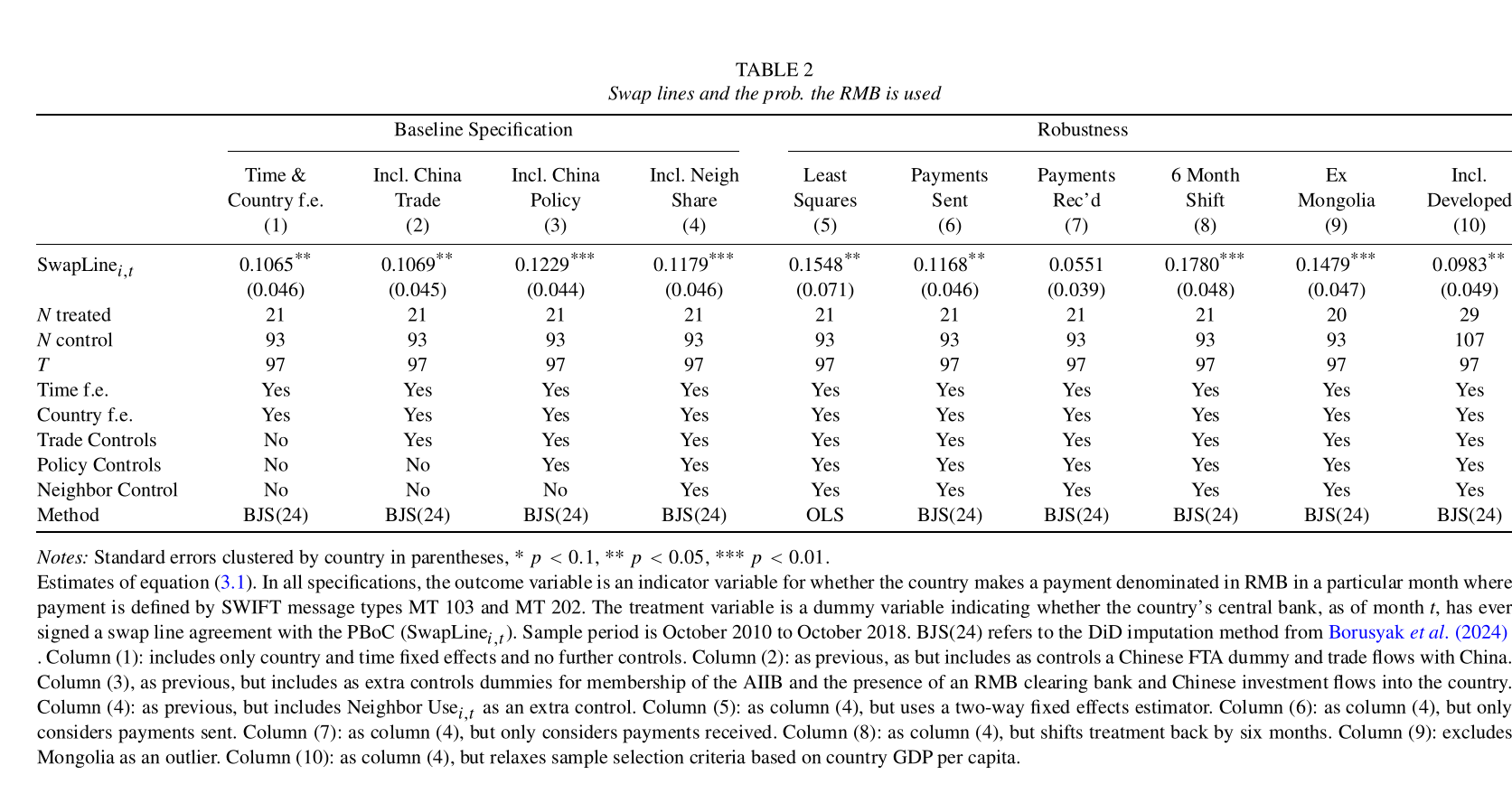
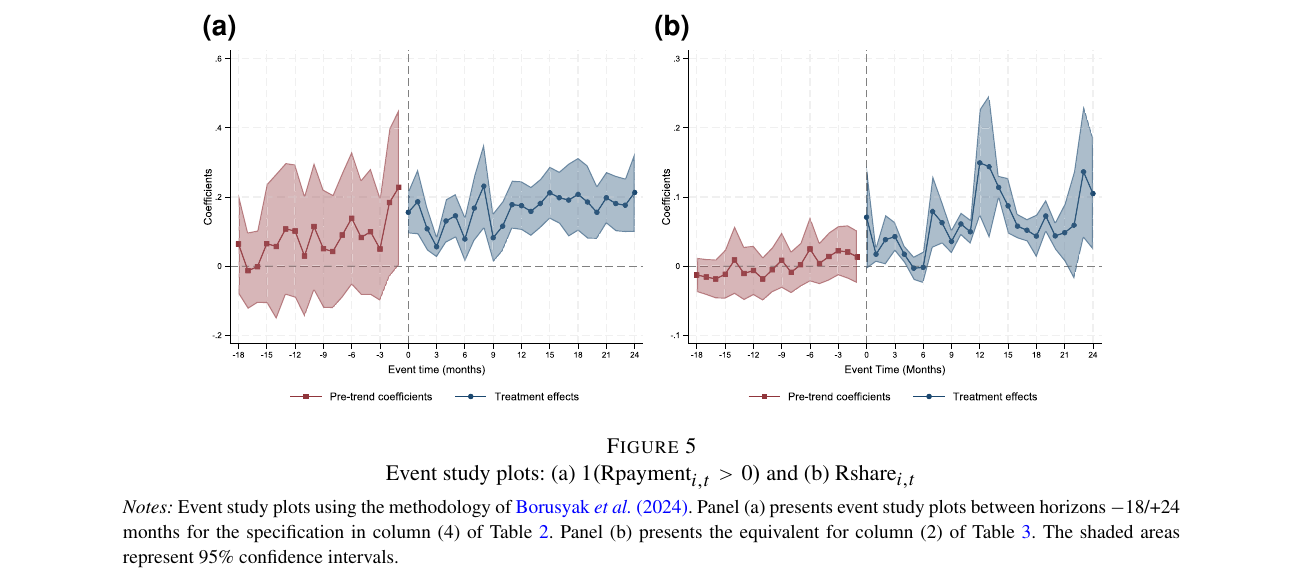
The extensive margin is the paper. Countries do not gently increase their renminbi use; they go from zero to positive. With fixed effects alone the coefficient is 0.1065; with the full control set, column (4), it is 0.1179, or 11.8 percentage points. Push treatment six months earlier to allow for anticipation and it rises by six points, to 17.8. Pre-trend tests reject only in the two months before signing, most of the effect lands inside a year, and “There is no reversion” (p. 12). One tidying-up: the paper’s own headline drifts, with the abstract saying 12 percent, the introduction and the conclusion both saying 14, and the baseline column saying 11.8. The baseline number is the one with a standard error attached.
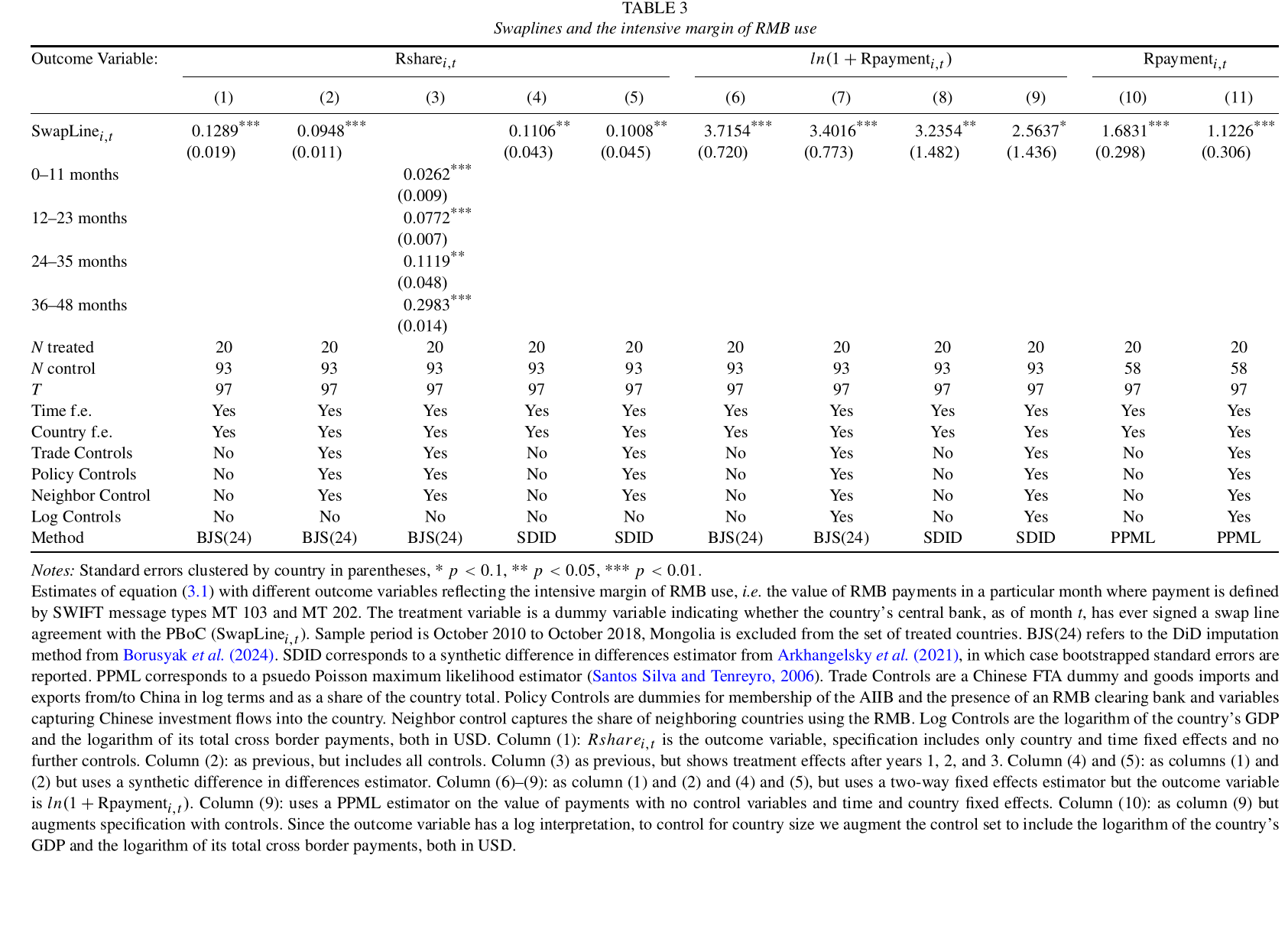
The intensive margin is where the essay has to be careful, because the headline number is an average and not an impact. Column (1) gives 0.1289, “an increase in the share of the rmb in international payments of 0.13% points” (p. 15), averaged over the post-treatment window. Broken out by horizon in column (3), the first eleven months deliver 0.026, the second year 0.077, the third 0.112, and years three to four 0.298 — “The effect compounds over time, rising to 0.3% points between years 3 and 4, or approximately one-fifth of the overall rise in rmb payments between 2010 and the end of our sample” (p. 15). Told properly, that is a slow-burn result, which is exactly what a threshold model with staggered price and borrowing updates should produce. And in levels the numbers are enormous: the Poisson columns imply “rmb usage between 250 and 440% higher than the control countries following the policy’s introduction” (p. 16), which the abstract renders, fairly, as a four-fold increase.
The mechanism, tested rather than assumed
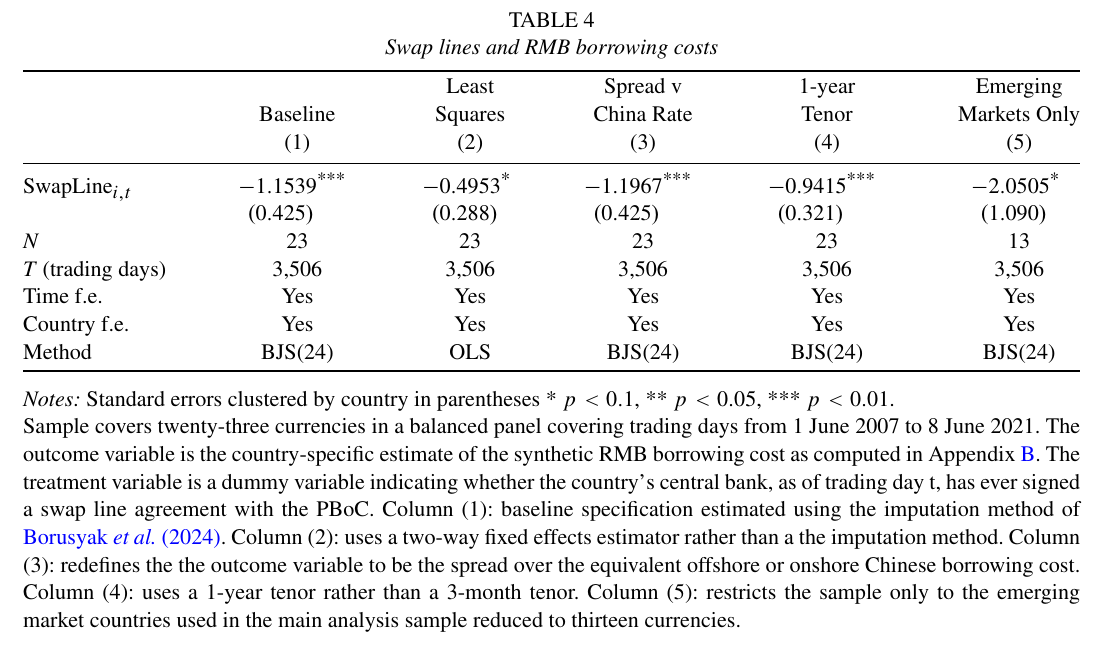
If the channel is really the price of credit, the price of credit should move. The authors build a synthetic three-month renminbi borrowing rate for 23 currencies over 2007–21 from spot and swap quotes, taking the cheapest of four onshore, offshore, direct and dollar-vehicle routes, and find that signing a line cuts it by 115 basis points, rising to 205 for the thirteen emerging-market currencies. For scale, the cross-sectional dispersion of these costs is “around 100 bp on a typical day, rising to around 400 bp when rmb rates are volatile” (p. 23). So the ceiling is worth roughly a normal day’s worth of dispersion — which is the whole idea, since a ceiling is priced off the tail.
Then the natural experiment the model asks for. On 11 August 2015 China adjusted the parity; “The rmb depreciated by 3% over the next two days, and would continue doing so for the next 18 months” (p. 25), and the PBoC defended the onshore–offshore gap by draining offshore liquidity, so offshore renminbi funding became expensive and erratic until a new regime around April 2017. This is the right kind of shock — financial rather than real, originating in China rather than in the counterparty, and unanticipated — and countries with a line kept paying in renminbi while countries without one cut back sharply. The estimates run from 2.2 log points without controls to 2.9 with, across ordinary and synthetic difference-in-differences.
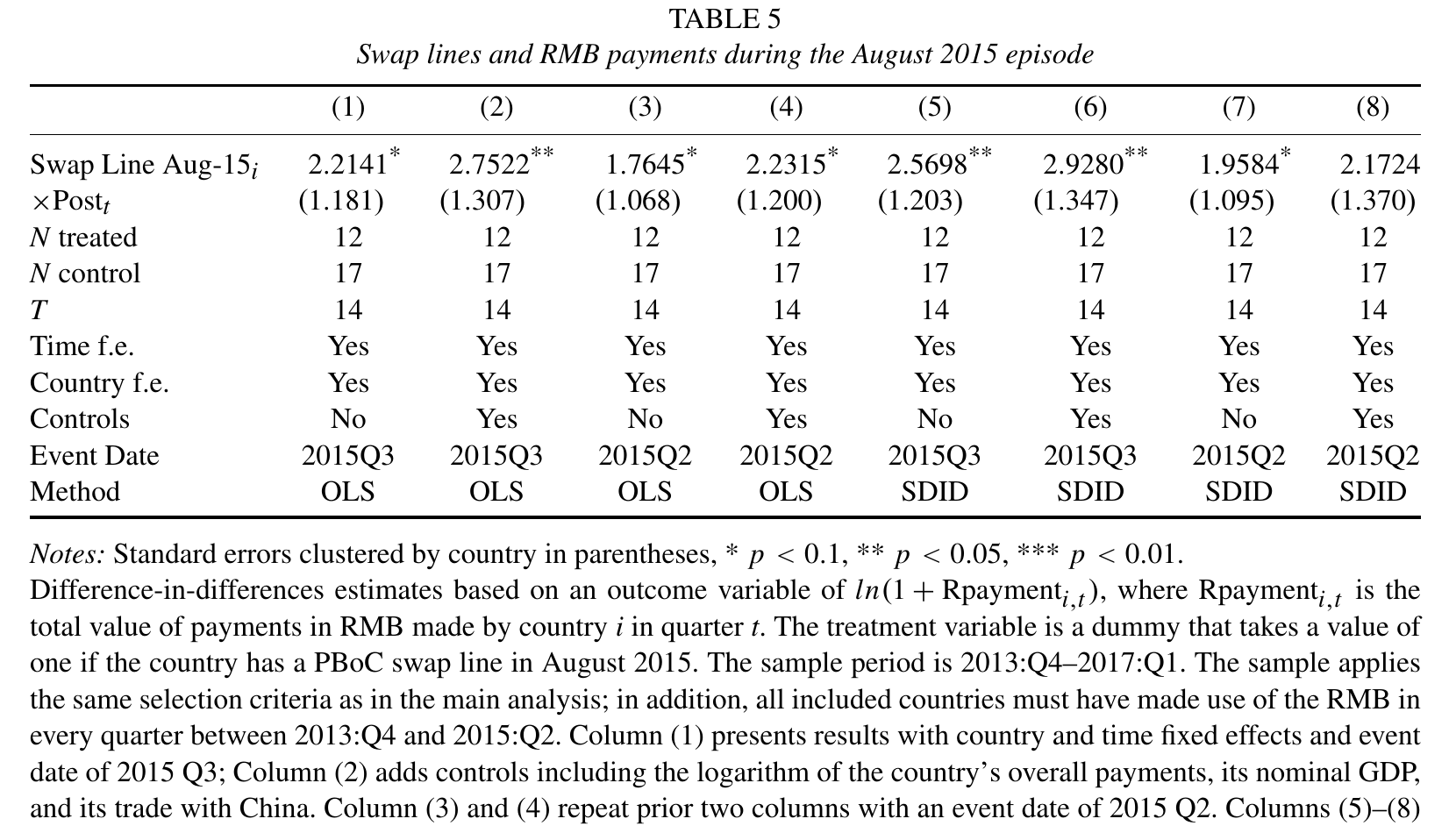
The channel narrows further. The effect shows up in exactly the messages that are trade finance rather than general payments, and within that it is essentially absent in countries below the median share of trade with China and large above it, absent-to-small below the median intermediate-import share and large above it, and larger in countries whose export industries need more working capital, proxied by American inventory-to-sales ratios from the 1980s and 1990s (p. 27). That is four cuts of the data agreeing with a model about working capital, which is more than most mechanisms get.
What the renminbi actually displaces
Here is the cleanest result in the paper, and the one most worth carrying into a conversation about geoeconomics. Look at the currency composition of a country’s payments with China after it signs a line. The renminbi share goes up 14.0 points. The dollar loses 7.9, the euro 2.6, sterling-yen-franc together 0.5, other vehicle currencies 2.8 — and the country’s own home currency loses 1.5, which is not statistically distinguishable from nothing.
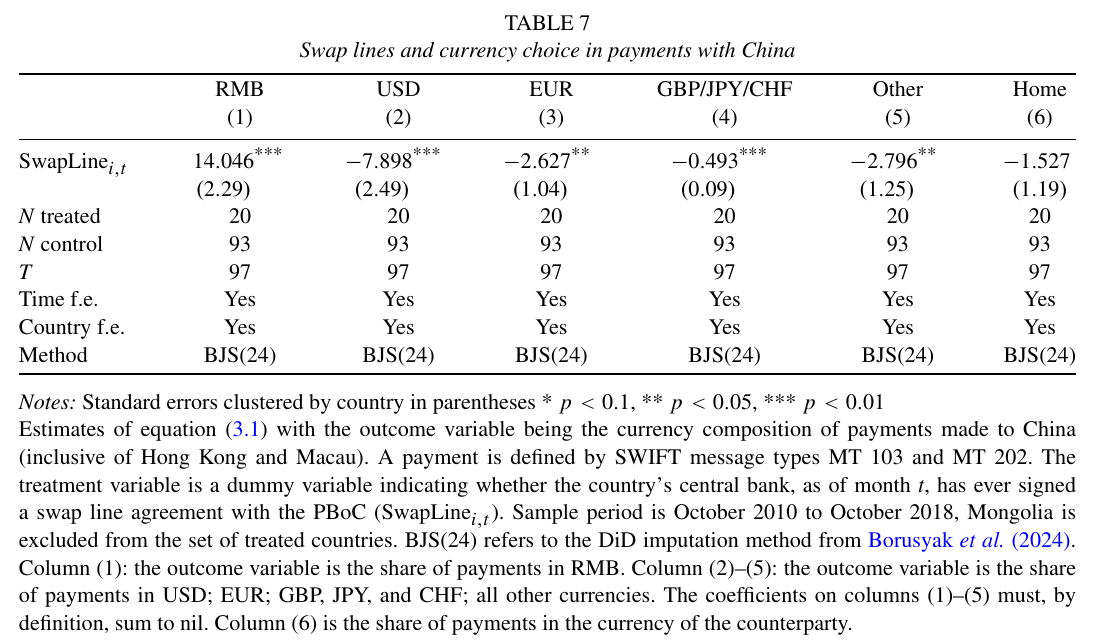
Internationalisation is vehicle-versus-vehicle. A country that starts paying China in renminbi does not stop paying in rand; it stops paying in dollars. Nobody is de-dollarising their own economy here — they are switching which foreign money they use to settle with a foreign counterparty, which is the only margin an outside central bank can actually reach.
What the seminar pushed on
Pierre-Olivier Gourinchas asked how sticky borrowing-currency decisions are and whether an interest-parity condition sits behind the model. Reis went to covered rather than uncovered parity: if cip “held exactly then it wouldn’t matter which currents you are borrowing because you can always change it to some other currency”, but for the renminbi “it’s extremely hard to borrow in forward markets against rmb or it’s extremely expensive”, so the borrowing-cost distribution stands in for the cost of not being able to swap out. Which reframes the policy nicely — a swap line is a ceiling on the cip deviation, or, as he corrected himself, “is not putting a ceiling but is actually creating almost such a market”.
A written question asked what the jumpstart costs the issuer. Reis: in a lucky small sample where the tail never arrives, a swap line “would appear like it’s a free lunch” — the PBoC lends nothing and all it has removed is perceived uncertainty. The true cost is the expected value of the tail you promised to absorb, and if the tail arrives often and “the foreign central bank doesn’t pay you back the rmb then you get to start getting very close to the subsidy case.”
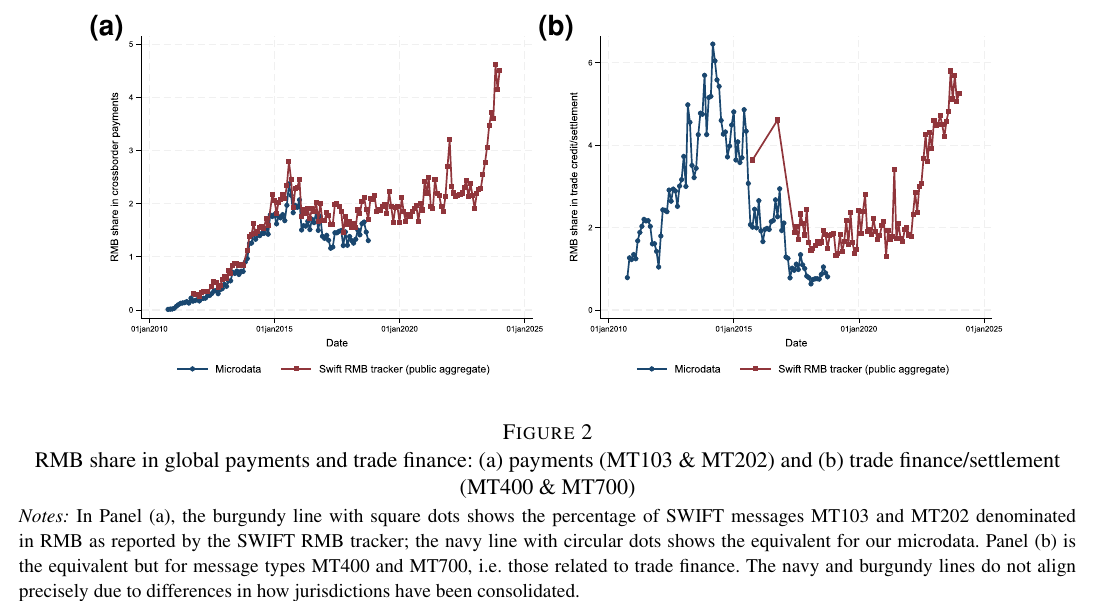
Fadi Hassan noticed that the global renminbi payment share fell after 2015 while lines kept being signed. Reis pointed out that almost no lines were signed after 2015, so the model predicts flat rather than falling, and the fall itself is absorbed by his time fixed effects, so the regressions are silent on it; he offered China’s slowdown and the imf’s sdr decision as conjectures. He used the second to kill the cynical reading he kept hearing, that “the swap lines were nothing but some posturing for including for the inclusion in the sdr”, on the grounds that posturing implies a zero coefficient and “our regressions right reject that super strongly.” Bahaj then added the concession, which is his and not Reis’s: “a lot of the variation in… the total [rmb] share is driven by the countries that are financial centers like the uk”, so the aggregate series is not the country-level object the paper estimates. The 2020 slide on screen during that exchange ended in 2018 with the share falling; the published version’s Figure 2 runs to 2024 and shows the decline was an interlude, the renminbi ending as the fourth most used payments currency and the second most used for trade finance by the last quarter of 2023 (p. 7).
Matteo Maggiori asked whether, under capital controls, a swap line is simply the only way to get renminbi at all, making the effect mechanical. Reis answered first: no, because the intended plumbing is that “there’s a guy in Pakistan a firm who’s already borrowing rmb, they go and discount that loan at the Pakistan central bank and then Pakistan goes and gets the rmb” — the credit already existed — with Argentina the exception, having drawn simply to obtain renminbi to defend its dollar peg. Bahaj followed with the operational answer: “the swap line doesn’t open up a payment system… it still goes through the same structure that exists already”, leaning on a clearing bank usually in Hong Kong, and what the line does “is just cheapens the cost of credit… by enabling a clearing bank to get rmb more cheaply from the PBoC”. Pressed on when the piping was laid, Bahaj conceded the clearing-bank dummy is a weak variable, since “a bank in Nigeria can always go to its Hong Kong correspondent and get the rmb, so the piping is really about the Hong Kong market and that was opened in 2009”, the London clearing bank being “an empty shell”.
One correction the published version imposes on the talk. In June 2020 Reis presented an instrumental-variables design using the timing of Xi Jinping’s state visits as an instrument for signing, and quoted effects of 20 percent and later 13 percent. None of that survives: there is no state-visit instrument and no IV anywhere in the published thirty-two pages, and the published estimates are 11.8 points in the baseline and 14 in the paper’s own headline, offered as an association rather than a causal effect. The same goes for the talk’s persistence table, whose first-year effect on the renminbi share was negative; the published Table 3 puts it at a positive 0.026 and rising.
Where it sits
Presented in block 3.1 as the empirical companion to Internationalizing Like China (Clayton, Dos Santos, Maggiori and coauthors 2025, now published in the American Economic Review, 115, 864–902): that paper opens the bond market to foreigners in the right order, this one exports the currency through the central bank’s balance sheet, and both are supply-side answers to a question Gopinath–Stein (2021) and Mukhin (2022) pose from the demand side. Its threshold logic is the firm-level version of the jump those papers get from complementarities, and its conclusion is the same as Mukhin’s last counterfactual: “Further policies to remove capital controls in China and some luck in a shock to the usd dominance (like World War I was for sterling) are likely required” (p. 30). It is on the list because the design — a threshold model, a staggered difference-in-differences on payments, and mechanism tests on funding costs, a funding squeeze and trade finance — is the cleanest empirical treatment of currency status we have.
What the group should notice is the shape of the instrument. The People’s Bank bought fourteen points of a country’s payments with China, mostly out of the dollar, with a promise it may never have to keep, at a cost that is the expected value of a tail. That is a very cheap way to buy a currency’s international status, and it works precisely because the buyer retains the option not to pay. Which means the resulting renminbi usage is collateralised by nothing except the issuer’s continued willingness to stand behind it — the same option, viewed from the other end, that block 2 is about.