Notes on:
Dollar Erosion: Understanding the Loss of Reserve Currency Status
NBER Working Paper 35328
24 January 2026
dollar · reserve currency · convenience yield · exchange rates · international finance
Talk · Paper · doi · Slides · PDF · Transcript
Written by Opus 5
Written from the draft dated 4 May 2026; the Hoover talk of 21 January 2026 presented the earlier 12 January draft.
Zhengyang Jiang (Kellogg), Arvind Krishnamurthy (Stanford gsb), Hanno Lustig (Stanford gsb) and Robert J. Richmond (nyu Stern), Dollar Erosion: Understanding the Loss of Reserve Currency Status — nber Working Paper 35328. Written from the May 4, 2026 draft; the talk quoted below is Krishnamurthy’s presentation to the Hoover Economic Policy Working Group at Stanford on January 21, 2026, an open-floor seminar with no formal discussant (the paper thanks Viral Acharya and Mahyar Kargar as discussants elsewhere).
The United States runs a small, extremely profitable export business
You are the United States. You produce goods, you sell some abroad, you buy some from abroad. You also produce a second thing, which does not appear in the trade statistics and which you never decided to produce: safe dollar assets. Foreigners want them — Treasury bills, agency paper, bank deposits, investment-grade corporate bonds — not merely for the yield but because a dollar safe asset is the thing you post as collateral, the thing you settle in, the thing you park money in when you are frightened. Because they want them for those reasons, they will accept a lower yield to hold them than they would demand on an otherwise identical foreign claim. That yield discount is the convenience yield, and the paper calibrates it at 2% a year.
Foreigners hold about 52% of U.S. gdp in these things. Multiply. The United States is collecting roughly 1% of gdp per year, forever, for the service of manufacturing liquidity. This is an export. It is invisible in the trade data because it is paid not in shipments but in forgone interest, and it is what allows the country to run a steady-state trade deficit without ever settling up: the deficit is not borrowing, it is the receipt for a good sold.
Anyway, in the steady state the accounting is an identity. From the paper’s external-balance condition:
Left side: foreign holdings of U.S. government bonds and private dollar bonds , each multiplied by the gap between the foreign interest rate and what the U.S. actually pays on them — seigniorage. Right side: the trade deficit, with the log real exchange rate. That is equation 11 in the paper, and it is the whole argument. The liquidity export funds the trade deficit. Stop the export and the deficit has to close.
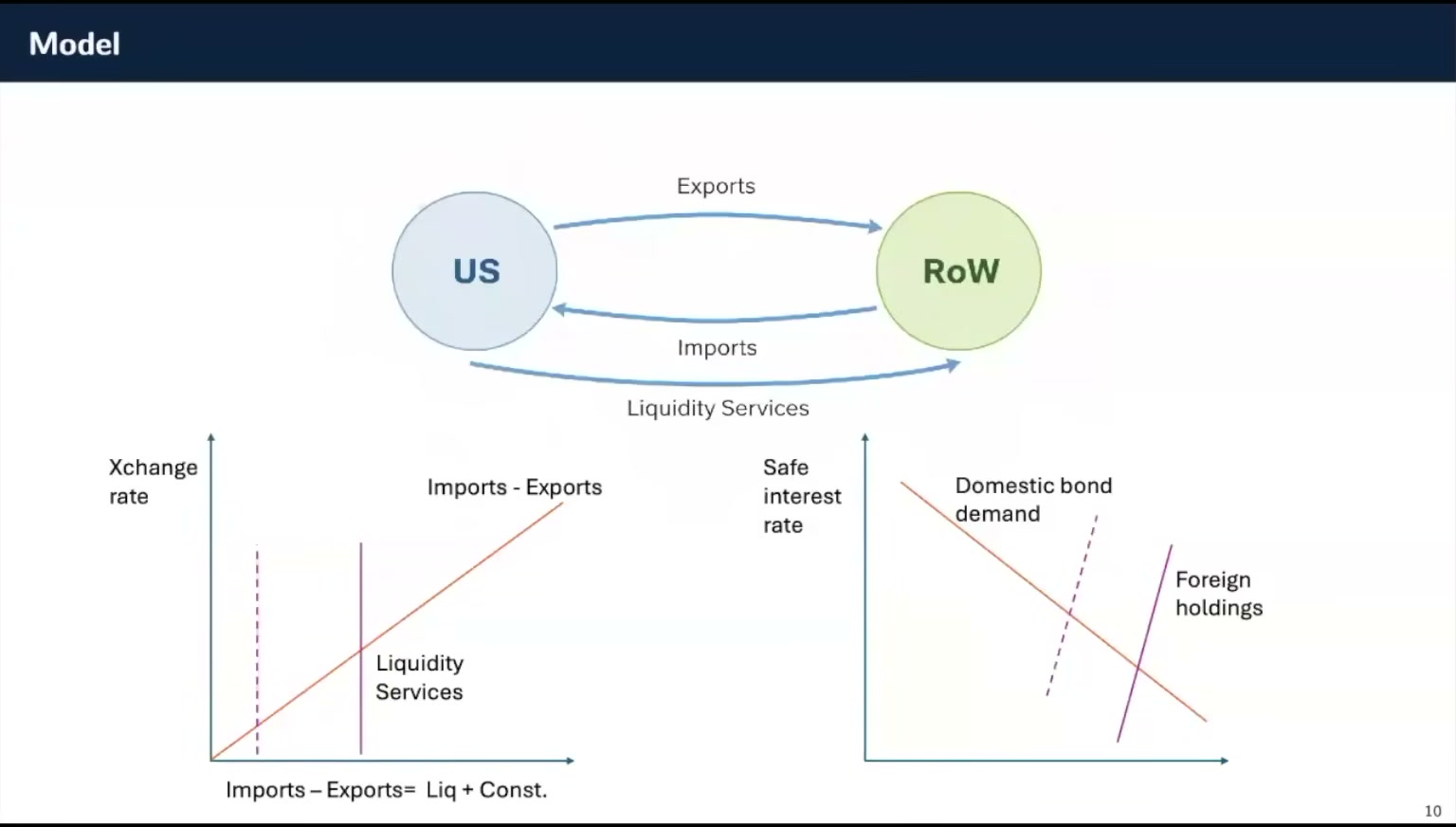
How does it close? Not through the asset market, which is where everyone looks. Through groceries. The seigniorage made American households about 1% richer; Americans have a home bias parameter of 0.95, so most of that extra spending went to American goods; take it away and there is now an excess supply of American goods that has to be cleared by making them cheaper relative to foreign goods. That relative price is the real exchange rate. The dollar depreciates not because foreigners sold it but because Americans got poorer and stopped buying quite so much American stuff.
The dollar’s overvaluation is small, and this is the point
Here is the number the authors clearly did not expect. Turning off foreign reserve demand entirely — not partially, not gradually, all of it — depreciates the real dollar by 8.81%.
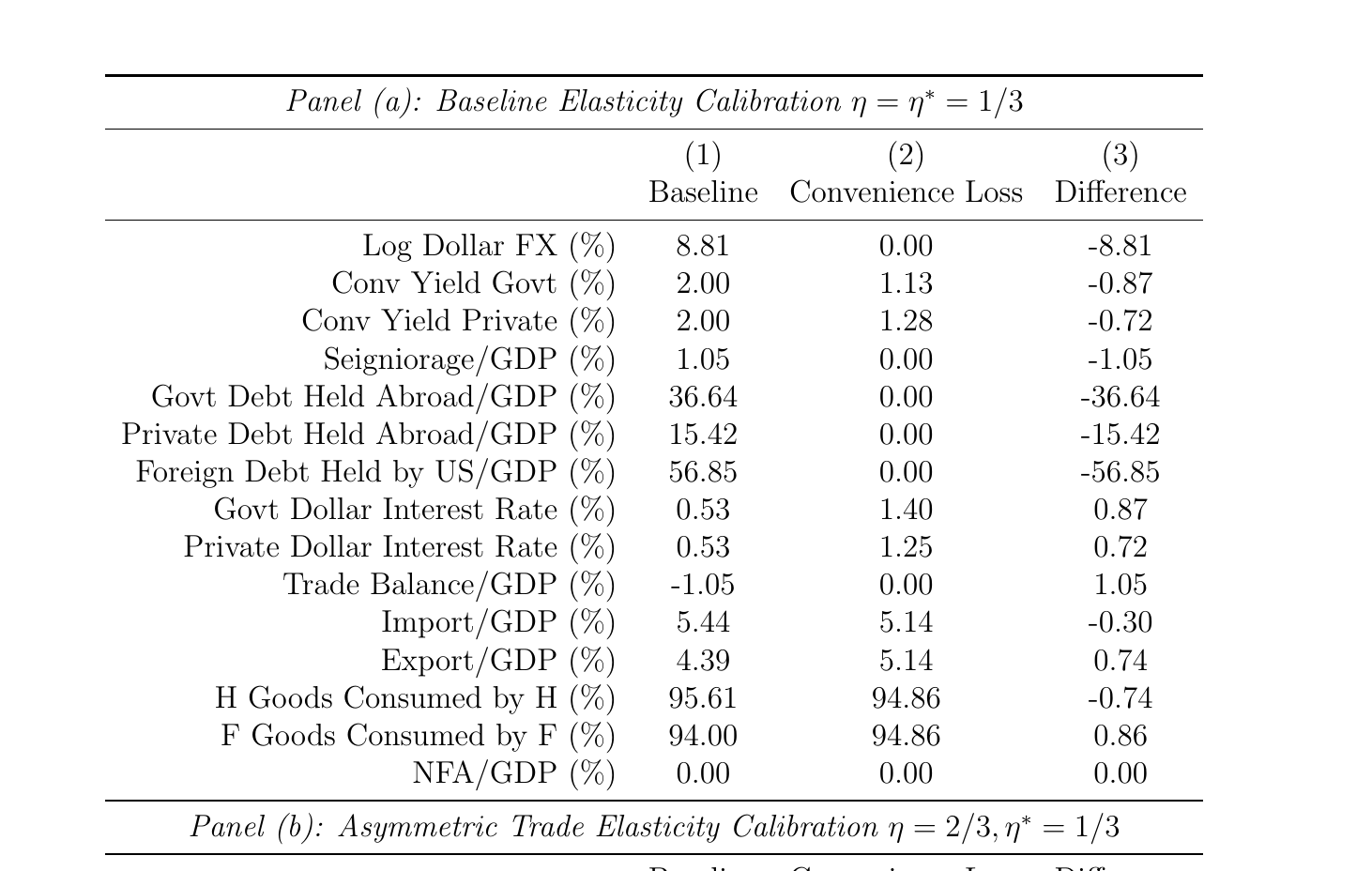
Meanwhile the interest rate on government dollar bonds rises 87 basis points and on private dollar bonds 72, because roughly half of gdp in dollar bonds has to be reabsorbed by Americans whose demand curve slopes down. So: exchange rate effect small, interest rate effect large. In the seminar Krishnamurthy was direct about which of those surprised him — “the exchange rate impact small, interest rate impact large and perhaps even larger” — and about why the first is small. It is the trade elasticity. He uses 1/3 from the trade literature, final-goods trade is only 9.83% of gdp, and a 1%-of-gdp swing in the trade balance run through a nearly closed economy with an inelastic import demand simply does not require much of a price move.
This lands directly on Stephen Miran’s (2024) argument that dollar overvaluation, driven by inelastic reserve demand, is what unbalanced American trade and hollowed out American manufacturing. The paper’s answer is not that the mechanism is fake. The mechanism is real, it is in the model, and it is worth 8.8% of the dollar — the entire thing, cumulated over the whole reserve-currency era. Whatever explains American deindustrialization, an 8.8% currency wedge is not a large enough lever. The most memorable moment of the seminar is a questioner working this out in real time and then asking Krishnamurthy to “write this up in five or ten pages in a way that the Mirans of the world might understand,” which is not a request economists usually get and which Krishnamurthy declined on the grounds that he might not be capable of it.
The flow is trivial; the capitalized value is $33 trillion
The other half of the paper is a present-value exercise, and it is where the small numbers stop being small. One percent of gdp a year is nothing. One percent of gdp a year forever, discounted as a risky claim that grows with gdp, is everything. The paper does it twice. Using the historical risk-adjusted discount rate and growth rate from the authors’ earlier fiscal work (Jiang et al. 2024), is 1.73% and the exorbitant privilege is worth 60% of gdp, about $18 trillion. Using aqr’s current forward-looking capital market assumptions — a 1.7% risk-free rate, a 1.6% equity risk premium, 1.8% growth, and a gdp beta of two-thirds — collapses to 0.97% and the same 1.04% flow capitalizes to 107% of gdp, roughly $33 trillion. Reserve currency status is, on this arithmetic, an asset worth about a year of American output, and it is one nobody has on a balance sheet.
The honest reading is that the $33 trillion is doing a lot of work with a denominator of 0.97%, which is what happens when you present-value a perpetuity in a low-real-rate world; the $18 trillion figure is the same claim discounted less aggressively. A seminar participant also pointed out that the growth rate ought to be global growth, since global demand for dollar safe assets is what the dividend rides on, which would make the number larger still. Krishnamurthy agreed on the spot and did not adjust it.
The erosion, which is the part that already happened
None of this would matter if the premise were hypothetical. It is not quite. The convenience yield on one-year Treasurys measured against euro safe assets swapped into dollars — historically almost always positive, averaging 22 basis points since 1988, and reliably rising during crises — went to zero in 2023 and negative in the summer of 2024, before the election and well before Liberation Day.
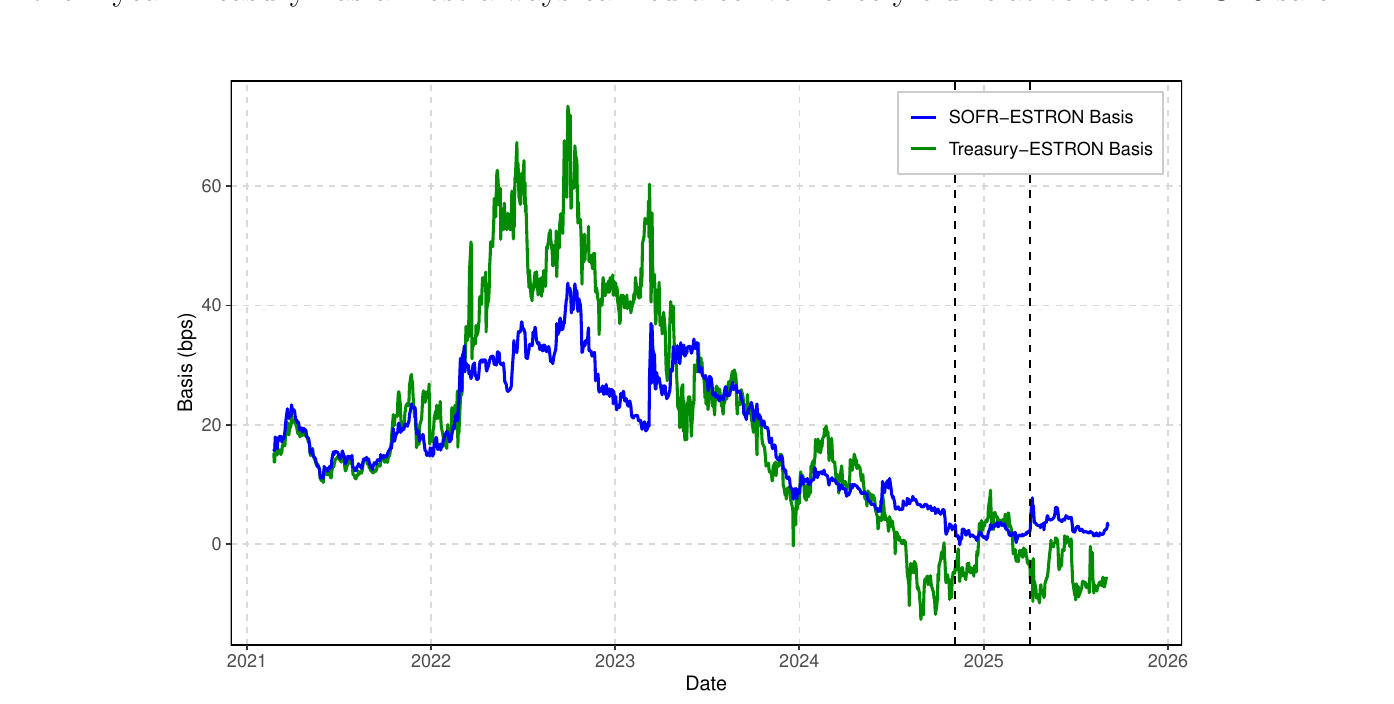
And in April 2025 the correlations flipped sign: the dollar depreciated while U.S. yields rose relative to European ones and the vix spiked. That is the wrong way round. The dollar is supposed to appreciate when the world blows up; that is the definition of a reserve asset. Ten-year yield differentials widened about 50 basis points, which under long-run uncovered interest parity implies a 5% dollar appreciation, and the dollar fell 6.5% instead.
The quantities tell a sharper story than the prices. Foreign investors’ share of U.S. public safe debt fell from nearly 45% in 2016 to 30% in 2025. Their share of private dollar safe debt sat still, between 10% and 15%, the whole time.
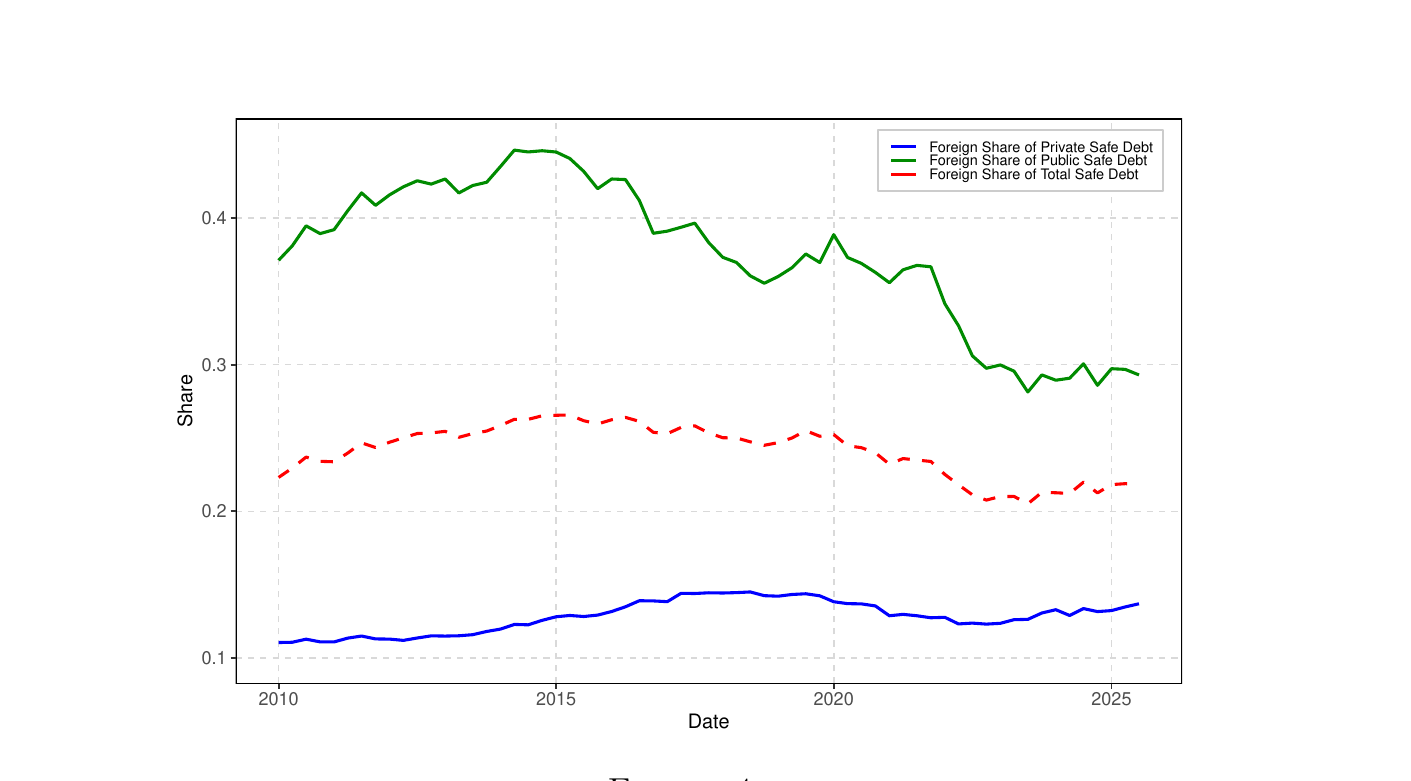
This is a fiscal signature, not a dollar signature. Foreigners did not leave the dollar; they left the Treasury, and stayed in repo and bank deposits. The paper’s step-by-step calibration reproduces exactly this and turns up something perverse in the process: when you reduce foreigners’ specific taste for U.S. government bonds, U.S. seigniorage revenue goes up relative to the uniform-retreat case, because degrading the public safe asset makes the private dollar safe asset scarcer and therefore more convenient, and America issues both. The country is a monopolist across the whole product line. Damaging one of its own products raises the price of the other.
What the seminar pushed on
Two objections stuck. The first, pressed hardest, was about the slope of the domestic bond demand curve: it is calibrated from Krishnamurthy and Vissing-Jorgensen’s (2012) historical data, and if foreigners are leaving because U.S. creditworthiness is deteriorating rather than because they fear sanctions and expropriation, then Americans should be less willing to absorb the bonds too, the curve steepens, and the 87 basis points is too small. Krishnamurthy conceded this cleanly — the calibration is most consistent with the sanctions story, he does not have a benchmark for how much to steepen the curve under the fiscal story, and the effect goes in the direction of making the large number larger.
The second was on the exchange rate: is there any framework that would make 8.8% bigger? Two answers emerged. Foreign reserve demand does not vanish into thin air in reality — it rotates into someone else’s safe assets, and if you model Americans buying foreign safe assets on the way out, the effect roughly doubles by symmetry. And tariffs make it bigger, because a smaller trade sector needs a larger price move to clear the same imbalance. That last one is in the paper, where a 15% mutual tariff turns the 8.81% into 11.26%. Though under the asymmetric elasticity calibration the same tariff scenario makes the dollar appreciate on the loss of reserve status, which the authors report and explain rather than bury.
The caveats are stated plainly and are load-bearing. This is a comparison of two steady states, holding the foreign interest rate fixed, holding everything else fixed, in an endowment economy. Add production and household labor supply and the depreciation falls to 3.54%, because a poorer America also produces less, and the supply contraction partly offsets the demand one. The model says nothing about the path, and the path is where the crises live.
Which leaves the finding in its most uncomfortable form. The thing people argue about — is the dollar overvalued, is that why the factories left — turns out to be the small number, bounded above by roughly 9% and probably less. The thing nobody campaigns about, the 90 basis points, is worth a year of gdp. The exorbitant privilege was never really a currency story. It was a very large, very quiet interest expense discount, and the only reason it was never on the balance sheet is that nobody bills you for it and nobody sends a notice when it stops.