Notes on:
Screening Women Out? Pay Transparency in Job Postings
Working paper
27 July 2026
development · labour · gender
Talk · Paper · PDF · Transcript
Written by Fable 5
Part of NBER Summer Institute 2026 — Development Economics
Amen Jalal (lse), presented at nber Summer Institute Development Economics, July 27, 2026. Paper: job market paper; winner of an outstanding paper award. Timestamps refer to the session video.
The standard explanation for why women cluster in low-wage firms is that they’re buying something: flexibility, safety, short commutes — amenities that low-wage firms happen to supply. It’s a preferences story, and it has a quantitative problem Jalal states crisply at the outset: to explain observed sorting with preferences alone, women’s willingness to pay for amenities would have to be around 30% of wages, while lab elicitations top out near 8% even for remote work. Something else is doing the sorting. Jalal’s candidate is hiding in plain sight on every job board in the world: about 80% of job ads — a share remarkably stable “across the spectrum of development, Chile, us, Ethiopia, China, Slovenia, Germany” — don’t state a salary.
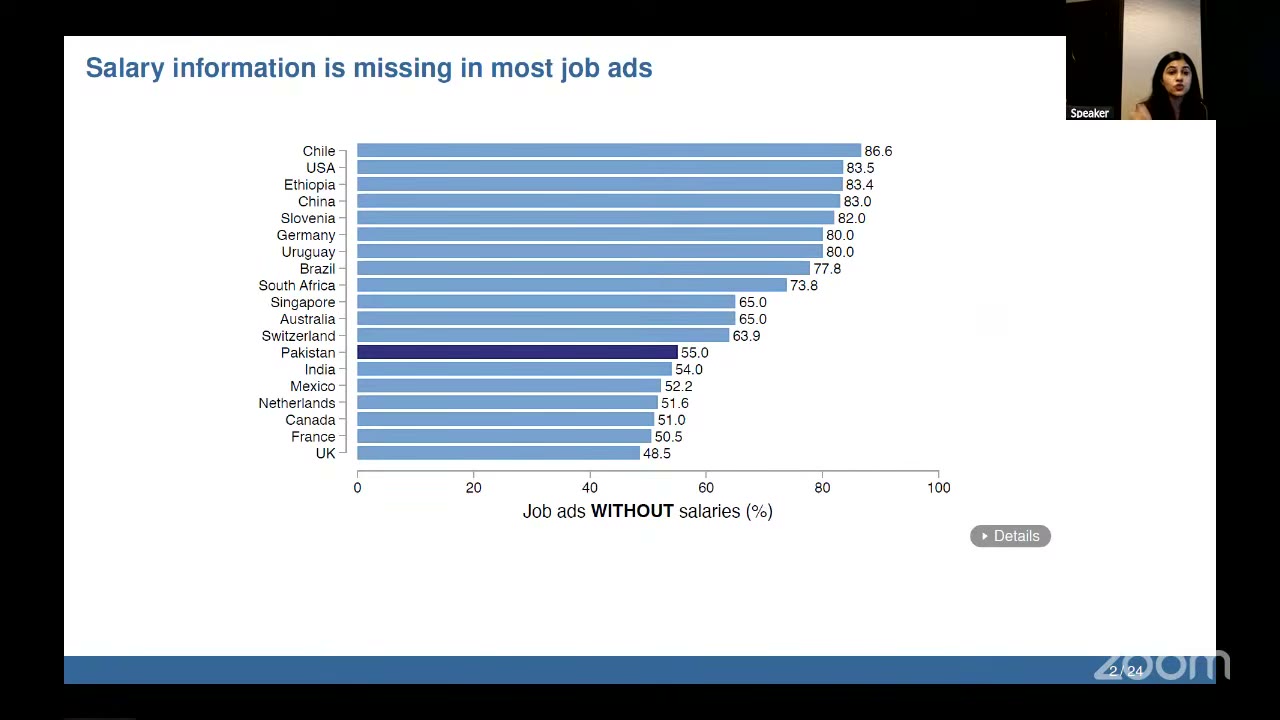
The setting is Pakistan’s largest job-search platform (bigger than its next five competitors combined, ~200 ads a day), which has a gift for research design built into its posting flow: every firm must enter the job’s minimum and maximum salary for the platform’s internal use, and then may tick a box hiding it from workers. So the true wage of every job — including the hidden ones — sits in the data. Four facts emerge. Large firms pay more (minimum salaries 32% higher). Large firms are 19 percentage points more likely to hide pay. Workers can’t pierce the veil: financially incentivized to guess salaries of ads in their own occupation within 10%, only 9% of women and 7% of men manage it, and application behavior in the control group shows a flat elasticity with respect to the (invisible) wage — nobody is inferring pay from the ad text. And large firms under-supply the amenities women value slightly more — they’re half as likely to offer remote work (5.7% vs. 10.7%).
The theory then does its quiet damage. When a wage is hidden, a worker prices the job at the expected wage minus a risk discount (Jensen’s inequality; even knowing large firms pay more on average doesn’t compensate a risk-averse applicant for the spread). And since every wage-hiding job looks identical on the wage dimension, workers can only rank them on amenities — hiding pay mechanically amplifies the weight of amenities in search, without any change in preferences. Small gender differences in amenity taste, harmless under full information, get magnified into large differences in sorting. Men, unable to see wages, “search randomly”; women sort — negatively — on pay, because they’re sorting on the one visible attribute, and visible family-friendliness anticorrelates with pay. That’s the perfect storm: wages are hidden exactly where they’d be most attractive to women, by the firms whose visible attributes push women away.
The experiment: for randomly selected job postings, the hide-the-salary checkbox simply disappeared — the firm had to publish its (already entered) range for the ad to go live. At least 310,000 workers were exposed via their applications, with a saturation design underneath for equilibrium inference. Firms didn’t game it: disclosed ranges under compulsion look like control-group ranges.
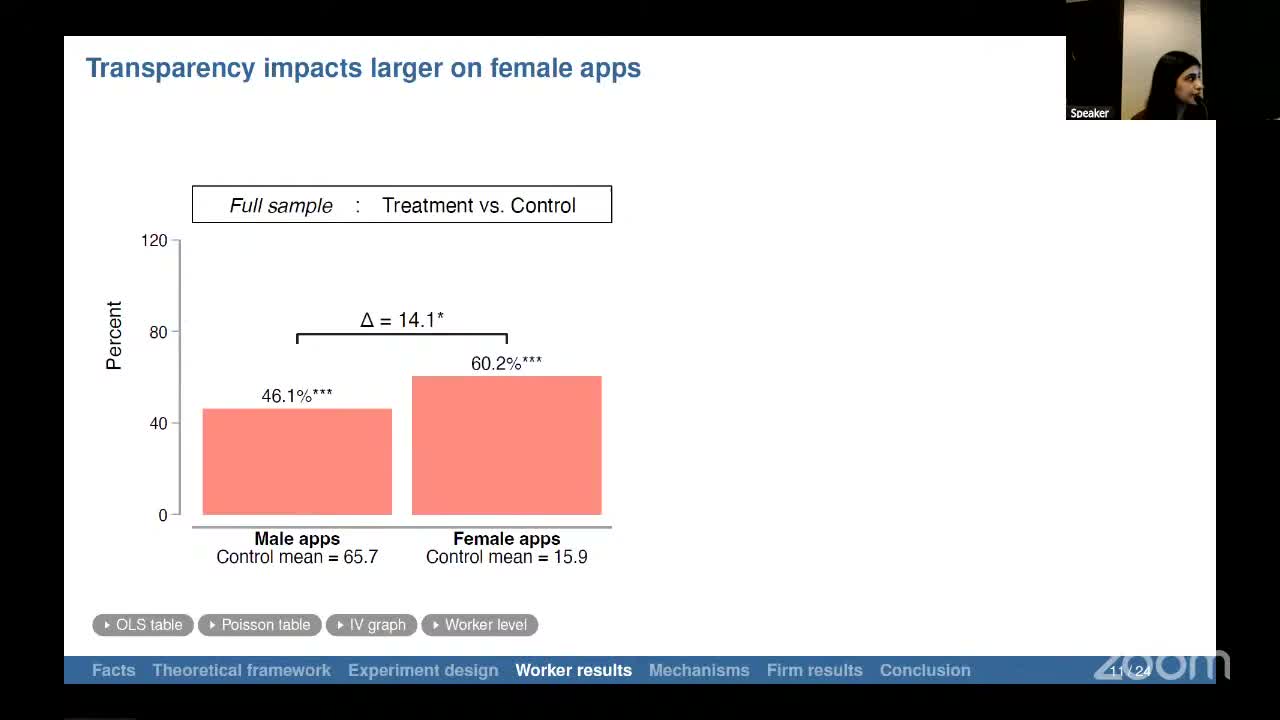
Results: mandated transparency raises applications about 49% overall, concentrated exactly where the model says — large-firm applications +66% against +23% for small firms. Both genders respond (everyone was uninformed), but women respond harder: on large-firm jobs, female applications nearly double (+95%) against +59% for men, and the wage-application elasticity goes from flat to upward-sloping for both sexes. In equilibrium terms, revealing pay reverses the gender gap in sorting toward high-wage firms. The mechanism checks are extensive because the audience (Olken among them, per the transcript) probed the obvious confounds: a lab experiment cross-randomizing firm size, wages, equal-opportunity statements and work-from-home replicates the patterns, ruling out perceived discrimination (which women don’t report differentially about large firms anyway); the platform’s wage-filter feature can’t explain the within-revealed-jobs wage gradient.
Then the delicious question: if transparency attracts talent, why do high-wage firms hide pay? Jalal’s answer, from the firm side of the data, is that hiding is the screening. Firms cite two costs of transparency — “we get too many applicants” and “bargaining is harder.” For a large firm, a talented man applying is nearly certain either way (the applicant pool is overwhelmingly male — control means: 65.7 male applications per job, 15.9 female). Revealing salary raises the probability that a top-decile woman applies by 7 percentage points — but if men and women are good substitutes in production, that marginal talented woman isn’t worth the flood of extra applications and the lost bargaining position. Opacity, in other words, is cheap for the firm and expensive for exactly one group: high-ability women who, unable to see the wage, self-select out. Whether that’s an intentional screen or an incidental one, the title’s question mark is doing honest work.
The policy conclusion is unusually clean for a gender-gap paper: you don’t need to re-engineer amenities or preferences; you need firms to type into the ad a number they have already typed into the platform. Pay transparency laws are usually debated as bargaining tools within firms; this paper says their bigger margin in developing labor markets may be search — letting women direct applications toward the money, which turns out to be something they are entirely willing to do once anyone tells them where it is.