Notes on:
Mussa Puzzle Redux
Econometrica
20 January 2023
real exchange rates · monetary regimes · financial frictions
Paper · doi · PDF · Transcript
Written by Fable 5
Oleg Itskhoki and Dmitry Mukhin. The syllabus lists the 2019 working paper; read here in the published version, Econometrica, January 2025. No recording of a seminar on this paper exists; the stand-in talk is Itskhoki’s afa 2023 lecture “Exchange Rate Puzzles and Policies” (New Orleans, presided by Markus Brunnermeier — transcript included, with audience Q&A), which presents the research program this paper belongs to. His 2021 Central Bank of Chile talk on optimal policy in the same framework is included as a second transcript. There is no discussant.
In 1986 Michael Mussa (1986) published what may be the single most damaging picture ever taken of flexible-price macroeconomics: when the Bretton Woods pegs died in February 1973, the volatility of nominal exchange rates jumped by an order of magnitude — unsurprising, that’s what floating means — and the volatility of real exchange rates jumped with it, instantly, by nearly the same factor. A change in monetary regime — paper, promises, the label on the unit of account — transformed the behavior of a real relative price overnight. In the Nakamura–Steinsson (2018) survey the paper cites, prominent macroeconomists rank this break alongside Friedman–Schwartz (1963) and the Volcker disinflation as the most convincing evidence that money is not neutral. And the standard inference, enshrined in textbooks, runs one step further: money is non-neutral because prices are sticky — with sticky prices, the volatile nominal rate drags the real rate along with it.
Itskhoki and Mukhin’s paper is about that second step, and its title move is to show the crime scene has a second, stranger body. Yes, the real exchange rate’s volatility jumped from about 2 percent to 10–12. But nothing else changed. Not inflation, not relative inflation, not consumption, not gdp — the volatility changes for every macro variable are typically within ±10 percent and insignificant, against a factor of 6 to 8 for exchange rates. (The one exception: relative interest-rate volatility doubled, which is what decoupling from U.S. monetary policy should do.) In the lecture Itskhoki puts it plainly: “you cannot eyeball any kind of structural break” in consumption or inflation, while the exchange rate break is visible from across the room — “an order of magnitude difference… you don’t really need very precise statistical tools.”
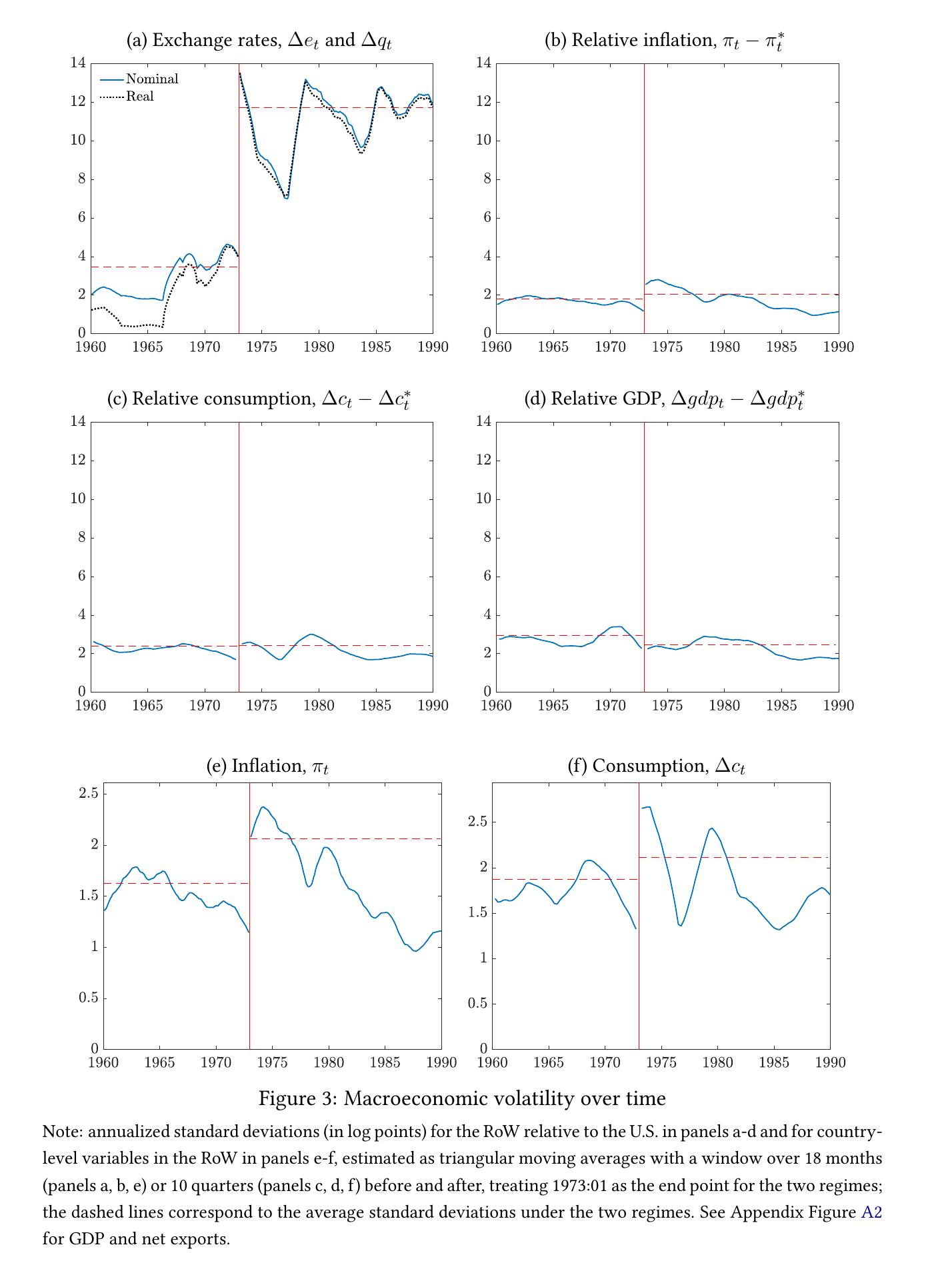
Why this kills both standard model families
The logic is a pincer built from two equilibrium conditions. The first is an identity: q = e + p* − p. If money is neutral (flexible-price irbc — the Backus–Kehoe–Kydland (1992) world from the first block of this reading list), the real exchange rate’s process cannot change with the monetary regime, so a nominal-rate volatility jump must show up in relative inflation. It doesn’t — relative inflation stays low and smooth. Score one for sticky prices.
But the second condition closes the trap. In essentially any model, international risk sharing imposes a relationship between relative consumption and the real exchange rate,
which with z ≡ 0 is exactly the Backus–Smith (1993) condition (paper five in this list). The paper’s Proposition 1 shows that in all “conventional” models — flexible or sticky prices, complete or incomplete markets, any openness, even with time-varying risk premia from habits or disasters — the statistical properties of zₜ cannot change with the monetary regime (exactly under the Cole–Obstfeld (1991) parameterization, approximately otherwise). So if the volatility of q jumps sixfold and z is regime-invariant, the volatility of relative consumption must jump too. It didn’t move. In the data, std(Δz) roughly quintuples after 1973. One sufficient statistic, directly measurable, falsifies the whole class: sticky-price New Keynesian models explain the exchange rate and get consumption wrong; rbc models get consumption right by failing on the exchange rate. As the paper puts it, the trilemma logic says a central bank can stabilize the exchange rate or domestic conditions but not both — yet Bretton Woods central banks apparently stabilized the exchange rate for free.
The proposed culprit: the risk premium, made endogenous
The resolution moves the non-neutrality of money out of the goods market and into the financial market. Households in each country hold only their own currency’s bonds; the currencies are connected by noise traders (a liquidity demand shock ψ) and risk-averse arbitrageurs who absorb imbalances. The arbitrageurs’ willingness to intermediate depends on the risk they bear, which is nominal exchange rate volatility. Equilibrium delivers a modified uip condition (equation 25 in the paper):
so uip deviations are proportional to the variance of the nominal exchange rate. There’s the switch. Under a float, σₑ² is large, intermediation is timid, and noise-trader shocks move the exchange rate a lot — these financial shocks, per the authors’ earlier disconnect paper (Itskhoki and Mukhin 2021), account for the bulk of floating-rate volatility while touching macro quantities almost not at all (that’s the exchange-rate disconnect, and it flips the Backus–Smith correlation negative, as in the data). Under a credible peg, σₑ² → 0, arbitrage capital becomes infinitely elastic, and the same financial shocks are absorbed frictionlessly: the risk-sharing wedge disappears endogenously. The peg doesn’t fight the financial shocks with interventions; it drains their power by making currency risk-free to intermediate. Money is non-neutral — with fully flexible prices — because the monetary regime sets the quantity of risk in the arbitrageurs’ problem.
This gets every Mussa fact at once: exchange rate volatility collapses under the peg (the financial component qᵠ vanishes); macro volatility barely moves in either regime because home bias keeps exchange-rate pass-through small and, crucially, the central bank under the peg is not forced to import volatility into inflation — the volatile thing it would have had to lean against has evaporated. The trilemma constraint is relaxed on the equilibrium path.
Overidentification, and the Swiss control experiment
The model makes side predictions that the standard account doesn’t: the floating-era pathologies should be creatures of the float. The Fama forward-premium coefficient was near +1 (uip roughly holding) under Bretton Woods and turned negative after; the Backus–Smith correlation was positive under the peg in every sample country and flipped negative under the float in all but two; the Balassa–Samuelson (1964) effect, invisible in floating data since Rogoff’s (1996) survey, shows up clearly within the Eurozone’s fixed rates. Covered interest parity, meanwhile, held equally well in both regimes — exactly what a risk-based wedge implies, since cip is a risk-free arbitrage. (In the Q&A, asked about uip versus cip, Itskhoki is disarmingly direct: uip deviations ran two orders of magnitude larger than cip deviations before 2008 — roughly 200 basis points against 20–40 — “if we wanted to build a model of just one object, we decided to go with uip.”)
Then the modern replay: Switzerland, 2011–2015. During the credible franc-euro peg, snb reserves were flat — the peg was not sustained by intervention — and fx turnover was, if anything, 20–30 percent higher than after. When the peg was scrapped in January 2015 the franc jumped 15 percent; to explain that with a currency-demand shock in a constant-elasticity model would require a demand jump of roughly 100 percent of Swiss gdp that is simply absent from transaction data. What changed at the regime boundary was the supply elasticity of arbitrage capital — the model’s exact mechanism, caught on camera in 2015 where the 1973 data are too coarse to see it.
What the lecture adds
The afa lecture is the research program with the scaffolding visible, and two of its riffs are worth keeping. First, on why the literature spent decades in the wrong place: Engel (1999) showed 90–95 percent of real-exchange-rate variation comes from the tradable component, which sent everyone hunting law-of-one-price deviations, sticky prices, pricing-to-market — and yet, Itskhoki argues, in a large class of models those deviations “wash out” in the aggregate (some markups rise as others fall), so the ppp decomposition is a dead end for general equilibrium purposes. The comovement of nominal and real rates needs no goods-market friction at all: “central banks are pretty good — outside of 2021–2022 — at stabilizing inflation,” so whatever moves the real rate moves the nominal rate one-for-one. Second, the disconnect exhibits: Abenomics halved the yen with no visible effect on Japanese inflation or output — a policy “successful at moving the exchange rate but not successful at doing anything to inflation,” which no conventional calibration can produce — and the same equations with sanctions plugged in for financial shocks trace the ruble’s 2022 path.
For this syllabus the paper is the block’s keystone: it takes the two anomalies the reading list opened with — bkk’s quantities and Backus–Smith’s prices — and shows they were regime-dependent all along, then relocates the failure from the goods market (where Chari–Kehoe–McGrattan (2002), next up, will show sticky prices straining to carry the load) to the financial market. Whether one buys noise traders as deep structure or as a placeholder, the identification move — one regime switch, one sufficient statistic, an order-of-magnitude gap that needs no econometrics — is the cleanest thing to happen to this evidence since Mussa drew the picture.