Notes on:
Internationalizing Like China
American Economic Review 115(3): 864--902
16 September 2022
geoeconomics · Renminbi · currency internationalization · reputation
Talk · Paper · doi · PDF · Transcript
Made with AI: Opus 5 (reading and writing)
Christopher Clayton (Yale som), Amanda Dos Santos (Columbia), Matteo Maggiori (Stanford gsb), Jesse Schreger (Columbia), “Internationalizing Like China,” American Economic Review 115(3), March 2025, 864–902. Video: Clayton presenting at the Macro Finance Society meeting, uploaded 16 September 2022 — a 20-minute talk, then a discussion by Olivier Wang (nyu) and a Q&A, 48 minutes in all. The figures are crops from the published version; no slides were available.
The guest list
Here is a thing you can do if you run a large country with a large bond market that foreigners are not allowed into. You can open the market. Or you can open it to particular people, in a particular order, over fifteen years, and never say out loud that this is what you are doing.
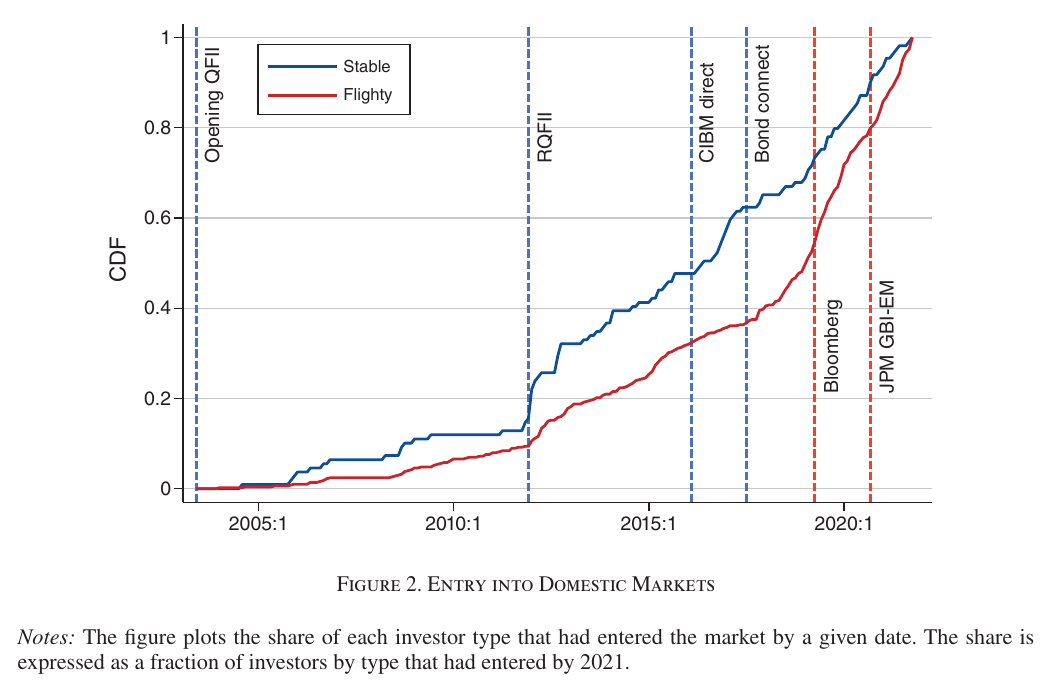
China did the second one. Its domestic bond market is the third largest in the world, behind the United States and the euro area, around 20 trillion dollars at the end of 2021 (p. 868), and for most of its existence it was shut. It opened through a sequence of programs with quotas, lock-ups and application forms: qfii from 2002, whose one-year lock-up was cut to three months in 2009 for pension funds, insurers, endowments, monetary authorities and open-ended funds; direct interbank-market access for central banks and sovereign wealth funds, quota-free from 2015 and quota-free for everyone with cibm Direct in February 2016; then Bond Connect in 2017, run out of Hong Kong, reachable from a Bloomberg terminal, no lock-up at all (p. 869). Read the order and the policy is legible: patient money invited first, impatient money invited last. A 2015 notice from the People’s Bank of China says the quiet part in the flat prose of administrative guidance — overseas institutional investors “shall act as long-term investors, and conduct trading based on reasonable needs for preserving or increasing the value of their assets” (p. 869 fn 5).
The authors build a monthly dataset of every foreign investor’s first entry through each of the four access programs, name-matched to FactSet and sorted into stable, flighty and bank (pp. 872–873). The result is the paper’s central fact, and it is a picture of a receiving line.
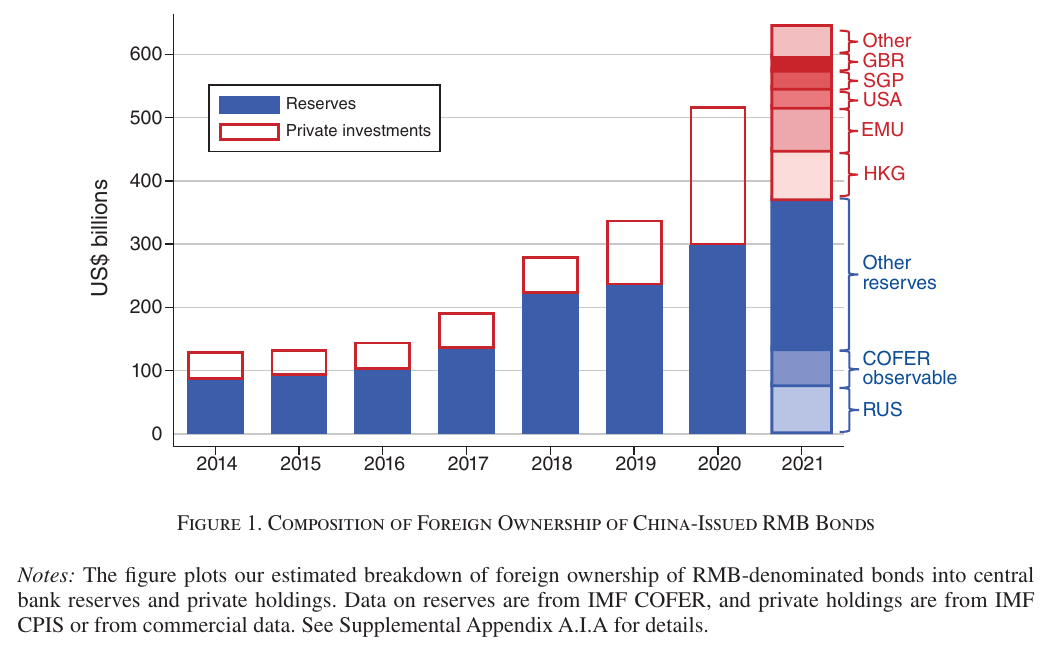
The money follows the same order. Foreign holdings of onshore rmb bonds went from under 150 billion dollars at the start of 2014 to nearly 660 billion at the start of 2022, the largest single-year jump — almost 200 billion — coming in 2020 (p. 870). Early on it was almost entirely reserves; the largest disclosed holder is the Central Bank of Russia, which went from under 1 billion dollars of rmb bonds in 2017:II to roughly 67 billion a year later, having cut its dollar reserves “apparently in response to us sanctions” (p. 871).
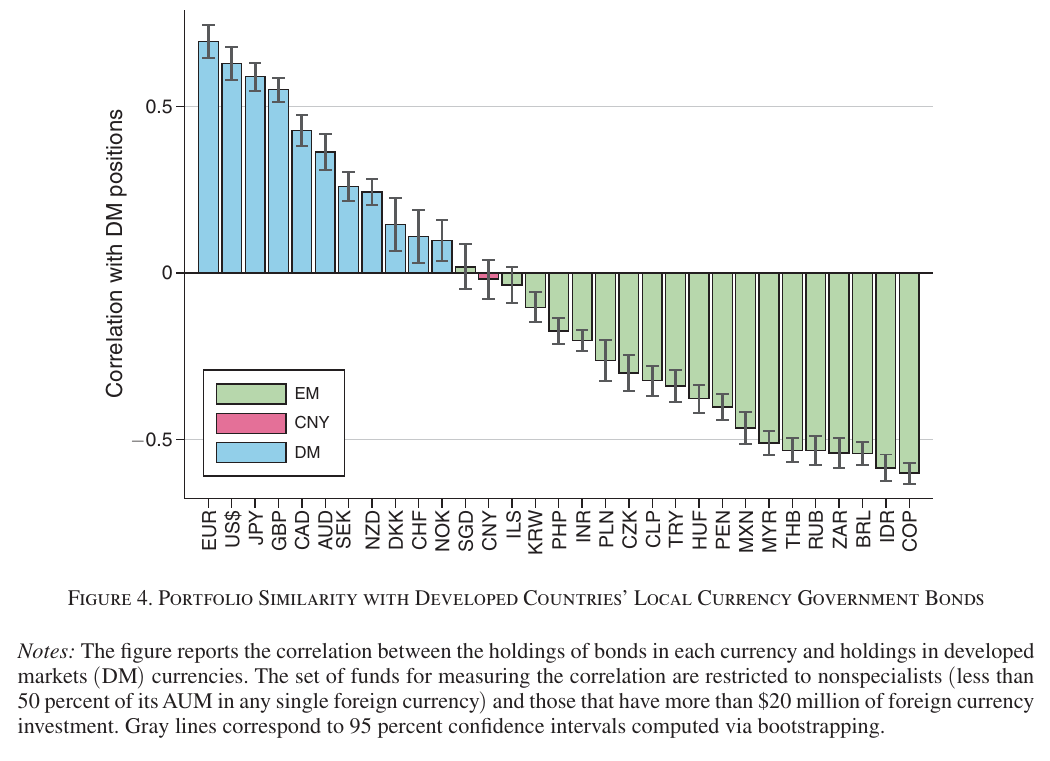
Foreigners are not buying Chinese credit risk. China Government Bonds are 67 percent of foreign investment and policy bank bonds another 30 percent, though those two are only 62 percent of the market; just 3 percent of foreign money goes into the 38 percent that carries real private credit risk (p. 872). To ask what slot the rmb occupies in a portfolio, the authors take 828 investment funds with just over 1.6 trillion dollars under management and ask, currency by currency, whether a fund’s holdings move with its holdings of developed-market currencies (p. 875). The T. Rowe Price International Bond Fund holds almost 62 percent of its foreign-currency book in developed-market currencies; the pimco Emerging Markets Local Currency and Bond Fund holds under 1 percent. In real and yen they sit at opposite ends. In renminbi they look similar (p. 876), which is the finding in miniature.
One caveat about a result you may have heard attached to this paper. In the talk Clayton showed a within-fund rebalancing exercise — what a mutual fund sold when it bought Chinese bonds — and reported that in 2019 the money came essentially entirely out of us Treasuries and other developed markets, and in 2020 a lot of it out of agencies and Treasuries [00:09:18]; Wang leaned on it as evidence that the rmb substitutes for safe assets rather than for risky credit [00:21:41]. It is a good exercise and it appears in neither the published version nor the superseded working paper. It stayed on the slide.
Two types, one parameter
The model. You are a government borrowing from foreigners through a domestic intermediary that funds long projects with short debt. In the middle of the period a bad state hits, the debt must be rolled, and the rollover is capped by a pledgeability constraint, with the fraction of end-of-date cash flows that cannot be pledged. Whatever cannot be rolled is met by liquidating projects at a discount , which hurts. You may be a committed government, which would never dream of imposing capital controls, or an opportunistic one, which picks mid-date. A tax on outflows keeps money from leaving, which relaxes the constraint, which means fewer fire sales. That is the temptation, and it is real.
Investors cannot see your type. They form a belief that you are committed — and that belief is not what prices your bonds. What prices your bonds is the probability you will not impose controls, which mixes the belief with the opportunistic type’s mimicking probability :
and this object, not , is what the paper calls reputation (p. 883). A government you are fairly sure is opportunistic can still be trusted this period, if it is currently in the business of pretending.
Now the crucial simplification, and the place where the published paper differs from the version Clayton presented in 2022. Stable and flighty investors “have identical preferences over (monetary) payoffs” (p. 879). They face the same demand schedule (equation 6). They do not charge different rates and they are not capacity-constrained. They differ in exactly one thing: borrowing from the flighty requires higher pledgeability — a lower debt-to-asset ratio — so (equation 4, pp. 879–880). Flighty means will not roll unless you are less levered, and nothing else. And because market reforms apply to the whole market rather than to one class, letting the flighty in raises to for everyone, including the stable investors already inside (fn 21, p. 880); the authors defend this pari passu assumption with Bond Connect, a platform used by all foreign investors including those who came in years earlier under stickier programs (pp. 882–883).
From which follows the line the whole paper turns on. If the opportunistic government imposes controls its payoff is scaled up by
and, verbatim, “ is a decreasing function of ; that is, the presence of flighty investors lowers the proportional gains from imposing capital controls” (equation 10, p. 884).
Sit with that, because the naive reading runs the other way. Hot money makes crises worse, so surely hot money makes you more likely to slam the gates. No. Capital controls are a device for stopping people from leaving; their value depends on what you extract from the people who stay. Once your creditors are the ones who demanded you be unlevered and were going to pull out anyway, trapping them buys proportionally less. The flighty are the creditors it is least worth expropriating.
Which is why the invitation is the signal
Proposition 1 (p. 882) gives a unique threshold : below it you set and borrow only from stable investors; above it you borrow equally from both classes, , at a common rate . The logic is a fixed-cost problem. Take logs of the date- payoff and the net worth multiplier separates from the debt term, so the step from to is a lump-sum charge levied on your existing, inframarginal stable holders. The benefit is a second pool of lenders without bidding up the marginal rate, and it grows with reputation, because you are a monopolist in your own debt market and a higher both lowers and flattens the schedule, and a monopolist facing a flatter curve extracts more. So you wait until the flat curve pays the fixed cost. You liberalize because you are already trusted, not in order to become trusted.
Except that the act of opening also makes you more trusted, precisely because : reneging is worth more before you open than after, so the invitation is differentially expensive for the bad type to send, and in reputation games such an action buys a jump. The mixing type’s indifference condition becomes an ar(1) in the committed type’s indirect utility,
(equation 15, p. 887), which is flat before opening up, (equation 19, p. 889), and at the opening-up step is scaled bodily upward:
The ratio is the jump (equation 20, p. 890). Afterwards the coefficient falls to (equation 21), so reputation grows more slowly once the market is open — you have spent the trick. “Opening up is a disproportionately expensive action for the opportunistic types to take,” the paper writes. “In reputation games, taking this type of expensive action comes with a jump up in reputation” (p. 890).
The uniqueness claims are narrower than they look. Proposition 2 (p. 888) gives a unique graduation-step Markov equilibrium only when investors are homogeneous, ; Proposition 3 (p. 890) gives at most one such equilibrium for a given opening-up step, and the paper is explicit that equilibria with different may coexist (pp. 890–891).
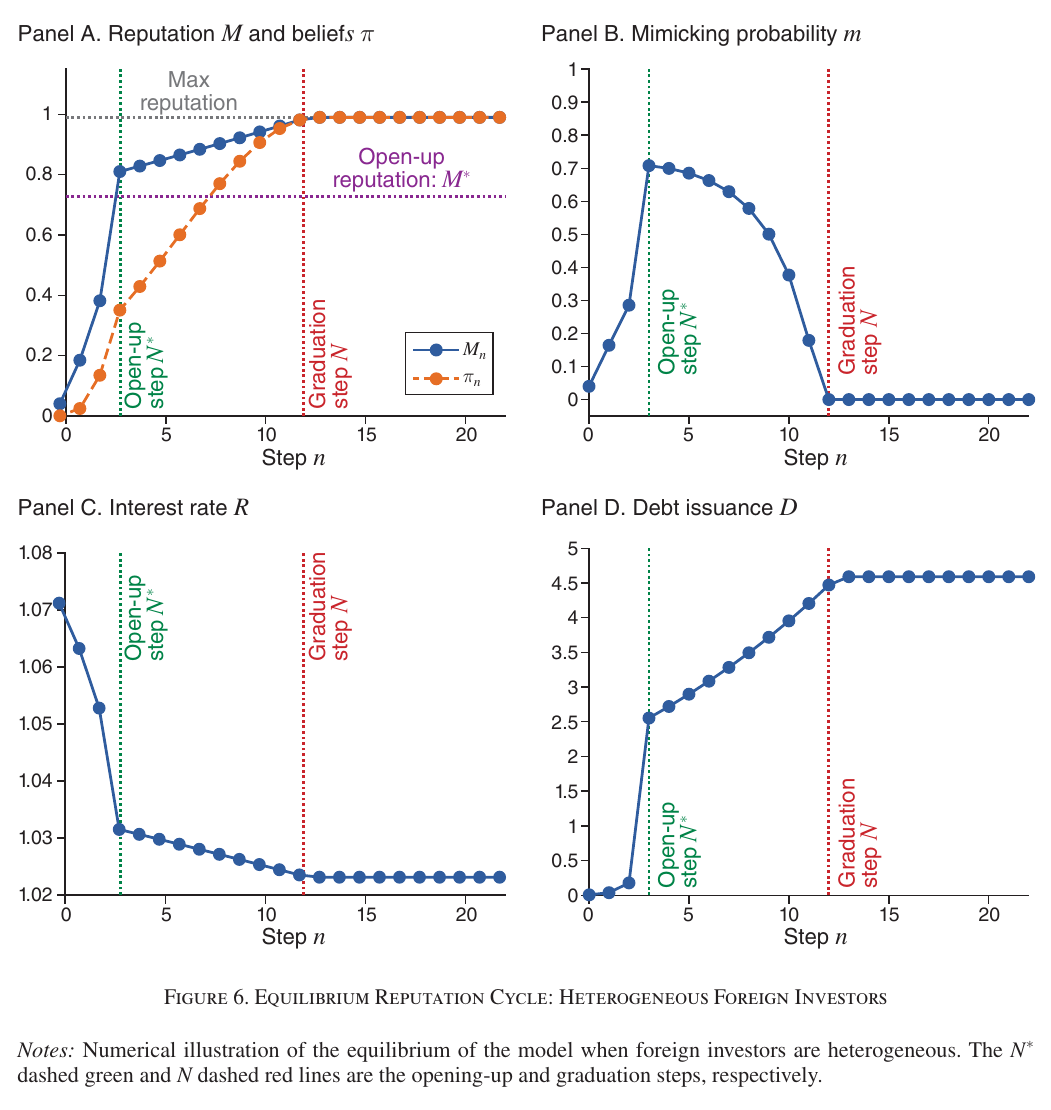
The illustration opens up at and graduates at , from prior beliefs . Most of the total decline in the interest rate is banked at the opening: to about 1.031 at , then a creep to about 1.023 over the following nine steps. The mimicking probability peaks near 0.71 at and goes to zero at . The authors insist the exercise is “intentionally stylized and qualitative … pure illustration without a quantitative focus” (p. 891), and they are right to; the shape is the content.
Graduation is the top of the cycle, not the end of the story
Two features stop this being a story about arriving. Types switch exogenously: a committed government is dissolved with probability and an opportunistic one with , each replaced unobservably by the opposite type, in the tradition of Phelan (2006) and Amador–Phelan (2021) (p. 885). So the ceiling on reputation is , never 1 — the market always prices the chance that the government it learned to trust has quietly been replaced by one it should not. And at the graduation step , the remaining gains being too small to be worth waiting for, the opportunistic type switches to the pure strategy : “all opportunistic governments decide to impose capital controls if a crisis occurs, thus restarting the reputation cycle” (p. 892). Beliefs collapse to and it begins again. Reputation here is not a ladder you climb and then stand on. It is a thing you build up in order to spend.
Reputation is built only in crises, and crises are rare
Section V adds a high state, with probability , in which nobody flees, controls do nothing () and therefore nobody learns anything; the old model is the low state. What investors price becomes . Proposition 4 (p. 896) gives three paths for a government at step $0 < n < N$: in the high state debt is flat; in the low state without controls there is flight now and more foreign debt next period; in the low state with controls the flight is shallower now and debt collapses back to after. Reputation moves only in the last two, which is to say only in crises, which is to say slowly.
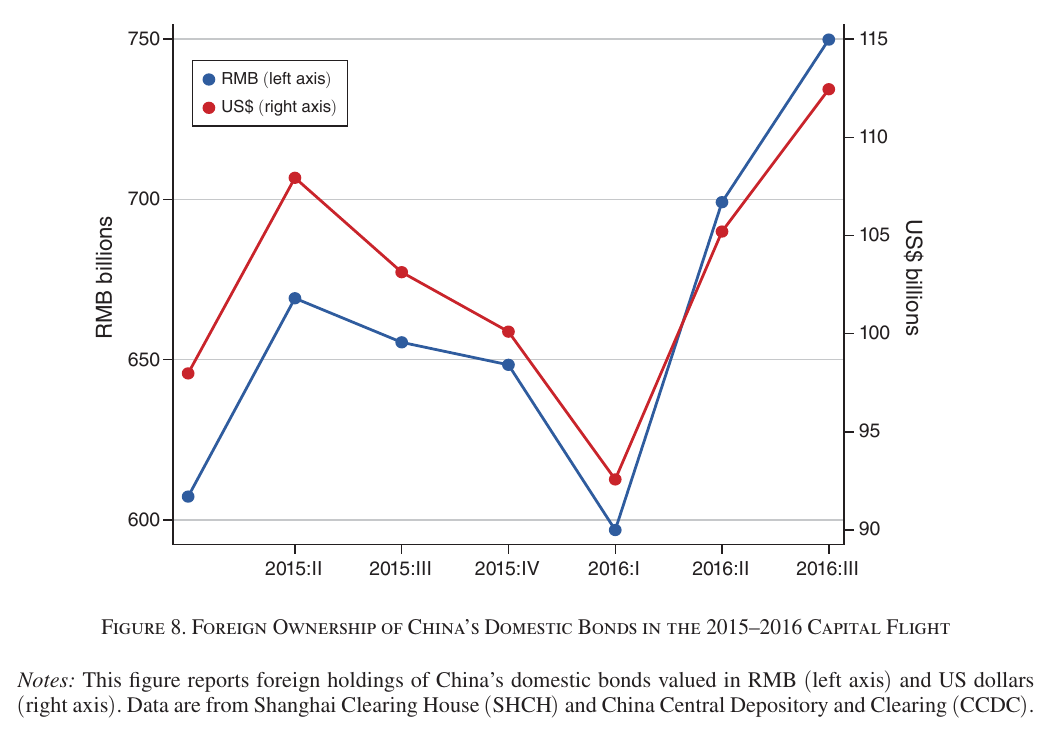
Then the paper walks 2015–16 through it. Foreigners sold 11 percent of their rmb bond holdings between 2015:II and 2016:I, 15 percent measured in dollars — from 108 billion to 92 billion — and were back above the old high by 2016:II (p. 898 and fn 35). During the episode the Bank of Japan’s Haruhiko Kuroda observed that “capital controls could be useful,” and the Financial Times editorial board agreed that “capital controls may be China’s only real option” (p. 899). China did impose restrictions — on its own residents and firms moving money out. It conspicuously did not restrict foreigners’ ability to sell and repatriate, and eased their quotas while the flight was still running. Standard Chartered names the thing exactly: “with continued downward pressure on the rmb, investors have feared a potential closure of investment channels resulting in an inability to access or repatriate funds” (pp. 898–899). The ft in mid-2016: for capital to come back, investors “must be convinced […] that the money they put into China will not be stuck behind a financial Great Wall.” They were convinced, the money came back larger, the rmb entered the sdr basket, and Bond Connect — the flighty investors’ door — opened the following year.
What the discussant asked, and what became of it
Wang’s discussion is unusually load-bearing, because two of his objections describe a model the published paper no longer has, which is the best outcome a discussant can hope for.
He objected that the flighty were being made bad on two dimensions at once — ex ante they charged more, ex post they ran — and asked for a version where the only difference was flightiness [00:29:31]. Clayton agreed on the day, calling it “a good critique of the way it’s set up right now” and saying they were thinking about relaxing it [00:41:11]. They did. In the published baseline the two classes are identical in preferences and demand and differ only in required pledgeability; the heterogeneous demand curves, and the cap on stable-investor size on which the entire 2022 exposition rested — the “we hit the capacity of the stable investors and then we open up” of [00:18:42] — survive only as a numerical extension in the Supplemental Appendix (p. 892). If you watch the talk after reading the paper, the capacity constraint is a load-bearing wall that has since been removed. Do not take the 2022 intuition home.
He also pressed on calendar time versus model time: reputation is built only in crises, China has had very few, and 2015 is contested, since the currency moved a great deal and many things happened at once [00:28:12]. He nominated 2022 — the rmb having depreciated sharply the week of the talk — as the next test. The published version answers by running the story forward: in 2022–23 the market and currency came under stress again through Zero Covid and the property sector, foreign holdings fell to 515 billion dollars by late 2023, and so far “China has allowed foreign capital to leave unobstructed” while continuing to court foreigners, launching Swap Connect in May 2023 — though it remains “an open question whether China will make it through this episode while avoiding the temptation to impose further controls” (pp. 870, 899–900).
His remaining points got paragraphs rather than models. That is blunt, since a central bank can instead cut rates or let the currency go and pay a reputational cost through uip [00:30:40], is met by a concession that “currency depreciation and/or inflation, or arbitrary administrative orders” can impair the promise without breaching the rule of law, plus a defence of modelling the outflow tax on the grounds that it is what investors actually name — “repatriation risk,” and whether China will “lock the gates” (pp. 893–894). Reserves as complement or substitute for reputation [00:32:33] gets one sentence: “one possible extension of the model is to allow for reserve accumulation as a mechanism to ‘build’ reputation” (p. 895).
And the question Wang spent his last four minutes on now gets nothing at all. He asked whether it is easier to build a reputation in a world that already has a safe asset or in an empty one, with the two natural data points: sterling’s 1931 depreciation cost it its status because a dollar was standing there to receive it, while the dollar’s 1971 depreciation cost it much less because there was nowhere else to go [00:37:13]. The 2022 abstract promised exactly this — competition among reserve currency providers, worsening the incentive to build reputation — and Clayton flagged it as an ongoing extension [00:19:39]. The published abstract’s closing sentence is now “We use our framework to shed light on China’s response to episodes of capital outflows.” Competition survives as a motivation for the monopoly assumption and a pointer to Farhi–Maggiori (2018) and Choi–Kirpalani–Perez (2022) (p. 894). Section V took its place, which is the right trade — the crisis section turns 2015 into a test rather than an anecdote — but the sterling question is still open and this paper no longer answers it.
Where it sits
This is the supply side of currency dominance, and the only paper in the block about a challenger rather than an incumbent. Gopinath–Stein (2021) explain why the dollar’s invoicing, banking and pricing roles reinforce each other; Farhi–Maggiori explain why a safe-asset issuer’s credibility is fragile; this one asks what a country that wants the job can do about the fragility, and answers: sequence your creditors, and wait for crises, because crises are the only time anybody is watching. It is the concrete version of the claim that alternatives to the dominant system are under-scaled by construction — you build one in crises survived, not in reforms announced.
The authors are careful that this is descriptive of China and not a scolding of anyone else. Most emerging markets cannot attract much stable money at low reputation, and the model says such countries “may choose to open up more quickly to flightier foreign capital” (pp. 892–893); Clayton put it more bluntly in the Q&A, that a country with essentially no stable capacity should open to the flighty almost immediately [00:43:02]. Which leaves the mildly awkward reading that the emerging markets doing the thing everyone calls reckless are running the same model as China from a worse starting hand. China’s advantage was never patience. It was being large enough that central banks would show up early — and central banks, it turns out, are the investors whose money is worth trapping.