Notes on:
International Sanctions and Dollar Dominance
The Economic Journal 135(672): 2567--2577
2025
geoeconomics · sanctions · dollar dominance · convenience yield
Paper · doi · PDF
Made with AI: Opus 5 (reading and writing)
Javier Bianchi (Minneapolis Fed) and César Sosa-Padilla (Notre Dame). The Economic Journal 135(672), November 2025, pp. 2567–2577; Advance Access 8 July 2025; eleven pages. This is the published version of record, and it supersedes nber Working Paper 31024. No talk recording could be found, so this is a pdf-only digest. Figures are cropped from the paper. The companion paper is their “On Wars, Sanctions and Sovereign Default”, Journal of Monetary Economics 141 (2024), pp. 62–70, which takes the sanctioned country’s side.
Yellen’s worry, written down
In April 2023 the U.S. Treasury Secretary said out loud what reserve managers had been thinking since Russia’s central bank assets were frozen: using financial sanctions that work through the dollar’s role could, over time, undermine the dollar’s role. This paper is a two-period model built to check whether that sentence is coherent, and it turns out to be coherent only under two conditions, both of which are the conditions under which the dollar is special in the first place.
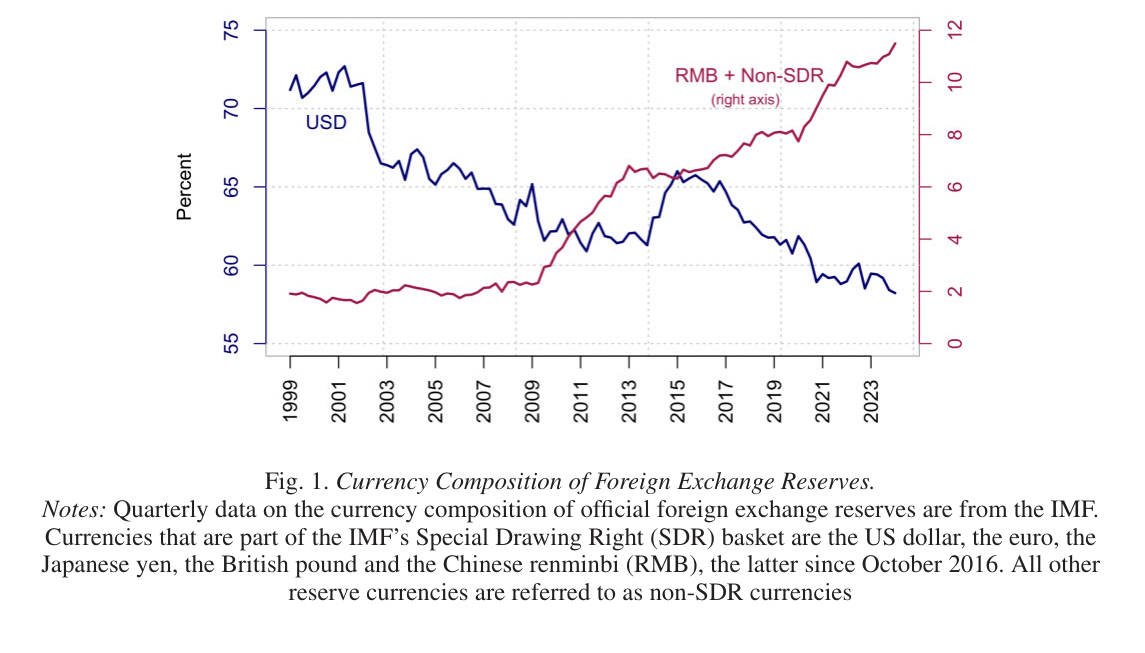
The setup is deliberately minimal. Two countries, the United States and China, and a rest of world where real assets pay . American investors (households, banks and government consolidated) issue safe dollar bonds paying nominal and invest the proceeds in real assets, but issuing bonds carries a quadratic portfolio cost . Chinese households get a non-pecuniary utility from holding dollar assets — the reserve-currency convenience — on top of their return. A financial sanction is modelled as the confiscation of a fraction of Chinese dollar holdings in period 2, with the proceeds not accruing to American investors (seized assets go to reconstruction funds, not to the issuer), so the sanction is a wedge, not a transfer. China’s first-order condition for dollar holdings is
(eq. 4 in the paper): the marginal convenience of a dollar asset must equal the return it gives up relative to real assets, after the expected haircut. An anticipated sanction therefore reduces the demand for dollar assets at any return. The U.S. supply curve is (eq. 2): the spread between real and dollar returns is what pays the issuance cost.
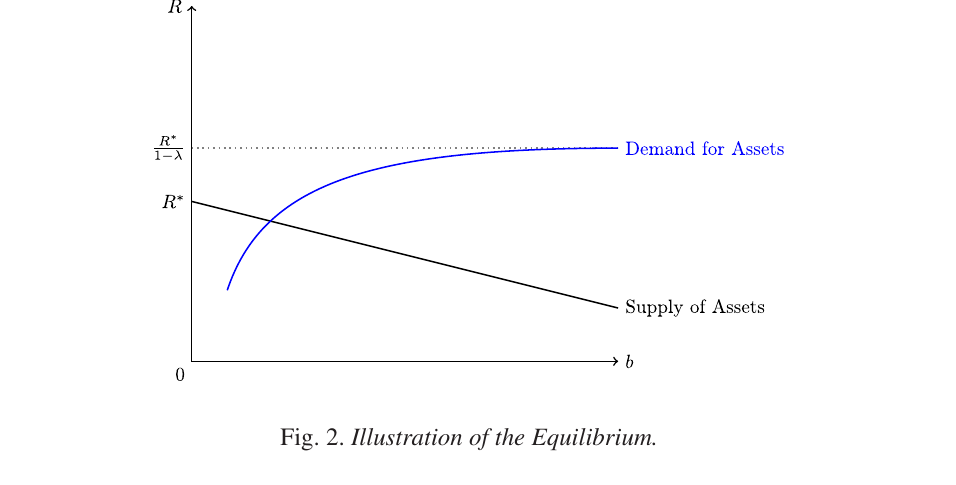
Two cases where nothing happens, and one where it does
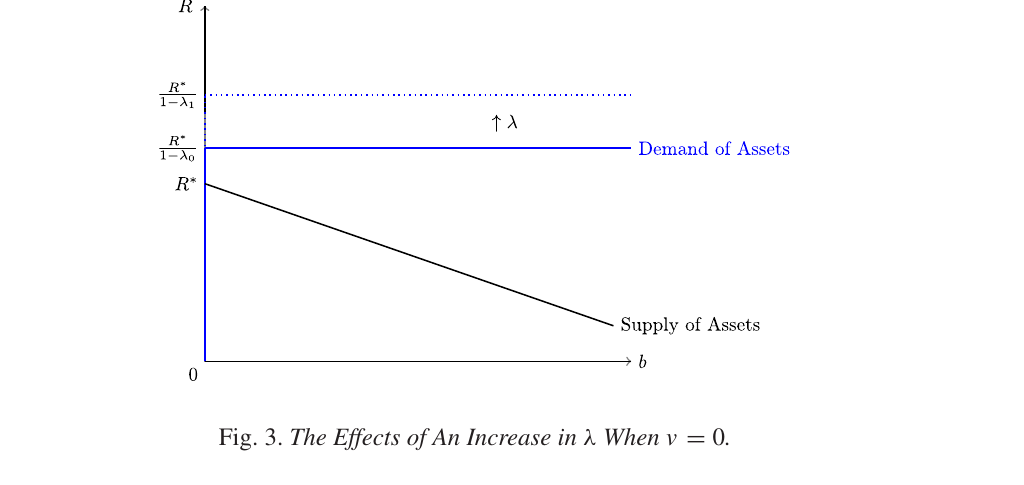
The paper first shows when Yellen is wrong. If dollar assets are not special (), China holds them only at , the U.S. issues them only at a spread, the demand curve is an inverted L, and a rise in moves nothing in equilibrium. If issuing dollar assets is costless (), supply is perfectly elastic, the dollar return is pinned to the real return, and again the sanction has no effect on the exchange rate. The exorbitant privilege needs both a convenience yield and a downward-sloping supply of safe assets to exist, and the sanction bites only through the same two ingredients.
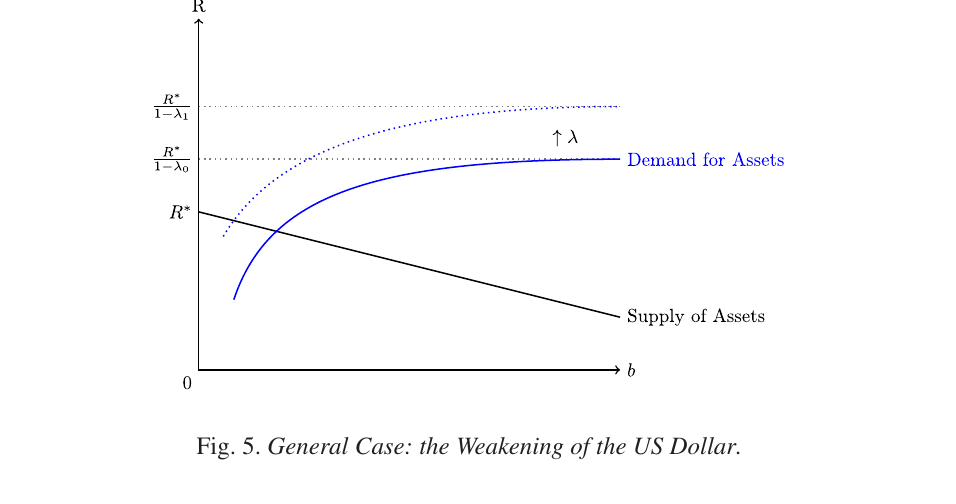
With both ingredients (Proposition 1), a higher raises the equilibrium dollar return , lowers China’s net return , reduces dollar holdings , and depreciates the dollar. The comparative static that carries the proposition is equation (5) on p. 2574, which sets equal to over a denominator combining with the curvature of scaled by , and is positive because is concave; the journal’s composition dropped the double prime on that , so the printed display should be read with . The depreciation comes from the price level: with the Chinese price level and the period-2 exchange rate pinned, a higher required return on dollar bonds at a given nominal rate means a higher expected dollar inflation, which is a weaker dollar today. The authors note that the Fed could defend the exchange rate by raising ; the welfare result does not depend on this, because the only welfare-relevant object is .
Everybody loses
The welfare arithmetic is two lines. China loses because its net return on dollar assets falls (the unnumbered display at the foot of p. 2574). The United States loses because the convenience yield it earns on its liabilities shrinks — the rise in is a rise in the cost of the debt American investors issue (eq. 6). There is no winner, and in particular the sanctioning country pays for its sanction in reduced exorbitant privilege even before the sanction is imposed, because the cost arrives through anticipation. A footnote adds the one exception: at the zero lower bound, a weaker reserve-currency status can be welfare-improving for the U.S., in the spirit of Caballero, Farhi and Gourinchas (2021).
The discussion section is candid about what is left out. With initial positions, a depreciation transfers wealth from China to the U.S., but by an envelope argument on the central bank’s choice this does not change the marginal welfare result. Sanctions differ from sovereign default because default relaxes the defaulter’s budget while a sanction raises no resources for the sanctioner — and a new footnote 10 on p. 2575, absent from the working paper, works out what happens if seized assets did go to American investors: supply becomes , so a rise in still raises , but and China’s net return do not move, and neither does welfare on either side. In an infinite horizon, expected future sanctions would feed back into today’s exchange rate through interest parity, and portfolio maturity and adjustment costs would matter; the authors flag a dynamic stochastic version as the natural next step.
Where it sits
This is the smallest model in the block and the one that most directly concerns the group’s monetary interests. It links the sanctions strand of block 2 to the currency-dominance strand of block 3 through a single wedge: the sanction is a tax on the convenience yield. Read it after Farhi–Maggiori (2018) (where the safe-asset supply curve comes from) and alongside Itskhoki–Mukhin’s (2026) Sanctions and the Exchange Rate (which works out the exchange-rate consequences of sanctions on the target’s side). The cms (Clayton, Maggiori, and Schreger 2026) nonlinearity-of-power result is the natural complement: this model shows that the hegemon pays for financial coercion at the margin, and theirs shows that the target’s best defense is to move a small share of its holdings, which is exactly the response here. The paper’s closing caveat is also worth keeping: sanctions that deter future wars might strengthen the dollar by other channels, and the model is not built to weigh that.