Notes on:
Hegemonic Globalization
Kiel Working Paper 2292
10 June 2025
geoeconomics · hegemony · alignment · trade agreements
Talk · Paper · PDF · Transcript
Made with AI: Fable 5.1 (reading and writing)
Fernando Broner and Alberto Martin (crei, upf, bse), Josefin Meyer (diw Berlin), Christoph Trebesch (Kiel Institute). This note follows the draft dated 11 September 2025 (75 pages); the reading list’s bibliography entry points to the earlier June version, CESifo Working Paper 11951, so page, table and proposition numbers here are the September ones. The companion note “Hegemony and International Alignment” (with Jiaxian Zhou Wu) is forthcoming in aea Papers and Proceedings. No seminar recording exists. The video is a 41-minute Spanish-language interview with Broner and Martin on Penn’s Ceteris Paribus podcast, hosted by Ángel Alvarado and uploaded 10 June 2025, three months before this draft; there is no discussant. Quotations from it are my translations from the captions. Tables and the one figure are cropped from the pdf; the pivotal equations are transcribed from it.
Kindleberger, with a mechanism
Kindleberger’s (1973) hegemonic stability thesis, that an open world economy needs a leading power to hold it open, has been in international political economy since 1973, and the paper’s own summary of what became of it is that the literature “has made few advances recently in part due to its lack of formalization.” The two globalizations of the last two centuries coincided with Pax Britannica and Pax Americana; the interwar fracture coincided with the absence of either. This paper supplies a formalization, and the surprising thing about it is how little it needs. There are no terms-of-trade effects, no tariffs in the baseline, and no coercion. There are two premises. Countries differ in the policies they would choose for themselves (the rule of law, regulation, licensing, currency, form of government, military alliances), and the gains from trade between two countries rise with how similar their chosen policies are, because similar policies are lower border costs. A hegemon is a large country and nothing else. Being large makes it worth aligning with, and that is the whole of its power in the baseline.
Put those together and policy choice becomes a coordination game. Each country weighs the cost of moving away from its own preferred policy against the trade it gains from being closer to everyone else’s. In the paper’s notation a country at location on a circle chooses a policy to maximize
(the unnumbered expression after eq. 2, paper p. 11): is the endowment, the value of each variety that can be traded, the rate at which policy distance destroys tradable varieties, the size of hegemon , and the cost of running a policy other than your own. The thing to notice is that the hegemon enters only through . It is a heavier term in the same sum as everyone else.
With one hegemon of size , Proposition 2 (p. 13) says fragmentation, everyone at its own preferred policy, is an equilibrium if and only if
and globalization, everyone at the hegemon’s policy, is an equilibrium if and only if
The gap of exactly one between the two thresholds is the mass of the small countries, and it is the mechanism: aligning with the hegemon is worth it on bilateral grounds alone only once the hegemon is big, but once everyone else has aligned, you are aligning with them too, so a hegemon a full unit smaller can sustain the same outcome. In between, both equilibria exist and a sunspot picks (globalization with probability ). Globalization always raises world welfare, but the countries whose preferences sit farthest from the hegemon’s lose from it and align anyway, because with everyone else at the hegemon’s policy there is nobody left to trade with on their own terms. Lemma 1 adds that equilibrium alignment is inefficiently low, since your aligning raises my gains from trade as well as yours.
Two hegemons, still only two outcomes
Now add a rising hegemon at the far side of the circle, as different from as it can be, and smaller. The first thing to get right, because the talk’s language invites getting it wrong, is what the model rules out. moves first and always sets its own policy, and the paper is explicit that this “rules out the outcome in which countries set to align with ” (p. 15). Nobody follows the challenger. The only two robust equilibria remain full fragmentation and full globalization, and in the latter itself is aligned with . There are no blocs in this section.
What has is a choice between the two, and, once large enough, the power to impose it. Proposition 3 (p. 16) says prefers fragmentation if and only if
a condition on the incumbent’s size and on preference heterogeneity, not on ’s own size at all: what weighs is the trade it gets from a world aligned at ’s policy against the cost of running that policy from the other side of the circle. If prefers fragmentation, it can force it, by announcing its own policy early, once
if it prefers globalization it can force that once . Below its threshold “prefers to wait to observe the sunspot and coordinate its policy” with everyone else, aligning with if the globalization equilibrium is the one played.
The way a large unravels globalization is the paper’s core, so it is worth walking through. plants itself at its own policy. For a small country the question was always whether to move toward ; the marginal reward for doing so used to be the trade gained with the mass sitting at ’s policy. Now moving toward also means moving away from , which is large and trades with everyone at a rate that falls with distance. The net reward drops to , and once that is below nobody moves and the globalization equilibrium ceases to exist. The introduction says it in one sentence: before, small countries “could simultaneously align with both the incumbent and rising hegemons,” and now “this is no longer possible.” Alignment is a single dimension, and you cannot be close to both ends of it. The result is not that countries go with ; it is that they stay home, everyone still trades with everyone, and trade is low. Figure 7 gives the welfare ordering. Countries near gain, because their policies move toward what they wanted; countries near , whose policies were already their own, only lose trade; world welfare falls (panel d). Broner’s revealed-preference argument on the podcast (23:28) applies to , which chose the deviation, and not quite to its neighbours, who gain in the model because the new equilibrium happens to suit them. Martin’s summary, that under unipolar alignment the West “was in the best of all worlds” and is the party with most to lose, is the model’s.
The flip side is footnote 8. Put next to instead of opposite it and the pair behave like a single hegemon of size , so growth of the riser can only strengthen globalization. That is the paper’s account of why the United States overtaking Britain did not break the first globalization and why China’s rise may break the second: what matters is not that a second pole exists but how far around the circle it sits.
Coercion, which is where the blocs are
Section 4 lets threaten to cut trade with any country not at its policy, or linked, directly or through any chain of trading partners, to one that is not. Proposition 4 shows the threat produces intermediate equilibria: a share of the countries nearest align and trade only with each other and the hegemon, the rest keep their policies and trade only among themselves. This is the first appearance of anything you could call a bloc, and the paper says so: “Without coercion, equilibrium results in either full fragmentation or full globalization. However, coercion introduces ‘intermediate’ equilibria, where some countries form blocs” (p. 24). threatens, per Proposition 5 (eq. 4, p. 21), if and only if
the expected size of the bloc against the trade it would have had anyway, with the chance globalization happens unforced. The stick pays only for a hegemon of intermediate size: too small and the bloc it can assemble is not worth the trade it forfeits with everyone outside, too large and countries were coming anyway. Coercion can also produce excessive globalization, alignment forced early enough that the losses of the far countries exceed the gains of the near ones.
The two-hegemon example (Section 4.2) is where the talk’s picture of a challenger peeling countries away does apply. While is small, does not bother to threaten. As grows, starts coercing pre-emptively, to keep “playing along,” and for a while nothing visible changes. Then is big enough that deviating pays even against the threat, because setting its own policy “attracts enough countries from the incumbent’s bloc” into the non-aligned group to compensate for losing trade with the bloc. ’s bloc shrinks discretely, then keeps shrinking as grows, until coercion no longer pays and the whole thing gives way to fragmentation. Martin’s gloss on the podcast, that the countries a challenger draws off “were in the existing bloc a bit a regañadientes,” grudgingly, because “there were a lot of gains from trade” but they never loved the rules (20:10), is a fair description of this section. The asymmetry survives: “C and the countries close to it benefit slightly from the deviation, whereas U and the countries close to it suffer significantly,” and world welfare falls.
Seventy-seven thousand treaties, sorted by a language model
The theory says alignment is a policy choice and hegemons induce it, so the empirics need a measure of alignment with variation across two centuries and many domains. The paper’s footnote on the usual proxies is that military alliances “are few in number” and un voting “only starts in 1945.” Treaties do better. The Global Treaty Database assembles the near-universe of agreements between sovereigns from 1800 to 2020, 76,849 in all, 70,840 bilateral and 6,009 multilateral, from Parry’s Consolidated Treaty Series, the League of Nations and un treaty series (56,960 from the latter alone), and the uk, us and Chinese national collections. Classification is the part worth knowing about before you use the data. Each treaty is assigned one of 22 categories, nine economic and thirteen not, by ChatGPT-4 turbo through the OpenAI api, from title, subject terms, description and keywords, at temperature zero, with “other” allowed when unsure (p. 29 and its footnotes). That is the obvious objection to a 77,000-row dataset, and the paper benchmarks it: every one of the 948 post-1948 trade agreements in desta (Dür, Baccini, and Elsig 2014) was picked up, and all but 123 of the roughly 1,500 pre-war agreements hand-coded by Pahre (2007) and Ptashkina (2022), which were added back by hand (Appendix B.3). The classifier also turns up 5,383 “secondary” trade treaties, on sanitary standards, merchant visas and the like, that no pta dummy contains. Economic treaties are 46,325 of the total and 65 percent of the post-war sample.
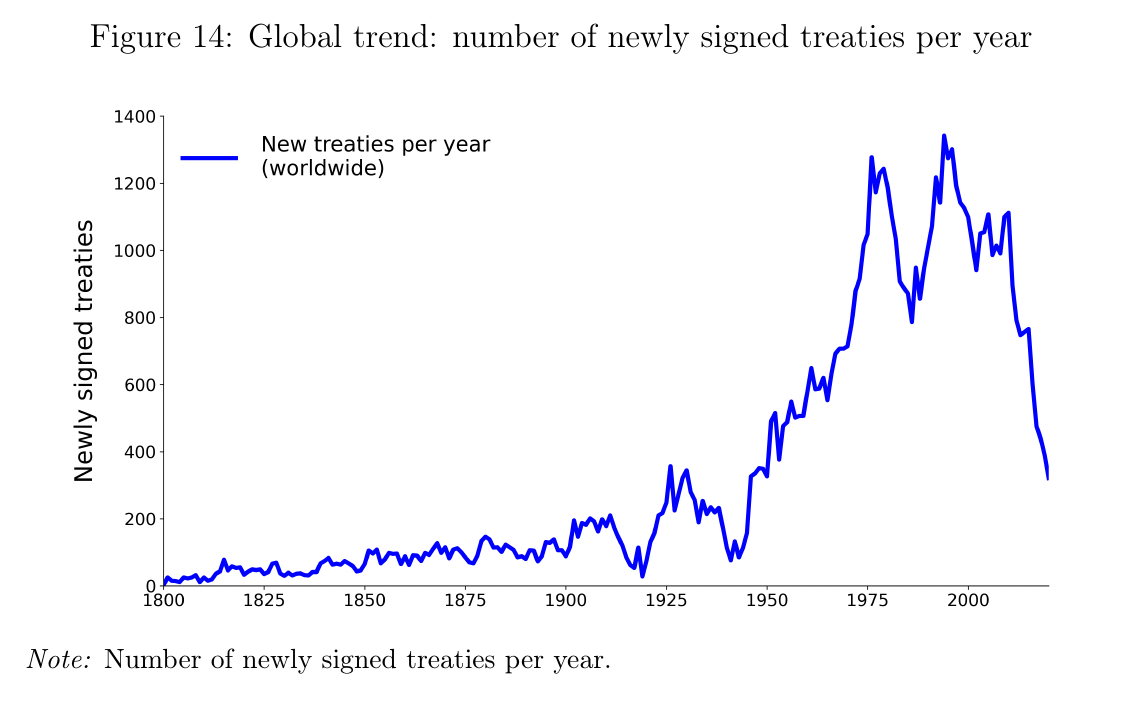
The raw series is worth the paper on its own. Treaty-making rises from under five a year before Waterloo to about 80 in the 1870s, nearly 200 before 1914, and over 1,200 a year in the 1970s and 1990s, with the two world wars as collapses. Then it falls from about 2001 to a level the paper calls “comparable to the collapse experienced during WW1 and WW2.” On the podcast Martin was careful about this (16:18): reporting lags could be part of it, though what they had checked said lags were “not the whole story.” The September draft is firmer than the June interview. It benchmarks the post-2001 drop against the uk, us and Chinese national collections and against the trade-agreement databases and finds similar declines everywhere, and it reports that multilateral treaty-making, which began falling before 2001, is now below its level in the early nineteenth century (p. 31–32). The paper’s own reading is the theory’s: countries are becoming less aligned as the world becomes multipolar.
The paper measures multipolarity too, and the essay would be incomplete without it. Hegemony is the Global Power Index of Moyer et al. (2024), hp-filtered, with 10 percent of world power as the threshold. On that measure Figure 15 has Britain dominant into the mid-nineteenth century, five roughly equal powers from 1900 to 1945, the United States dominant after 1945 with the ussr second into the 1980s, and China rising since the 1990s “to a level comparable to that of the Soviet Union in the early 1950s.” Figure 16 plots the gap between first and second: 100 to 200 percent through the Cold War, a record 400 percent in the 1990s, and under 100 percent by 2022, “approaching the levels of the interwar years” (p. 34). If you take the model literally, that is walking toward its threshold.
Two tests and an indirect effect
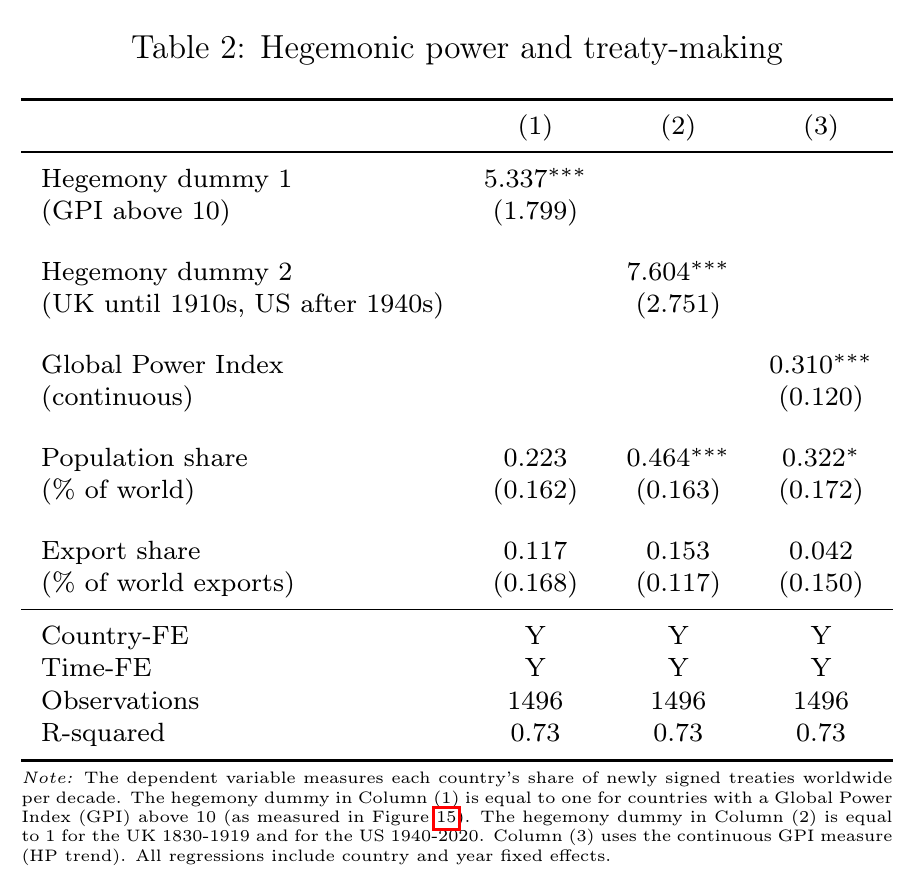
The first test is that hegemons sign disproportionately. Table 2 regresses a country’s share of the world’s treaties per decade on its hegemonic status with country and decade fixed effects and population and export-share controls (N = 1,496): the gpi dummy adds 5.3 percentage points, a narrative uk-then-us dummy adds 7.6, and each gpi point adds 0.31. The paper calls that sizable “given that even the largest powers only account for 10–25 percent of all global treaties signed per decade.” The maps in Figures 17 to 19 give the reorientations: South America from British to American treaties between the 1870s and 1900s, Africa from Soviet to American by the 1980s (Iran, Iraq, Vietnam, Finland and Sweden moving the other way), and between the 1990s and 2010s most of the map flipping from the us to China, especially in the Global South.
The second test is gravity. Table 3 runs ppml on bilateral exports 1830–2020 with exporter-year and importer-year fixed effects. The elasticity of trade to treaties signed in the past 20 years is 0.255; economic treaties 0.276, non-economic 0.192; the total stock 0.460. Adding pair fixed effects cuts the coefficient to 0.102 but it survives, and holds separately pre-WW1 (0.111) and post-WW2 (0.101). The paper’s illustration, from the column without pair effects, is that moving from the 25th to the 75th percentile of us treaty intensity in 2010 (26 to 47 treaties, roughly Ethiopia to Belgium) goes with 20.65 percent more trade with the us.
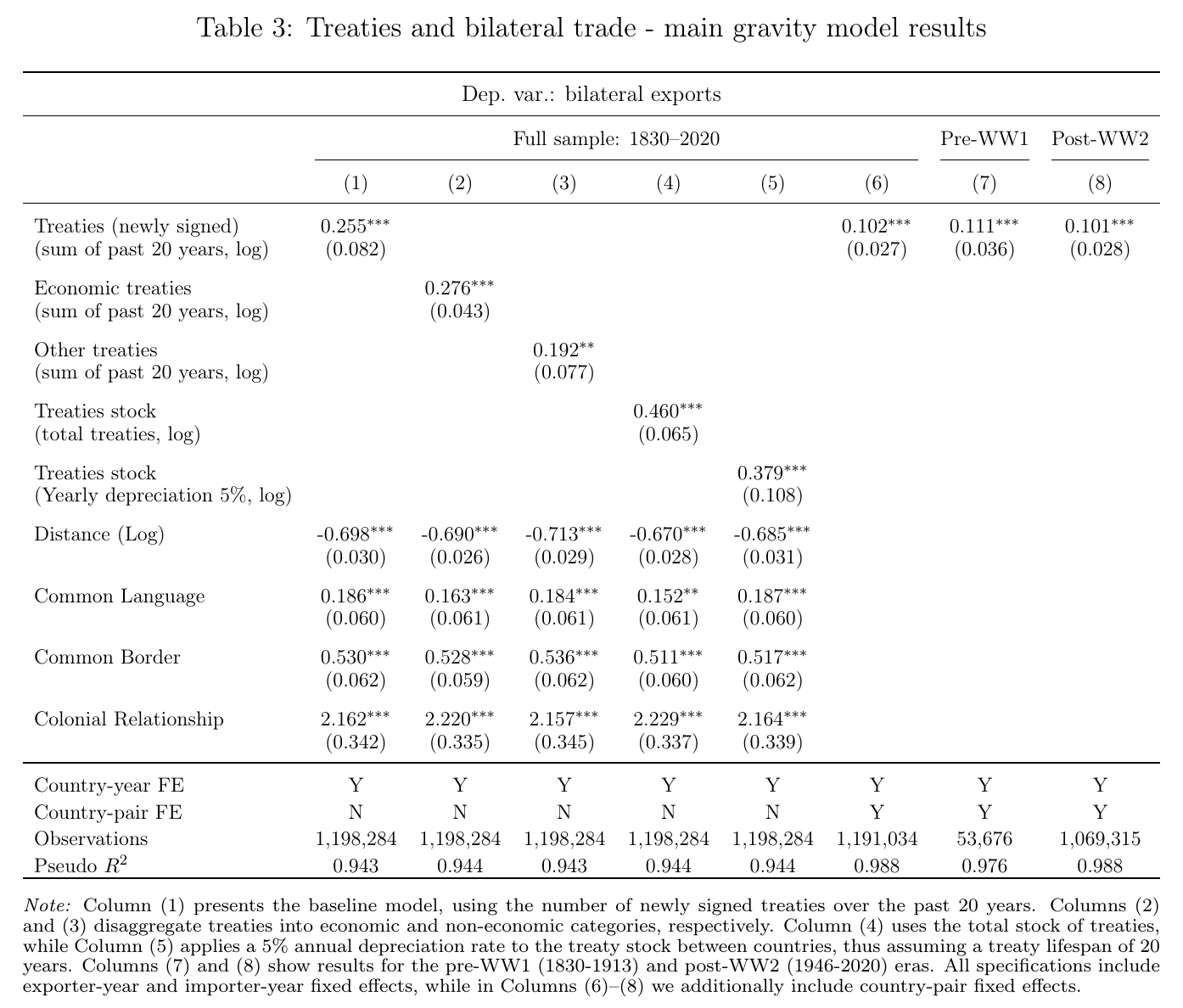
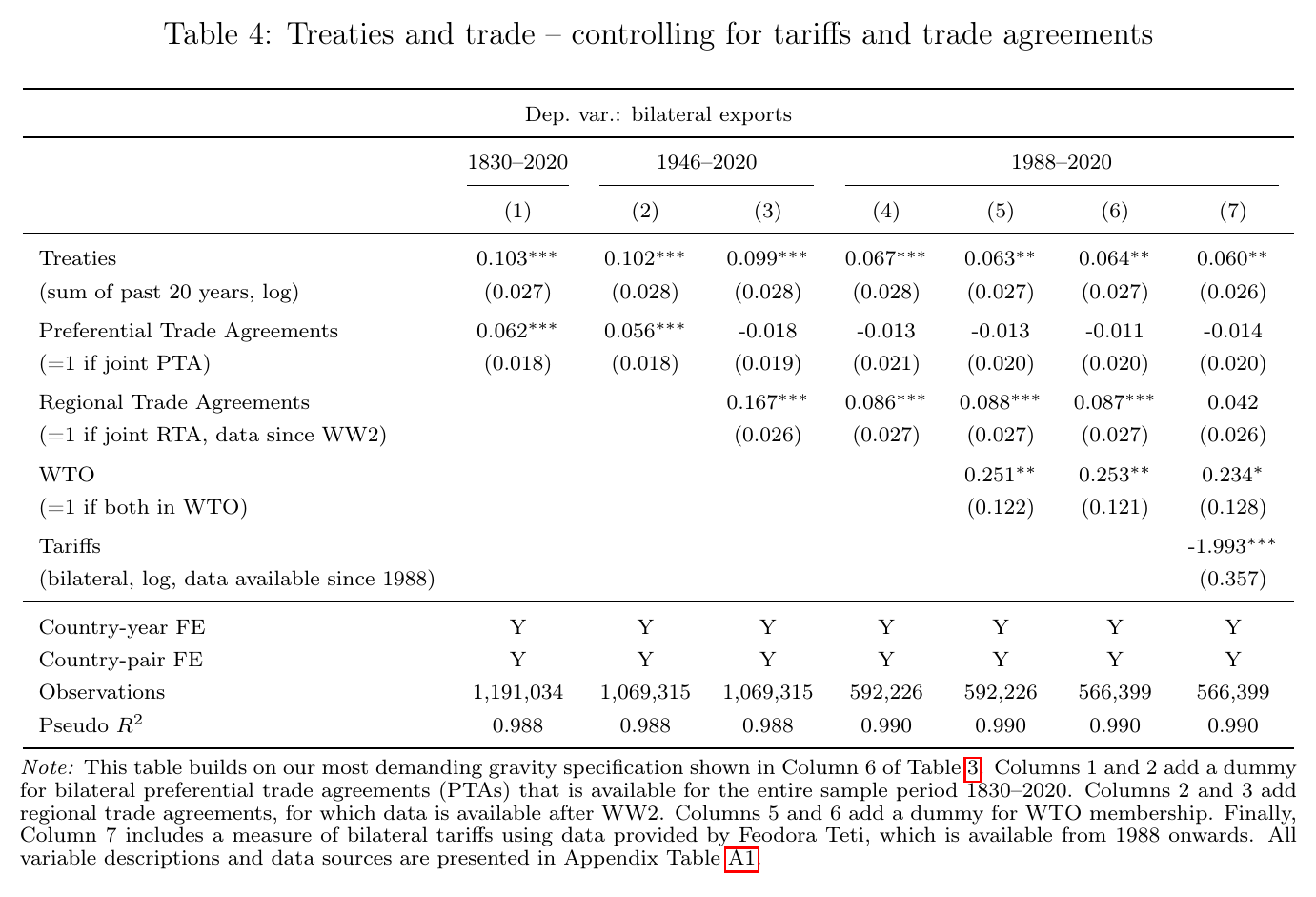
Table 4 keeps the treaty coefficient at 0.060 once bilateral tariffs (Teti’s (2025) data, 1988 on, coefficient −1.99), ptas, rtas and wto membership are in; treaties are measuring something the trade-policy variables do not.
On direction, the paper is more careful than a summary of it tends to be, and the care is worth keeping. “We can establish correlation but not causality,” it says; “both directions are at work in the theory, and they are plausibly at work in the data as well” (p. 39–40). What it offers is the Yotov et al. (2016) lead-lag test in Table 5: treaties signed 10 to 20 years ago carry 0.070, treaties of the past decade 0.047, treaties of the next decade 0.019 and insignificant, so treaties are, in the paper’s phrase, a leading indicator of trade, “while indicative” and with the authors advising “caution in interpreting the results as causal rather than correlational.” Figure 20 gives the episodes: Western European treaties with Nato members quadrupling between 1944 and 1949 before exports pick up after 1947, developing-country treaties more than doubling between 1965 and 1975 while exports stagnate to the mid-1970s, and Eastern Europe’s treaties with the West more than quadrupling by 1993 ahead of its reintegration.
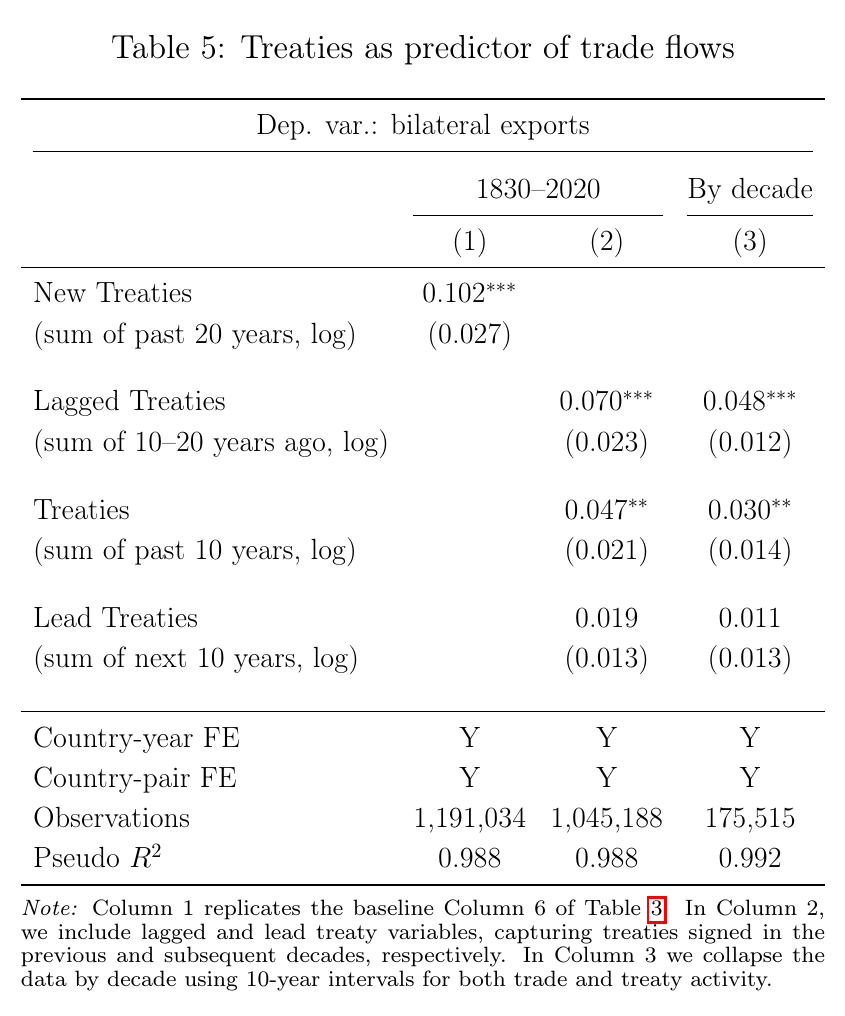
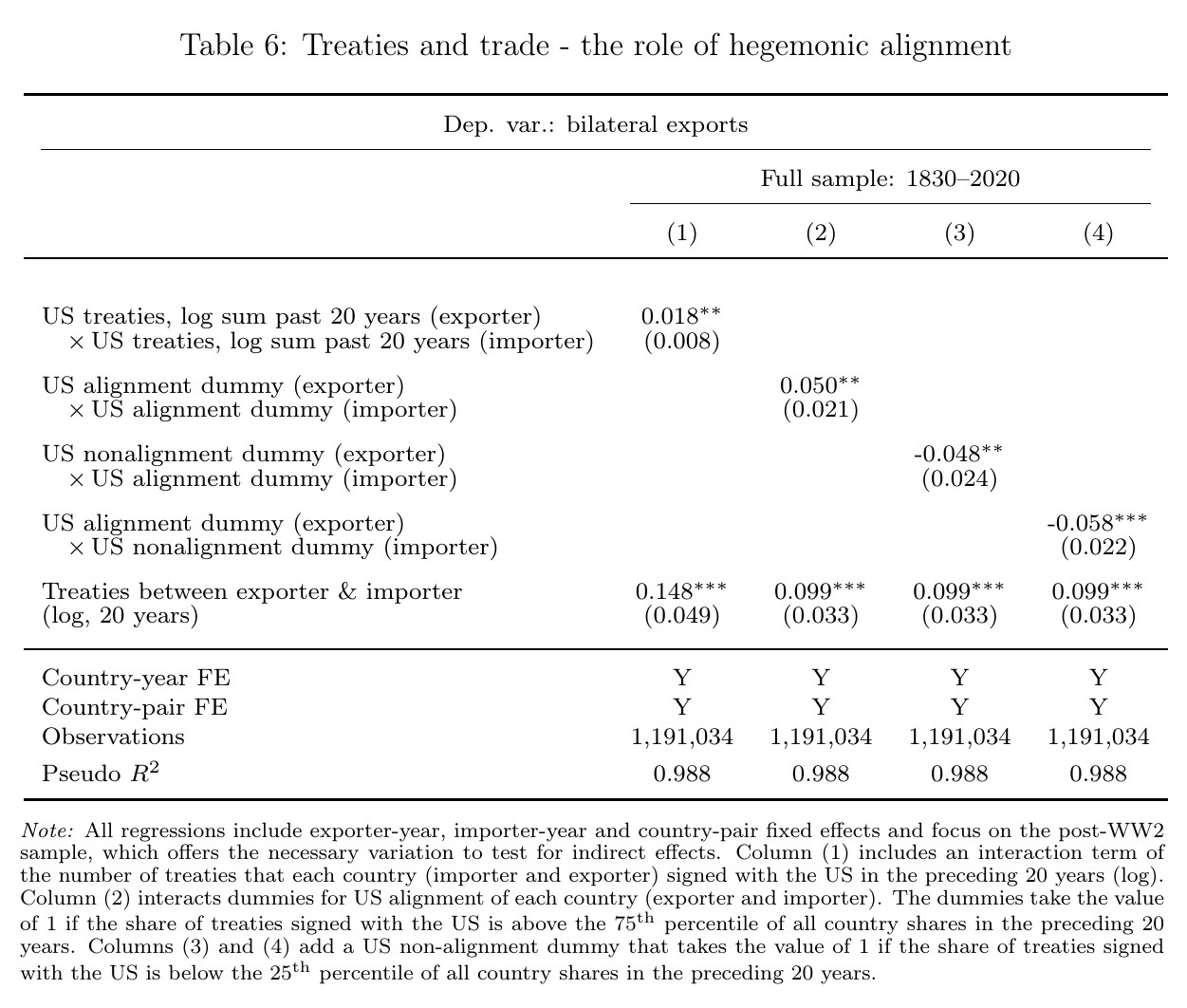
Table 6 tests the theory’s distinctive prediction, the indirect effect: aligning with the hegemon aligns you with everyone else who has, so two countries close to the hegemon should trade more with each other than their own bilateral treaties predict. The alignment variable is a share, not a count: a country is us-aligned in a year if the fraction of all its treaties over the past 20 years signed with the United States is above the 75th percentile across countries, and non-aligned if below the 25th. With the pair’s own treaties controlled (0.099), two aligned countries trade about 5 percent more with each other (0.050); an aligned exporter and a non-aligned importer trade about 6 percent less (−0.058), and the reverse pairing about 5 percent less (−0.048). One inconsistency to flag: the table’s note says the regressions “focus on the post-WW2 sample,” but its header reads “Full sample: 1830–2020” and its observation count, 1,191,034, is exactly the full-sample pair-fixed-effects count from Table 3 (the post-war sample there has 1,069,315). The draft disagrees with itself about which sample this is; I have not resolved it, and a reader who wants to cite the magnitude should ask. The pattern is the same-bloc, cross-bloc asymmetry the paper cites Gopinath et al. (2025) for in a footnote, here in treaty shares over a longer sample.
What the interview added
The interview predates the draft and is a good record of how the authors think about the theory rather than of the tables. Asked which treaties matter more, economic or not, Martin redirected to the point that the hegemon needs to demand nothing: “even if the hegemon asks nothing of us, its mere presence will tend to produce this alignment” (08:11). Asked whether a country can stay neutral and trade with both, he said the empirics do not test that; they test the two pillars, that treaties go with trade and that hegemons sign a disproportionate share.
On whether China has reached the critical size, nobody had to ask. Broner raised it himself: “a natural question is whether we have already reached this critical size” (13:45), suggested Russia’s behaviour looks like the start of an unraveling, and when the host asked whether that was his view answered “It is possible. We don’t know for sure, but what we are seeing is consistent with this view.” His account of China’s earlier phase, adopting the rest of the world’s policies in the 1990s and 2000s because at intermediate size staying apart would have meant trading with almost nobody, is the paper’s footnote 14, which quotes Jones and Yeo (2022) on a China that “sought to profit from key arrangements” of the order and now “seeks to subvert” them. Martin went further (37:50): a more multipolar world is “inevitable,” the United States having been half of world output after 1945 and a quarter now (his numbers, not the paper’s), and “our theory would tell you yes, we are going to see some fragmentation.” Broner’s version of the bad case was a world with “a series of powerful countries at the antipodes of us preferences,” which “unfortunately seems to be the world we are heading to.” He also named the model’s exogenous preferences as its limit: the hope that trade with China and Russia would make their preferences converge on ours “does not seem to have worked.”
The host noted at the top that the paper predates the 2025 tariff war. The authors did not claim it for the coercion section; Martin’s reading was sharper than that (29:00). They wrote the paper thinking about China, but now the United States is the one using the stick, “even against countries that seem to be its allies,” and in the model a hegemon strong enough does not need the stick, so its appearance “may in itself already be a sign of relative weakening.” That is the model turned on the incumbent: coercion is what an intermediate-sized hegemon does. (The paper’s own point of contact with the tariff war is different and appears as future work on p. 49: hegemons that anticipate their rivals’ growth “may have incentives to limit trade with emerging powers in an effort to curb their ascent.”)
The exchange most useful for a reader in a small open economy was on Latin America (30:15). Martin’s answer, offered as not quite the paper’s, was that a unipolar world is good for your trade and bad for your bargaining position, since a single power can extract rents from you, and a second pole gives you somewhere else to go. Broner corrected the record on the model’s behalf: in the theory trade is mutually beneficial and rent extraction “we have not developed sufficiently; it is something we are thinking about for future work.” His own answer for a country with intermediate preferences (33:32) was that either single-pole world is fine, the bipolar bloc world is worse, and being made to choose is choosing “between two bad options,” though choosing beats isolation.
Where it sits
Against Clayton, Maggiori and Schreger (2026), where the hegemon’s hold runs through input dependence and coercion is the story, this is the model where coercion is an appendix to a mechanism that runs without it: a hegemon is a big trading partner, alignment is a coordination good, and the reason a second pole can break globalization is that alignment is one-dimensional and you cannot be aligned with both ends of it. It is also the only paper in the block with two hundred years of data. The Global Treaty Database, language-model classifier and all, is worth tagging as a resource in its own right, and the reading group should keep two versions of the word “bloc” separate: the empirical one, which Table 6 finds in the data, and the model’s, which exists only once somebody starts making threats. The authors’ own view, on tape, is that the somebody has started, and that it is not the country they wrote the paper about.