Notes on:
Hegemonic Competition with Carrots and Sticks
Working paper
2026
geoeconomics · hegemony · foreign aid · alignment
Paper · PDF · Transcript
Made with AI: Fable 5.1 (reading and writing)
Timothy Meyer and Nicolas Wesseler; discussed by Alberto Martin. nber Summer Institute, International Economics and Geopolitics, July 16, 2026 (the session runs from 01:18 to 02:16 of the video). Paper: the January 5, 2026 draft, marked as a job market paper.
Buying votes is a procurement problem
Suppose you are a superpower and you would like a smaller country to be on your side. You have two ways to pay for that. You can hand the country money — loans, grants, a dam — which is a carrot. Or you can remind the country that it trades a great deal with you and that this could stop, which is a stick. Both are priced in the same currency, the country’s welfare: the carrot is worth what it pays, and the stick is worth what the country would lose if you cut it off. The country has its own view about where it wants to sit between you and your rival, and it tilts away from that view in proportion to what you offer and what you threaten. Your rival is doing exactly the same thing from the other side. What you have, in other words, is two bidders in an auction for alignment, except that the thing being bought is continuous, the bidders can also threaten, and the auctioneer has preferences of its own.
That is the Meyer–Wesseler model, more or less. Two hegemons and a collection of small countries, each country choosing an alignment between zero (the Soviet Union) and one (the United States). The country’s payoff falls with the distance between its action and its bliss point, rises with the transfers it receives, and falls if it is hit with tariffs; tariffs are all-or-nothing and set as cutoff rules, so the stick is never actually swung in equilibrium (realized sanctions show up in about two percent of hegemon dyad-years in the data), and power is measured as the consumption a country would lose if the hegemon cut off trade. The hegemons value each country’s alignment at some country-specific rate , pay for carrots out of pocket, and pay for sticks in foregone trade. Proposition 1 gives the country’s reaction function in closed form, eq. 7 in the paper:
Here is the log-odds of the bliss point, and are American and Soviet carrots, and measure how much a dollar from each side moves the country, and the last two terms are the welfare loss each hegemon could inflict by cutting off trade. Two things to notice. First, the signs: alignment with a hegemon rises in that hegemon’s carrots and in its power relative to the rival’s, and Soviet money enters with a minus sign because it pulls toward zero. (The discussant’s gloss, that alignment is “increasing in the carrots I get from either side”, means the same thing — alignment with whoever is paying — and is easy to misread.) That is the empirical content; as Meyer said, it looks like a regression, and it is the regression they run. Second, the sticks enter only as a difference. A lone hegemon could extract a country’s whole trade surplus; with a rival on the other side the country has an outside option, and you can only extort the surplus you have in excess of your opponent. Then the hegemons’ first-order conditions make the optimal carrot hump-shaped in the rival’s carrot: when the Soviets do little, it is optimal for the Americans to do little; as the Soviets ramp up, the Americans match; and past some point it becomes too expensive to compete and, in the paper’s phrase, the hegemon starts to give up. Payments are largest where the two powers are roughly balanced. Nobody pays much for Latin America, where the United States dominates on sticks and therefore does not need carrots.

Anyway, the Cold War
The reason to write this down is that the Cold War is a thirty-year natural laboratory with unusually good bookkeeping. For Soviet carrots the authors digitized declassified cia reports on “Communist Activities in the Third World,” which tracked Soviet economic, military, technical and educational aid, some four thousand projects, with the thoroughness you would expect; for American carrots they use the Greenbook. Aid was big. Table B.2 puts it at about two and a half percent of gdp for the average recipient, more than a tenth of the average recipient’s government budget, and the distribution is skewed enough that the median country got about half of that and the largest recipients more than seven percent of gdp. (In the talk Meyer went a step further and called it, to first order, the main capital inflow into these countries; the paper’s version is the milder statement that official flows are often the main source of external finance for developing economies.) Of the 113 recipients, 72 took money from both sides over the course of the Cold War — the pinkish countries on the map, Egypt and India prominent among them.
The Aswan dam is the canonical exhibit, and the paper tells it more carefully than the talk did. Nasser secured funding by alternating between Soviet and Western support; the Soviets ended up financing the dam, which came to supply more than half of Egypt’s electricity, and made very nice posters of it, as Meyer noted. The Americans did not retreat. They counter-bid with more aid, most famously by paying to move the temples at Abu Simbel out of the way of the reservoir the Soviet dam was creating. Both sides paid for the same dam, which is the model’s whole point. And when the authors later run the numbers, the twenty-five to forty percent bump in Soviet aid that the dam represents explains only about two percent of Egypt’s late-1950s shift toward Moscow; since Egypt’s alignment then stagnates, the paper reads the dam as having kept Egypt from drifting toward the Americans rather than having pulled it East.
Sticks are computed rather than observed: the welfare loss to each country from being cut off from trade with each hegemon, out of a standard single-sector Armington model with a trade elasticity of five and a tariff factor of a thousand in both directions, which makes the American stick larger simply because the United States traded more. Alignment is un General Assembly ideal points, projected onto the segment between the two hegemons and validated against Olympic boycotts and recognition of the People’s Republic. The contested regions — Africa, the Middle East, South Asia — are where both carrots and sticks are in play, which is what the hump predicts; separately, the valuations the model backs out (below) put Turkey, India, Spain, Pakistan and Brazil at the top of the American list in the early 1960s and Egypt, Indonesia, India, Iraq and Afghanistan at the top of the Soviet one, which is roughly what a historian would have guessed.
The identification problem is the obvious one: a hegemon gives money to countries that are drifting, so aid and alignment are jointly determined. For carrots the instrument is shift-share, using swings in a hegemon’s aid to a whole region, excluding the country itself, interacted with each country’s prior share of that regional budget. The swings are supposed to come from politics inside the hegemon rather than inside the recipient: the Alliance for Progress in 1961, the Nixon administration’s 1969 decision that it had failed (Kissinger: “Nothing important can come from the South”), Carter’s cuts, Soviet expansion after nuclear parity in the mid-1970s. (In the talk Meyer framed 1969 as U.S. priorities shifting toward the Pacific; the paper’s narrative is the Latin American cut plus the Kissinger line, and separately notes American aid to Asia falling after Vietnam.) The authors check that regional alignment, Polity scores, coups and cia or kgb activity do not predict the regional shifts. For sticks they use the decline of air relative to sea transport costs, following Feyrer (2019), which changed predicted trade with each hegemon differentially across countries — and, they show, changed student flows quite differently, so it is goods that moved.
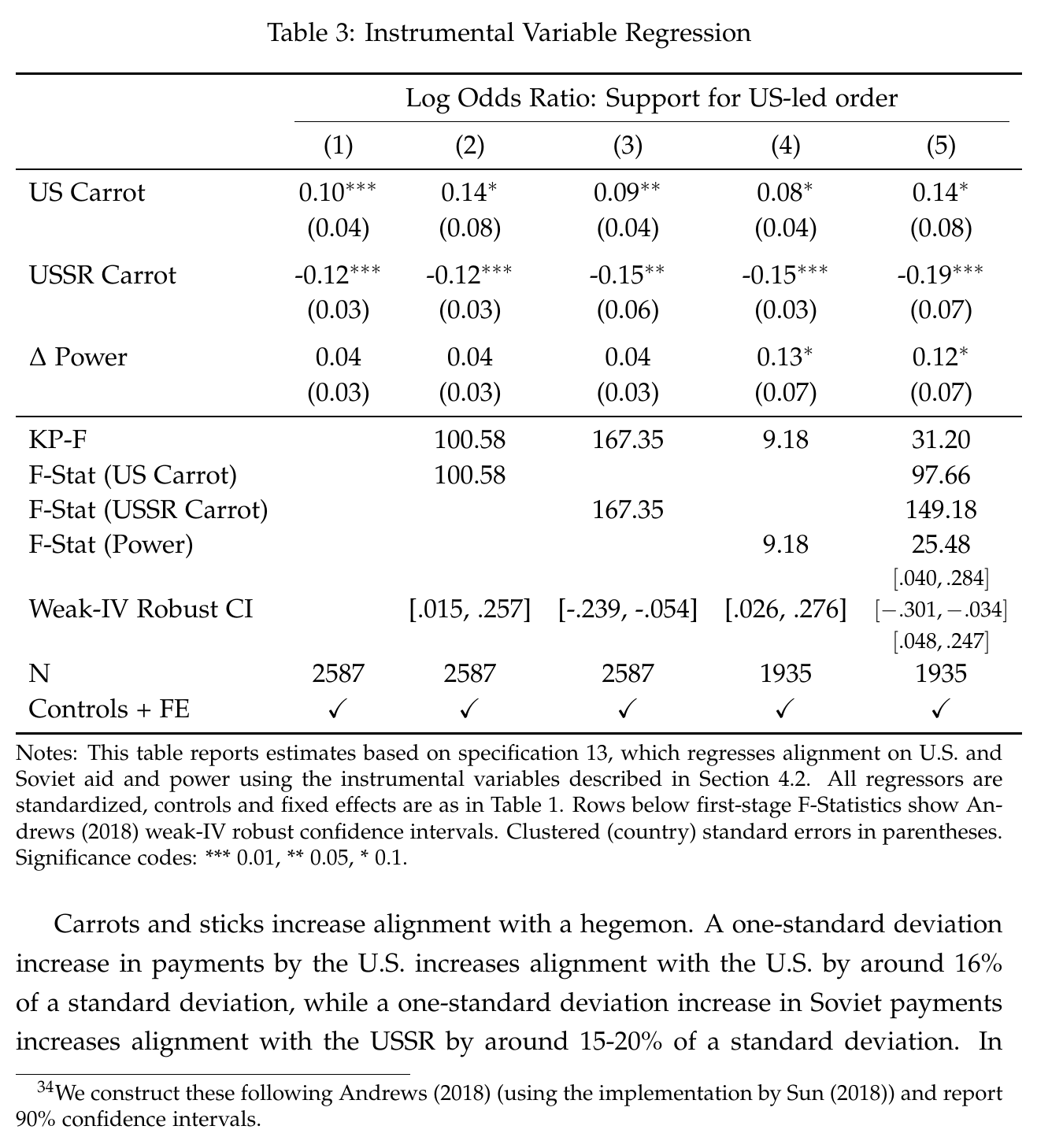
Instrumenting makes every coefficient bigger. The U.S. carrot goes from 0.10 to 0.14 standard deviations, the Soviet carrot from −0.12 to −0.19, and the power difference — an insignificant 0.04 in ols — triples to 0.12, significant at ten percent, with a first-stage F for power alone of only 9 that the talk was careful to flag (the sample also shrinks from 2,587 to 1,935 observations, because the transport-cost instrument exists only for countries with a coastline). The paper’s reading is the interesting one. If ols is attenuated for aid, that is consistent with hegemons paying the countries that would otherwise be drifting away from them — which is exactly the endogeneity story from the previous paragraph, seen from the other side. For power, the trade-cost instrument picks up long-run integration rather than year-to-year noise in historical trade data, so it cleans up measurement error. Neither reading says the ols was fine.
The finding, which is a number
The tools work, and they are expensive. Doubling American aid to an initially neutral country — about 120 million dollars at the average level of initial aid — moves that country’s alignment by about two and a half percent of a standard deviation, which is moving from the fiftieth to the fifty-first percentile. That is 1.2 percent of the geopolitical distance between a neutral country and the average Nato member, two percent of the Allende-to-Pinochet swing, or, in the paper’s most memorable translation, a 4.5 percent increase in the odds of the country joining your 1980 Olympic boycott (the slide rounded that to five). The Soviet number is about the same. Returns diminish sharply: getting the country to 0.55 rather than 0.51 costs more than 2.5 billion dollars, roughly what the United States sent Egypt after Camp David, and that surge explains about ten percent of Egypt’s realignment. Getting the same shift with a stick would require raising the country’s trade dependence on you by about five percent of Mexico’s present-day dependence on the United States, or three percentage points of trade over gdp — which sounds small until you notice the exchange rate implied by the paper’s iso-power curve: one percentage point of threatened welfare loss is worth multiplying aid by about 150. Sticks are cheap and mostly unavailable; carrots are available and mostly ineffective.
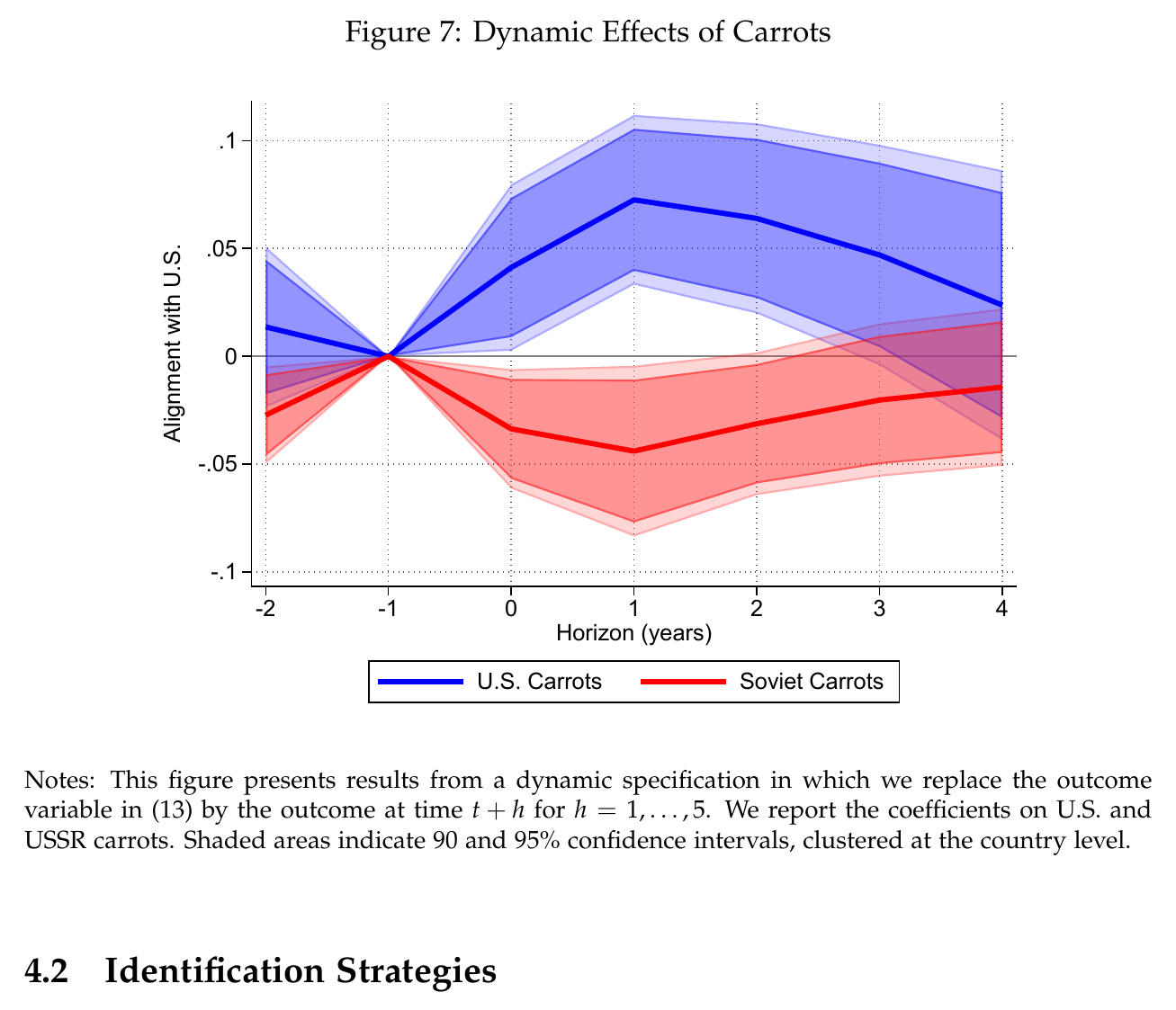
And the effect does not last, at least not directly: in local projections, the bought alignment peaks a year after the commitment and recedes by year three. So you are not buying a convert; you are renting a vote. The paper adds a wrinkle worth keeping. Alignment itself is persistent — the coefficient on lagged alignment is about 0.69 — so the long-run multiplier on a sustained increase in aid comes out at about 0.15 for the United States, one and a half times the short-run effect, and about −0.1 for the Soviets, slightly below theirs. The lease is short, but a tenant who keeps paying accumulates a little.
Here is where the model does something clever with a disappointing number. If hegemons were spending this much to buy this little, and were behaving rationally, they must value alignment enormously. The hegemon’s first-order condition inverts into a revealed-preference valuation, eq. 9 in the paper:
is what the United States would pay to move country i from full Soviet alignment to full American alignment; it is large because is small (about 0.02 to 0.05 in Table C.8) while observed spending is not, and it is larger still for countries already near either end, where carrots move them least. On this arithmetic both hegemons valued winning all of the non-aligned at twenty to forty percent of U.S. gdp for most of the Cold War, and the geopolitical benefit-cost ratio of aid — the valuation times the alignment it bought, net of cost, over cost — comes out at about five for the United States and 4.5 for the Soviets.
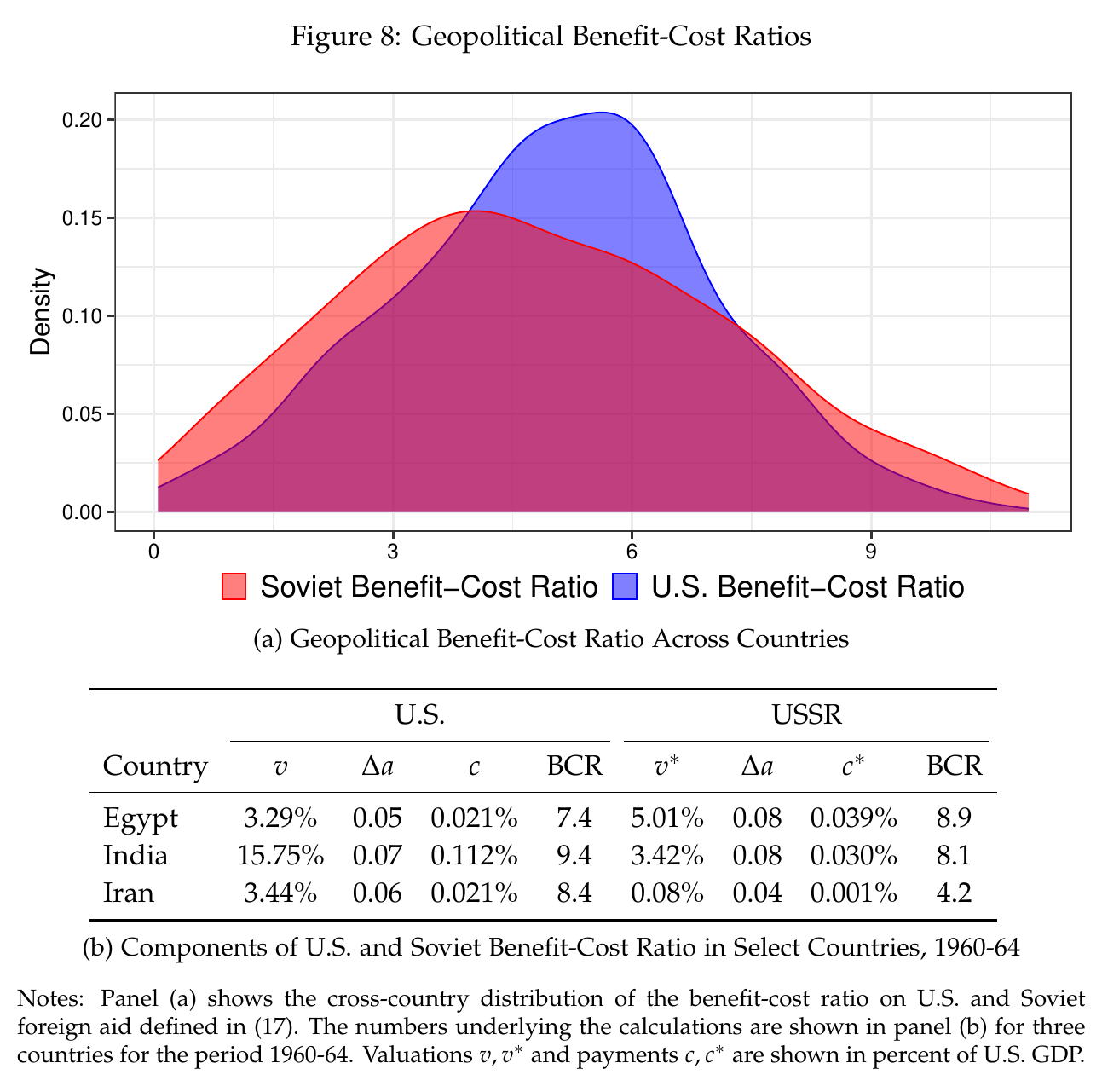
The Egypt row is the one the discussant seized on: the implied willingness to pay to flip Egypt from Soviet to American alignment in 1960–64 is 3.29 percent of U.S. gdp. The valuations correlate with the things you would hope — proximity to wars, oil, and, less nobly, trade with the hegemon itself. The authors are upfront that they are model-inverted: Alekseev and Lin’s (2025) estimate of what the United States would pay to win a conflict with China is ten times higher, Becko and co-authors’ (2025) military-spending proxy four to five times lower, and if aid has any humanitarian motive the ratio is an upper bound.
Then the authors point the machine at the present. Shut down usaid, re-measure carrots and sticks for the United States and China, and trace out China’s reaction function. Two channels compete: with the Americans gone, China can compete more effectively, but it also no longer needs to, because alignment is cheaper to buy when nobody is bidding against you. The second channel wins in most places, especially in Africa and Asia, where countries were already leaning toward China; Chinese aid is projected to fall by five to ten percent across much of Africa, twenty in some countries, and to rise where the shutdown puts a former American client in play — Albania, Colombia, and Liberia, where the model has Chinese aid up ten percent. The average recipient shifts toward China by about 0.035 on the unit line, roughly fifteen percent of the Turkey–France distance — a modest move, not a new world order — but the countries that move the most are the ones that started out as American allies, because an indiscriminate cut falls hardest on your friends. Sticks cannot fill the gap: to hold alignment constant, American economic leverage would need to rise twenty to a hundred percent in Latin America and more than twentyfold in East Africa or the Middle East. The paper cites a Brookings commentary by Yun Sun (2025) on Chinese hesitancy to step up in Africa, and the post-1990 precedent, when American aid fell most for strategically important countries once the rival was gone. In the talk Meyer also mentioned preliminary work finding a very muted Chinese reaction to the shutdown; the tape garbles who did it, but in the Q&A he named Andreas Fuchs and co-authors, who see only a small slice of Chinese aid.

What the discussant wanted to know
Alberto Martin, who opened with Perón — ni yanquis ni marxistas, peronistas — and disclosed that he had finished preparing after Argentina’s win the night before, accepted the results and pushed on the framing in three ways, plus one he remembered in the morning. First, why is an instrument a carrot or a stick at all? A tariff you lower for good behavior is a carrot; aid you withhold for bad behavior is a stick; they are two sides of one schedule, and it is not obvious the model should hard-code which is which — especially since the paper’s definition of power counts only sticks, so a richer hegemon that can make transfers cheaply, which the late Soviet Union could not, gets no credit for it. He also found it unnatural that sticks enter the country’s incentives while carrots shift its bliss point directly. Meyer’s answer: the asymmetries are there because they get the model to the data “in a very elegant way”, and the symmetric alternative has a specific defect — a model of rescindable aid-for-policy offers has only one hegemon paying any given country in equilibrium, which is not what the data show (the paper cites Groseclose–Snyder 1996 and Bueno de Mesquita–Smith 2016 for that result); the contest can be microfounded as an all-pay auction over many binary votes with taste shocks, and the appendix shows the winner-pay version gives nearly identical numbers when is this small. Second, the sticks result admits a softer reading. Countries with large gains from trade with a hegemon may align not because of the shadow of sanctions but because alignment itself lowers the cost of interacting — the mechanism in Martin’s own work with Broner, Meyer and Trebesch (2025) — and the paper cannot distinguish brute force from gravitation; Martin said so himself: it does not question the result, only the interpretation. Third, and most consequential, the high valuations come from dividing a large spend by a small response, and if un votes are a noisy proxy for what aid actually buys (bases, intelligence, alliances), the denominator is understated and the three-percent-of-gdp number is inflated. His tell was a nice one: if the United States really cared about General Assembly votes as such, Egypt’s vote would be worth exactly as much as Fiji’s, and nobody behaves that way. The fourth comment, echoing the previous paper, was that everything here is bilateral, and buying Egypt presumably moves Libya and Algeria, which would also contaminate the backed-out valuations; the paper has a preliminary check on spillovers weighted by trade and by distance and finds them small and mostly insignificant.
The floor, as far as the tape allows
A word about the recording. The chair collected questions — “Steve”, then “Kristin and Jaya” — and the tape is blank for the three minutes in which they were asked; it picks up with Meyer’s answers. A second round, with the chair calling “Giovanni”, “Max” and “Lena”, is only partly audible. So what follows is reconstructed from the answers, and nobody’s surname is on the tape; a sibling digest in this collection guessed one, and this one will not.
The questioner the chair called Steve asked about arms sales: they are in the Greenbook to the extent they were subsidized, Meyer said, and should therefore be in the carrot. The next answer, to a question the tape does not attribute, concerned aid and growth: if you thought aid was meant to support growth, Meyer said, it would all go to the poorest countries, and the allocation looks very different — which is the paper’s whole premise wearing a development-economics hat. Kristin asked about China. Meyer pointed to work by Andreas Fuchs and co-authors that sees only a small slice of Chinese aid and finds very little response to the shutdown, one reading of which is that China cares about things other than alignment — debt restructuring, say — and conceded that the toolbox is endless (they control for imf lending; other transfer instruments should follow). Jaya asked whether the rival’s counter-response attenuates the estimates: if the Soviets always pushed back hard, you would see the Americans doing little and conclude aid does not work. Meyer said American and Soviet spending are only somewhat correlated in the data, so the mechanical attenuation is not obviously large, though it could be that the hegemons cared about things other than alignment.
In the second round a questioner, apparently Lena, voiced the field’s shared frustration with General Assembly voting as an alignment measure and pointed to the Security Council literature, where temporary members get more aid and worse-rated World Bank projects, as a place where alignment is costly and therefore informative. A follow-up suggested more left-hand-side variables — a new bilateral-influence measure, the state visits from the previous paper, military basing. Meyer’s replies were about data: they have tried non-linearities in alignment and find a bit; the constraint is that you need something continuous, covering many countries, as seen from both Washington and Moscow, and there were not many American state visits to Zambia in the 1950s, let alone Soviet ones. On the Security Council he read the evidence as consistent with his story, since a marginal, temporary bump in a country’s importance producing a large jump in aid is what you expect when influence is dear. A last, unrecorded question drew the answer that they have specifications controlling for realized sanctions and the power measure predicts alignment over and above them, and that sector-level trade is too thin historically to do anything more sophisticated than total flows.
So the paper’s headline is that geoeconomic tools are effective but pricey, and its subtext is that the price is informative. If alignment is this expensive to rent and hegemons keep renting it, either they value it far more than the voting record can show, or the voting record is not where the value lands. The authors lean toward the first; the discussant toward the second. The Aswan dam, meanwhile, was paid for twice — once by the Soviets to build it and once by the Americans to move the temples it would have drowned — and by the paper’s own arithmetic it bought Moscow about two percent of Egypt’s turn.