Notes on:
Natural Resources and Sovereign Risk in Emerging Economies: A Curse and a Blessing
NBER Working Paper 31058
20 January 2023
sovereign debt · default · commodities
Paper · PDF · Appendix
Written by Fable 5
Franz Hamann, Juan Camilo Méndez-Vizcaíno, Enrique Mendoza and Paulina Restrepo-Echavarría. The syllabus lists the 2023 working paper as “Resource Curse or Blessing?”; read here in the latest (November 2025) draft under its current title, with online appendix. No seminar recording exists; the included related video is Martín Uribe’s 2021 Central Bank of Chile talk “Does the Commodities Super Cycle Matter?”, a different paper on adjacent territory, quoted at the end.
An oil field is collateral you cannot pledge but also cannot lose. That tension is this paper’s engine. A sovereign’s creditors can shut it out of bond markets, but they cannot shut it out of the world oil market — Venezuela in default still pumps and sells. So oil reserves are a form of wealth that survives default, which makes them something subtler than an asset: they are self-insurance against the consequences of your own future misbehavior. And a borrower who can quietly build up its post-default consolation prize is a borrower whose promises are worth less. Hence the title’s verdict, delivered without a question mark in this draft: a curse and a blessing.
The facts to be explained
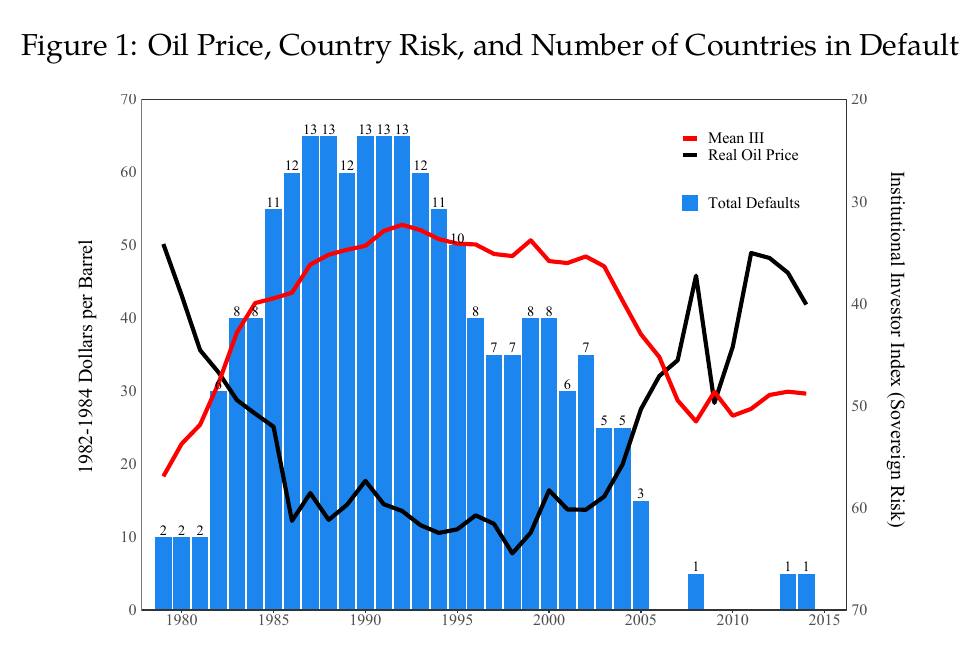
The empirical canvas is the 30 largest oil-producing emerging economies, 1979–2014. Three regularities. First, they carry real debt (external public debt averaging 22.5 percent of gdp, weighted by oil output) and default with gusto — sixteen of thirty at least once since 1979; Argentina, Ecuador, Gabon, Indonesia, Nigeria, Russia and Venezuela repeatedly — with debt and country risk correlated at about −0.6. Second, country risk tracks the oil price tightly over the cycle: the weighted correlation between the real Brent price and the Institutional Investor country-credit index is 0.69 (higher index = safer), visible to the naked eye in the paper’s opening figure. Third — the novel, and oddest, fact — in dynamic panel regressions, oil production lowers country risk on impact and in the long run, but oil reserves cut risk only marginally on impact and raise it in the long run. Markets like oil flowing; they are suspicious of oil stored.
The model: Eaton–Gersovitz (1981) drills a well
The framework is the canonical default model of this block — value of repaying versus value of defaulting, exclusion plus a price penalty on oil exports above a threshold (an Arellano (2008)-style cost, dressed as a foreign tariff h(p)), risk-neutral lenders pricing bonds off the default probability — with one new state variable: oil reserves s, run by the sovereign itself (a fair reading of state oil companies), with Hotelling-style extraction costs that fall with reserves and rise convexly in extraction. The sovereign now chooses debt and next period’s reserves, and the crucial asymmetry is that s appears in both value functions while b appears only in the repayment one. Reserves raise the value of default, because they finance extraction — hence consumption — during exclusion.
The analytics (Propositions 1–4, verified numerically at the calibrated solution) deliver the mechanism cleanly: default and repayment payoffs both rise with reserves, but default sets shrink as reserves rise and grow as reserves fall — and default incentives strengthen when oil prices fall. So the model reproduces fact two by construction and fact three by equilibrium logic: in the short run after a bad oil shock, reserves accumulate (extraction is cut while prices are low) and their presence still reassures; over time, a sovereign hoarding reserves is a sovereign lowering its own cost of default, and spreads price that in. The local-projection impulse responses make the sign switch explicit: for about five years after a negative oil-price shock reserves rise while risk falls, and for the next fifteen both rise together.
What strategy costs the strategist
The quantitative punchline is a nice piece of institutional irony. Compare three economies: one that can commit (no default risk), one with default risk but mechanically constant extraction (oil as endowment), and the full model. Mean sustainable debt: 52 percent of gdp with commitment, 28 percent with default risk and rigid oil, 23 percent with default risk and strategic oil. The sovereign’s ability to manage reserves against its creditors — cutting extraction and stockpiling in the run-up to a default, then drawing the hoard down to prop up post-default consumption — costs it five percentage points of gdp in borrowing capacity before any default happens. Lenders charge for the option you hold, even if you never exercise it.
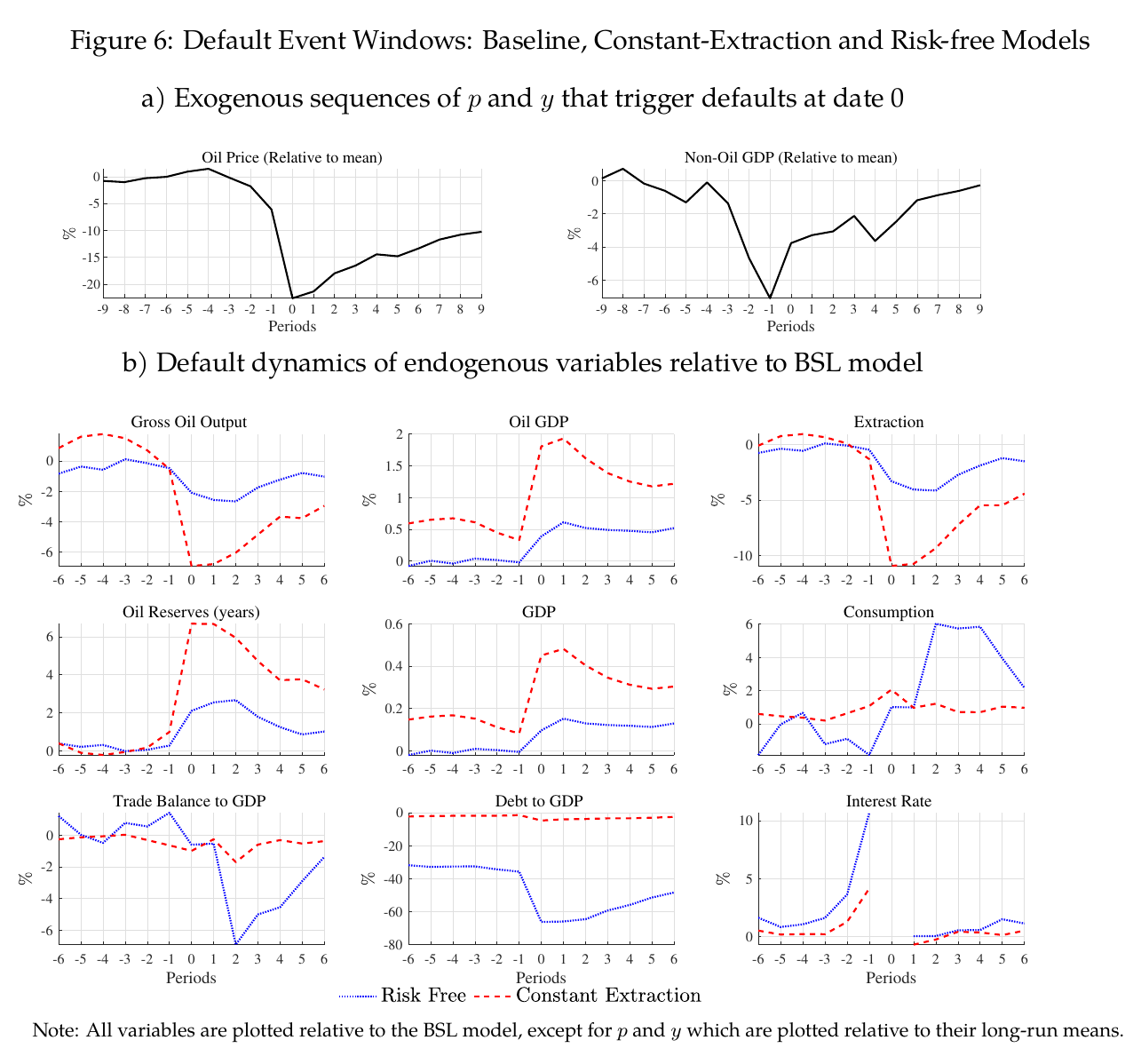
The extension with rare, large, uncertain discoveries adds a finding with a memorable shape: for risk-neutral global investors, lumpy discoveries barely matter, but for a risk-averse sovereign without commitment they raise oil-sector risk enough to induce more reserve hoarding — and defaults now come after long dry spells of discoveries, triggered by smaller drops in prices and output. A country whose geology has gone quiet defaults on softer provocation.
The scorecard is candid: the model nails the oil-price/risk correlation and income comovements, does reasonably on gdp and trade-balance volatility, but consumption and spreads come out too volatile and reserves and extraction too smooth — the standard eg family’s rough edges (compare Tomz and Wright’s (2007) complaints, two entries back) inherited rather than solved.
Placement, and the Uribe footnote
Within this reading list the paper is the block’s synthesis in action: Eaton–Gersovitz supplies the skeleton, Bulow–Rogoff’s (1989) ghost is appeased with explicit trade penalties, and Mendoza’s own (1991) observation — that interest-rate and terms-of-trade fluctuations matter most for indebted commodity economies — returns three decades later with the sovereign’s balance sheet fully endogenous. It is also the instructor’s research line on display: the wedge between what a country could borrow and what its incentives let it borrow, here given a barrel-denominated mechanism. Uribe’s (2021) companion talk supplies a useful discipline on the shock side: decomposing commodity prices into a permanent “super cycle” and stationary cyclical components, he finds the celebrated super cycle explains less than a fifth of emerging-market output variance — “the narrative out there is a little bit exaggerated” — while stationary commodity-price and world-interest-rate movements do the heavy lifting. That is exactly the frequency band where this paper’s default risk lives, which is reassuring: the mechanism is hitched to the part of the oil price that actually moves output.