Notes on:
Consumers’ Attention to Monetary Policy: The Importance of Having “Skin in the Game”
Federal Reserve Bank of Cleveland Working Paper 26-31
13 November 2026
rational inattention · household expectations · central bank communication · monetary policy
Talk · Paper · doi · Slides · PDF · Transcript
Made with AI: Opus 5.5 (reading and writing), GPT 6.1-Sol (reading), Fable 5.1 (adjudication), Sonnet 5.5 (verification)
Part of Monetary Economics Program Meeting, Fall 2026
Ina Hajdini, Edward S. Knotek II, James Mitchell, Mathieu Pedemonte and Taylor Shiroff, presented at the nber Monetary Economics Program Meeting, 13 November 2026, by Pedemonte; discussant Oliver Pfäuti. Version used: Federal Reserve Bank of Cleveland Working Paper 26-31 (October 2026), with the conference deck.
Consumers’ attention to monetary policy, in this paper, behaves like any other costly input: you buy it in proportion to what you stand to lose by not having it. That much is just rational inattention (Sims 2003). The paper’s twist is about who is left holding the cheap information once a central bank decides to make it cheaper. In the model the answer is the people who were already paying attention, and in the data the people whose attention actually moves around fomc meetings are mostly the ones who were not.
The setup
You are a household with log utility, a known income stream, and a bond position. The real rate is iid and you do not see it; you see a Gaussian signal of it, and you can sharpen that signal at a cost per unit of entropy reduction. Get the rate wrong and you mis-time consumption, and how much that costs you scales with your steady-state bond-to-consumption ratio . This is the paper’s “skin in the game”, and it enters as , so a heavy borrower and a heavy saver are equally exposed. Minimise expected loss plus information cost and you get Proposition 1 (Hajdini et al. 2026, eq. 8, p. 11):
Here is attention, the share of prior real-rate variance that the household’s signal removes, is the posterior variance, the discount factor and the threshold below which buying any information is not worth it.
So attention is zero up to a threshold and then rises concavely in . Everything else in the paper follows from the shape. Raise rate volatility or lower the cost of information and the curve shifts up and the threshold falls; the authors’ Figure 2 plots the volatility case, and the text below it (p. 12) makes the same point for cost. But the curve is flat at the top. A household with a lot at stake is already near full attention and has nowhere to go, so outside shifters, news supply and volatility, move mostly the households near the threshold. The paper writes this down as six implications (p. 14): attention rises with stakes, falls with individual cost, rises with news and with volatility, and the last two effects are smaller at high stakes. (The deck’s backup slide notes, fairly, that these comparative statics hold on the interior, while the survey records a yes/no; the crossing of the threshold is a separate, extensive margin.)
The data
The evidence is the Cleveland Fed’s daily consumer survey, a repeated cross-section with no panel: over 170,000 attention observations, about 74,000 of them matched to household characteristics (Pedemonte at 04:38:50). Attention is “have you heard news about monetary policy or the Federal Reserve in the last week?”, yes or no, which measures reported exposure rather than understanding. Skin in the game is not a balance sheet. It is whether you plan to buy a home or a vehicle in the next month or year. These are two different objects, and the discussant will make a living off the gap.
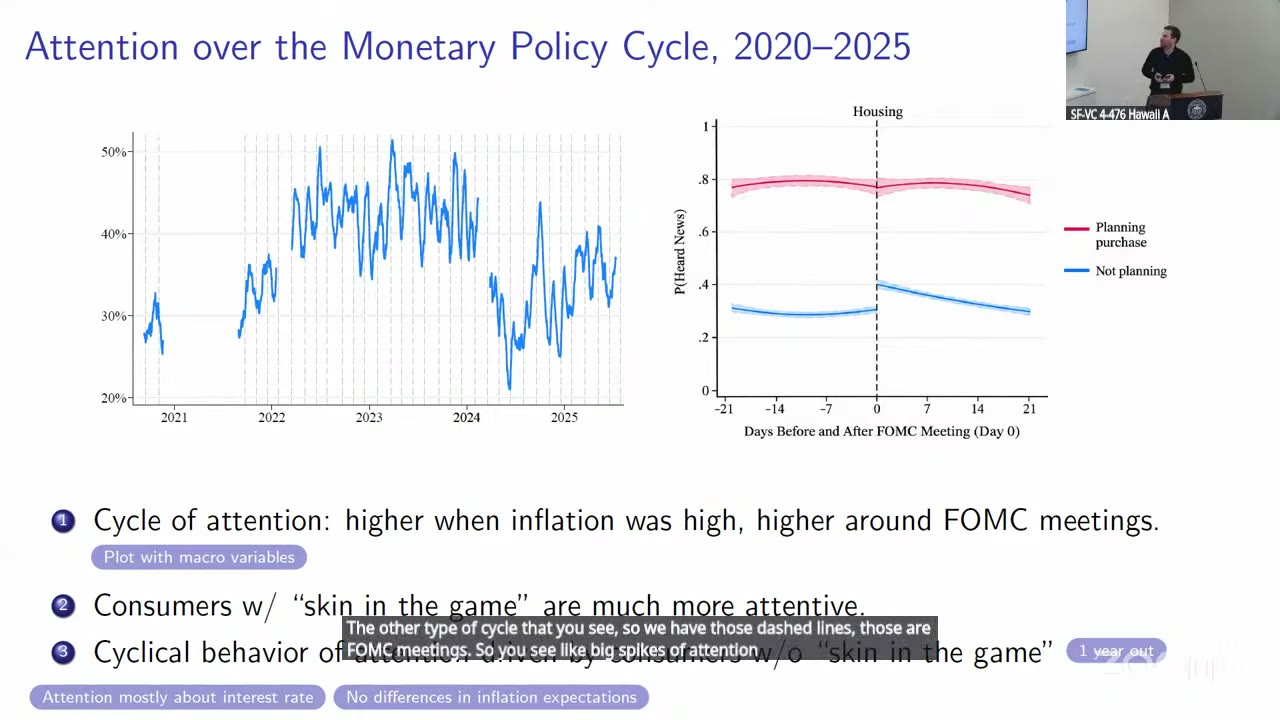
The motivating picture is the right panel above. People planning to buy a house next month say they heard Fed news about 80 percent of the time, before the meeting and after it. Everyone else starts around 30 percent, jumps to about 40 right after the meeting, and drifts back down. The fomc cycle in aggregate attention is, in Pedemonte’s words, “mainly driven” by people with low skin in the game (04:43:27).
The regressions line up with the six predictions. Planning a purchase in the next month raises the probability of having heard news by 28 to 32 percentage points (p. 3), against a 29 percent base for non-planners (p. 22). Pedemonte said “30% higher attention” on the day, which is percentage points, not percent. More education goes with more attention. A one-week moving average of Factiva article counts on monetary policy or the Fed, instrumented with days to and from fomc meetings, raises attention, and so does the 30-day standard deviation of the one-year Treasury yield. Then the interactions:
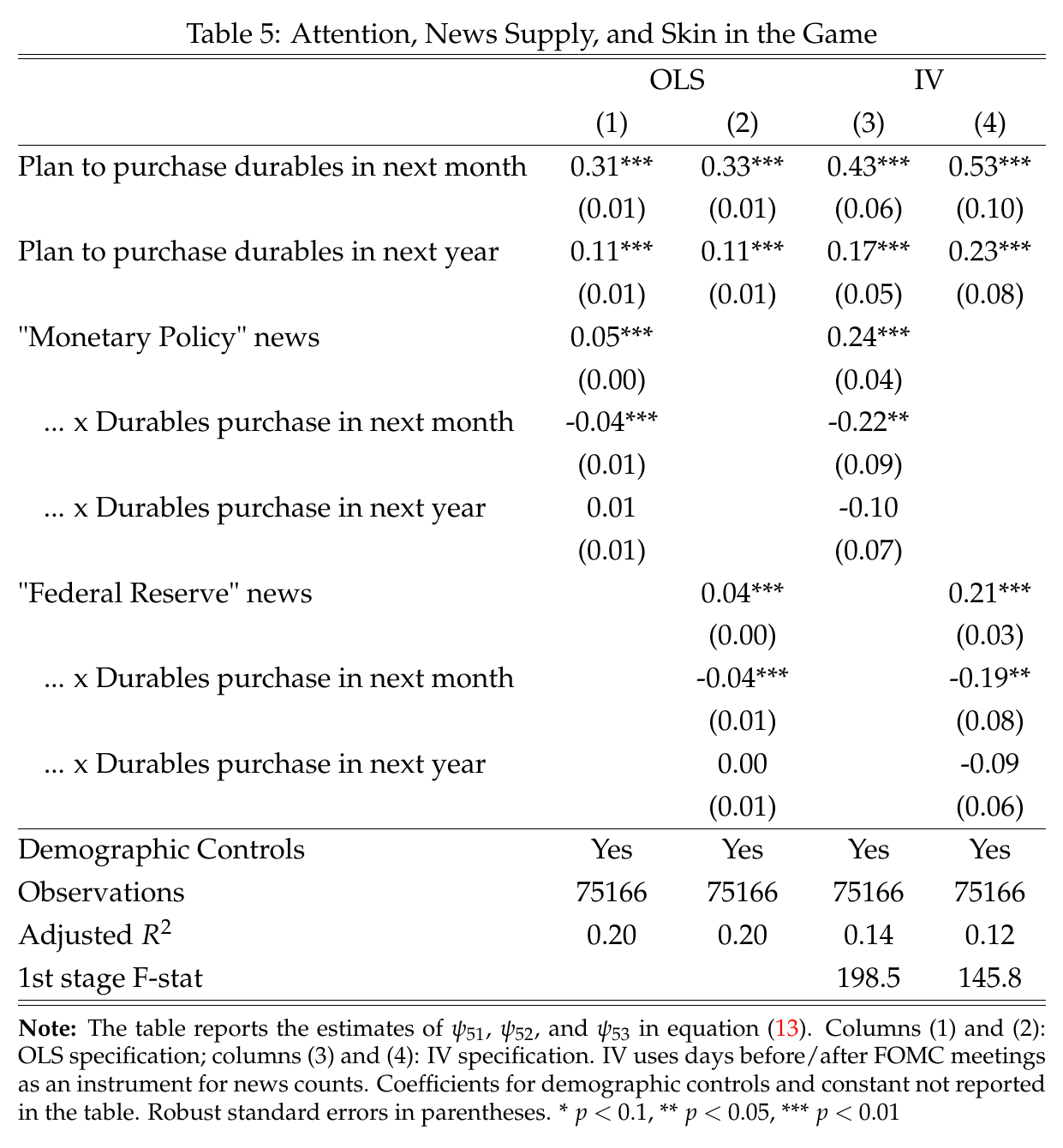
In the iv column, a unit of monetary-policy news (a standardised moving average, not an article) raises attention by 0.24 for non-planners, and the interaction with a next-month plan is −0.22. Net of that, next-month planners get roughly 0.02, which is the flat line in the picture restated as a coefficient. The volatility interaction does the same work: the paper’s Table 6 finds a large negative interaction with next-month plans, so most of the response to rate volatility belongs to non-planners too.
Two caveats travel with all of this. The news instrument relies on meeting dates working only through measured news supply, and the deck’s own backup slide says that predetermined meeting dates “alone do not establish this”, since meetings also change salience and content. And purchase plans could be a consequence of attention rather than a cause of it. The paper’s arguments are that the coefficient is stable across hiking and easing periods and across life-cycle timing, and that attention shifters do not predict plans; Pedemonte was candid that “we don’t have a formal test there” (04:49:30). Selection into who plans to buy a house is not removed by any of it. (One more small honesty point from the deck: a backup table that adds demographic controls shows numeracy no longer predicting attention once education sits in the same regression. The paper reports only the version without controls.)
The surprising part
Now let the central bank talk. In Section 5 it can lower the information cost from to , at a resource cost, for whichever households it targets. Plug optimal attention back into the loss and you get (eq. 15, p. 33):
is the household’s welfare loss from inattention: for an attentive household it depends only on the cost of information, and for an inattentive one only on its exposure.
Look at the top line. Once you are attentive, your loss does not depend on how much you have at stake. You have already bought enough information to make your exposure irrelevant, and what you pay is the price of that information. So a uniform cut in hands every already-attentive household the same gain, and the households that newly cross the threshold gain less.
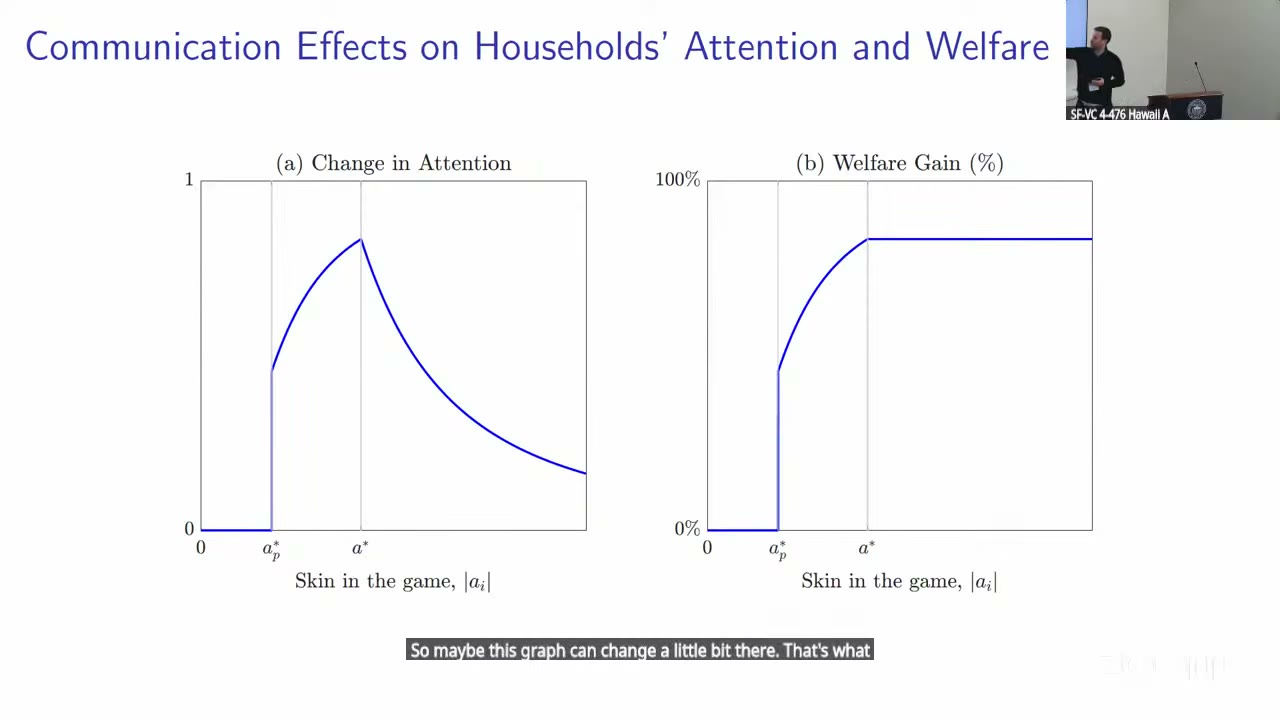
This is the paper’s real result, and it is a little bleak. The attention a central bank can actually move is the attention of people who, by revealed preference, did not need it. The welfare goes to people who were already paying. The paper’s targeting rule, Proposition 2, picks households with above a communication threshold. When talking is cheap that set reaches below the old threshold; when it is dear it covers only the highest-stakes households. In the model, communicating in high-volatility periods is better, and by eq. (18) more aggregate attention means a larger aggregate consumption response to the rate. All of this is model output under a uniform cost cut and a symmetric distribution of positions. Nothing in the survey measures welfare, consumption responses, or any communication experiment. Pedemonte put it plainly in Q&A: a central bank that cares only about aggregate attention would chase the low-stakes households, “but they’re not going to do that much with that information”, and the alternative is an “underwhelming result”, that “if you just want to transfer wealth, you should focus on people that have high skin in the game” (05:25:10).
The discussion
Pfäuti liked the paper and opened with a backhanded compliment that is also a real point: all six predictions hold, which is good news for rational inattention generally, because the predictions are generic to the class (05:00:34). The main critique was the gap between the model’s skin (a net bond position) and the data’s skin (a purchase plan). Pfäuti wrote a two-period model with durables and exogenous chances to adjust them, with the paper’s balance-sheet channel deliberately switched off, and it still delivered all six predictions. The models come apart elsewhere. Evidence Pfäuti cited suggests home buyers stop watching mortgage rates once they have bought, which fits a purchase opportunity and not a standing debt position (05:06:48). And if bond positions reflect patience, impatient borrowers might attend less, not more. Pfäuti’s proposed test was whether financial positions predict attention once you condition on purchase plans. This matters for the policy section, since it decides whether you target purchasers or balance sheets. There was no reply on the recording.
Pfäuti also ran a Michigan Survey exercise on the consequences of attention: the change in buying attitudes on attention interacted with monetary-policy surprises. The coefficients came out negative throughout, “kind of consistent with the theory”, but noisy and sensitive to which interview wave measures attention. That is the discussant’s evidence, not the authors’. Pfäuti also asked whether attentive people hold more accurate beliefs. Pedemonte said attentive and inattentive respondents have similar inflation expectations, and recalled attentive ones being more accurate about the direction of interest rates, without a number. Two further points went unanswered. The news regressions should control for volatility, since the two move together. And the level looks high: often around 40 percent say they heard Fed news, against about 1 percent of households and 3 percent of firms mentioning monetary policy in an open-ended German survey (05:15:03). A prompted yes/no and an open-ended question are not the same instrument, which is partly the point.
The floor was sharper. One questioner said the agent who needs to understand policy is the bond market, and that a household buying a house needs a mortgage quote, not the Fed; anchored expectations with nobody paying attention might be the best case, “diametrically opposed” to the paper (05:21:18). Pedemonte answered that bond investors are high-stakes too, so targeting them is in line with the paper, and that a buyer still wants to time the purchase. A follow-up closed that door: expected policy is already in the mortgage rate, so “you’re in the business of beating the bond market” (05:26:49). Pedemonte conceded it was a fair point that needs more thought, and someone else offered the fixed-versus-floating choice as the margin where Fed-watching might still pay. Another questioner called the interaction signs “not robust predictions of the model”, “entirely driven by functional form assumptions” (05:23:51). Pedemonte answered with the data, the fomc picture again, rather than with theory. That is a fair answer for the empirics and no answer for the model.
Which leaves a funny shape. The paper’s best evidence is that the people who pay attention to the Fed are the people about to sign a mortgage. Its best theory says that making the Fed easier to follow mostly helps them. And the room’s best objection is that what they actually need is the mortgage rate, which the bond market has already set for them.