Notes on:
Standardization and Expansion of Employment and Wage Records
NBER EMRI conference panel
18 September 2026
wage records · unemployment insurance · official statistics · data infrastructure
Talk · Transcript
Made with AI: Opus 5 (reading and writing), GPT 5.6-Sol (reading), Fable 5.1 (adjudication), Sonnet 5 (verification)
Part of Innovations in Measuring Employment, Fall 2026
“Standardization and Expansion of Employment and Wage Records” — Session 4 of the nber conference on innovations in measuring employment, morning of 18 September 2026. Erica Groshen (Cornell ilr, former bls Commissioner), Julie Hatch (bls), Chris Kurz (Federal Reserve Board) and Frank Fiorille (vp Risk and Compliance, Paychex), chaired by one of the organisers. There is no paper. There was no discussant either, so this is an account of an argument rather than a summary of a result: everything below comes from the recording and from the two decks that were projected. Two of the four panellists spoke without slides, which means a good deal of the operational detail here exists nowhere except in what they said out loud. The speaking order was Hatch, Groshen, Kurz, Fiorille, which is not the order they were billed in.
The object
Everything on this panel is an argument about one row in one table, so start there. Every covered employer in the United States files two things with its state every quarter. One is an establishment-level report — headcount and total wages — and that is the raw material of the qcew, the near-census against which the payroll survey is benchmarked. The other is a worker-level ui wage record, one row per employee per quarter, and that is what the Census Bureau’s lehd is built on. Groshen’s inventory of what is in that row: employer, worker id, industry, quarterly earnings, time period, “that’s about it.” And then the sentence that was also printed on her slide, delivered twice in case anyone missed it: “bls has not had access to these. The Bureau of Labor Statistics has not had access to these.”
So the agency that publishes the number the bond market trades on has never been allowed to see the worker-level file that sits directly underneath its own benchmark. Not for legal reasons anyone can point to cleanly, as we will get to. The records belong to fifty-three jurisdictions, each of which runs its own unemployment insurance programme, and each of which is now enhancing its records — adding fields — in its own way and on its own schedule.

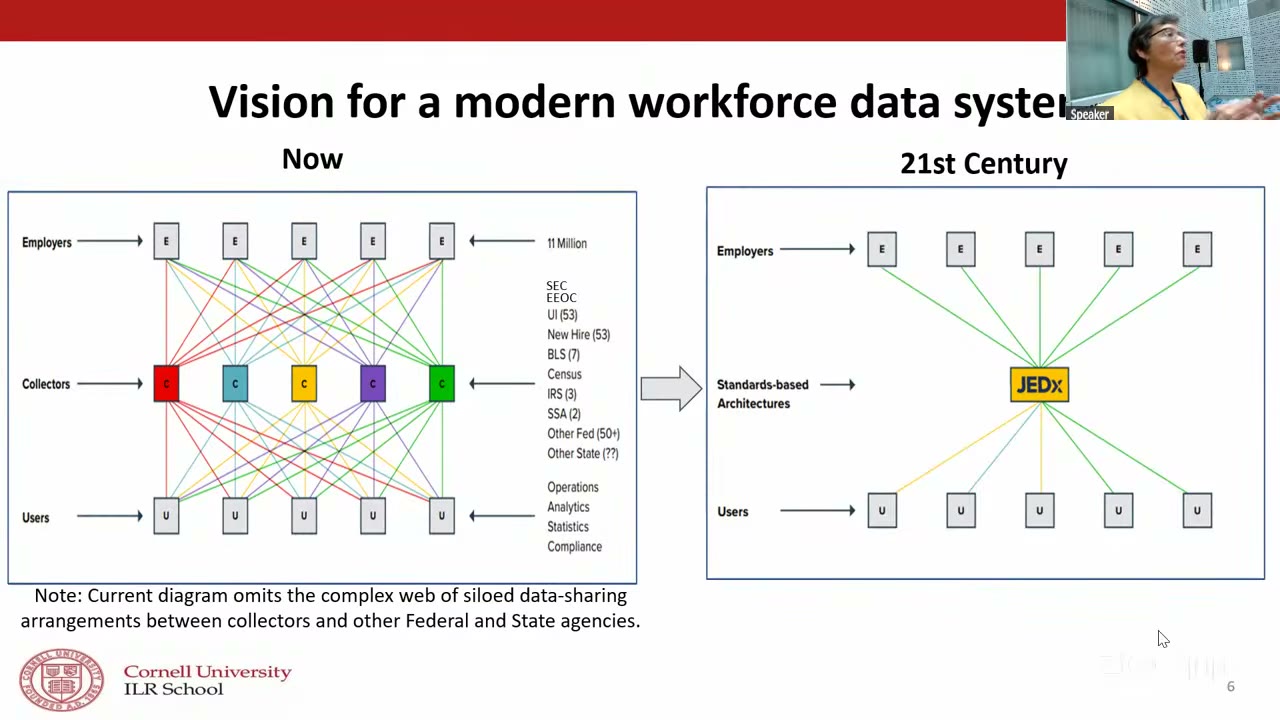
The other Groshen slide is the one the panel turns on, and it is the only picture anybody drew of the actual problem. Eleven million employers on the left, each reporting to some subset of the sec, the eeoc, fifty-three ui agencies, fifty-three new-hire systems, seven bls programmes, Census, three irs filings, two ssa filings, fifty-plus other federal collectors and an unknown number of state ones. “The contents are similar, but not the same.” A very large employer, she said, fills in something like 175 reports. The note at the bottom of her own slide concedes that the diagram understates it, because it omits the web of siloed data-sharing deals among the collectors themselves.
What everyone in the room wants
“Enhanced wage records” means the same quarterly worker row plus three fields: job title or occupation, work location, hours. Those three fields are, not coincidentally, exactly the things the statistical system currently buys with a survey or manufactures by inference. Occupation is what oews fields an entire survey programme to collect. Hours at the worker level is what the productivity accounts approximate by, in Hatch’s word, torturing ces against cps. Location is what subnational jolts needs and what remote work is quietly destroying — an establishment with a remote worker in another state has to open a ui account there, at which point the state lmi shop has to guess the industry code without the address data it does not want to be holding in the first place.
Hatch’s central claim, and the most useful thing said on the panel, is that the traction is not coming from statisticians. It is coming from the ui administrators, because enhanced records make benefit determination more efficient and improve fraud detection. She reported a plenary session on enhanced wage records at the state workforce agencies’ conference that week, in a room that is “mostly actually for the ui folks,” and an outgoing eta official who had become the first person from that agency she had ever heard advocate for enhanced records voluntarily on a national stage. This is the right way to build the coalition and it is faintly humiliating for the public-good argument, which has been available the whole time and has moved nothing.
Her asks are correspondingly concrete. Timelier wage-record access to fix jolts, where a multi-year comparison against lehd shows the same trends but levels of a different magnitude, and to restore monthly state jolts, which bls had to pause. Occupation on the record so that oews becomes a hybrid programme in which states are funded to clean administrative data rather than to field a survey — and if it arrives quarterly, oews stops being a not-quite-time-series, which she called a game changer. Hours at the worker level to repair the ces hours and earnings series, which she says have taken the brunt of the hit and are published at a coarser aggregation than employment for no better reason than data bargaining with large respondents. She is also, to her credit, unsentimental about her own crown jewel: qcew revises — the ces preliminary-to-final benchmark gap simply is the qcew revision — and qcew imputes, a little, and a little more than it used to.
Anyway
Kurz, speaking for himself and not the Board, described himself as one of the guys in the garage: the adp project a decade ago was five people, and “we actually made it work.” He named the input class psad, private sector administrative data for payroll, made the case that the exodus from the statistical architecture has already begun on the forecasting side, and then dropped the line that reorganises the entire conference:
“An important thing to also keep in mind is that there’s a portion of the [qcew] that is already submitted by private payroll providers. Question is, what is that portion? It’s close to 40%. So when we’re thinking about leveraging private payroll information for the ces, we should realize we’re already doing that in an important part of our statistics already.”
Two days of this conference were an argument about whether the government dares to build official statistics on private payroll data. Kurz’s point is that the line was crossed years ago, quietly, inside the benchmark itself, and that nobody noticed because of how it was crossed: when an employer outsources payroll, the payroll provider becomes the entity that physically files the state ui report. The data arrive as a regulatory filing rather than as a vendor feed, so they do not feel like private data, so nobody had to have the argument. The choice on the table is not whether to let private payroll into the official system. It is whether to keep pretending the route in is compliance rather than partnership.
Handle the 40% with the care it deserves. Kurz said it out loud, in his own presentation, and gave no source; his slide behind him carried the sentence “Portion of the qcew is submitted by private payroll providers” without the number. It was also not disputed by the bls official sitting next to him, which is weak evidence but not nothing.
His design proposal follows directly from it, and is the most concrete thing anyone offered. Payroll providers already file qcew for their clients; give them a button that submits a ces report the same way, route it through JEDx via the providers rather than firm by firm, and carry naics, birth and death dates, and payment type — so that a bonus or a reimbursed lunch is not counted as a payroll event. The providers get something back: knowledge of their clients’ industry and size class, and saved client time. He is insistent that none of this works without the micro data, for the unglamorous reasons — you cannot see what an outlier is doing, you cannot compare your sample frame against qcew, and a single organisation reclassed by a couple of thousand jobs can move a month. And you need a birth-death framework, because a continuous sample trends down mechanically and diverges from qcew, which he notes “shows up in other data sources.”

The set-aside
Then, in the Q&A, Hatch quietly revealed that bls had already tried to do exactly this, and explained why it failed, and the explanation is not any of the things you would guess. Not privacy law, not the Paperwork Reduction Act, not vendor reluctance:
“We just discussed internally, like, yeah, payroll providers are our main thoroughfare. Like, can we work directly with them and in fact pay them to produce, say, a ces report where, to your point, you just click a button. And our procurement people told us we couldn’t target specific firms and we would probably have to be a small business and put it aside. It was more of a procurement challenge and once we realized that, that idea kind of fizzled.”
A federal small-business set-aside rule killed the national payroll data feed. The thing you want to buy is a file held by a handful of very large firms, and the rules governing how you buy things require you to not do that. The chair’s response was the correct one and it came from the chair, not from a panellist: stop thinking of it as a procurement at all, and think of it as a new mode by which firms discharge their mandatory or voluntary compliance with statistical programmes. Which, given the 40%, is the mode most of them are already in.
The seat at the table
And then there is Fiorille, whose presence is the structurally interesting fact of the session: a payroll-company executive on a federal-conference panel about whether the government should build a national wage-record system. He was straightforwardly good value. Paychex pays one in eleven private-sector employees every two weeks; its small-business index, built about twelve years ago, covers firms under fifty employees, comes out on the Tuesday of jobs week ahead of both adp and the payroll release, and — this is the pitch, aimed precisely at the sore spot — “this is not a sample. This is coming right off payroll journals. So there’s no revising it.” Late cut-off, so the Houston floods showed up in Houston-metro employment almost immediately. Drill-down to city, metro and sector. Large enterprises lately running around 100.4 on an index scaled to 100, the under-fifty firms around 99.1 or 99.2. Hours worked rising every month for five or six months, which he reads as small firms squeezing the existing workforce before hiring. And occupation, the field the states are struggling to add, he says they already have: Paychex is getting good data on job descriptions, which he framed as the way to track what ai is doing to specific jobs.
Then he offered it. “We’d love to work with you all to provide it and support it.” No price, no licensing terms, no exclusivity, no ip. And when the chair invited him to react to Kurz’s vision, he raised his own bid: rather than chasing firms one at a time, go to the National Payroll Consortium — “really all the big payroll providers” — whose members together pay almost half of all private-sector employees. “That would be my idea.”
Read that charitably, because charitably is how it makes sense: this is a company whose data is a byproduct, whose index already goes to congressional offices district by district, and for whom becoming infrastructure is worth considerably more than whatever a federal data contract would pay. Nobody is hiding anything. But notice what was actually proposed in a room full of federal statisticians, which is that an industry trade body become a standing supplier to the federal statistical system, offered by one of its members, unpriced. Groshen confirmed that JEDx is already working with the consortium and has met “encouragement rather than resistance.” Hatch drew the lesson that the business proposition has to be real — if providers can sell this as a service it goes further than statistical agencies making the public-good argument alone. Everyone agreed. Nobody asked what happens at renewal, and nobody mapped any private index to a revised payroll count; the Paychex series is a small-business measure and was presented as a complement, not as a substitute for anything.
Not mostly legal
Asked — by a questioner who prefaced it with “I’m kind of mildly deathly afraid of the answer” — how many laws would have to be rewritten and how many interagency agreements signed, Groshen gave the session’s most consequential answer: “Actually, I don’t think it’s mostly legal.” The one statute that would help most would establish a presumption of access: if you are a state running a federal programme and producing data, the presumption is that the federal government can see it. “That’s probably just one law, and I don’t know how easy it would be to write it, to get it passed.” Of the American Statistical Association’s thirty-step modernisation roadmap, she said the administration already has the authority for the bulk of them. And a presumption rule would dissolve the interpretive knot at eta, which “up until recently has always said, we can’t ask the states to do that, it’s their data” — a reading she pointedly described as the lawyers’ interpretation rather than something clearly in the statute.
On how many states are actually moving: bls’s wage-records programme is voluntary, about three years old, and by Hatch’s count — she runs it — “I think we’re almost up to 41.” Groshen, an hour later and explicitly deferring to Hatch, guessed 37 or 39 and growing rapidly. Fifteen or twenty states are working on adding occupation. Washington has collected it for a while; South Carolina and Nebraska are in; Texas is getting ready, which Hatch flagged because Texas is traditionally the employer-friendly state, “so it isn’t like a red-blue” split. What none of them are doing is adding it the same way as each other. “There is no standardization currently. Not all of them are adding the same element the same way.”
The question from the floor
The sharpest intervention came from Julia Pollak, the Labor Department’s chief economist, and it was a mechanism-design question rather than a plea. Implementation is policy; the thing keeping her up at night is acceleration. She would love a presumption of access, except that states will call it an unfunded mandate and say, in her rendering, “we are here for program administration, go away.” So, theoretically — there are things underway she could not discuss — should each state get a grant of one to five million dollars to modernise its wage records? “And they do it all their own way. Does that not defeat the purpose?” The whole point is interoperability. “We can’t federalize this, we can’t centralize it,” procurement rules mean you cannot buy the thing and impose it, you cannot tell every state which vendor to use. “What is the path forward that could result in the best outcome, the most quickly, with the greatest employer buy-in and state buy-in? That is what I’m trying to find, the silver bullet. Help me find it.”
Groshen offered two. Use reauthorisation as the vehicle: these programmes come up for renewal on a cycle, so write into each renewal that data produced to run the programme should be available to the federal government. And copy the bargain that already works — qcew is not mandatory either, but the states are funded for it and get valuable data back, “so they’re happy to participate.” Make the wage-records programme qcew-like, and fund it, perhaps out of the ui trust fund, on the argument that it pays for the labour-market information the states need to run their own workforce and training programmes.
Hatch had the last word of the panel, and it is the one sentence worth carrying out of the room: “I would just add that when we change naics codes, we don’t spend years talking to each state on how they need to do it.” The premise that fifty-three jurisdictions cannot be made to file the same fields the same way is false on its face, because the federal government already does it, routinely, for industry codes, and nobody calls that an unfunded mandate.
So the session spent an hour searching for the mechanism that would persuade fifty-three jurisdictions to add three fields to a five-field row, while — if Kurz’s unsourced figure is anywhere close — roughly 40% of the benchmark that anchors the whole payroll series was already arriving from a handful of private firms, one of whom was sitting at the end of the table having already volunteered, in public, at no stated price. The silver bullet was three seats down. Somebody still has to work out how to accept it.