Notes on:
Open Dumps and the Global Trade in Garbage
STEG Working Paper
28 July 2026
development · environment · trade
Talk · Paper · Slides · PDF · Transcript
Written by Fable 5
Part of NBER Summer Institute 2026 — Development Economics
Matthew Gordon (pse), Anna Papp (ucsb) and Monica Shandal (ucsc), presented by Gordon as a nine-minute lightning talk (“about one minute for every year that we’ve worked on this project”) at nber Summer Institute Development Economics, July 28, 2026. Timestamps refer to the session video.
Two stylized facts open the talk. First: the default destination for the average piece of garbage in a low- or middle-income country is an open dump — an unlined, unmanaged pile that leaches, attracts, and, with some regularity, spontaneously combusts. Second: despite this, high-income countries ship large volumes of waste to low- and middle-income countries, a trade whose logic Larry Summers once famously described, in a leaked World Bank memo, as “impeccable.” (The memo was about pollution generally; the garbage trade is its purest living descendant.) Whether the logic survives contact with data has been hard to check, for the excellent reason that nobody has data — waste statistics are worst exactly where waste management is worst.
So the paper builds the data, and the construction is the intellectual core. You cannot just train a machine-learning model to find dumps in satellite imagery and count the pixels, because ml classifiers have non-classical measurement error and you would be doing causal inference on the model’s hallucinations. Instead: crowdsource seed data (an ngo’s membership mapped dumps for the “Atlas of Plastic Waste”), train a model on Sentinel imagery to recognize the spectral signature of garbage, and then — this is the trick — don’t trust the model. Use its predictions only to decide where to send human verifiers, oversampling the ambiguous images, and construct estimates that remain unbiased “even if the model were complete noise”; a good model just buys you precision. It’s a design-based rescue of machine learning, portable to any rare land use, and the validation is charming: when Albania capped a dump in Durrës in 2021 and built football stadiums on top, the model stopped flagging it.
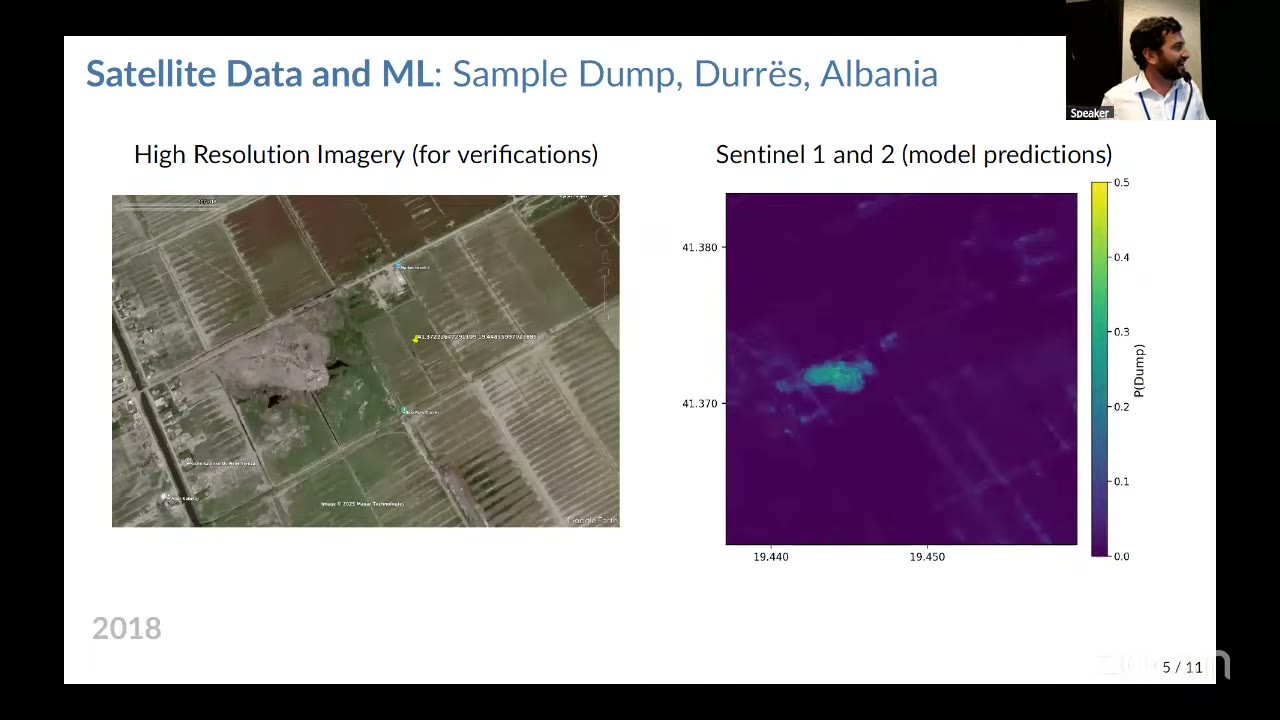
The resulting first-ever globally representative time series says dumps are not where a naive model of land prices would put them. They cluster at the 95th–99th percentiles of population density — “not in the Manhattans of the world… more in the New Jerseys,” and in poor countries squarely in the Jakartas and Mumbais — meaning the externalities land on a lot of people. And they are frequently on fire.
Then the natural experiment. In 2018 China, which had absorbed 50–90% of global waste imports depending on category, banned essentially all of it; shippers diverted flows to Southeast Asia and elsewhere. A shift-share IV — instrumenting each country’s import change with what it would have received if exporters had reallocated pre-ban China volumes to their existing partners — yields 0.111–0.179 m² of new open-dump area per additional kilogram of net imports, an elasticity of 1.2–1.5. The elasticity exceeding one is the quietly damning part: imported waste doesn’t just get dumped, it overwhelms domestic disposal capacity and pushes local garbage into dumps too.
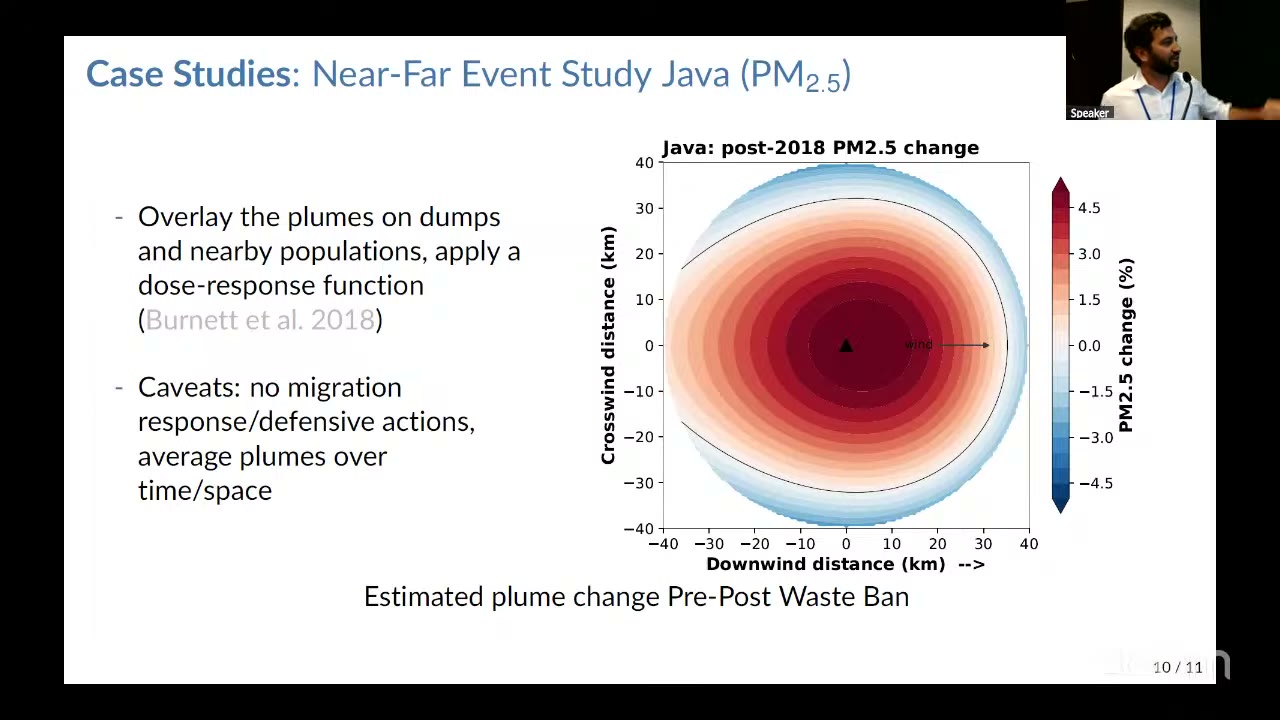
For Java, where the team catalogued nearly the universe of dumps, the welfare arithmetic gets specific. Post-ban import surges raised dump fires and PM2.5 by nearly 6% near dumps; modeling the pollution as plumes declining with downwind distance, overlaying them on population, and applying the Burnett et al. (2018) dose-response function gives an estimated 4,381 additional premature deaths per year (95% ci: 1,836–7,295).
Against that, the benefit: Indonesians do pay for this waste — it’s an input, so imports generate real consumer surplus, which the authors estimate deliberately generously (linear demand, an upper bound). The ratio comes out to $12,672 of consumer surplus per premature death — about $13,000, rising to roughly $15,800 with slag and textiles included, with a confidence interval topping out near $30,000. Standard values of a statistical life, including ones calibrated for middle-income countries, are orders of magnitude higher. The authors are careful about what this is not — not a full welfare analysis (no exporter producer surplus, which for the us side of the collapsed trade they put at $190 million; mortality counted only near Java’s dumps) — but for an Indonesian policymaker deciding whether to restrict waste imports, the relevant ratio is theirs, and it is not close.
The impeccable logic, it turns out, priced the pollution at whatever an importer would pay for a bale of mixed plastics, and the mortality at zero. Thirty years later, someone finally built the dataset to check the arithmetic, and the arithmetic says the Jakartas of the world are selling life-years at about a hundredth of the going rate — with the pile visibly on fire from space.