Notes on:
Government Funding Costs Under Financial Repression
NBER Working Paper 35391
13 November 2026
financial repression · fiscal theory of the price level · government debt · bond risk premia
Talk · Paper · doi · PDF · Transcript
Made with AI: Opus 5.5 (reading and writing), GPT 6.1-Sol (reading), Fable 5.1 (adjudication), Sonnet 5.5 (verification)
Part of Monetary Economics Program Meeting, Fall 2026
Roberto Gómez-Cram, Howard Kung, Hanno Lustig and David Zeke, presented at the nber Monetary Economics Program Meeting, 13 November 2026 (by Lustig, as far as the recording lets one tell); discussant Marco Bassetto; note based on nber Working Paper 35391, June 2026.
Government funding costs under financial repression
Financial repression is a tax that comes with a very particular sales pitch: the people paying it mostly don’t notice. Lustig defines it in the talk as all policies that push government bond prices above what a free market would clear at, and the menu runs from the Civil War’s National Banking Act (banks could issue notes if they held Treasuries) through wartime yield-curve control to Basel risk weights, liquidity coverage ratios and quantitative easing. The paper’s claim is that these are all one thing, a wedge in the bond Euler equation, and that the interesting part isn’t that the wedge taxes bondholders. Of course it taxes bondholders. The interesting part is that it also insures them, and they are grateful enough to accept a lower risk premium for it.
The setup
You have an endowment economy with two kinds of people. A fraction are asset holders with Epstein-Zin (1989) preferences, taken to the infinite-eis limit so the real rate is pinned down and every yield movement is a risk premium. The other are hand-to-mouth. The only shock is a persistent shock to government transfers (transfers, not purchases, which matters later), the government issues nominal long-duration bonds, and the usual Taylor (1993) rule and tax-on-debt rule sit in the background. The authors focus on the fiscally-led regime: monetary policy accommodates () and taxes respond too weakly to debt, so an unfunded transfer is paid for by surprise inflation marking the nominal debt down to its fiscal backing.
Limited participation is what makes this priced. Goods-market clearing forces asset holders to consume the endowment plus the surplus scaled by , so a deficit is mechanically a transfer from bondholders to the hand-to-mouth, and the inflation that devalues the bonds arrives at exactly the same moment. With , as Lustig put it, the household’s bonds are “perfectly hedged” by the present value of its own future transfers and fiscal risk carries no price. With fiscal risk is concentrated on the few people who hold the debt, and they want paying.
Now add the third instrument. Asset holders face a portfolio constraint, which shows up as a multiplicative wedge on the bond Euler equation, and the wedge follows a rule, (eq. 20): repression is turned up when spending is high. That is roughly what governments do in wars, and it is the whole model.
The mechanism
A transfer shock hits. Without repression, the bond price has to fall far enough, through inflation, to bring real debt into line with lower surpluses. With repression, the wedge props up the bond price at precisely that moment, so less surprise inflation is needed (Proposition 1). Bondholders lose less on impact. But a bond bought above its frictionless price earns less afterwards, and the paper’s return impulse response is for every period after the shock (Gómez-Cram et al. 2026, 39). “The costs for bond holders are backloaded,” in Lustig’s phrase (00:13:40).
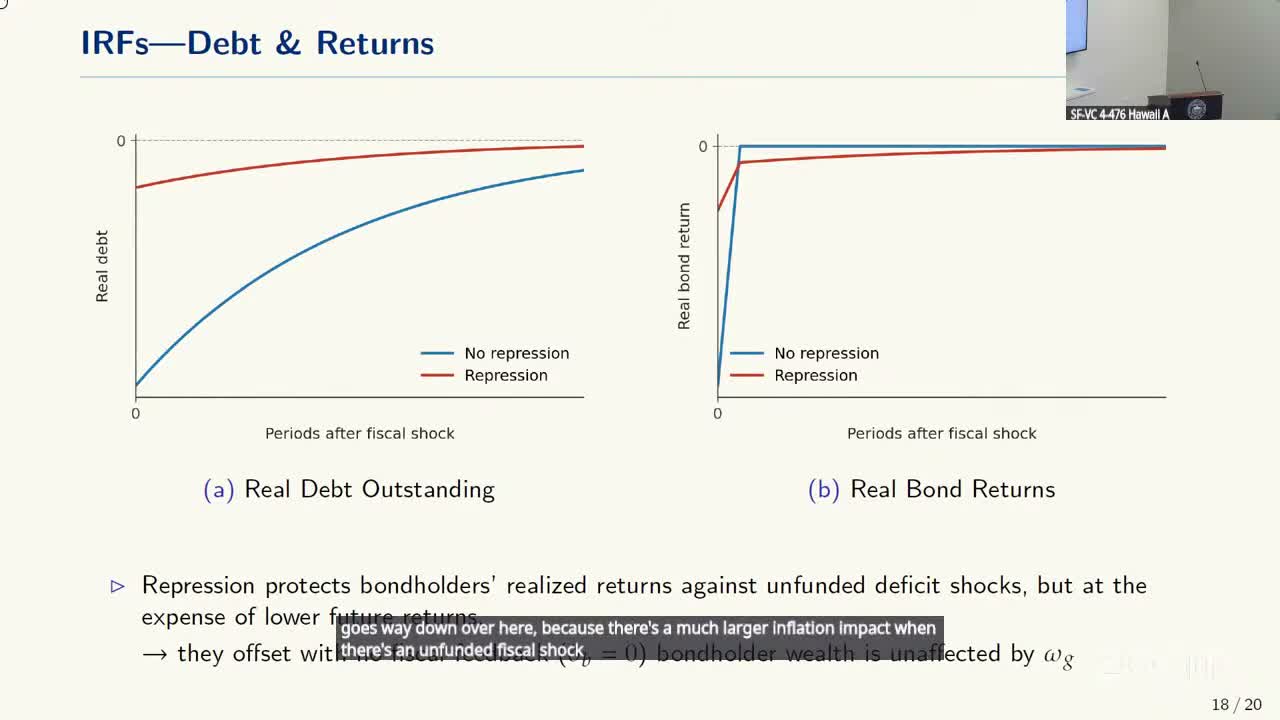
So far this is a retiming of the bill, and the paper is admirably blunt about it. Corollary 1.2 says that when taxes don’t respond to debt (), the repression loading has no effect at all on asset holders’ utility: the surpluses are exogenous, and the consumption claim depends only on them. Repression “is not a free lunch for bondholders,” says the abstract; they pay less inflation tax now and more subsidy later. With the propped-up debt pulls in more taxes and the hit to bondholders shrinks; with it grows.
The one surprising thing
Here is the bit worth the price of admission. Even at , where bondholders end up exactly as well off, the bond risk premium falls as rises. The closed form is eq. (36):
Here is the share of debt the hand-to-mouth are forced to hold, the steady-state surplus, the shock’s persistence, the tax response to debt, and the model’s fiscal-burden and fiscal-backing composites, risk aversion and the shock variance. Set and still enters through , which is the impact return. The premium is a covariance (the proof writes it as the impact return times the marginal-utility response times ), and repression moves the loss off the date when the shock lands and onto the quiet dates after. The bondholder pays the same total, but pays it in states that don’t covary with the bad news, which is what being insured means. The implicit tax doubles as an insurance policy, and the government collects the premium on the policy in the form of a lower required return.
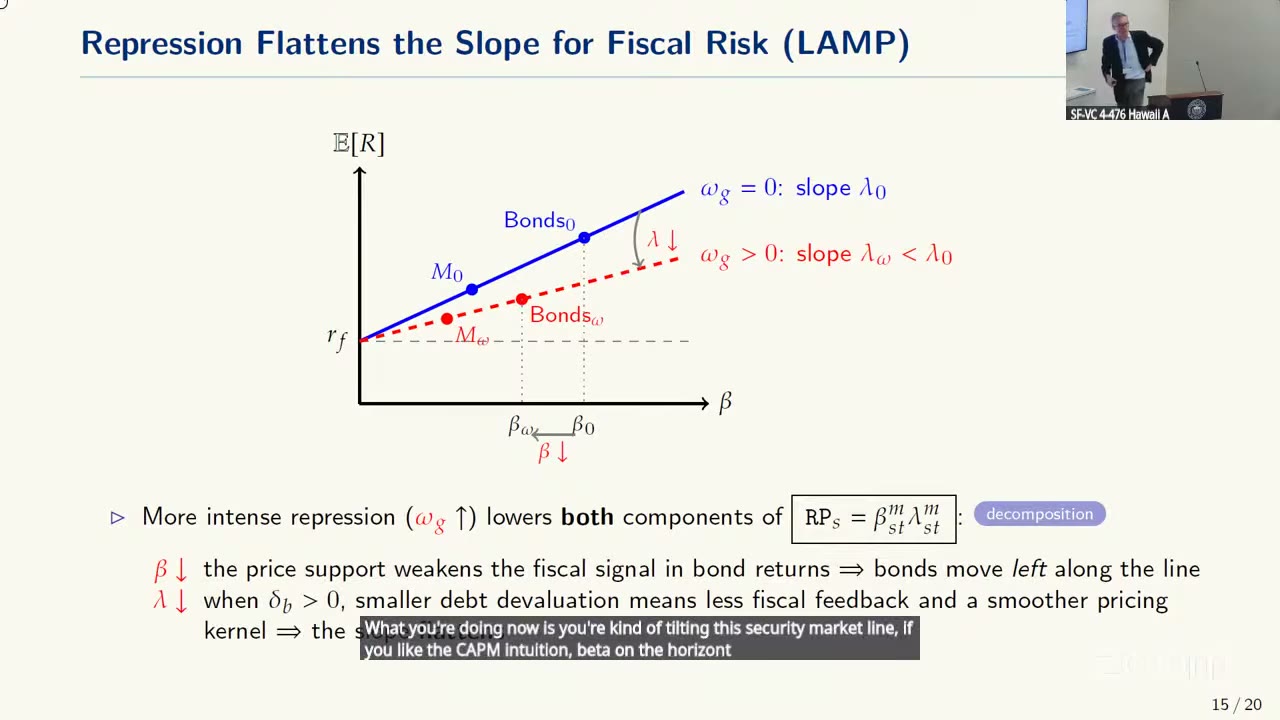
Two qualifications the abstract doesn’t make. First, the premium falls in only if exceeds a threshold (Corollary 1.3b); the abstract and the talk’s taxonomy slide say “lowers bond risk premia” flat, and the slide above already narrows the price-of-risk half to . Second, the risk premium is only one of two funding-cost channels. Lustig separated them in the room: “there’s a direct subsidy effect,” and then “a higher order effect where you get a lower average funding cost” (00:25:47). The subsidy is the plain tax; the retiming story explains the premium, not the whole bill. And a footnote quietly holds up the premium result: the constraint is assumed not to depend on what you held last period, and if it did, “risk premia would internalize the lower future expected returns and the sign of risk premia becomes indeterminate” (Gómez-Cram et al. 2026, 29n10). The insurance is cheap partly because the insured are assumed not to read the fine print about next period.
Everything here is analytical, first-order and uncalibrated. There are no numbers, only signs, and figures without axis values. (The talk’s bond-price impulse response also crosses above the no-repression line, which the paper’s Figure 1 does not; presumably a different parameterization.)
The other regime, and the discussant’s knife
If monetary policy is active and fiscal policy is too, Leeper (1991) gives you no stable equilibrium. The paper’s Proposition 2 says repression can fill the gap, at one specific value:
with the discounted continuation value of the long bond. At that loading inflation is zero, the central bank keeps control, and bonds become a hedge with a negative premium (Corollary 2.3). The introduction calls this “a distinct determinacy region.”
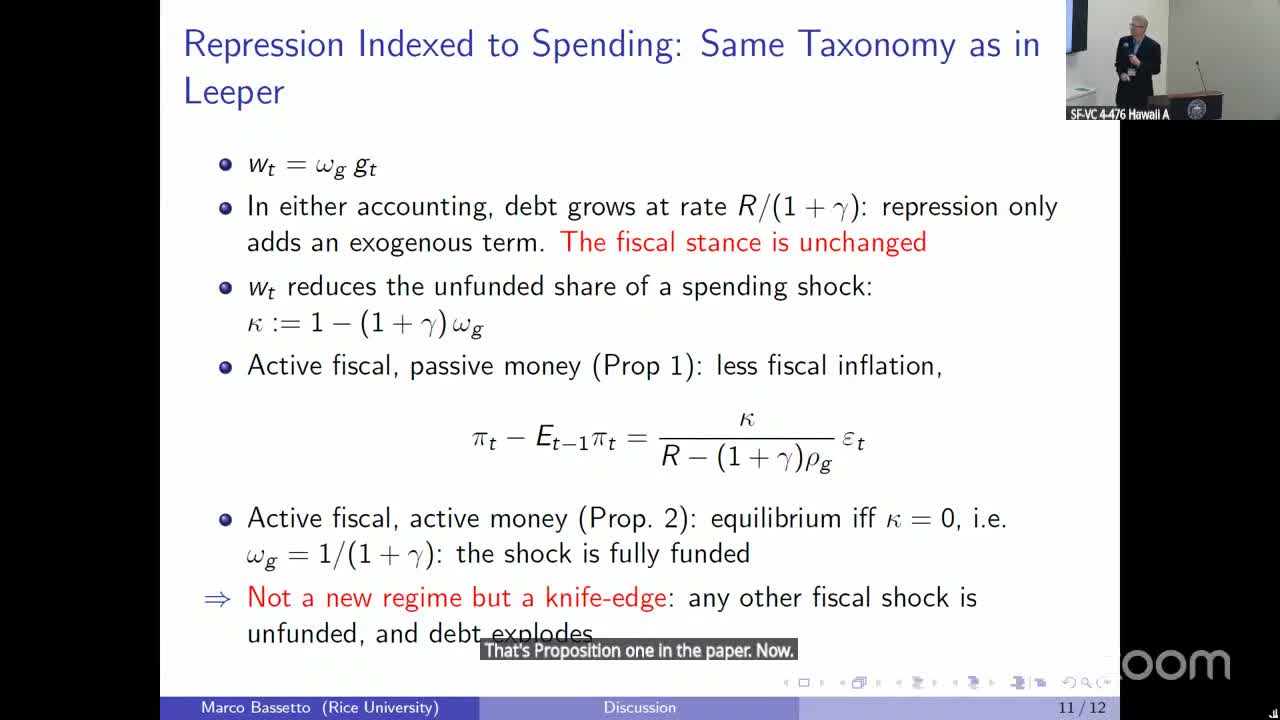
Bassetto’s discussion took that phrase apart. Rewrite the model with one-period debt and book the repression revenue at issuance (you sold an overpriced claim, so under honest accounting you got the money then), and spending-indexed repression just shrinks the unfunded share of the shock to , with the tax response. Proposition 1 is “less fiscal inflation” because the deficit shock is smaller. Proposition 2 is : “Not a new regime but a knife-edge” (00:45:01). Active-active still explodes; repression is calibrated so that nothing ever pushes it off the steady state. “You’re just walking on a tightrope and it can work.”
The earlier part of the discussion made the accounting point concrete. In a three-period Ramsey economy with actual purchases, optimal tax smoothing wants state-contingent debt that pays less when spending is high, so risky debt with a premium is optimal, consistent with the paper. To make the debt safe you could tell a bank (Bassetto’s “Diego”) to hold it at a high price, threaten examiners if they object, and extract the resources as a lump-sum tax. “I haven’t made the taxes disappear” (00:35:01); the low return is the tax. Under complete markets with no special demand for safe debt you wouldn’t bother. Only if some investor pays a liquidity premium for safety might repression earn its keep, an investor Bassetto added and the paper does not have. Bassetto also suggested indexing repression to debt instead, which collapses back into ordinary passive fiscal policy once revenue is booked up front, and closed on a pet peeve: banks held about 0.015% of gdp in excess reserves from 1984 to 2008 and hold about 9% now, yet in December 2025 the Fed stopped shrinking its balance sheet for fear of reserve scarcity. “That to me looks like financial repression” (Bassetto’s reading, not the paper’s).
The chair waived a reply. In the Q&A Lustig conceded the point anyway: “I agree with what Marco said, by the way, about the characterization of regimes” (00:53:49), and indexing to debt was “how we started writing the paper, but it has some counterintuitive implications,” perhaps to be revisited.
The floor
The first questioner found the Leeper framework too bang-bang; Lustig agreed and said the stylization buys closed-form risk premia, where most of the literature linearizes “the hell out of this” and has no premium at all. A second asked why, given post-war yield-curve control, the model keeps a Taylor rule rather than a pegged rate path. Lustig hadn’t considered it, and noted that until 1951 the Fed was “clearly not in the driver’s seat.” A follow-up (probably the same questioner) observed that the us abandoned yield-curve control when inflation got out of hand, which looks like regime switching; Lustig pointed to the paper’s stochastic-duration extension, where anticipated exit weakens repression and exit itself sets inflation off, and to Japan. Asked about real effects on private credit, Lustig said that needs distortionary taxes and probably capital, not done here, and added that repression is “best to be avoided,” since people don’t see the tax. Asked whether a small central-bank balance sheet means less repression, Lustig called balance sheet to gdp a proxy for “financial repression light,” with Japan “the winner.” The last questioner objected that qe is an asset swap and nobody is forced; Lustig answered that reserves are non-marketable debt that cannot leave the banking system, the questioner remained unpersuaded, and a final speaker (presumably Bassetto, from the reference to “my example with Diego”) split the difference: with abundant reserves you pay the market price, and only once reserves are scarce is regulation doing the forcing. That one ended contested.
Which is a fitting place for it to end. The paper’s best result is that you can insure bondholders by taxing them later, and they will thank you for it with a lower premium. Its discussant’s best point is that the bill is the same bill, just with a different date on it. Both are right, and the gap between them is the part the bondholder doesn’t see.