Notes on:
Global Hegemony and Exorbitant Privilege
NBER Working Paper 32775
2025
geoeconomics · hegemony · exorbitant privilege · military power
Paper · PDF
Made with AI: Fable 5.1 (reading and writing)
Carolin Pflueger and Pierre Yared. Presented at the nber Summer Institute International Economics and Geopolitics meeting, July 10, 2025 (discussant: Iván Werning). No recording of that session or of any other presentation of this paper could be found online, so this is written from the paper alone — the November 21, 2025 draft (nber Working Paper 32775).
The bond market is part of the army
Here is a thing that is true and a little uncomfortable. The United States spends more on its military than anyone, and it also borrows more cheaply than anyone, and these two facts are usually filed in different cabinets — one under “national security,” the other under “exorbitant privilege,” Giscard d’Estaing’s sour phrase for the dollar’s funding advantage. Pflueger and Yared’s paper puts them in the same cabinet. Cheap borrowing pays for the military; the military is what makes the borrowing cheap; and because each feeds the other, the system has the properties of every feedback loop — it amplifies small advantages into large ones, and, past a certain gain, it can flip.
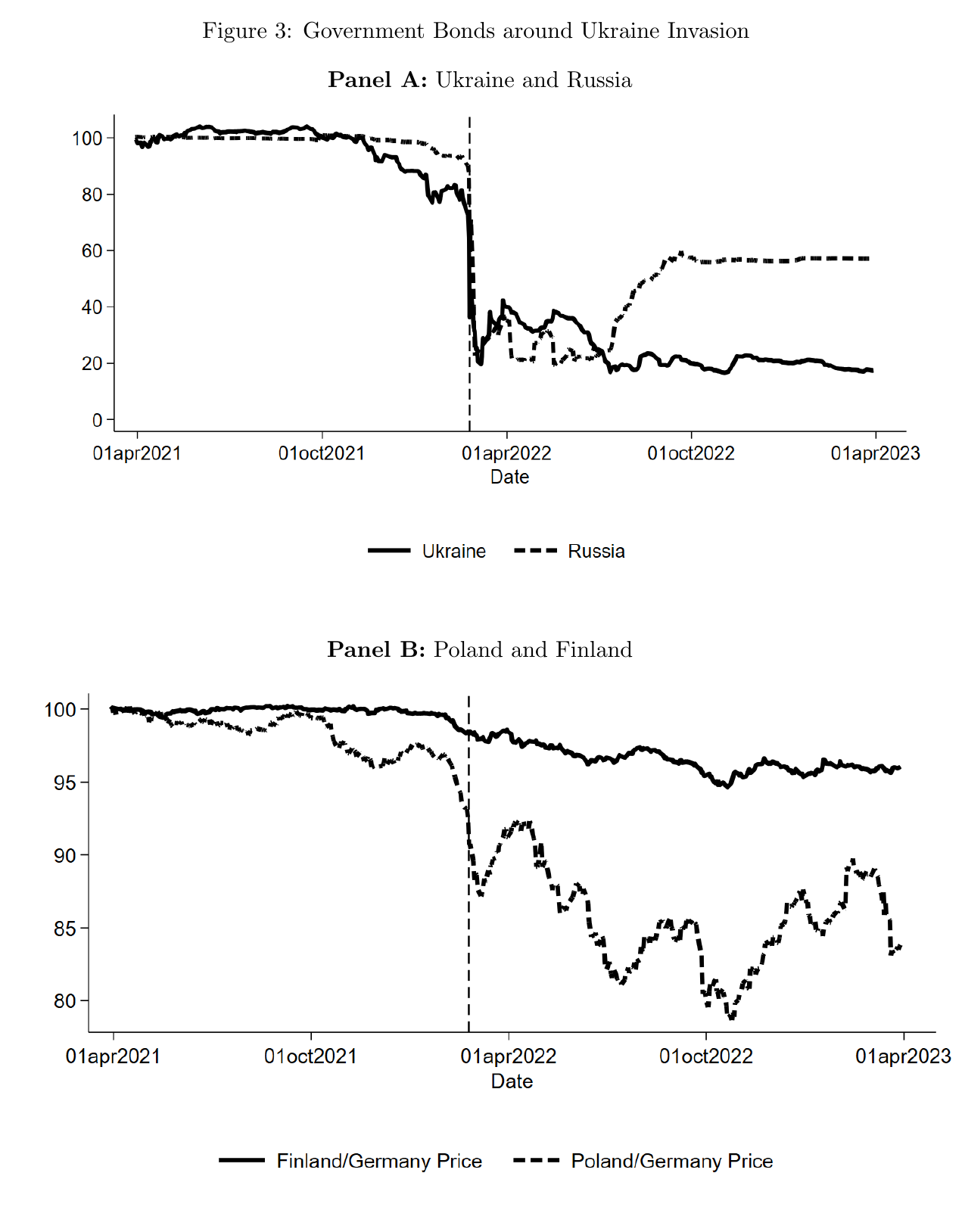
Start with the three facts the model is built to match. First, military hegemons borrow cheaply, and the identity of the cheap borrower changes when military standing changes. Britain’s real borrowing cost relative to the Netherlands went from a 1.42 percent disadvantage in 1700–1795 to a 1.98 percent advantage in 1796–1900, the switch coinciding with the Dutch defeat in the Anglo-Dutch War of 1780, the Napoleonic invasion of 1795 and the bankruptcy of the Dutch East India Company the year after; the financial center moved from Amsterdam to London and stayed there until, between the two world wars, it moved to New York along with the ordering of U.S. and U.K. yields. Second, the funding gap between the hegemon and everyone else widens with geopolitical tension: the U.S. borrowing advantage over other developed countries is 45 percent correlated with a newspaper-based tension index, shrinking in the 1990s, rising after 9/11 and Iraq, and, in the paper’s own phrasing, spiking with the invasion of Ukraine. (A footnote checks that the same spread measured against Japanese yields correlates far less well, which is the authors’ reason for reading this as military strength rather than generic flight to safety.) The case study is Finland and Poland, neither of which was attacked in February 2022 and whose euro bonds nevertheless fell about 4 and 15 percent against maturity-matched German bonds — a geopolitical risk premium of roughly 40 basis points for Finland and a percentage point and a half for Poland, for the crime of being nearby. Since Germany was hit too, the authors call these lower bounds. (U.S. bond prices, the paper notes without showing them, rose.)
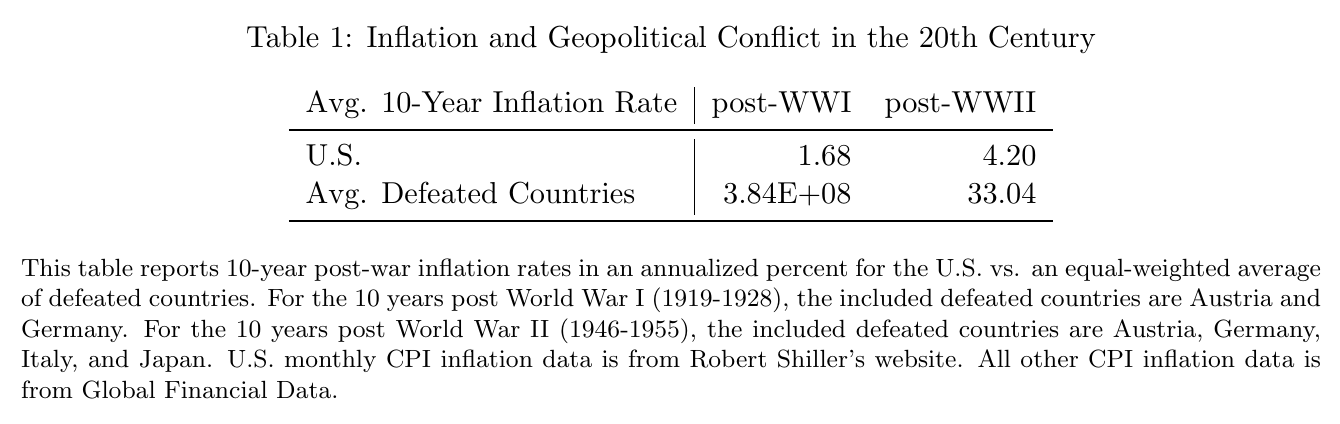
Third, losers of wars devalue. The defeated countries of both world wars inflated far more than the United States in the following decade (the post-1918 entry in the table is not a formatting error; it is Austria and Germany, in annualized percent), and in the nineteenth century Austria, Russia and Turkey lost half or more of their currencies’ silver content, mostly during the Napoleonic wars, while sterling lost six percent in a hundred years.
Anyway, the model
Two countries, otherwise symmetric except that one has an exogenous military edge (geography, technology). Each period there is some chance of war, fixed and outside anyone’s control. Each government chooses how much to spend on defense versus other public goods, how much to borrow from deep-pocketed international investors, and whether to default. Military strength is a stock — accumulated spending that depreciates — and the probability of winning a war is a contest function of relative strength. Losing destroys the endowment, so a loser defaults; that is the third fact, built in. Investors, as in the rare-disasters literature, put a premium on payoffs that arrive in war states, so the bonds of the country more likely to win are worth more for their safety.
You might ask why borrowing matters at all here, and the answer is worth a paragraph, because it is the paper’s one deliberate thumb on the scale and the authors are open about it. Governments and investors have the same preferences, so what a government raises by selling a bond today equals what it expects to pay back tomorrow, and the debt terms cancel out of its objective. That is Ricardian equivalence, straight out of Barro (1974), and left alone it says borrowing is irrelevant to military spending, which is not a paper anyone wants to write. So the authors assume the cost of losing a war is enormous (Assumption 1 takes it to infinity), and that does two things at once. Every government spends nothing on other public goods and everything on the military, and every government borrows to the absolute limit of what investors believe it will repay. In equilibrium, then, the quantity each country borrows is pinned — a fixed share, the debt capacity , of its tax revenue — and the only thing the bond market gets to vary is the price. Which is the whole game. The price of a bond is
(eq. 6 in the paper), where is the war probability, the premium investors put on a unit that pays in the war state, and the probability that country wins — so the price gap between the two countries is times the gap in their odds. Subtract one country’s budget constraint from the other’s and everything collapses to one line in the military gap :
(eq. 8; is tax revenue, the depreciation rate, the exogenous edge, the logistic contest function). Read left to right, this period’s gap in military spending must equal this period’s gap in what the bond market handed over. Read right to left, the bond-market gap is an S-curve in the very military gap it finances, and the product sets how steep the S is — the gain on the amplifier. That is where debt capacity lives, and why the authors describe it as equal, in equilibrium, to global investors’ demand for liquidity.
With low gain the story is the comfortable one. The exogenously stronger country borrows more cheaply because it is less likely to lose and default; the funding advantage lets it spend more on the military; the steady state (in peace) is unique and the strong country stays strong. Tension raises the spread, because war risk is default risk for the weak country and safe-haven demand for the strong one — fact two. Raise debt capacity, or raise the exogenous advantage, and the loop amplifies: the hegemon’s financial and military leads grow together. So far the paper reads as a formalization of Britain’s long nineteenth century and America’s long twentieth.
Where it gets interesting: multiplicity
With intermediate or high debt capacity, a second steady state appears in which the exogenously weaker country dominates. It is sustained entirely by expectations: if bond investors believe the weaker country will build enough military capacity to overcome the other’s natural advantage, they lend to it cheaply; the cheap funding finances the buildup; the buildup validates the belief. The conditions that make this possible are the ones you would guess if you thought of the model as an amplifier: a small exogenous gap (so the weak country can plausibly catch up), slow depreciation of military capital (so a buildup accumulates), and — the counterintuitive pair — a higher probability of war and a higher war risk premium. Those last two make safe bonds more valuable in exactly the state that matters, which strengthens the loop, which is what creates the second equilibrium. The things that make being the hegemon most valuable are the things that make the position contestable.
Two things about this deserve to be said slowly. The first is that exogenous military advantage is not the same kind of thing as debt capacity, even though both amplify the loop: more shifts the S-curve up and makes the equilibrium more unique, while more steepens it and makes it less. The second is the sentence in the paper I found most surprising: none of this happens without a global bond market. No borrowing at all, and each country spends its endowment on tanks and the equilibrium is unique. Domestic borrowing only, from investors without deep pockets, and both countries borrow to their domestic limit and the equilibrium is unique again. It is only when both governments are bidding for the same pool of foreign money that one country’s safety premium becomes, arithmetically, the other’s funding cost, and a belief about who wins can finance itself. The self-fulfilling sovereign-debt-crisis literature has one borrower and a market that can panic about it; here there are two borrowers and a market that can only ever move money from one to the other.
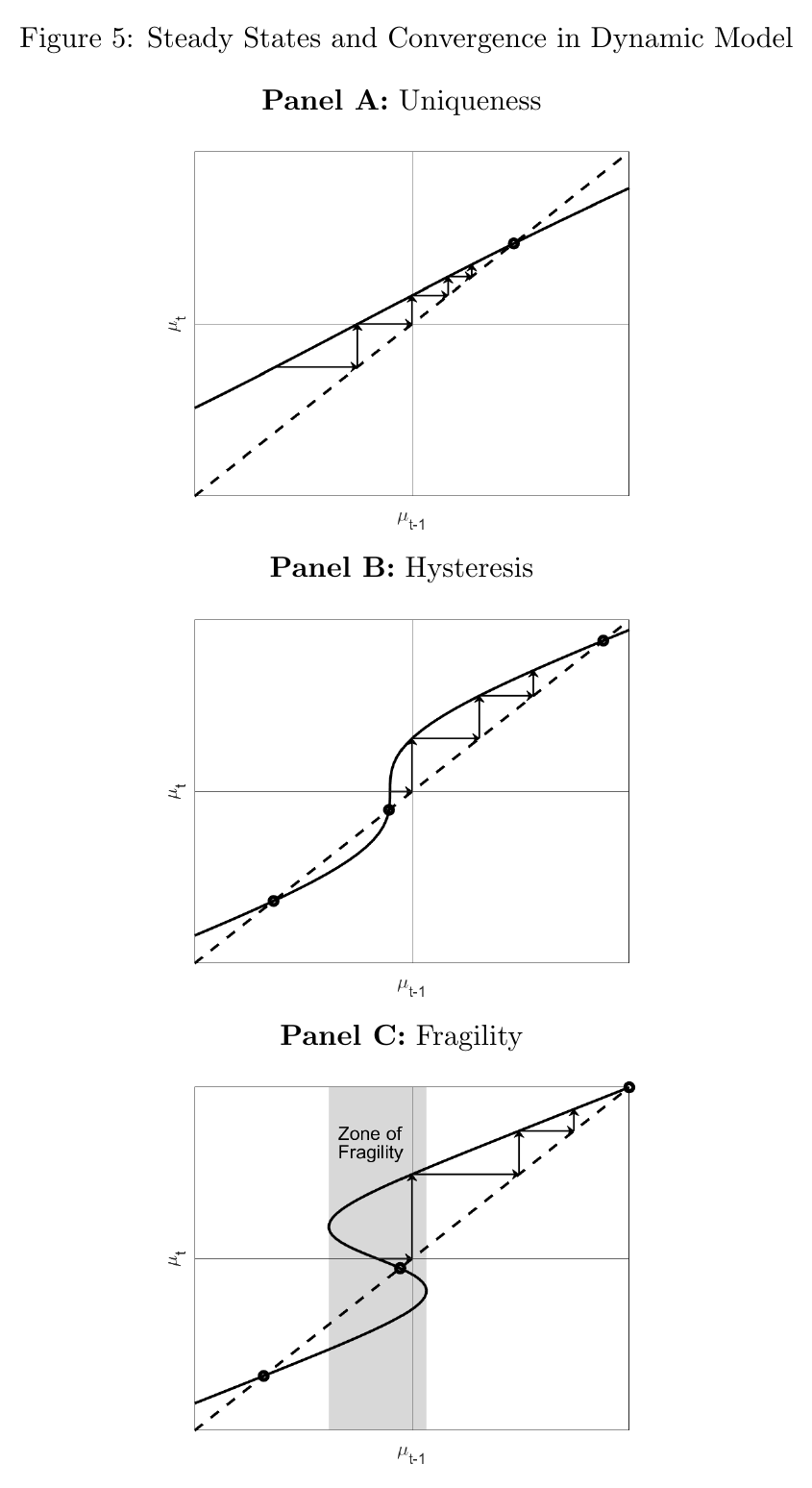
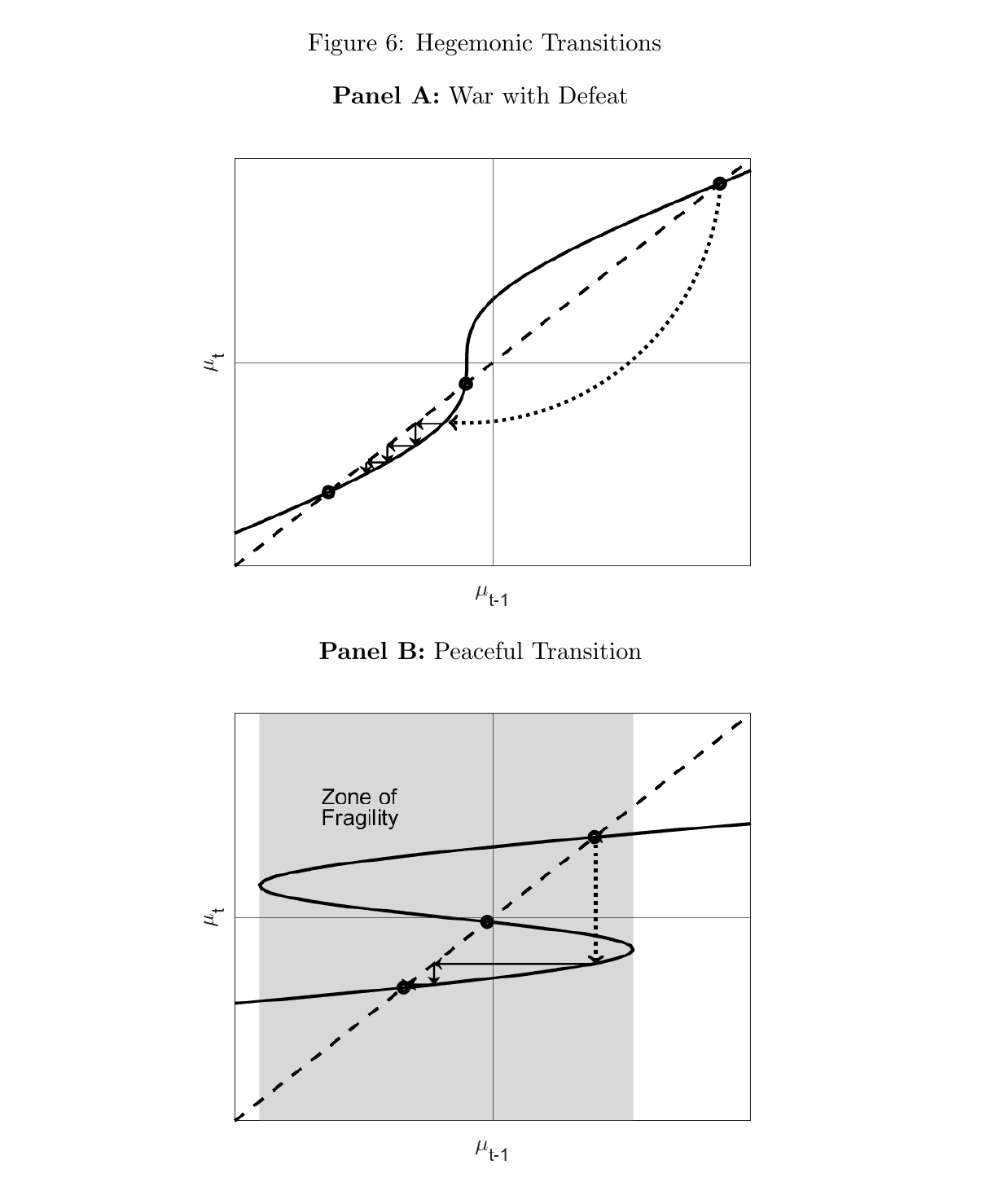
Then the dynamics, which is where the paper earns its title. At intermediate debt capacity there is hysteresis: the map from last period’s military gap to this period’s is a steep S but still a function, so there is a unique convergent path, initial conditions decide who ends up on top, the leader’s twin advantages compound over time, and only an actual war — a realized roll of the dice — can produce a transition, after which the new hegemon consolidates. That is, roughly, Amsterdam to London to New York, each handover marked by a war. At high debt capacity the map folds back on itself. For the same inherited military balance there are several this-period balances consistent with rational pricing, and the paper calls the folded range a “zone of fragility”: inside it initial conditions do not determine the outcome, dynamics can be non-monotonic, and a hegemonic transition can occur without a war, coordinated by nothing but a shift in bond-market expectations. When bond prices move budget constraints strongly enough, beliefs become self-fulfilling, exactly as in the self-fulfilling debt-crisis literature — except that here one borrower’s crisis is another borrower’s coronation, and the state variable is not the stock of debt but the stock of missiles.
The threshold for fragility, from the appendix, is . It falls with the war probability and the war premium, so fragility arrives at lower market depth when the world is more dangerous and investors more frightened, and — note what is missing — it contains no depreciation rate at all. Hold that thought.
The depreciation catch, and the drones
Here is the condition without which the headline result cannot be read, and it cuts the opposite way from what the last section primed you to expect. Slow depreciation helps a second steady state exist: a challenger needs time to pile up the stock, and if the stock rots quickly it needs more borrowing capacity to get there, so the multiplicity threshold rises with . But a peaceful transition between the two steady states needs both of them to sit inside the zone of fragility, and Corollary 2(ii) says that there is a war-free transition path “if the depreciation rate is sufficiently high.” The intuition is almost embarrassingly simple once said: if last period’s military capital has mostly evaporated by this period, both countries inherit roughly the same thing, and the bond market’s vote this period decides the balance nearly from scratch — “a bond-market coordinated reset of the military balance,” in the paper’s words. The fragility threshold has no in it because fragility is about how strongly today’s prices move today’s spending; depreciation only decides how much of yesterday is still around to anchor you. Faster obsolescence widens the zone of fragility (the appendix shows its edges running off to infinity as approaches one, while the steady states stay put, so eventually the zone swallows them). So the two-line summary is: low depreciation makes a challenger possible and the incumbent sticky; high depreciation makes the incumbent fragile. The paper’s own topical illustration is that “if the depreciation rate of military technology rises, e.g. due to shifts away from expensive fighter planes towards cheaper replaceable drones, then geopolitical fragility and peaceful hegemonic transitions may become possible.” A hegemon whose edge is a fleet of things that take a decade to build is protected by that decade. A hegemon whose edge is things that are obsolete in eighteen months is protected by whatever the bond market believes this quarter.
The asymmetric extension, where the two countries differ in debt capacity rather than in military technology, adds one more lever. A gap in debt capacity acts like an exogenous military advantage: a large gap favors uniqueness and the dominance of the deeper market, and with enough of it a country can dominate even from an exogenous military disadvantage. Narrow the gap — the challenger deepens its market, or the incumbent damages its own — and multiplicity returns; whether that multiplicity is the sticky kind or the fragile kind depends on the average of the two capacities, so a world in which both rivals have deep markets is the fragile one. The authors’ reading of the Napoleonic Wars is this extension, and only this: Britain prevailed “in large part because of its higher debt capacity.” The model does not need Britain to have had the better army, and the paper makes no claim about how the two militaries compared.
What it says about now
The paper does not say that a Treasury-market rout would hand hegemony to China. It says the conditions under which such a thing is possible are debt capacity high enough that bond prices bite, war risk elevated enough that safety is precious, a challenger with a deep enough market of its own, and military capital that goes obsolete quickly — the Discussion’s own list is “two powers relatively evenly matched militarily, financially, and fiscally,” well-developed global financial markets, and rapid obsolescence. My tally, not theirs, is that several of those are more true than they were a decade ago. On the challenger, the authors are measured: absent an outright technological leap, a “necessary — though not sufficient — condition” is the deepening of China’s financial markets, and renminbi internationalization, cips, swap lines and a central bank digital currency are “still modest in scale.” Which is why they call those efforts a matter of U.S. national security, and why they file open capital markets, prudent fiscal policy and an independent central bank under defense. Their most direct claim about current policy runs the other way: the bond-market turmoil of late 2024 and spring 2025, “attributed in part to the actions of so-called ‘bond market vigilantes’,” and the possibility that “should these pressures force a shift toward austerity, our model suggests this could trigger a reinforcing cycle of declining military expenditures, reduced strategic influence, and higher sovereign borrowing costs.” That is the amplifier running in reverse, and it needs no war to start. They end by saying it is too early to tell whether the gap between the two countries’ markets will narrow enough for any of this to bind.
The wry part is the cost side. Every factor that strengthens the complementarity between financial and military dominance — deeper markets, higher tension, bigger risk premia — also introduces multiplicity and fragility for the incumbent. The hegemon’s privilege and the hegemon’s exposure are the same number.
(Since there is no recording, I cannot report what Werning or the room pushed on. The obvious places are the exogenous war probability — countries here do not choose to fight — and the reduced-form treatment of debt capacity as a parameter rather than something a hegemon, or its rival, can build. On the first the authors have an answer ready: a footnote says the empirical literature does not support a strong link between armament and the likelihood of war, and that endogenizing it “further broadens the scope for equilibrium multiplicity, but otherwise leaves the central mechanism in this paper unchanged.” On the second, the asymmetric extension gestures at it without modeling the building.)