Notes on:
Geopolitical Payoffs
Working paper
2026
geoeconomics · foreign aid · alignment · Cold War
Talk · PDF · Transcript
Written by Fable 5
Part of NBER Summer Institute 2026 — International Economics and Geopolitics
Andrei Levchenko, Nitya Pandalai-Nayar and Henry Young; discussed by Jesús Fernández-Villaverde. nber si International Economics and Geopolitics, July 16, 2026 (video 05:48–06:47). Paper: June 2026 draft, conference.nber.org; slides also posted.
Does aid pay for itself?
There is a story people in donor countries like to tell about foreign aid, which is that it is not really charity, it is marketing: you give a country money, the country buys your tractors and your grain and your fighter jets, and the money comes back through the front door with interest. The story is old — the paper traces the narrative evidence to at least 1966 — and it is newly official, since the administration that shut down usaid, terminating about 86 percent of American aid disbursements, said the remainder should be “geared towards our national interests” and promptly tied hiv assistance to Zambia to mineral access. It is a testable story. The test requires knowing how much aid raises the donor’s exports to the recipient, which is an econometrics problem, and then how much those extra exports are worth to the donor in welfare, which is a trade-model problem, and Levchenko, Pandalai-Nayar and Young do both. The answer is that the story is about 27 percent true.
The data, which is the hard part
The Cold War is the laboratory because it is the last era of great-power competition in which two sides poured money into third countries with openly strategic intent. The Western half of the aid data is the oecd’s dac database. The other half did not exist in usable form: the authors digitized Soviet and Chinese aid from the cia’s annual Handbook of Economic Statistics and related records (Meyer and Wesseler (2026), presenting that morning, had digitized a different set of cia reports for a related purpose, and the discussant noted that two papers in one day had gone to the archives to reconstruct Moscow’s checkbook, which takes nothing away from either). The result is 26 donors, including the ussr and China, and more than a hundred recipients, 1962–1989, merged with bilateral trade from cepii and the imf.
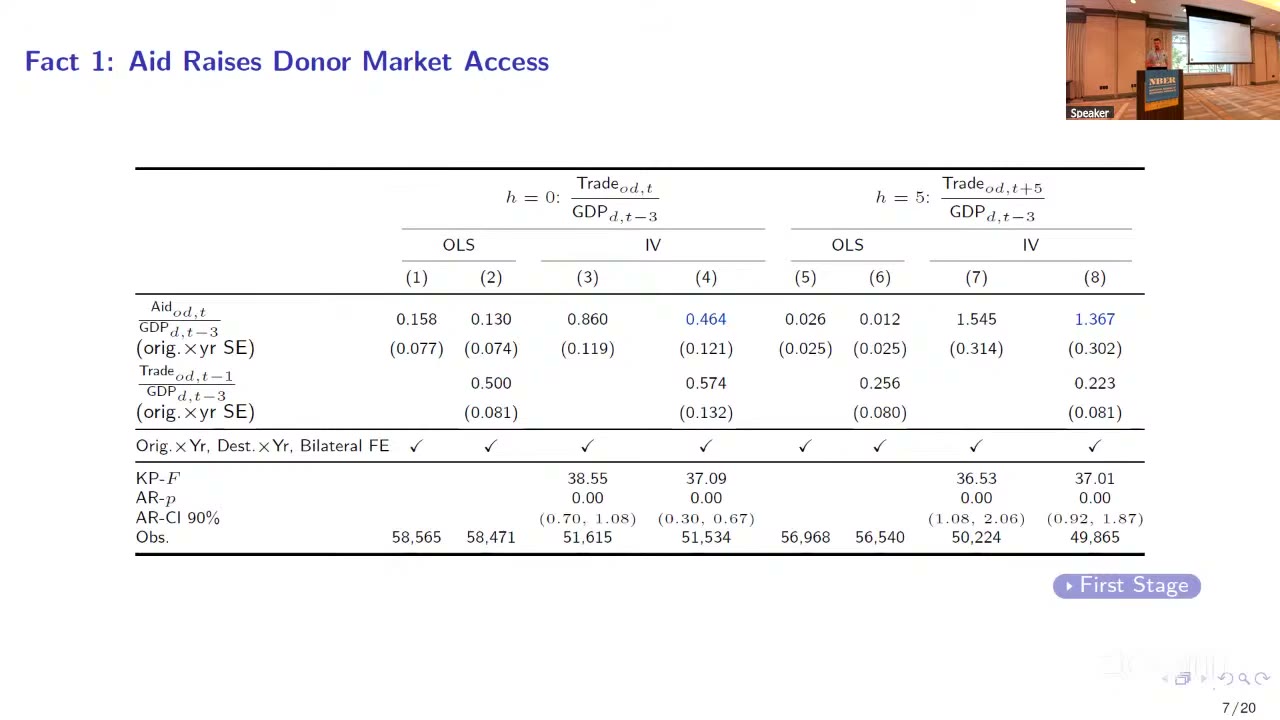
Aid is not randomly assigned, and the direction of bias is ambiguous — donors may give to partners about to matter more, or to partners about to drift away — so the authors build a shift-share instrument in the Rajan–Subramanian (2008) tradition: predicted bilateral shares from a gravity equation for aid (distance, colonial history, income, ideology), times the donor’s total aid budget that year, in a leave-one-out version, with origin-year, destination-year and pair fixed effects. The IV estimates are larger than ols, which they read as measurement error in the Soviet and Chinese numbers attenuating the naive regression. The headline: a dollar of bilateral aid raises the donor’s exports to the recipient by 46 cents on impact, rising to $1.37 five years out. Two companion results round out the picture. Aid also pulls the recipient’s un voting closer to the donor for up to five years, consistent with the morning’s paper; and there is suggestive evidence that aid from one bloc reduces the other bloc’s market access in the recipient, beyond the ordinary multilateral-resistance effect. Aid buys you friends, as Fernández-Villaverde put it, but not best friends — and it costs your rival a customer.
Anyway, the model
Exports are not welfare. To get from one to the other you need a multi-country trade model calibrated to Cold War production and trade, into which aid enters twice: as a transfer of resources, and as a reduction in the donor’s bilateral export cost to the recipient, sized to match the regression estimates. Then you run the experiment everyone has in mind: cut the U.S. and Soviet aid budgets by 86 percent, the usaid proportion, and see what happens. In the 1970s, the middle decade, the trade-weighted trade cost facing American exporters in recipient countries rises about 12 percent, and American welfare rises by 0.15 percent — the sum of a 0.21 percent gain from keeping the money at home and a 0.06 percent loss from worse market access. Aid, in other words, defrays 27 percent of its own cost through the market it opens. The Soviet numbers are almost identical: a 0.29 percent direct gain, a 0.09 percent market-access loss, just under a third recovered. Part of the reason the number is not larger is mechanical and a little deflating: recipient countries are small, so even a large proportional increase in exports to them is not much gdp for a superpower.
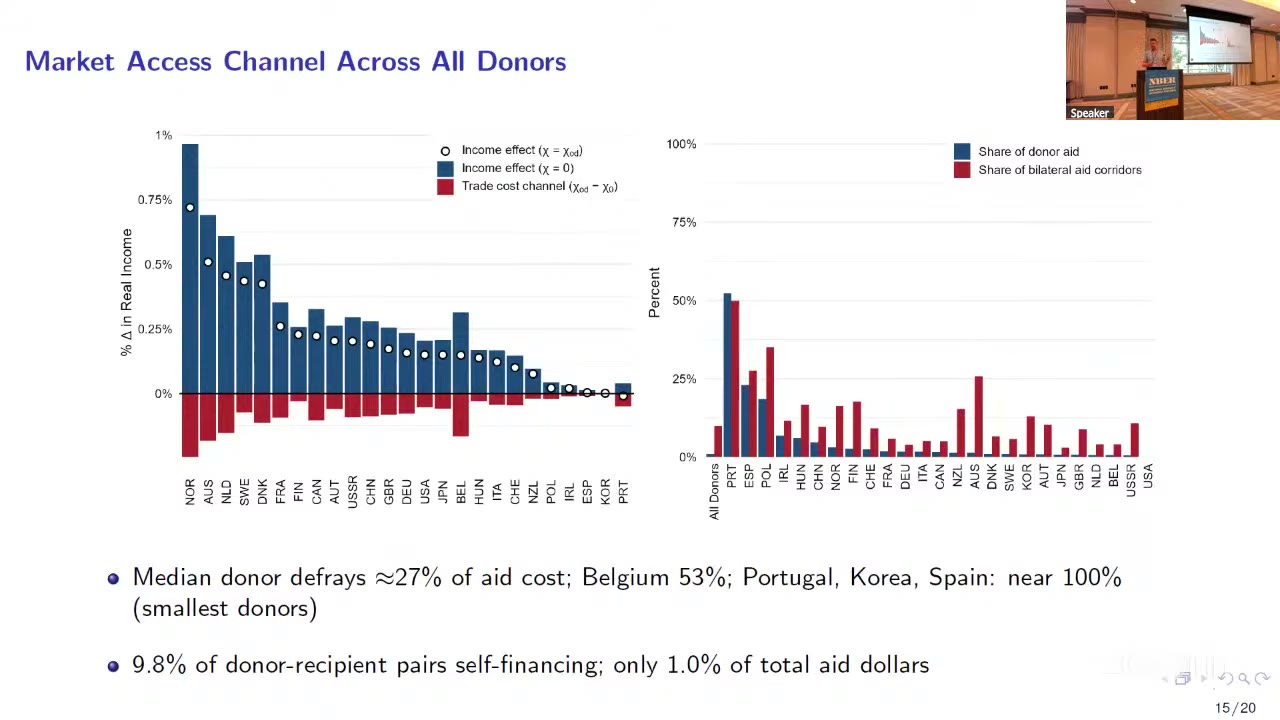
The authors then go looking for anywhere the story is fully true. Across all 26 donors the average market-access recovery is also about 27 percent. Only three countries’ aid comes close to paying for itself — Spain, Portugal and South Korea — and across the full cross-section of donor-recipient pairs, 9.8 percent of pairs, accounting for one percent of global aid dollars, return market access worth at least the aid. On the geopolitical side the picture is similar. The cost of aid and a recipient’s un alignment are essentially uncorrelated in the cross-section; the costliest recipients for both superpowers were countries of intermediate alignment, most prominently India and Turkey; and applying the estimated alignment effects to actual flows, U.S. and Soviet aid never once flipped the sign of a recipient’s net support. Nobody switched camps. The discussant’s analogy was a campaign strategist: you do not spend in Utah or San Francisco, you spend in Pennsylvania, and India — a democracy and a market economy that flew a mixed air force of Soviet and Western hardware — was Pennsylvania, taking money from both sides and, in his phrase, a friend with benefits who never crossed the line.
What a dollar of aid is
Fernández-Villaverde liked the paper a great deal (clear, well written, putting hard numbers into a literature he described as too often narrative, and the kind of empirical-plus-quantitative pairing he tells his gravity students to aim for) and spent his time on what the denominator means. Military hardware is priced at cost, and cost tells you little: the carrier the United States gave Spain in the 1960s, which Spain operated for 25 years, had roughly scrap value to the U.S. Navy when it was handed over, so was the aid worth its World War II construction cost or its 1963 resale value? Export versions of weapons are deliberately degraded — the Saudi F-15 is not the usaf F-15 — so hedonic pricing would be needed. Much aid is below-market credit rather than grants. And what is a price in a socialist economy? The Soviet Union kept Cuba happy by buying its sugar above the world price and selling it oil below; that was a real transfer that may or may not appear anywhere. Then the indirect effects: Egypt’s T-54s and T-55s were Soviet-bloc aid built in Czechoslovakia and Poland, so the exports showed up on someone else’s ledger, and American aid to a country may translate into purchases from Germany or Britain. And aid is a best response, not a return — his favorite example being North Vietnam telling Moscow that Beijing was more revolutionary and Beijing that Moscow was, and collecting from both.
His mechanism comments are, I think, the most useful thing a future version could absorb. Why would a dollar of aid keep paying out for five years? Lock-in. Aid arrives as equipment and technical assistance, and equipment needs spare parts, upgrades and maintenance that only the original supplier provides — which is why, after Sadat expelled Soviet advisers in 1972, Egypt’s tanks became a problem it has spent billions of dollars and more than fifty years trying to solve with American retrofits. Calibers are a qwerty problem (the 7.62 Nato round is not the 7.62 Soviet round, and Egypt still uses the latter); so are rail gauges, 50 versus 60 hertz, and nuclear reactors, which Rosatom sells cheap because the money is in the fuel — the Hewlett-Packard printer model of statecraft. And tastes: American grain shipments made bread popular in Japan and Korea, which still buy American wheat, and the American cheddar served to Spanish schoolchildren in the 1950s left the discussant’s father unable to eat cheddar to this day. The static model, he noted, sits uneasily on dynamic estimates, and Spain, Portugal and South Korea were not just small recipients but miracle economies, which suggests aid might be a bet on takeoff — picking winners — rather than a purchase of market share.
The room’s question: what is the 73 percent?
Chenzi Xu and a questioner the chair called John (John Sturm Becko, presumably) both asked what it means to model aid’s effect as an iceberg trade cost, which is a technology, when what is happening looks more like a preference shift or a policy change, which have very different welfare implications. Levchenko’s answer was that for the donor’s welfare the distinction is second-order — what matters is whether the demand curve for its goods shifts out — while conceding it matters a lot for the recipient’s welfare, which the paper does not emphasize. Lena (a political scientist, defending her discipline’s theory-and-data aid papers) raised the possibility that alliances drive both aid and trade, which is what the instrument and the pair fixed effects are for, and pointed out that the constituencies that benefit from market access and those that pay for aid are different, which the authors found fascinating and have not done. Tied aid — pl-480 requiring purchase of American grain — is, Levchenko said, not a problem for the question but part of the answer. A political scientist called on as Peter — Rosendorff, I take it — noted that Japanese and Chinese aid was often designed to build export-facilitating infrastructure for resource-scarce donors, and the authors’ estimates outside the hegemons are indeed larger, not smaller. Someone suggested that for a development economist the benchmark is zero, not one hundred, and 27 percent looks pretty good. And the chair’s question was the right one: having lived in the data, do the authors think the shortfall is nonlinearity (a local estimate that misses regime switches), many small payoffs that only add up in aggregate, or simply that aid is aid and is supposed to be npv-negative? Levchenko said they had taken a bite and 70 percent is left; you could put it back into preferences and explain everything, which is not the game; there may be more collectible market-access channels (multinationals, services); and it is also squarely on the table that governments are not optimizing, Eisenhower having had some views about who captures these budgets.
The last exchange was about whether, given the enormous heterogeneity across pairs, a donor could cut smartly — drop the aid that buys nothing and keep the one percent that pays for itself. Yes, in principle. Was there evidence the recent cuts were done that way? The authors had not checked, but could.