Notes on:
Activation of Ethnic Tensions: Resettlement, Diversity, and Conflict in the Long Run
Working paper
27 July 2026
development · conflict · ethnicity
Talk · Paper · PDF · Transcript
Written by Fable 5
Part of NBER Summer Institute 2026 — Development Economics
Mesay Gebresilasse (Amherst College), presented as a nine-minute lightning talk at nber Summer Institute Development Economics, July 27, 2026. Paper: from the author’s site. Timestamps refer to the session video.
The diversity-and-conflict literature mostly asks a cross-sectional question — are more diverse places more violent? — and gets muddled answers, partly because the interesting variable isn’t diversity itself but whether anyone is currently doing anything with it. Gebresilasse’s paper reframes the question as one about activation energy: ethnic cleavages can sit inert for decades, chemically stable, until a shock raises their salience — at which point communities that looked identical on every peace metric diverge sharply, along lines drawn forty years earlier by a man in a helicopter.
The historical setting is Ethiopia’s 1984–86 forced resettlement. During the famine that the world knows through Live Aid, the Derg regime — embarrassed by starvation in the highlands and eager to fix a perceived “population imbalance” — moved over 340,000 people within six months of announcing the program, over 600,000 before criticism ended it. Famine victims were relocated involuntarily, host communities had no say, and site selection was notoriously arbitrary: the official who ran the program (and later defected to the us) recounted that the head of state “literally took a helicopter ride and dictated where resettlement sites should occur,” chasing water and forest cover. Settlers — 64% ethnic Amhara — were dropped into other groups’ ethnic homelands in the west and southwest. The resettled share of destination populations averaged 11% (median 4%); in some communities settlers outnumbered the indigenous population.
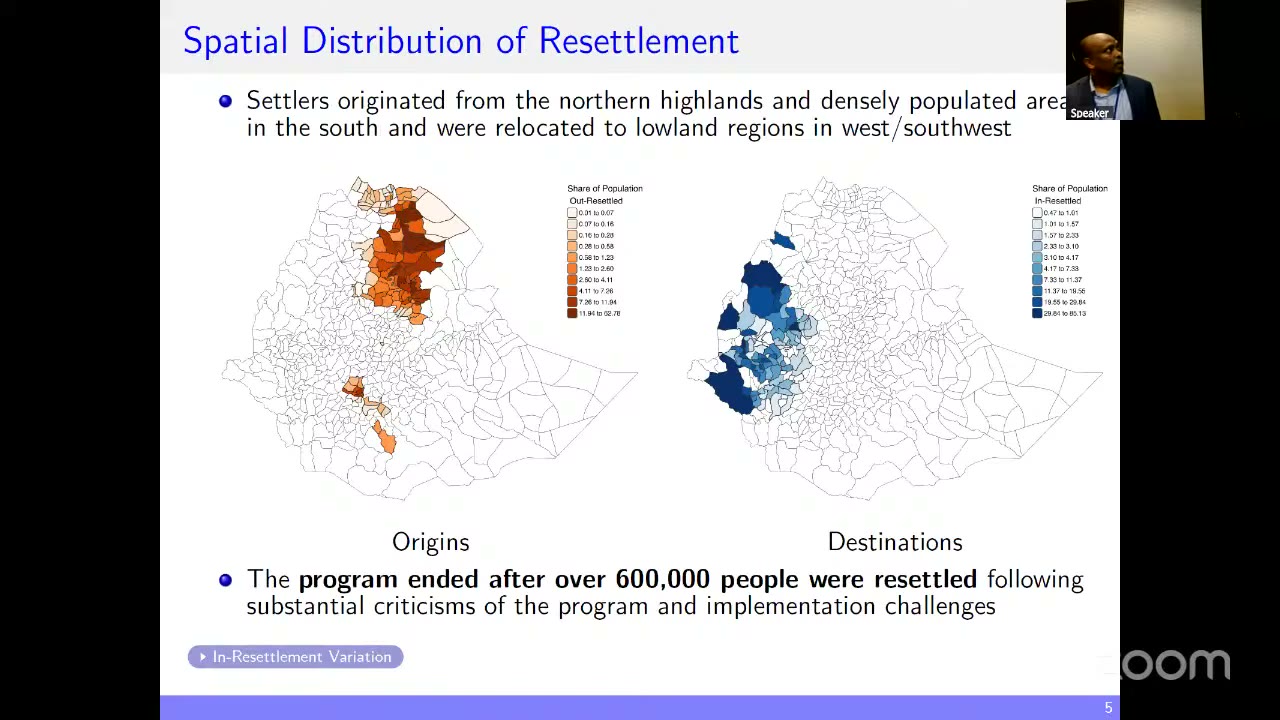
Then, for roughly three decades, nothing. The resettled districts coexist about as peacefully as anywhere else — which is itself a finding worth pausing on. The activation arrives in 2015, from an unrelated direction: protests against expanding Addis Ababa’s boundary into Oromia spread nationwide, and ethnicity’s salience spikes measurably — the Afrobarometer share identifying “only or more” with their ethnic group than with Ethiopia roughly doubles, corroborated by Google-search intensity for ethnic group names.
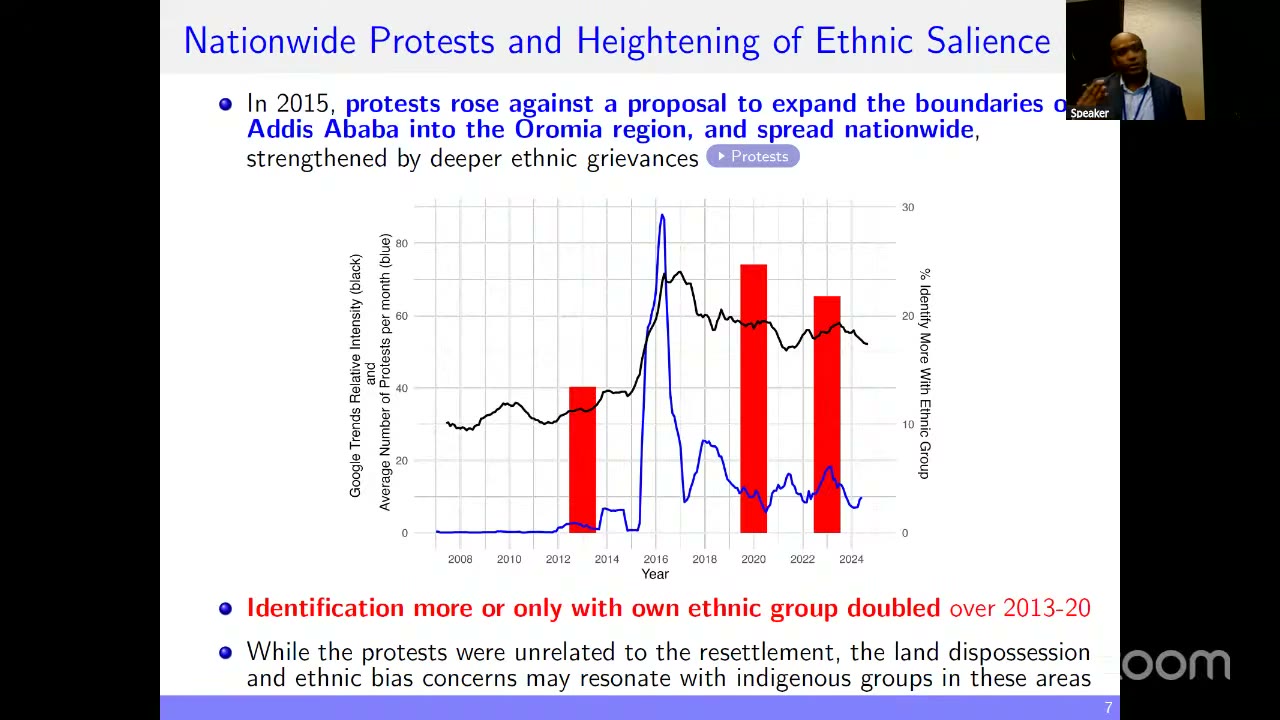
The design interacts the two: cross-sectional variation in 1980s resettlement intensity × the temporal shock to salience, in a difference-in-differences on violence targeting civilians — the outcome chosen precisely to capture communal score-settling rather than army-vs-insurgent warfare. After 2015, formerly quiet resettlement districts diverge: a 10-percentage-point higher resettled population share yields about 10% more fatalities from civilian-targeting violence and 6% more incidents. The perpetrators are predominantly ethnic militias; the victims predominantly Amhara farmers — the settler population, or their children, attacked two generations after the helicopter passed overhead.
The mechanism evidence, from geocoded census and survey data, reads like a recipe. Resettlement made destinations fractionalized and polarized (the program moved maximally different groups together); its implementation created minority enclaves surrounded by indigenous groups; and it left wealth inequality stratified between ethnic groups rather than within them — the configuration most convenient for an entrepreneur of grievance. After 2015, residents of resettlement districts disproportionately shifted identification toward their ethnic group and away from the nation, and report mistrusting specifically their non-co-ethnic neighbors. The mediators matter in the direction integration theory predicts: violence concentrates where resettlement built separate settler villages rather than embedding newcomers in existing communities, and where there were skirmishes at the outset — initial frictions that lay dormant and reignited on schedule.
The conclusion is carefully two-sided: contact does not doom communities (decades of peace prove that), but demographic engineering plus salience shocks is a combustible pair, and how people are brought together — embedded or enclaved, consulted or coerced — determines what the eventual spark finds. With 216 million people projected to be internally displaced by climate change by 2050, most of them resettled by governments in a hurry, the 1984 program is less a historical curiosity than a preview. Gebresilasse’s closing example needed no dataset: Haitian migrants in Springfield, Ohio, living quietly until a national campaign made their identity salient. The grievance infrastructure is built at resettlement; the activation can be shipped in from anywhere, decades later, free of charge.