Notes on:
Foreign Political Risk and Technological Change
NBER Working Paper 33964
2025
geoeconomics · innovation · political risk · de-risking
Paper · PDF · Transcript
Made with AI: Fable 5.1 (reading and writing)
Joel Flynn, Antoine Levy, Jacob Moscona and Mai Wo. Presented by Moscona in Paper Session I (“Geopolitical Spillovers”) of the 4th Kiel-cepr Conference on Geoeconomics, Sciences Po Paris, 30 October 2025, with Ralph Ossa discussing by video link. The paper was also on the nber Summer Institute’s International Economics and Geopolitics programme on 10 July 2025 (discussant Tarek Hassan), but no recording of that session was found. The draft read here is the 3 July 2025 version (nber Working Paper 33964); a 6 November 2025 draft exists and was not consulted.
Decoupling without a tariff
The fragmentation literature is mostly about governments: tariffs, sanctions, export controls, and the trade that reroutes around them. This paper is about the thing firms do before any of that happens. In 2014 Elon Musk told a Senate committee that the Atlas V rocket could not be said to provide assured access to space while its main engine depended on President Putin’s permission, and American rocketry got a great deal more investment. After the 2024 U.S. election, the eu started pouring money into defense R&D to reduce its reliance on American weapons. Nobody had cut anyone off yet. The risk was enough. Flynn, Levy, Moscona and Wo call this insurance innovation: when the supply of an input from abroad becomes politically uncertain, domestic firms invent their way out of needing it, and the foreign supplier loses the market whether or not the feared disruption ever occurs. Ossa’s one-line summary in the discussion is the right one: this is a private-sector channel of global fragmentation, anticipatory, endogenous, and requiring no policy at all.
The model and its paradox
Home producers can use a domestic or an imported input, differ in productivity, and can pay to innovate. With some probability, foreign political trouble raises the cost of the import, by some amount. Raise either the probability or the severity and domestic innovation rises, productivity rises, and import reliance falls, so Foreign loses exports to Home even in the state where nothing bad happens, with the loss scaling with the strength of Home’s technological response. If trade restrictions are more likely between adversaries, the response should be bigger for risk coming from non-allies. Underneath the clean aggregate prediction the firm-level picture is messy in an instructive way: intermediate-productivity firms innovate as insurance; the most productive firms, who never import, do nothing in the baseline model and respond only to price effects in an extension; and (the paradox the paper flags) the firms most exposed to imports never innovate at all, because they are the ones for whom inventing a substitute is hopeless. That is why the empirics live at the sector level, where the predictions are crisp.
Anyway, the patents
Innovation is the universe of U.S. patents from PatentsView, linked to six-digit naics sectors, and separately all R&D by Compustat firms. Political risk is the icrg index, twelve components averaged into one number per country-year, which has the virtue of being the longest-running such thing (147 countries, since 1984) and the vice of being a composite. Exposure is a shift-share with a twist. Each foreign country’s risk is weighted not by the share of a sector’s U.S. imports that came from that country but by that share squared, with shares fixed at their pre-2000 average, and sector and year effects absorb everything that is not the interaction. This is equation 3.2 in the paper:
where is a sector, a foreign country, a year and the pre-2000 baseline. Squaring the shares turns the measure into a risk-weighted Herfindahl of supply concentration, the same object the European Commission’s supply-risk reports use, so that it rises when a sector’s imports are concentrated in a risky country and not merely when some of them come from one. That also sets up the obvious placebo: the plain, un-risk-weighted Herfindahl, entered alongside, does nothing (Table 1, Panel A). Concentration by itself does not make anyone invent; concentration in places that might cut you off does. (The paper reports that plain-share versions of the measure give similar results, in the appendix.)
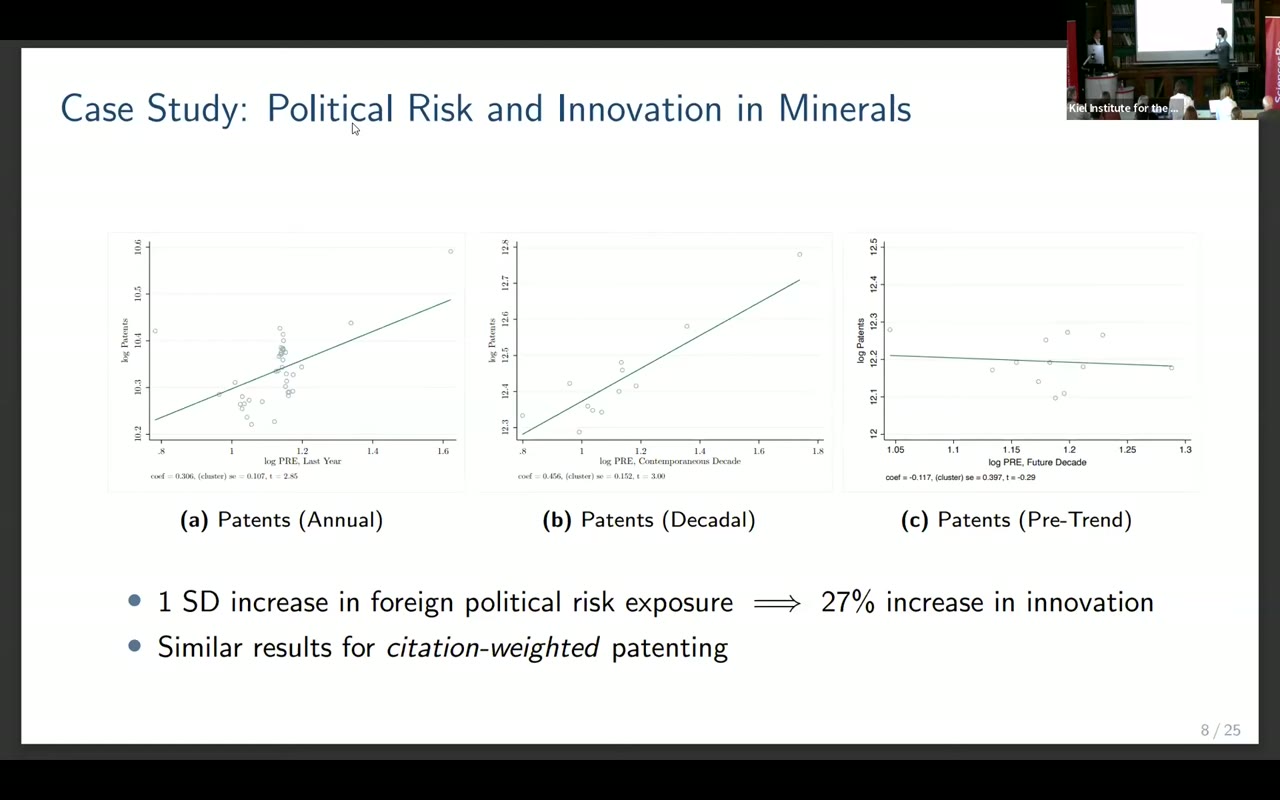
The first cut is minerals, where exposure is geological: weight each country’s risk by its squared share of the usgs’s known deposits of each mineral, counted rather than sized, because the deposit data carry no reserve figures. A one-standard-deviation rise in a mineral’s risk exposure is followed by a 27 percent rise in patents mentioning it, with no pre-trend and a response about half again larger at the decade horizon, consistent with innovation taking time and responding to risk that looks persistent. Across all U.S. sectors the coefficient is strikingly similar, 0.336 against 0.306 for minerals, but the exposure measure is spread differently, so the standard-deviation effect is about 22 percent rather than 27. (Moscona rounded both to “about 30 percent” on stage; the numbers here are the paper’s.) It holds for highly cited patents, for “important” patents by textual novelty, and for high-value patents by stock-market reaction, and it shows up again in Compustat R&D. It comes from new firms entering and, depending on the specification, incumbents patenting more. And it is asymmetric: a rise in risk raises patenting, but a subsequent fall in risk does not lower it, which will matter later.
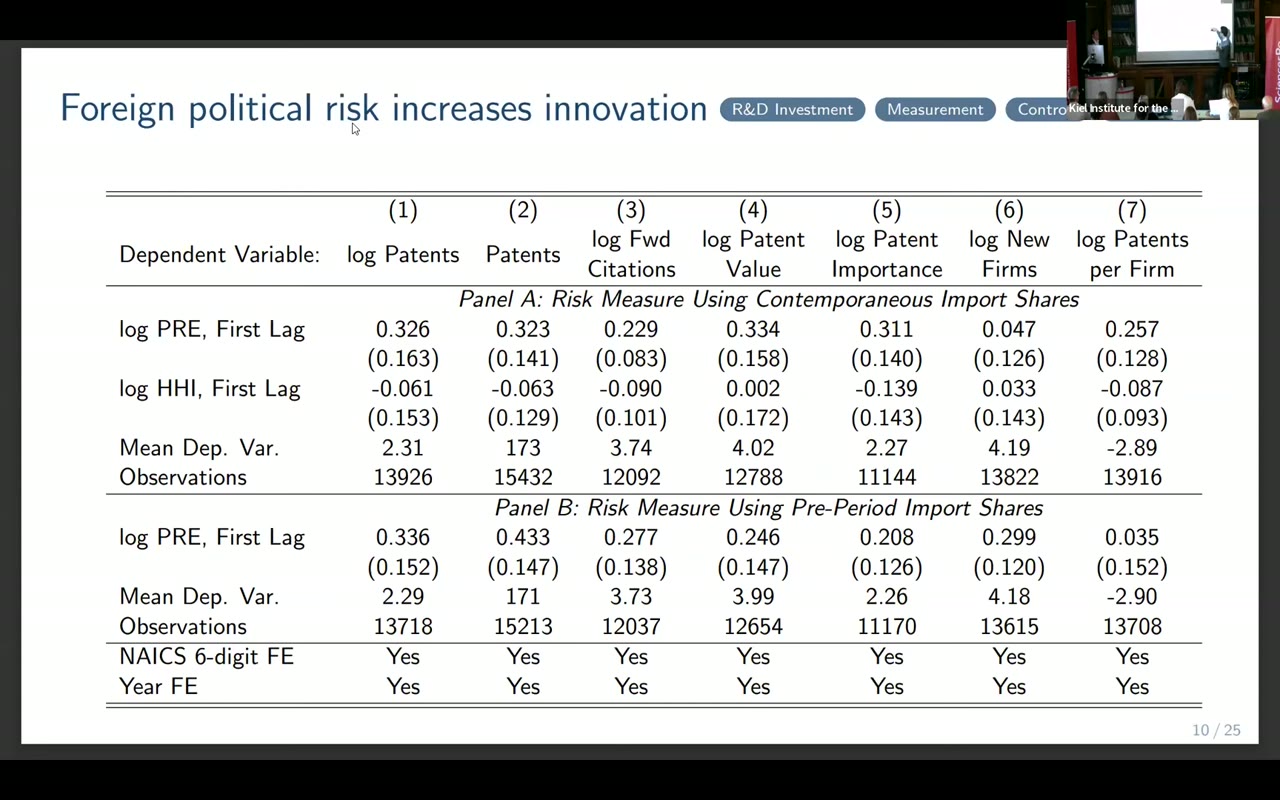
Then the mechanism checks, which are what make this more than a correlation. Heterogeneity by firm runs the way the model says: the middle of the innovation distribution drives it, with some response at the top. By assignee, patents held by firms account for essentially all of the response, about 98 percent, because firms hold nearly all patents; patents assigned to universities also rise, and patents assigned to the government do not. Government-interest patents, the ones funded by federal money whoever owns them, respond too, but by less than the full sample. And sectors the government has designated “critical” are not where the effect lives to the exclusion of everything else: the point estimate is slightly larger for critical sectors, non-critical sectors respond strongly too, and the difference is not statistically significant. (In the Q&A Moscona remembered the lean the other way, “if anything a little bit stronger for the non-critical”; the paper’s figure has critical slightly ahead, and either way the gap is noise.) A questioner in Paris asked whether DoD money to General Dynamics then or Palantir now could be masquerading as private response, and Moscona’s answer was that every cut they can make says the private response is there on its own. Using Compustat to separate each firm’s technology space from its goods space, only shocks to the technology space move innovation, so this is about supply risk in what firms invent, not about expected competition in what they sell. And there is suggestive evidence of spillovers along the supply chain, larger from shocks to downstream sectors than upstream ones, which would mean the baseline understates the response.
Enemies, and the exporter’s problem
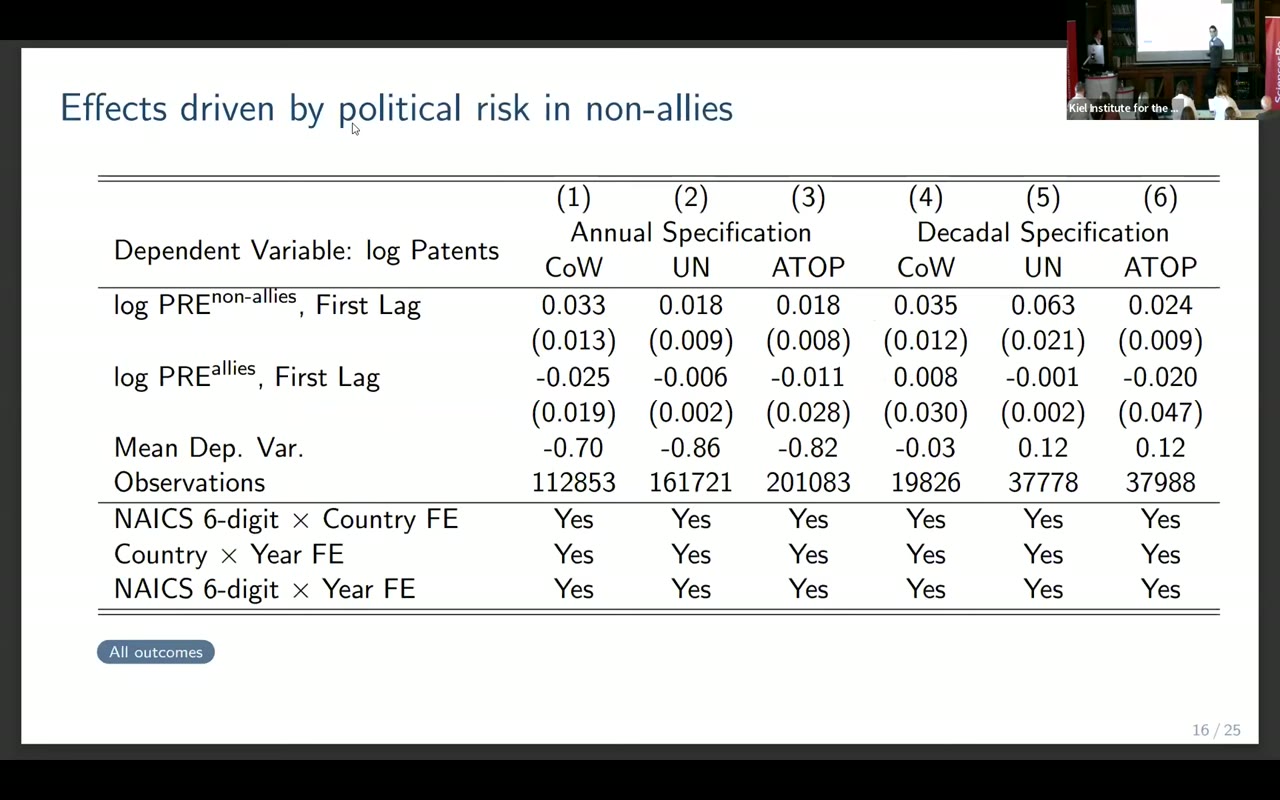
Go global, country-sector pairs with country-sector, country-year and sector-year fixed effects absorbing any sector trend and any country trend, and the result survives, with a point estimate a good deal smaller than the U.S. one but the same shape: no pre-trend, and about three times larger at the decade horizon. Now split exposure by whether the risky country is an ally or a non-ally. The Correlates of War and atop definitions are dummies, allies if the pair had any alliance in force that year (a defense pact, a non-aggression treaty, an entente), and only the un-voting version is a median split on ideal-point similarity; Moscona said in the Q&A that continuous versions look similar, and that the definitions are held fixed over time on purpose, so that alliances cannot themselves respond to risk and innovation. It is essentially all non-allies. Risk in countries you have no political relationship with is what makes you invent; the ally coefficients are small and mostly indistinguishable from zero. The wedge, moreover, comes from the kinds of risk a government controls, instability of government institutions and, less so, expropriation, and not from wars or ethnic and religious tension, which disrupt supply for friend and foe alike. That is the paper’s case that firms are pricing anticipated policy rather than disorder, and it matches the auxiliary finding that new trade restrictions are more likely to emerge between non-allies after political risk rises in either one, which is what makes the threat credible there. The final piece turns the lens on the exporter: a country-sector whose export markets are high-innovation markets loses more exports when its own political risk rises, because those markets are the ones that invent around it, and since the innovation does not reverse when the risk subsides, neither does the export loss. Technological change, in other words, amplifies the export cost of being politically risky, and does so before any sanction is written.
Ossa’s discussion, which was mostly about policy
Ossa (joining by video, with apologies) called the paper novel, creative and well executed, and then asked the three questions a discussant should. How big is this channel relative to the ordinary first-moment trade shocks the fragmentation literature studies? Under what conditions do firms choose innovation over the alternatives, diversifying suppliers or stockpiling, and might there be some complementarity between them? And is there a market failure here at all, is insurance innovation socially optimal, since that is what determines whether government has any role? His reflections went further. The paper is, he argued, an argument for a rules-based trading system, because it shows that the risk of trade-policy shocks, not just their realization, reshapes economies, and predictability is what such a system provides. Policymakers rush to “resilience” as soon as there is a problem without asking what the market failure is; firms already bear the cost of broken supply chains and already have reason to insure, and one particularly compelling argument he had heard for a failure is that prices cannot politically rise enough in a disruption (the respirator in a pandemic) for private insurance to be worthwhile. And he worried that the entire debate, and now the firms in this paper, point toward strategic independence, which means investing in your weaknesses, whereas the founding logic of European integration was strategic interdependence, making France and Germany dependent on each other precisely because they were foes.
Moscona’s reply was that innovation and reallocation could be substitutes, a question that is open in climate adaptation too (breed heat-resistant seeds or move the farm), with no research on how the two interact; that almost no empirical work exists on whether the market gets the direction of innovation right, with one exception he plugged, which from the recording is evidently Acemoglu’s (2023) Ely lecture, “Does the Market Get the Direction of Technology Right?” (the name is garbled on the tape; Moscona identifies it only as the aea lecture by the adviser to two of the four co-authors); and, the part most relevant to the conference, that small government moves cascade, because part of why firms respond to foreign risk is that they anticipate restrictive trade policy, which raises their incentive to innovate domestically, which deepens the decoupling the policy only hinted at. The paper shows that direction, he said, and one could imagine the same thing running the other way, toward openness.
So the paper’s finding is that a great deal of fragmentation is happening in R&D departments rather than trade ministries, it is aimed at adversaries, and it is mostly private. Whether that is reassuring depends on whether firms insure against the right risks, which is the market-failure question Ossa put to the authors and which Moscona, for his part, said there is almost no evidence on.