Notes on:
Economic and Psychological Returns to Social Relationships: Alleviating Constraints to Network Formation in Malawi
Working paper
27 July 2026
development · networks · mental health
Talk · Paper · PDF · Transcript
Written by Fable 5
Part of NBER Summer Institute 2026 — Development Economics
Gabriella Fleischman (University of Pittsburgh; the work is her Harvard job market paper), presented at nber Summer Institute Development Economics, July 27, 2026. Paper: from the author’s website. Timestamps refer to the session video.
Development economics has an enormous literature saying that social networks are valuable — they smooth consumption, transmit job information, share risk — and almost no causal evidence about what a new relationship is worth, because networks form endogenously and no irb will let you randomize friendship. Fleischman found the next best thing: a population whose networks have been exogenously demolished. Under patrilocality, women in rural Malawi move to their husband’s village at marriage — the median woman in the sample arrived four years ago, at around age 20, half married as teenagers — leaving their own ties behind and inheriting a network dominated by the husband’s relatives and weak ties (only 36% have any “strong tie,” a trusted best friend). These women are measurably worse off than women in their home villages, and their networks are homophilic by income: they’re 12% more likely to link with someone who has the same roof material.
The intervention is almost comically minimal, which is the point. Meal-sharing is common and desired — women share about three meals a week and say they’d like more, though rarely with their own friends. So the experiment simply lubricates an invitation: 1,600 low-ses migrant women are shown a list (with photos) of six neighboring women — all of whom have already agreed, at recruitment, that they’d welcome a meal invitation (99% say yes) — and an enumerator offers to deliver invitations on the inviter’s behalf. That’s it: it removes the information asymmetry (who would say yes?) and the effort cost, which women describe overwhelmingly as fear of rejection. The guest lists are randomized — all high-ses neighbors (the top 20% by an ses index), all low-ses, or a mix (allowing choice) — and a cross-randomized voucher at the local butcher makes serving a meal with meat as cheap as one without, testing whether the price of hosting binds. Everything downstream is left alone: after the invitation goes out, nobody follows up experimentally.
Take-up answers the “why don’t these links form on their own?” question by itself. 81% of women send an invitation — identical whether the list is high- or low-ses, and unmoved by the voucher — almost all to people outside their existing network, neighbors within 800 meters whom they already know by sight and have usually spoken to. 63% share a meal within the year. So the binding constraint is not norms, not price on the extensive margin, not willingness of either party: it is that nobody was willing to go first. (The voucher does matter on composition: with choice, cheap meat tilts invitations toward high-ses guests — prices constrain cross-class linking specifically, which is the theoretically loaded margin.) A year later, networks haven’t grown — degree is flat — but they’ve churned: new people in, old people out, with the composition drifting away from the husband’s relatives toward the woman’s own friends (a precise 0.1 sd index effect), her own advisors, her own confidantes. The intervention didn’t add a contact; it renovated the network.
Then the returns, which are large enough to justify the paper’s title having two halves.
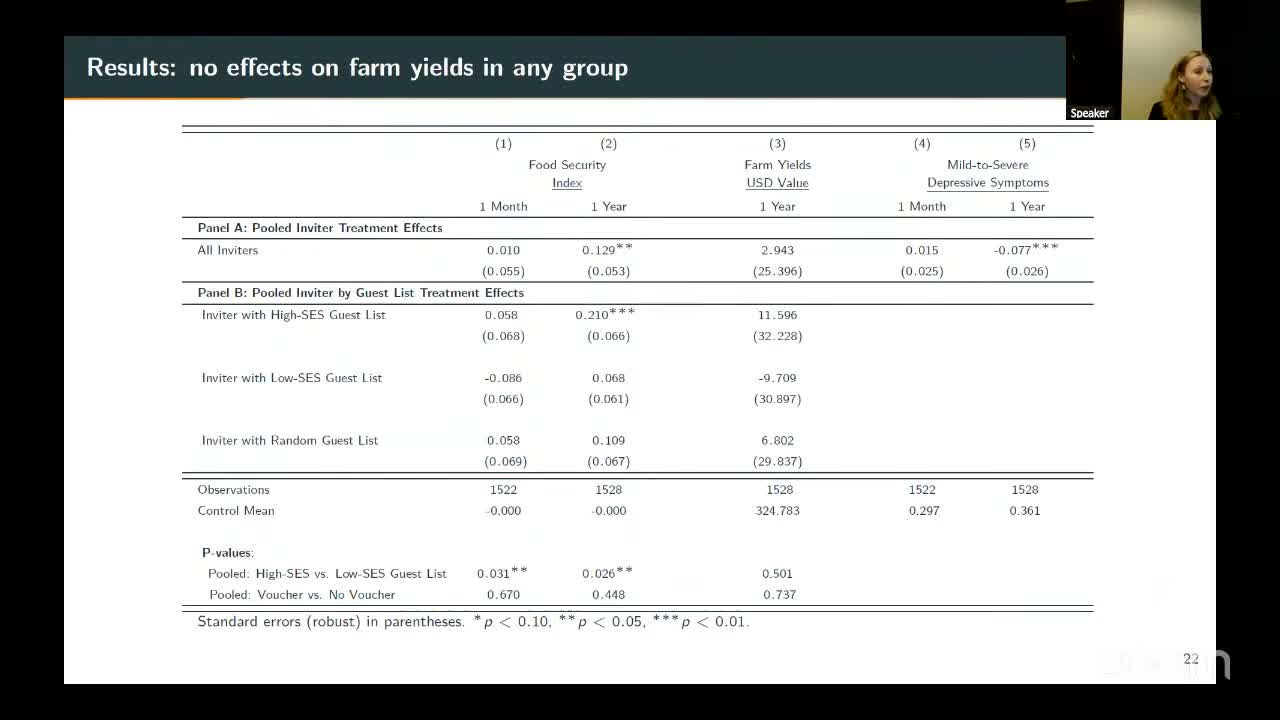
A year out — a year of genuine food shortage, in which over half the control group ate one meal a day for the three-month lean season, in a sample where half the women were pregnant or breastfeeding — food security rises 0.13 standard deviations pooled, and mild-to-severe depressive symptoms fall by about 8 percentage points against a 36% control prevalence. But the headline finding is that the two benefits come from different people. The economic gains are driven almost entirely by high-ses guest lists (+0.21 sd food security, three times the low-ses arm); the mental-health gains are driven by low-ses guest lists, with effects more than twice the high-ses arm’s. A single meal invitation cannot buy you both.
The mechanisms are traced with unusual care. The economic channel is not meal-sharing itself (no long-run change), not borrowing (nothing, on any margin), not piecework referrals (nothing). It’s information: within one month, women with high-ses guest lists are 50% more likely to earn self-employment income — tiny businesses, typically selling prepared food — and the effect persists through the lean season. Women say they picked these guests because they’re knowledgeable, report discussing business, are observed directly copying the guest’s own self-employment activity, and, asked how they started, most commonly answer “someone told me it is profitable.” The psychological channel is the relationship itself, not resources: the clincher is that the richest of the low-ses women get equally large depression reductions when handed high-ses guests — what matters is social proximity, someone close enough in class to actually confide in. (Low-ses-guest women report less loneliness, share more secrets with their own friends, and — the one conversational topic that differentiates the arms besides business — discuss romantic relationships.)
The Q&A poked at experimenter artifacts — isn’t a high-ses woman just complying because “Gabriella told me to”? Fleischman’s defenses: guests opted in before knowing anything; meal-sharing and reciprocation rates don’t differ by guest ses; within-experiment rejections look just like naturally-occurring ones; and every downstream benefit requires a chain of voluntary choices nobody scripted. Asked whether anyone objects to these friendships: no norms prohibit them (cross-gender linking would be inappropriate, hence the all-women design), and divorce rates, if anything, fell.
The framing that stays with you is the market-failure one. These are neighbors — people who live 800 meters apart, know each other’s faces, and are each leaving what turns out to be a 0.2-sd food-security improvement or a major depression-risk reduction on the table because initiating a friendship is embarrassing and everyone underestimates everyone else’s willingness to say yes. It’s a coordination failure with the cost structure of a poverty trap and the solution cost of a photocopied list of names. The talk’s closing point is aimed at the group-intervention literature: programs that merely bring people into a room often disappoint, and this paper suggests why — the friction isn’t meeting, it’s the specific, vulnerable act of asking. What the enumerator really delivered, at essentially zero marginal cost, was plausible deniability.