Notes on:
Tariffs, Investment, and the Missing Trade Collapse
NBER Working Paper 35630
23 October 2026
tariffs · trade · investment · US economy
Talk · Paper · doi · Slides · PDF · Transcript
Made with AI: Opus 5.5 (reading, diagram and writing), GPT 6.1-Sol (reading), Fable 5.1 (adjudication), Sonnet 5.5 (verification)
Part of International Finance and Macroeconomics Program Meeting, Fall 2026
Francesco Ferrante, Andrea Prestipino, Andrea Raffo and Michael Waugh, “Tariffs, Investment, and the Missing Trade Collapse,” presented by Waugh at the nber International Finance and Macroeconomics Program Meeting, 23 October 2026; discussant George Alessandria. Version used: nber Working Paper 35630, August 2026, alongside the deck as presented, whose series run a quarter past the paper’s. Values read off charts are approximate.
You raise the us effective tariff rate from about 3 percent to almost 12, the highest since Smoot-Hawley, and you ask a trade economist what happens to imports. This is as close as the field comes to a free question. Imports fall. Then the annual averages arrive, and real imports went up straight through it. Waugh’s origin story is a Wall Street Journal piece on why everyone got Trump’s tariffs wrong, which he thinks “our president circulated,” followed by meetings in which he was looked at: “Mike, like what do you think?”
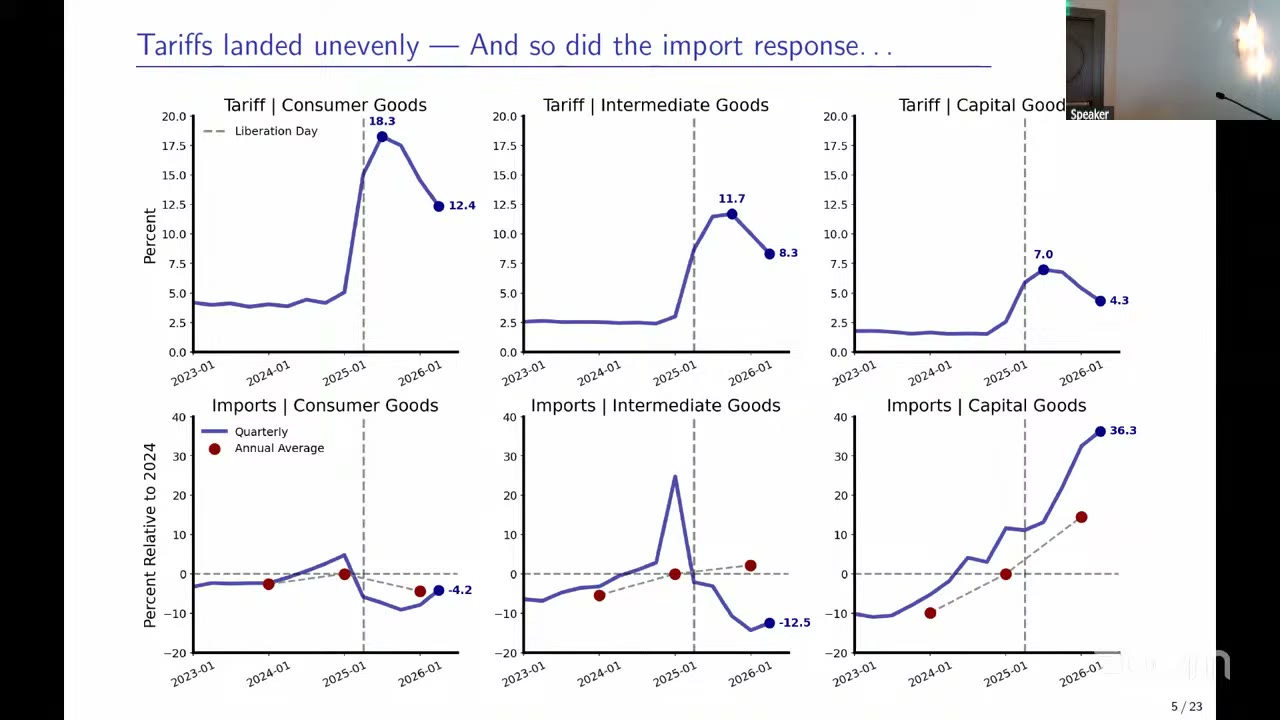
Anyway, the answer from Ferrante, Prestipino, Raffo and Waugh is that imports are not one thing. They are three things of about equal size, each of which got its own tariff and had its own year. Consumption goods took the biggest increase and fell, as in the textbook. Materials took a mid-sized increase that was announced ahead, so firms stocked up and imports spiked and then collapsed. Capital goods took the smallest increase and surged anyway, because a separate ai investment boom arrived at the same moment and, in Waugh’s words, “completely masks any negative effects of tariffs in the model.” Waugh knows how that sounds: “Sometimes I wake up at night, go like, dude, this is obvious.” The part he calls not obvious comes second. A tariff on capital goods is not a supply shock. It works like a negative investment-demand shock, so output and inflation fall together, and it runs through the same equation as the boom with the sign flipped. On this accounting 2025 put a big positive shock and a small negative shock through one margin, and only the small one was policy.
The raw material is the most useful slide of the talk. The paper puts the tariff increases at about 13 percentage points on consumption goods, 9 on intermediates and 6 on capital goods (the live frame reads closer to 14, 9 and 5; Waugh’s early line, that capital goods were “basically left untouched,” is stronger than either). Latest-quarter imports relative to 2024 are down 4.2 percent, down 12.5 percent and up 36.3 percent. One small correction to the tidy version: “only capital imports rose” holds for the latest quarter, because the 2025 annual average for intermediates still sits about 2 percent above 2024, and the authors’ choice to file pharmaceuticals under intermediates supplies, Waugh says, a big component of that spike.
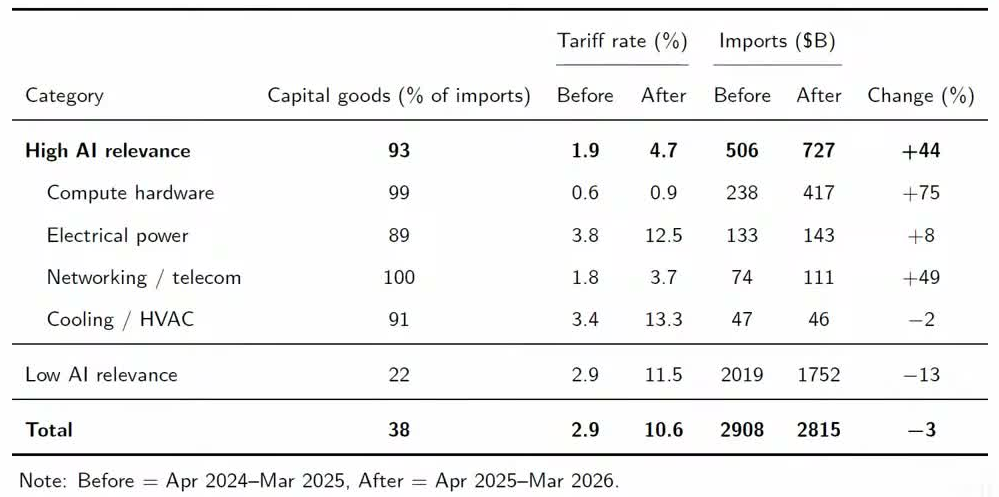
To attach ai to the capital-goods number, Waugh ran every HS10 code through an llm with, roughly, the prompt “do you think this would go into a data center?” It took about a day and about $500, which he reports the Fed has not yet paid back. The result classifies products, not buyers, so the honest verb is his “likely.” Compute hardware was nearly exempt, tariff 0.9 percent, and grew 75 percent. High-relevance goods as a group grew 44 percent, low-relevance goods fell 13. My favourite cell is the one Waugh also likes: cooling equipment took a tariff increase of about 10 points and imports barely moved. That cuts two ways, since within the high-relevance group the rows with the largest tariff increases, power and cooling, also grew least (my reading of the table, not theirs).
The model: one good, three doors
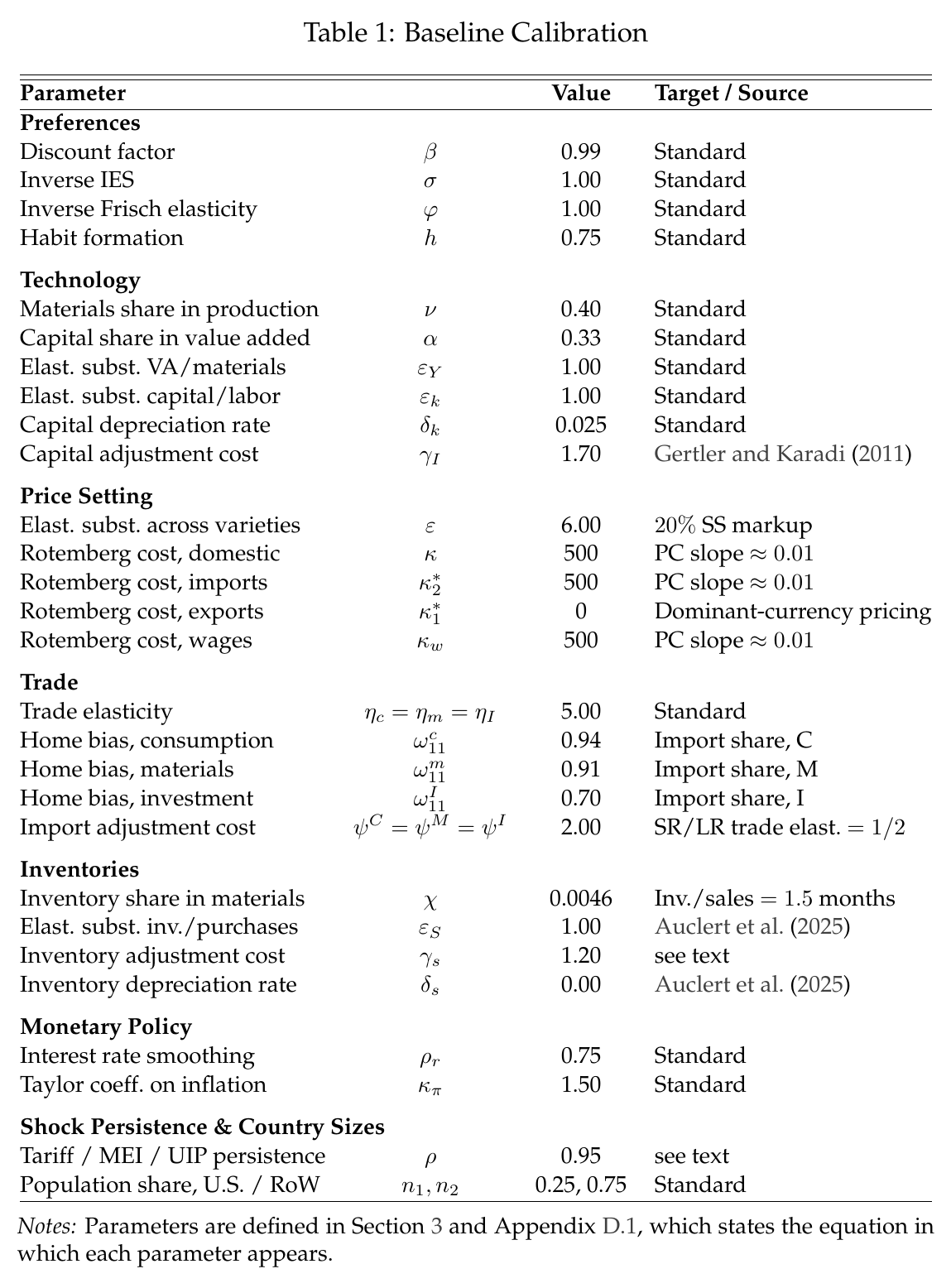
This is a two-country New Keynesian model with the usual furniture: sticky prices, sticky wages, habits, adjustment costs, dominant-currency pricing. (Waugh gave it one slide and says this is all “kind of new to me,” which is “why we got Francesco here.”) The one piece of novelty is at the border. There is one foreign good, and it pays a different tariff depending on what the importer says it is for, with reporting assumed truthful.
Door one is the textbook. Foreign exporters’ prices are sticky in dollars, so a consumption tariff lands on the buyer one for one. A 10 percent tariff times a 6 percent import share gives a 60 basis point rise in the price level, once, and it dies out of four-quarter inflation. Output barely notices: the gdp trough on the paper’s impulse responses is about 0.14 percent, the paper’s text rounds to “about 0.2,” and Waugh says Fajgelbaum and Khandelwal’s 11 basis points from a standard trade model is “almost exactly what this is showing.” Three numbers, one claim, which is that Armington (1969) channels alone do not get you doom.
Door two is the inventory block, taken from Auclert, Rognlie and Straub, in which “material services” are a ces of the flow of materials and the stock on the shelf. Because the stock is productive, firms value holding it, and because tariffs are announced, today’s goods are cheap relative to tomorrow’s (the paper’s equations 10 and 12). So they buy now. For one quarter the tariff raises imports, which is a strange thing for a tariff to do and accounts for the spike. Waugh on the device: “it’s kind of weird, but it works,” and “George might complain about this.”
Door three is the paper. Capital is built from an investment bundle, and the bundle’s price contains the tariff:
In equation 15, is the real price of installed capital, is the marginal efficiency of investment, is the investment-bundle price that the tariff raises, is the adjustment cost and is the discount factor, so a higher and a lower hit the same margin.
The rest is the sticky-price equilibrium, because the equation alone does not give you the sign. The tariff raises the cost of capital and you want a slightly smaller capital stock. Investment is the flow, so the flow drops a lot (“I want to lower my capital stock a bit. Investment is the flow. So I got to drop my flow a lot.”). Output is demand-determined, so hours fall, so marginal cost falls, so firms cut prices. A 10 percent tariff on investment goods takes gdp down more than 1 percent, investment about 11.5 percent, and inflation falls. Put a matched negative mei shock beside it and the two trace each other, except for consumption, because only the tariff has revenue to rebate. Investment’s import share is 30 percent against 6 for consumption and 9 for materials, which is why this door is so exposed. (The aggregate-imports result rests on a different fact, that capital goods are a third of imports. The two get merged easily.)
The assumption holding the whole thing up is in the white space of the diagram. The mei shock is a wedge chosen so that the model’s investment matches the data’s, and the paper calls it ai. Waugh chose it to move investment forcefully without the spillovers of a productivity shock. And it is unrelated to the tariffs by fiat: “we’re going to take a stand in the model that those are completely orthogonal things and they just happen to show up at the same time.” He names the risk himself, in the form of a nightmare in which Kevin Hassett goes on Fox and Friends and says tariffs caused the investment shock.
The fit, and what it does not fit
The authors feed in the actual end-use tariff paths as anticipated (in 2025Q1 in the paper; at 2024Q4 in the talk, where Waugh says the agents get the whole path), a string of unanticipated mei shocks chosen to hit aggregate investment, and a string of unanticipated uip shocks chosen to hit the real exchange rate. So the agents foresee the tariffs and are surprised by the ai boom every single quarter, and of those two the second is the more plausible. “Nothing else is fitted,” the paper says, and the untargeted aggregates do come out in the right shape: gdp ends at about 1.2 percent in the model against about 1.0 in the data, consumption falls by about 0.6 in both, and imports match the spike.
That success is a broad-shape success, which Waugh is more candid about than the paper’s introduction, where the match extends to imports “in aggregate and across categories.” The model misses the 2025Q1 gdp dip. Inflation peaks at about the right height but “too soon,” and the last point is about 0.26 against about 0.92 in the data. And capital-goods imports, the category carrying the story, reach about 6 in the model and about 22 in the data, while consumer imports trough at about −9 against about −14. A footnote concedes the capital undershoot. My reading is that the aggregate fit partly nets misses in opposite directions. These numbers are also on a constructed gdp that drops structures, residential and government, relative to a 2015–2019 trend. That choice is disclosed, and Waugh’s joke about trying to sell a house tells you which way it leans, but the resilience being explained is resilience of a chosen concept.
Take the boom out and the accounting gives you the doom after all. Imports fall by “nearly 10 percent” by the end of 2025, gdp falls about 0.7 percent (Waugh says “60 to 70 basis points,” the presented frame troughs around 0.63) and inflation rises about 0.7 points. Those are model contributions conditional on those shocks and that transmission, not identified ai effects. The tariffs drive the inflation, the boom drives gdp and investment, and the profession’s doom and gloom was, on this reading, correct about a counterfactual.
The tariff that barely moved
Split the tariff drag by door and the smallest tariff does most of the output damage while pushing inflation very slightly the wrong way for the stagflation story, about −0.05 points against about +0.7 from consumption tariffs.
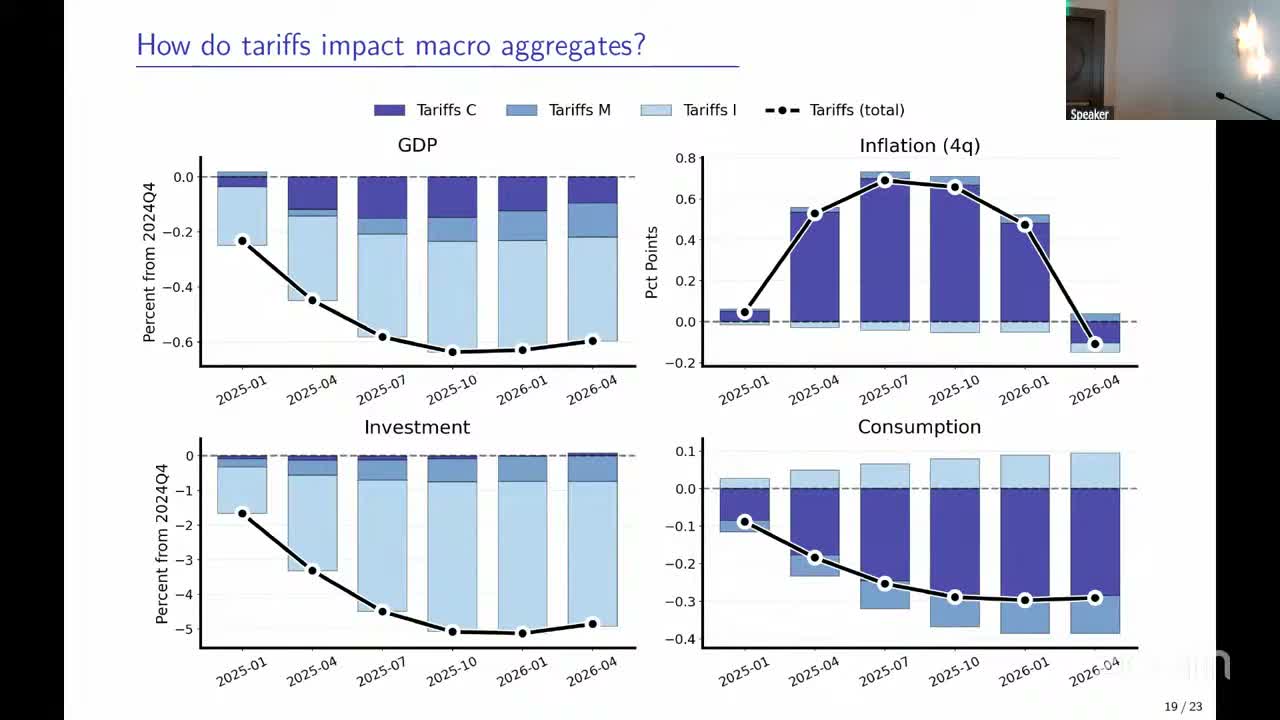
How much is “most” depends on who is talking, and here the record needs a small repair. The paper’s introduction says capital tariffs “account for three-fourths of the output costs from tariffs.” Waugh says “almost completely.” The bars say about 84 percent in the first quarter, then about 60 to 67 percent in every quarter after, on both the presented frame and the paper’s own Figure 12; the paper does not say how it gets three-fourths. Call it about two-thirds on the published decomposition and three-fourths in the text. It is still a striking number, and it is conditional on sticky prices and wages, demand-determined output, the Taylor (1993) rule and that 30 percent share.
The counterfactual makes the point sharper. Spread the same average tariff evenly across end uses, with no boom in the picture, and the investment decline about doubles, to nearly 10 percent, gdp goes from about −0.7 to almost −1, and peak inflation goes from just under 0.7 to about 0.4. So the 2025 mix bought about 0.3 of a point of gdp for about 0.3 of a point of peak inflation. Whatever was intended, a tariff schedule that loads up on consumers and spares machines turns out to be a fairly specific choice along an output-inflation frontier, one a central bank would like to know about. The historical version runs the same 10 percent tariff through recalibrated economies: as imports grew and tilted toward capital goods, the paper reports that the output cost “more than tripled” since World War II (the plotted peak goes from about −0.17 in 1940 to about −1.28 in 2025, so that is an understatement).
One soft spot, which the authors raise themselves: the one-sector model taxes all capital goods although compute hardware was almost exempt, and shocks all investment although the boom was in one corner of it. Their two-sector extension puts the mei shock on ai and the investment tariff on the rest, and Waugh says it may become the baseline. It repairs the composition of trade, and the paper calls the aggregates close to the baseline, with gdp up “roughly half a percent” over the year. Whether the two-thirds survives is a fair next question.
The discussion: “no and yes”
Alessandria likes the accounting (“clean, intuitive”), notes that the paper has both lessons of the Great Trade Collapse in it, inventories and the composition of demand, and is less in love with the rest: “Then things go off the rails. There’s sticky prices, sticky wages, dominant currency pricing.” His question is whether recent trade dynamics are surprising, and his answer is “no and yes.”
No, because an Armington equation has a demand term and you are supposed to divide by it. Take out gold, which is pure stockpiling, then divide imports by demand, and the implied elasticity through 2026Q2 goes from −0.36 on raw real goods imports to 0.87 over goods final sales to 2.42 over an equal-weight index of goods consumption, equipment and ict. The sign only flips on the raw numbers. Control for demand and the collapse is not missing, in his words “actually there is a trade collapse,” and the mystery moves to why final demand boomed. That is compatible with the paper’s story and takes some of the fun out of the title.
Yes, because the micro elasticity really did fall, and this is the one that bites. In Khan et al. (2026), “Trade Dynamics When Tariffs Aren’t Tariffs,” on which Alessandria is an author, product-source regressions with good-by-time and source-by-time fixed effects absorb demand. The short-run elasticity sits around −2.7 to −2.9 through 2024 and around −1.2 to −1.5 from 2025Q1 on. (He said “2.5, 2.6” and “half as big”; the frame governs. On my reading of the axis, the jump is already in the 2025Q1 point, before Liberation Day.) He attributes the gap “entirely” to Section 232 goods versus ieepa goods. ieepa tariffs were later refunded, and his slide says firms viewed them as likely to be refunded from early on, with weaker pass-through to prices as well.
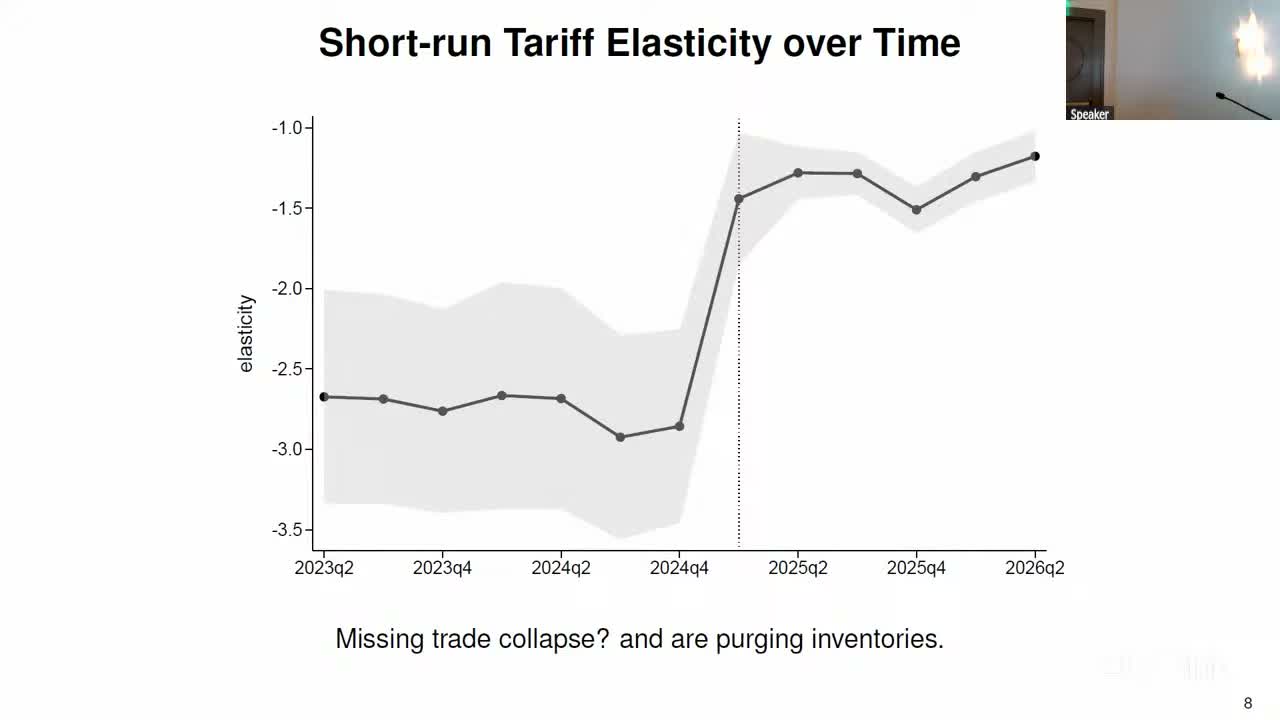
If that is right, a chunk of the 2025 tariff was less a tax than a forced loan to the Treasury, and nobody reorganizes a supply chain around a loan. This is the discussant’s evidence and hypothesis, not a verified legal claim, but it lands directly on the model, which feeds in the effective rate as real and anticipated, with and a short-run elasticity half the long-run one. That is about 2.5, which matches the old micro estimate and not the new one (my reading). “Some of the results should be revisited,” Alessandria says, mildly.
On inventories, the block is “pretty unusual”: not sS, no stockouts, and an input is worth more the more of it is sitting on hand, as though a gallon in the car were more valuable because the gas company holds a hundred more. His slide puts imported inventories at about five months against 2.5 for domestic goods, and the model targets 1.5, though those are different stock-to-sales concepts and do not compare one for one. The sharper point is by end use. In Census categories the boom and bust shows up in industrial supplies (about +45) and in consumer goods excluding food and autos (about +43), while capital goods just climb. The model holds inventories only in materials, so door one has a front-loading episode its diagram has no shelf for. “You should really be thinking about inventories in every sector.”
Then the part I would lose sleep over if I were Waugh. “This is me being Kevin Hassett”: the paper rebates tariff revenue lump sum, but there was a tax bill. In a similar model of his own, without nominal rigidities or inventories and with tariffs held past 2026Q2, Alessandria sends the revenue to an investment subsidy and gets welfare of +0.90 percent against −0.16 under the rebate, with investment peaking near +28 percent, a kick that, he says, could be any I shock. His slide is titled “Linking Tariffs to investment boom.” That is the objection Waugh imagined on Fox and Friends, now with a transition path, and it is the one arrow the diagram declines to draw. He hedges it: his model, his numbers, not comparable one for one, the truth “someplace in between,” and a subsidy to all investment should not show up only in ai, though whether the bill favours ai is “an open question.” He also suggests taking the inventory block to Covid first.
There is no recorded reply. The Q&A at the end of the session is lost in the audio, with only fragments surviving, so how the authors answered is unknown and I would not infer assent from that. What exists is the pre-emption in the talk: the orthogonality stated outright, the inventory device conceded in advance, two sectors offered as the fix for composition.
The policy line Waugh closes on is the one the paper can defend under all of this: “if this ai boom collapses, then we’re left with these negative effects of the policy.” The shock and the policy are separate objects, and the tariff is still there after the data centres are built. He listed two things that keep him up at night, that the paper is completely obvious and that Kevin Hassett shows up on television. The capital-tariff result takes care of the first. The discussant, in a model with no sticky prices, spent his last few minutes putting a number on the second.