Notes on:
Economic Sanctions: Stylized Facts and Quantitative Evidence
Annual Review of Economics 17: 175--195
2025
geoeconomics · economic sanctions · Global Sanctions Data Base · gravity · survey
Paper · doi · PDF
Made with AI: Opus 5 (reading and writing)
Gabriel Felbermayr (Vienna University of Economics and Business and wifo), T. Clifton Morgan (Rice, political science), Constantinos Syropoulos and Yoto V. Yotov (both Drexel). Annual Review of Economics 17: 175-195, 2025, doi:10.1146/annurev-economics-081623-020909. The version read is the published article, open access under cc by 4.0, which supersedes the accepted manuscript circulated as Drexel cgpa Working Paper 2024-01; page numbers are the journal’s. No talk recording was found; pdf-only digest. Figures 1 to 3 are cropped from the published version; the paper has no tables and no elasticity of its own, but it does run one regression, a pooled probit on the dyadic panel whose results are reported in prose in footnote 10 (p. 181). Three trade economists and one political scientist, and the division of labour shows: the economists count, the political scientist explains why the count is a biased sample.
What gets counted
A sanction, in the Global Sanctions Data Base (2020) this survey is built on, is a measure restricting bilateral economic activity between a sender and a target; a case is a political decision by a country, a group of countries or an international organisation to impose one. The fourth release covers 1950 to 2023 and holds 1,547 cases, tagged by sender, target, stated objective, type, intensity and the reason it ended; it has no product detail and leaves out both wto-legitimate measures and unofficial boycotts, which the paper notes is how China usually does this (p. 177, footnote 4). The cases spread into a dyadic panel: for any pair of countries in any year, is there a sanction between them.
Before the numbers, the mechanism that shapes them, because the paper’s most useful idea is that the count is a count of failures. You are a large democracy, the modal sender, and you want a smaller country to stop doing something. You do not, in the first instance, sanction it; you say that you will. If the threat works, nothing is written down anywhere. If the target was always going to stand firm, it ignores you, and now you must follow through or your next threat is worth nothing. So the sanctions that reach a database are the ones addressed to targets who could not be moved, plus the bluffers you called. The authors say so on p. 189:
Senders must, at least with some regularity, impose sanctions on recalcitrant targets to maintain the credibility of their threats. This implies that studying only cases of sanctions imposition focuses primarily on those cases in which sanctions cannot work and might seriously underestimate the success rate of using sanctions as a matter of policy.
Morgan (2009, 2014) built the Threat and Imposition of Economic Sanctions data set for exactly this reason. Keep it in mind: every figure below is drawn from the subsample where the threat had already been ignored.
Six hundred programmes, twelve percent of pairs, a quarter of trade
The headline numbers are on the opening page (p. 176): sanction programmes in force rose from about 200 ten years ago to about 600 in 2023, and about 12 percent of existing country pairs and 27 percent of world trade are under some sanction. Figure 1(a) is the case count by initiator. The United States is close to half of all active cases in most years and had sanctions against 113 countries in 2023; the eu is about a tenth; the un has only 26 active cases, but each binds every member. Russia (53 countries on its list), Britain (50) and China (47) follow. The receiving end is far more dispersed: seventeen countries (North Korea, Somalia, Libya, Afghanistan among them) are sanctioned by essentially everyone, 48 by nobody, 50 by a single sender (footnote 5).
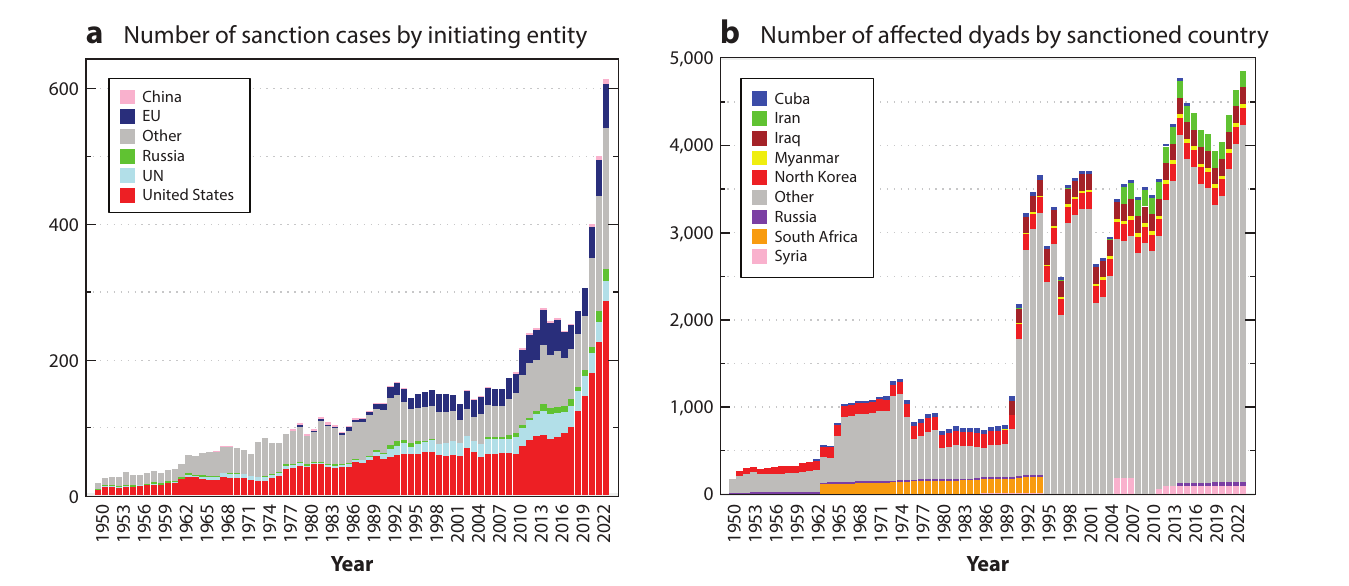
Panel (b) switches to pairs, which is what a gravity regression sees: almost 3,000 under un sanctions in 2023, about 2,000 under eu ones. Since the number of states has almost quadrupled since 1950, and the number of pairs sixteenfold, the right unit is the share of pairs, and that series has two regimes: around 4 percent, drifting down, from the 1950s to the 1990s; an abrupt jump to 8 percent around 1990; a slower climb to about 12 percent in 2023. On trade, 26.8 percent of world goods trade in 2020–23 was affected by some sanction, 12.1 percent by trade sanctions specifically, an all-time high; before the 2010s trade sanctions never touched more than 5 percent.
Most of it is not trade sanctions
This is the fact the trade papers downstream most need. The gsdb knows five types (trade, financial, travel, arms, military), and Figure 2(a) collapses them into four mutually exclusive bundles. Complete trade embargoes covered 3 percent of pairs in the early 1990s and have been below a tenth of a percent since 2003; the authors read the collateral damage of the Iraq embargo as the reason. Partial trade sanctions, since the early 1990s, almost never travel alone. Non-trade measures alone cover almost 10 percent of pairs in 2023, about 80 percent of all regimes; in the authors’ words, “most sanction regimes do not directly target trade flows at all” (p. 180). By single type, the probability that a pair is under travel sanctions is about 7.5 percent, financial about the same, trade about 2.5 percent.
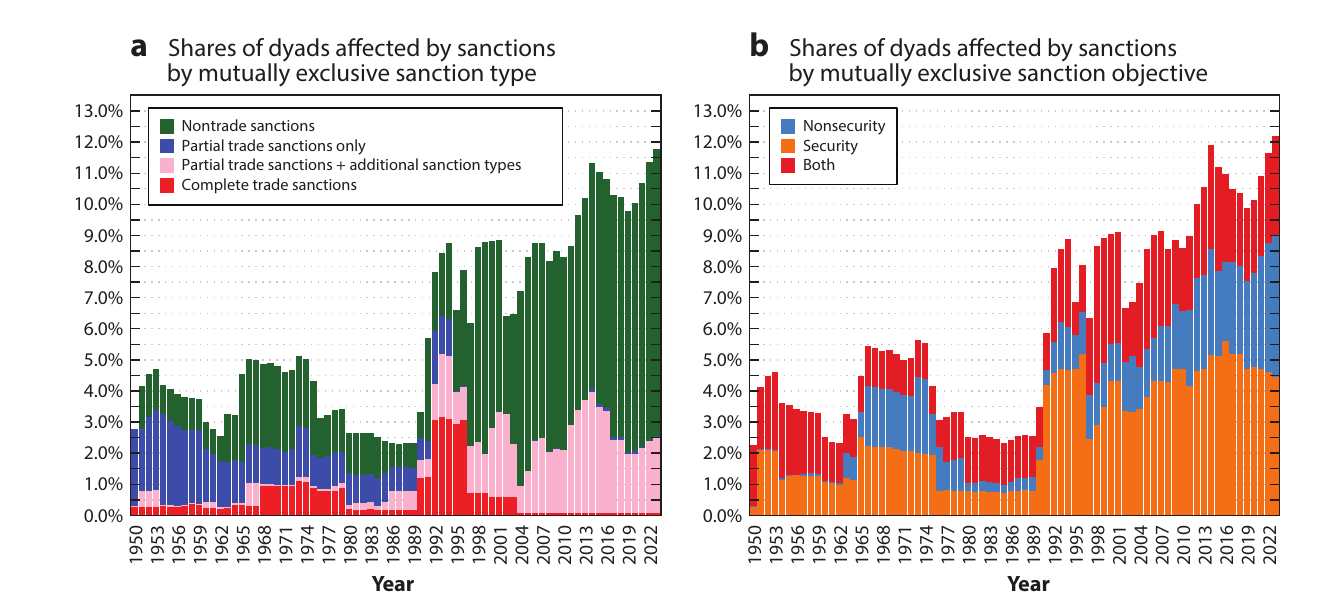
The stated objectives moved too. Defending human rights is by far the most common; changing a specific policy was over 60 percent of cases in the 1950s and is under 10 percent in the 2020s; regime destabilisation has gone to almost nothing. Panel (b) folds the nine objectives into security (ending or preventing a war, terrorism) and non-security: early in the sample almost every regime had a security motive, and in 2023 about three-eighths of sanctioned pairs are non-security only, the same share security only, a quarter both. Footnote 9 is the honest aside: public statements may not reveal the true, possibly protectionist, intentions.
Who sanctions whom, and why the answer drifts
A pooled probit on the dyadic panel gives the geography you would expect (distance lowers the probability of a sanction, shared minorities raise it, a colonial tie does nothing) and two results that matter. Size asymmetry: a sender that is very large relative to the target is about one percentage point more likely to sanction it, against a baseline of about 6 percent, but the effect is small and negative before the 1970s and grows from the 1990s to an average marginal effect of 0.25 in the 2020s. Footnote 12 reads this through the selection story: in earlier decades large countries got their way by threatening, so the imposed sanctions you observe are between countries of similar size; as openness rose, evasion got easier, threats worked less well, and asymmetric pairs began appearing in the data. The trend in the coefficient is the decay of the threat. Regime type: a democracy is 5 percentage points more likely to be a sender and 17 points less likely to be a target. “Sanctions, it appears, are instruments of choice of democracies” (p. 182).
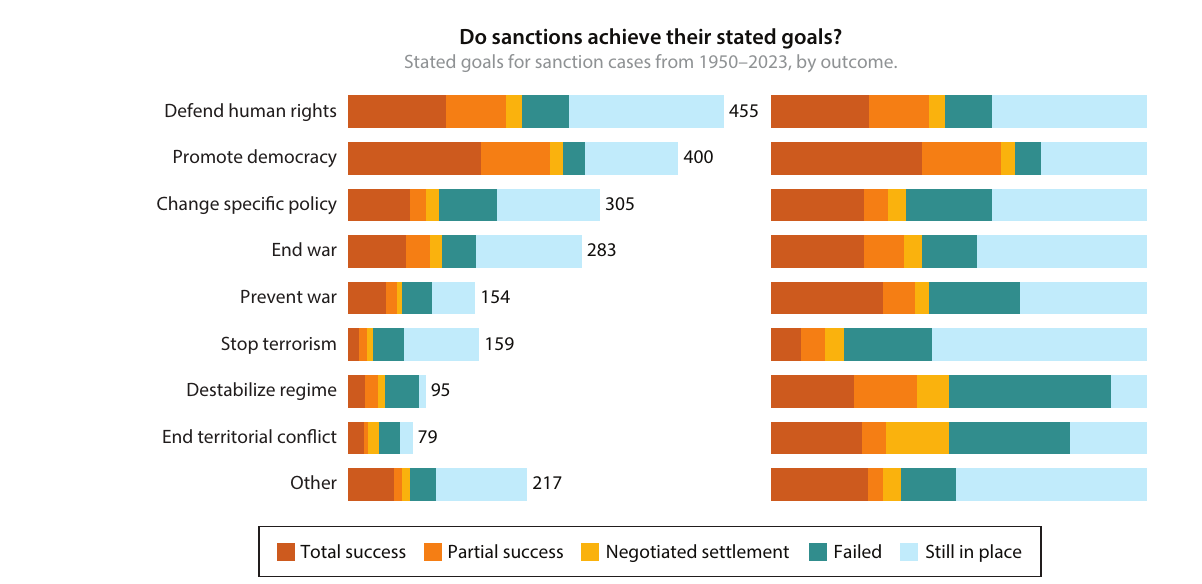
Outcomes are coded from the sender’s own announcements, which footnote 13 says to treat with caution. Of the 455 cases citing human rights, about 40 percent are still in place, another 40 percent or so ended as total or partial success, about 5 percent in settlement and 15 percent in failure; preventing a war succeeds more often than ending one; regime destabilisation mostly fails. Duration is very skewed: 5.4 percent of sanctions begun in the 1950s are still on (North Korea), while completed 2010s sanctions lasted 2.7 years on average. Financial and travel sanctions are the least likely to be lifted, “possibly due to their minimal cost to the sender” (p. 183): the cheap ones are the ones nobody gets around to removing.
The effects: the signs are here, the coefficients are elsewhere
Section 3 sorts effects into primary (on target and sender), general-equilibrium (on third countries, through diversion) and extraterritorial (direct effects on third-country relationships), and states three conclusions. Primary effects on targets are negative, large and often persistent after the sanction ends. They are very heterogeneous, by type, completeness, industry and sender (the 2014 sanctions on Russia bit very differently across eu members), so that a common coefficient can mask most of what is going on; multilateral sanctions are much stronger than unilateral ones. And effects on senders are usually small and short-lived, which the authors attribute to senders being large and choosing whether, when and how to sanction, with the possibility that some sanctions are “fake” and mask economic motives.
A reader who arrives wanting the elasticity of trade to a sanction should know that the survey does not print one; it describes the findings and hands out warnings, and the warnings carry numbers. Kwon, Syropoulos, and Yotov (2024) find that ignoring extraterritorial effects biases the estimated primary effect of trade sanctions by more than 50 percent. Sanctions, unlike free-trade agreements, are lifted as well as imposed, and the two-way-fixed-effects estimates everyone has relied on are biased under entry and exit whether or not the exit is modelled. Endogeneity, recognised since Morgan (1995), has mostly been ignored.
The rest of Section 3 is about how much of a sanction leaks. Diversion to third countries mitigates the primary effect, and the sum of small third-country effects can be large: China and India together took close to 75 percent of Russian crude exports in the first quarter of 2023 against 26 percent in 2021 (footnote 14). Targets also restructure; the trade sanctions on Iran raised output in some agricultural sectors by up to 30 percent. The extraterritorial section broadens the term beyond secondary sanctions to any direct effect on relationships with outsiders, of either sign. For Cuba, the welfare loss from the extraterritorial reach of us sanctions exceeds the primary loss. For Russia after 2022, the group’s release-4 estimates find large falls in direct bilateral trade costs with China, India and Turkey over and above diversion, possibly enough to net Russia a gain. Senders cut trade costs with third countries after sanctioning, the carrot; the stick is bnp Paribas’s 8.9 billion dollar fine. The inference the authors draw is that the gap between estimated and actual cost to targets may be why higher costs do not reliably buy higher success.
Do they work
The disciplines used to disagree because they measured different things: economists called a sanction effective when it did damage, political scientists when it achieved its stated aim. The opening page puts the convergence well: “The political science community has come to accept what economists already knew (i.e., that sanctions bring substantial economic effects), and economists have come to accept what political scientists have long understood (i.e., that substantial economic costs do not always bring changes in policy)” (p. 176). The old verdict that sanctions never work came from Cuba-style cases, prominent precisely because they failed; large-N work put success at about a quarter of impositions, and adding threats raises it to over half. Since sanctions are cheap for the sender, “even a 30% probability of success might be highly cost-effective” (p. 190), and the imposed failures are what keep the threats credible.
Anyway, this is also the paper’s explanation of why the profession was so united on Russia in 2022:
We have very good evidence that sanctions, no matter how costly, seldom induce a state, especially one with an authoritarian government, to stop military operations once they have begun. By increasing the cost of the policy, however, they might dissuade the target or other potential aggressors from future hostile actions.
Compelling and deterring are different products, and the same instrument is a poor one for the first and, on this evidence, a decent one for the second. The conclusion then poses the questions the data cannot answer: “If sanctions are costly to all sides, why are they imposed in the first place? What prevents rival states from settling their differences peacefully through negotiation?” (p. 191). That is Fearon’s (1995) question, and the authors’ own answer, in a companion paper (Felbermayr et al. 2024), models sanctions as an inside option in a bargaining game where governments cannot commit to future settlements.
Where it sits
Context in 2.3, and the first thing to read in it; Sections 2 and 3 are the ones that matter. It was preferred to the same group’s 2023 jep survey because it is newer, built on the fourth gsdb release, and not gated. What it fixes for the block are the denominators (12 percent of pairs, 27 percent of trade, 600 programmes), the definition of a sanction the gravity literature uses, the fact that four-fifths of regimes never touch trade directly, and three named biases in the estimates. The list’s own sanctions papers each pick one of its open questions. Becko (2024) takes the sender’s side: the survey’s puzzle that senders lose little, and its aside about economically motivated sanctions, become a theorem that sanction taxes are optimal tariffs with the weight on the target flipped. Hausmann, Schetter, and Yıldırım (2024) take heterogeneity and design, asking which products a coalition should ban once the survey’s multilateral-beats-unilateral finding is read as a statement about shares. Crozet and Hinz (2020) take 2014, where the survey already reports that effects differed across eu members, and find the mechanism in trade finance, which is what an 80-percent-non-trade sanction bundle looks like from the customs data. Egorov and coauthors (2026) take the compel-versus-deter distinction, recast as coercion versus punishment, together with the rerouting result: if Russian trade re-forms through Turkey and China, as the release-4 estimates say it did, the right outcome to measure is output, not flows. The selection question, the sanctions threatened and never imposed, is the one nobody on the list takes up with data; it reaches the block through Mulder’s (2022) interwar history and the threat-based models of 2.2.
One caveat to carry into all four. Every elasticity in the papers that cite this survey is estimated on imposed sanctions, which is to say on the cases where the threat had already failed, and the paper’s own footnote 12 shows that sample changing shape over time. Six hundred programmes in force is a large number of threats that did not work, or the price of keeping several thousand others credible, and the survey, reasonably, declines to say which.