Notes on:
Weaponized Interdependence: How Global Economic Networks Shape State Coercion
International Security
29 October 2019
geoeconomics · weaponized interdependence · economic networks · sanctions · international relations
Talk · Paper · doi · PDF · Transcript
Made with AI: Fable 5 (reading), Opus 5 (writing)
Henry Farrell (then George Washington University, now Johns Hopkins) and Abraham L. Newman (Georgetown). International Security 44(1), Summer 2019, pp. 42–79, doi:10.1162/isec_a_00351; the pdf read is the published cc-by version. The talk used is the authors’ keynote at the Fletcher School conference on the paper, 29 October 2019, introduced by Daniel Drezner, with twenty minutes of questions; three slide frames are taken from it. Figure 1 is cropped from the pdf. A political-science article with no model in it, and the most-cited paper in the interdependence literature, with something over 1,600 citations.
A network is a map of who has to fly through Atlanta
Start with the airline. Delta could fly you from Salt Lake City to San Salvador directly, and does not, because it is cheaper to run everything through Atlanta. Nobody in Atlanta planned to be the place the rest of the map depends on; the topology is the residue of a cost-minimization problem. Now notice what it does to Salt Lake City. If you are a spoke, every trip you take runs through a place you do not control, and the hub can see all of your itineraries and can, if it likes, decline to sell you a ticket.
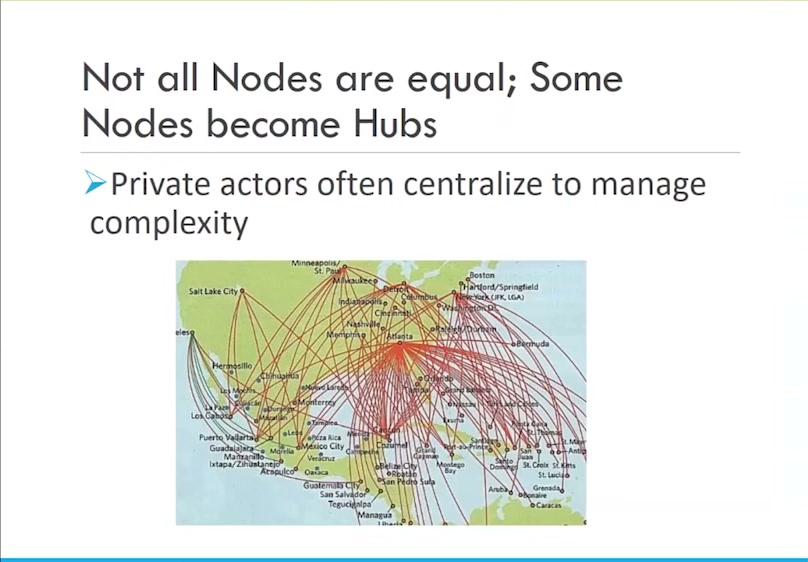
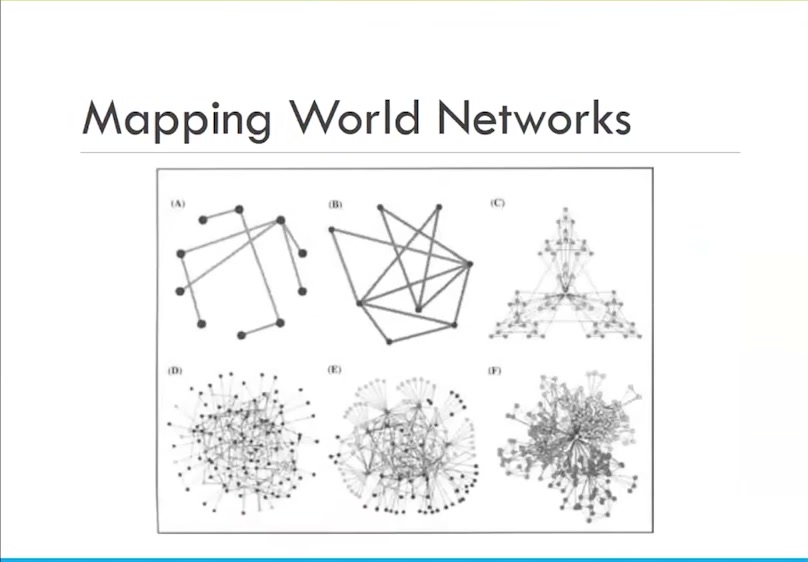
The paper’s claim is that the global economy has quietly turned into this. Its target is the liberal picture of globalization as a flat mesh in which power diffuses and cooperation is the only game; Keohane and Nye (2012), quoted on p. 48, thought it a “mistake to envisage contemporary networks of globalism simply in terms of a hub and spokes of an American empire.” Farrell and Newman’s reply is that this is what the networks became, not by design but through ordinary forces, which the paper lists on p. 51 without claiming to have exhausted them: preferential attachment, network effects, the plain efficiency of centralized communication, and learning-by-doing at the nodes that already see the most. The result is a degree distribution so skewed that “the exact statistical classification of the distributions is irrelevant; what is important is that social networks tend to be highly unequal” (p. 51), and once established such structures have focal power, because a challenger must coordinate many actors to defect at once. The hubs, moreover, sit disproportionately in the United States, because the last wave of globalization happened while American firms dominated the relevant innovation cycles. The sentence that carries the article is on p. 47: “Focal points of cooperation have become sites of control.”
Two things you can do with a hub
Here are the definitions verbatim, since the whole subsequent literature borrows the words. The first (p. 55):
The first weaponizes the ability to glean critical knowledge from information flows, which we label the “panopticon effect.” Jeremy Bentham’s conception of the Panopticon was precisely an architectural arrangement in which one or a few central actors could readily observe the activities of others. States that have physical access to or jurisdiction over hub nodes can use this influence to obtain information passing through the hubs.
And the second (pp. 55–56):
The second channel works through what we label the “chokepoint effect,” and involves privileged states’ capacity to limit or penalize use of hubs by third parties (e.g., other states or private actors). Because hubs offer extraordinary efficiency benefits, and because it is extremely difficult to circumvent them, states that can control hubs have considerable coercive power, and states or other actors that are denied access to hubs can suffer substantial consequences.
The asymmetry is in that last clause. Denial is devastating to the target because it has nowhere comparable to go; the paper’s counterfactual (p. 70) is that if the United States and the eu had been able only to close their own markets, “adversary states could readily have turned to other financial partners.” The network is what removes the alternative.
Two conditions must hold to use either effect, and the paper requires both. The state must have “physical or legal jurisdiction over hub nodes,” which by the geography above means the United States, the eu and “increasingly, China.” And it must have the domestic institutions to act: a regulator like ofac, post-9/11 subpoena powers, an agency built for bulk collection. The second condition is where the variation comes from. A state can sit on a hub and lack the plumbing, or have the plumbing for surveillance but not for denial, or be constrained by its own norms (eu privacy law is the example of a rule that blocks the panopticon at home).
Not size, and not bilateral dependence either
It is worth being exact here, because “jurisdiction, not size” is a compression. The authors distinguish their mechanism from two established ones on pp. 54–55: market power, meaning leverage over access to a large domestic market, and bilateral dependence in the Keohane–Nye sense. Their sentence is that these “are important, but they are far from exhaustive.” Size is not dismissed; it is demoted to one of three channels, and the claim is that position in a network is a distinct source of power the other two cannot explain. In the talk Newman puts it in one line: the United States is using network tools against China, and “China is responding with whatever you call market power… it doesn’t have privileged hubs” (30:28). Same rivalry, two different currencies. The evidence for the distinction is variation across cases, which is the paper’s actual design: if market size were the whole story, the United States should use the chokepoint wherever it has the market, and it does not.
The evidence, which the authors themselves call a plausibility probe
The two “analytic narratives” (p. 58) are histories, not tests, and the paper says so. They are nonetheless the best short history of the two hubs you will find.
Swift was born defensive. In the 1970s Citibank tried to sell the world’s banks a proprietary messaging system, and a consortium of European and American banks built a cooperative instead so as not to depend on it, headquartering it near Brussels “to sidestep the emerging rivalry between New York and London.” In 1977 it served 22 countries, roughly 500 firms and about 3,000 messages a year; by 2016, more than 200 countries, some 11,000 institutions and over 6.5 billion messages. The paper’s one figure is that curve.
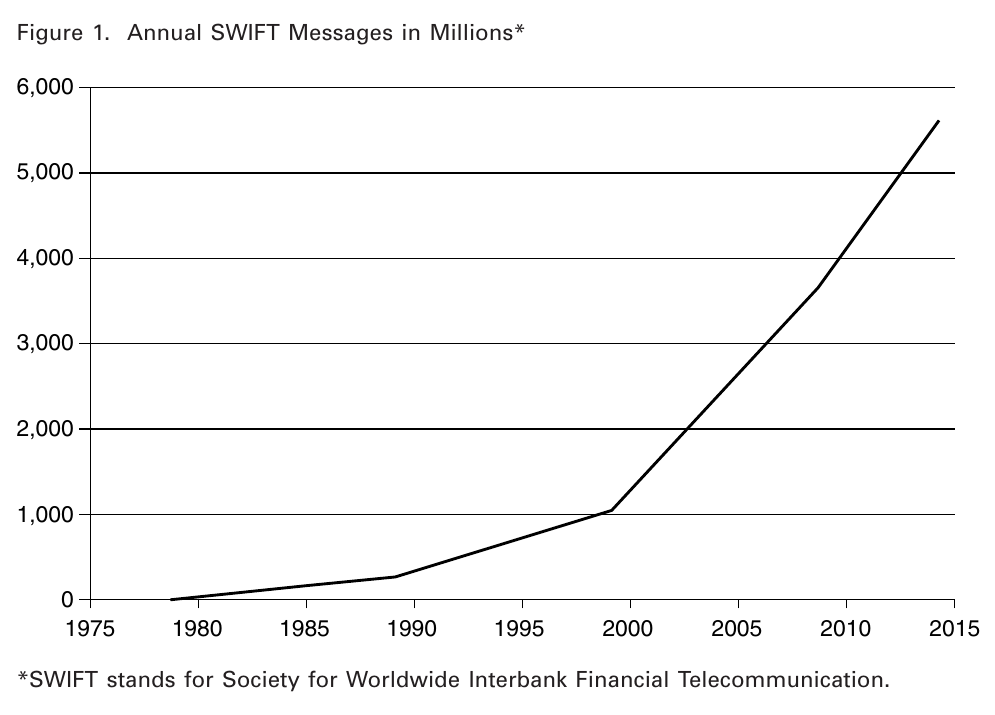
The panopticon came first. The fatf asked Swift for its records in 1992 and was refused; Swift’s position was that it was a carrier, not a data processor. After September 2001 the Treasury concluded it could subpoena Swift, and could, because Swift kept a mirror data center in Virginia; the Terrorist Finance Tracking Program ran secretly on that data until the New York Times exposed it in 2006, after which the eu, having protested, renewed the arrangement so long as it got a share of the take. The chokepoint came a decade later. Per Swift’s 2010 annual report nineteen Iranian banks and twenty-five other institutions were on the system; in February 2012 the Senate Banking Committee adopted language allowing sanctions on Swift itself, the eu banned messaging services to the targeted banks in March, and Swift cut them off, its former ceo calling this “an extraordinary and unprecedented step.” Lifting the ban became one of Iran’s central demands in the nuclear talks. The paper stresses that this took both jurisdictions: the eu alone lacked the institutions, and the United States alone would have struggled against a hub located in Belgium. The 2018 sequel, in which Swift delisted Iranian banks again under American pressure while Europe objected, is the paper’s own mechanism beginning to strain the alliance that operates it.
The internet is the other half of the design. The concentration numbers: 97 percent of intercontinental traffic runs over roughly 300 cables, and “one estimate” has 70 percent of global web traffic passing through Amazon’s servers in Northern Virginia. The United States used this for surveillance on an enormous scale, through prism’s compelled production and “upstream” collection at at&T’s backbone and at cable landing stations; the paper quotes Michael Hayden’s “This is a home game for us.” What it did not do is use the chokepoint. Successive administrations had tied American strategy and commercial interest to an open internet, had no institutional means of ordering Google or Facebook to cut out a country, and when an American official once asked Twitter to delay maintenance during the 2009 Iranian protests the request was controversial enough not to be repeated. The same state, over the same hub, exercises one effect and declines the other, which the authors argue no account built on market size would predict.
The one surprising thing
Both capture stories run through the hub’s own defensive choices. Swift located itself in Brussels to escape New York and London, and it was the backup data center in Virginia, a prudent piece of disaster planning, that put it inside American jurisdiction. The internet was designed as a distributed network that, in the line by the activist John Gilmore that the paper quotes on p. 61, “interprets censorship as damage, and routes around it,” and it was the commercial logic of exchange points, cloud providers and Section 230 that converted it into hubs. In neither case did a state build the lever. The concentration that saved everyone transaction costs is the same concentration that later cost Iran its banking system, and nobody who built it was pricing that.
The Fletcher audience pushed on the loosest joint. One questioner asked how much of this is interdependence and how much “plain old dependence,” since in the chokepoint cases “B is dependent on A” (45:08). The answer (Farrell’s, I think; the captions are rough here) is that it is dependence on a specific emergent structure rather than on a partner, which is a concession as well as a reply. Another offered Iran as a “crucial case”: if Iran “takes a lickin’ and keeps on tickin’,” is that not evidence for the flat world (49:41)? The authors’ answer was that who complies tracks the network story, and Drezner closed by distinguishing resistance from resilience: not giving in is not the same as thriving (57:07). Neither question gets a clean answer, because the paper has no way to price the target’s outside option.
What the economists took from it
The article has no equation, no cost of coercion to the coercer, and no equilibrium response by the target. It has, on p. 77, one sentence that reads like the outline of a model: “States are locked into existing network structures only up to that point where the costs of remaining in them are lower than the benefits: should this change, one may see transitions to new arrangements.” That is a participation constraint with an outside option, stated in prose, and Clayton, Maggiori and Schreger’s Framework for Geoeconomics (2026) is what it looks like written down: a hegemon threatening to withdraw an input, a target that stays only while staying beats leaving, and power measured as the gap. The conclusion also forecasts the second cms paper. The more a privileged state uses its privilege, the more targets “attempt to isolate themselves from networks” or “reshape networks so as to minimize their vulnerabilities,” and the paper’s list of Russian blockchain plans, Chinese chip programs after zte and European talk of a payments channel is the informal version of the insulation loop in A Theory of Economic Coercion and Fragmentation (2024). The nonlinearity in the power statistic there, that near-total control of an input is worth far more than most of it, is the formal reason a hub differs from a large market. Porcellacchia, Trebesch and Wache’s Digital Chokepoints (2026) is the submarine-cable case this paper gestures at on p. 62 and does not write.
Two caveats follow for the theory papers. First, the mechanism is scoped to networks with hubs; the paper says outright (p. 76) that oil markets are liquid enough to “present no single point of control,” so a model that treats every traded input as a potential chokepoint is going beyond the source. Newman’s first open question at Fletcher was exactly this one.
Second, the institutional condition has no counterpart in the economics, where a hegemon with the position simply has the power. The internet case is the reminder that the United States sat on the biggest hub of all and, for two decades, chose not to.
The two follow-ups add cases rather than mechanism. The Uses and Abuses of Weaponized Interdependence (Drezner, Farrell and Newman, eds., Brookings 2021) collects the responses and applications, with a research-agenda chapter that is essentially the second half of the Fletcher talk written up: when hubs disappear, what targets and firms do, how sub-networks interact. Underground Empire (2023) is the book-length narrative of dollar clearing, the internet backbone and semiconductors; of those, it is dollar clearing that the article defers on p. 74 to “unpublished research,” together with “some globalized supply chains,” the internet backbone having been done here.
Where it sits
Context in 2.1, read before the cms Framework so that the participation constraint arrives as an answer to a question rather than as a modelling choice. Thirty-eight pages, the theory in the first seventeen, the rest history you will want anyway. The paper’s own last word, on p. 79, is that if the transatlantic quarrel over secondary sanctions turns into competing financial instruments, “the United States may face the slow erosion of its ability to weaponize key economic networks.” Newman’s slide at Fletcher put the same point in the words of a former Treasury secretary.

The mechanism, in other words, comes with its own depreciation schedule, and the paper that named it was already worrying about the balance sheet.